
It is September 26th. Your ERAS is basically done. Personal statement polished, program list ready, letters in.
Then your school sends the email: “Updated MSPE (Dean’s Letter) will be released October 15.”
And now you are stuck asking the classic, anxiety‑inducing question:
Do I delay submitting ERAS so programs see a better MSPE? Or submit now and hope no one cares that my Dean’s Letter is the old one?
Here is the reality:
- Submitting ERAS on time is critical.
- Your MSPE matters—but usually less than you think.
- Waiting can help in a few narrow scenarios.
- In a lot of others, it just quietly hurts you.
I will walk you through a blunt, practical checklist so you can make the call in under an hour, not lose a week spiraling, and move on.
First Principle: ERAS Submission vs MSPE Release Are Not the Same
You need this straight before anything else.
- ERAS application: You control this. You choose the day you click “Submit.”
- MSPE (Dean’s Letter): Your school controls this. For NRMP‑participating programs, MSPEs are traditionally released October 1 (or a date specified that cycle).
Most programs:
- Accept and start sorting ERAS applications the moment the system delivers them (the “opening” date).
- Do not have your MSPE yet.
- Start offering interview invites before October 1 based on what they already have: scores, transcripts, letters, personal statement, school, etc.
So if you delay ERAS “waiting for the new Dean’s Letter,” understand what that does:
- It does not make the MSPE arrive earlier.
- It just makes your entire application show up later in the queue.
That is often a bad trade.
Quick Triage: 30‑Second Answer If You Are Average
If all the following are true:
- You are applying to a non‑hyper‑competitive specialty (IM, FM, Peds, Psych, Neuro, Path, etc., not derm, ortho, ENT, plastics, ophtho).
- Your school is LCME or COCA accredited, reasonably known, nothing wildly unusual.
- You passed your clerkships without major professionalism issues.
- You passed Step 1/COMLEX 1 on first attempt and have Step 2/Level 2 score >= around 220–230 (or equivalent).
- Your letters are decent and in.
Then: Submit your ERAS as early as the system allows. Do not wait for an updated MSPE.
You will gain far more from being in the early pile than from some incremental improvement in how your Dean phrases “Above expectations.”
If that is you, you can stop here. Submit. Spend your energy on interview prep.
If you are not sure—or you know your situation is more complicated—keep going.
How Programs Actually Use the MSPE
Most applicants dramatically overestimate how much time PDs spend reading MSPEs. I have watched PDs and APDs open 100 applications over lunch. Here is what happens.
Practical reality
For most programs and specialties:
- The MSPE is not the first thing they open.
- Many skim only:
- Summary graph of performance (if present)
- Any “red flag” or professionalism section
- Class rank-ish language (“outstanding,” “excellent,” “very good”)
- Clerkship performance summary boxes
- They may not read narrative lines like “She is a pleasure to work with” at all.
MSPE matters more when:
- There is no Step 1 score (fully pass/fail era).
- The student is from a lesser‑known or newer school, and the PD wants context.
- There is concern: multiple fails, remediation, LOA, professionalism questions.
MSPE matters less when:
- You have strong Step 2 and solid LORs in that specialty.
- You are from a school whose students they see every year and already understand the grading system.
So: An “upgraded” MSPE usually does not move you from reject → interview by itself, unless it is cleaning up or explaining something that previously looked pretty bad.
The Real Question: What Is Changing in the New MSPE?
You should not be guessing. You should know exactly what “new Dean’s Letter” means in your case.
Ask yourself (and if needed, your dean’s office):
- Is this just the annual routine update (adding 4th‑year rotations, correcting typos)?
- Or is there a specific, substantive change that could alter how programs see me?
Typical situations:
Routine cycle update only:
- Adds final grades from late third‑year or early fourth‑year.
- Maybe adds one or two honor designations.
- Maybe cleans up some phrasing.
- Usually not worth delaying ERAS.
Substantive change that might matter:
- A previously missing core clerkship grade is now an Honors instead of Pass.
- A concerning comment is being rephrased or contextualized (e.g., remediation explained appropriately).
- There was an actual error (wrong grade, omitted explanation) that made you look worse.
If you do not know, talk to someone.
A Practical Decision Checklist
Let us walk through a clear checklist. Be brutally honest with yourself.
Step 1: Specialty competitiveness
Which bucket are you in for this cycle?
| Bucket | Examples |
|---|---|
| Hyper-competitive | Derm, Ortho, ENT, Plastics, Ortho, IR, Neurosurgery, Ophtho, Urology |
| Moderately competitive | EM, Anesthesia, OB/GYN, Radiology, Transitional Year at big institutions |
| Less competitive (relatively) | IM, Peds, FM, Psych, Neuro, Path, PM&R |
Rule of thumb:
- Hyper‑competitive: Every piece of your app is scrutinized. MSPE can matter more.
- Less competitive: Timing and volume of apps matter more; MSPE upgrade rarely decisive.
Still, even in derm/ortho, a later ERAS submission stamps you as late. That is not good.
Step 2: Your current risk factors
Be honest about any “yellow/red flags”:
- Any clerkship failure or remediation?
- Any Step 1/COMLEX 1 fail or Step 2/Level 2 fail?
- Any LOA not clearly for something neutral/understandable (parental leave, military, serious health issue)?
- Any prior professionalism write‑up?
- Are you from a brand‑new or unaccredited/transitioning school where PDs might be skeptical?
If no to all → your MSPE is probably not a high‑impact document.
If yes to one or more → what the MSPE says about this can matter a lot.
Step 3: What exactly will the “new” MSPE improve?
Here you need specifics, not vibes.
Examples where waiting might help:
Your current MSPE:
- Shows a string of early Passes, but since then you have:
- Honored Medicine and Surgery at a strong academic site.
- Completed a sub‑I with “outstanding” comments.
- The updated MSPE will include and clearly highlight those.
- Shows a string of early Passes, but since then you have:
There is a documented error:
- Wrong shelf score recorded.
- Incorrect clerkship location (looks like community when it was actually at their main university hospital).
- Narrative suggesting chronic professionalism issues when this was resolved and mischaracterized.
Your dean’s office explicitly told you:
- “We are rewriting the narrative around your LOA/remediation to better reflect the situation; the prior wording was unfairly harsh.”
Examples where waiting is usually pointless:
- They are “reformatting” the letter to align with new AAMC guidance.
- They are changing some generic adjectives (“strong” vs “outstanding”).
- They are just adding a short 4th‑year blurb like “Completed acting internship in Internal Medicine at our affiliate hospital with strong performance.”
Step 4: Program timelines and invite patterns
Now layer in the timing piece. Programs do not all send invites the same week, but there are patterns.
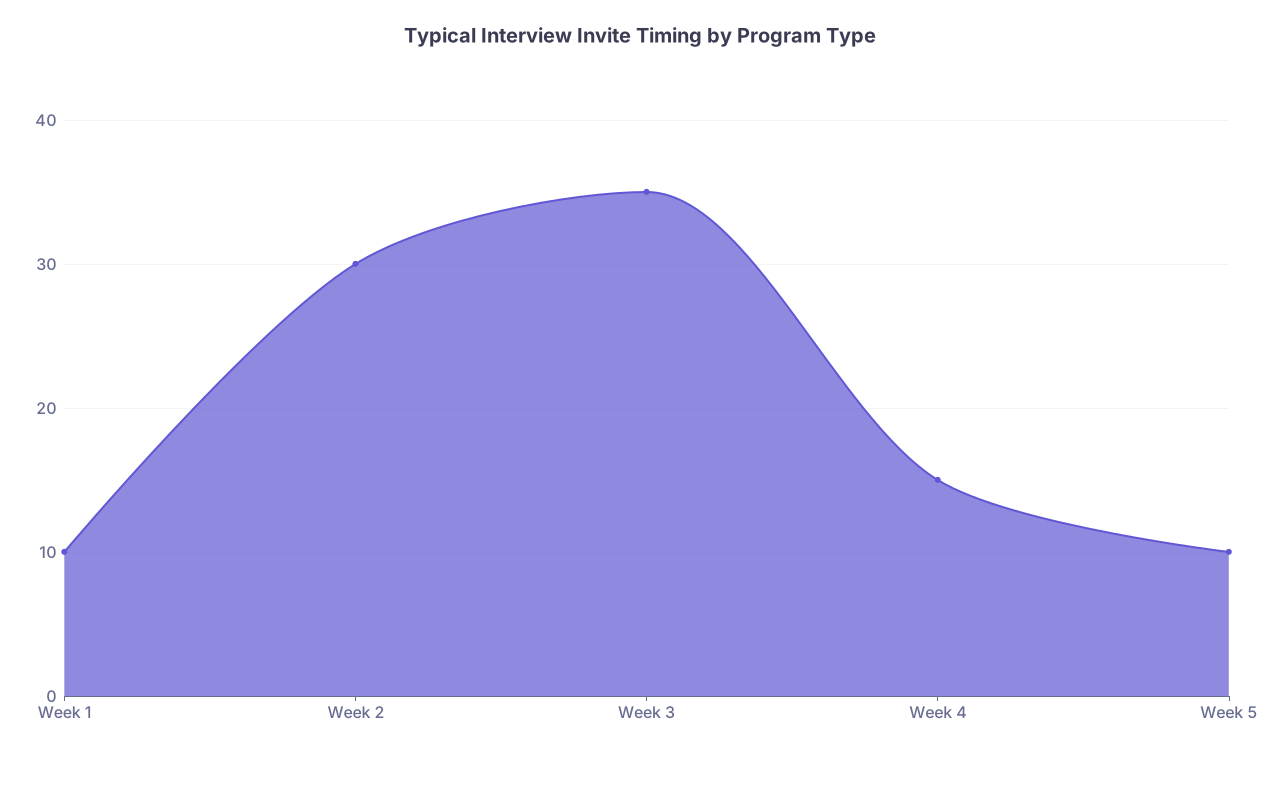
| Category | Value |
|---|---|
| Week 1 | 10 |
| Week 2 | 30 |
| Week 3 | 35 |
| Week 4 | 15 |
| Week 5 | 10 |
For many core specialties:
- First wave of invites: very soon after ERAS applications are released.
- Second wave: after Step 2 scores and MSPEs are available.
- Then trickle invites as cancellations happen.
If you submit:
- On time / early: You are eligible for both waves.
- Late (weeks after opening): You may only be realistically in play for second wave or late cancellations.
And no, “but my MSPE will be a bit nicer” rarely compensates for missing an entire early wave of invites.
When You Should Not Wait: Clear‑Cut Cases
Let me be direct. If any of these describe you, do not hold ERAS for an updated Dean’s Letter.
You are already close to or after the ERAS opening date.
Every day you wait now moves you down the stack. That hurts.Your MSPE changes are minor and cosmetic.
- A couple of extra “Honors” on sub‑Is that are not core rotations.
- Slightly upgraded language your dean says “should help” but nothing was incorrect before.
You are applying broadly to less competitive fields.
- Internal Medicine, Pediatrics, Family Medicine, Psychiatry.
- You have passing scores on first attempts and no faculty is alarmed about your current MSPE.
You have strong letters and Step 2 but are average in clerkships.
- Programs will care much more about your Step 2 and specialty letters than whether your Dean says “excellent” or “very good.”
In all those cases, submit ERAS as early as you can and let MSPE update when it updates.
When Waiting Might Be Worth It
There are some edge cases where a short, controlled delay is rational.
You can consider holding ERAS submission for up to ~3–7 days (not weeks) if:
You have a concrete plan with your dean’s office.
- You have seen a draft of the old MSPE.
- You have documented, factual corrections that affect:
- Whether you look like you failed vs passed.
- Whether you appear chronically unprofessional vs one‑time issue resolved.
- The dean confirms: “Yes, we are fixing this; updated MSPE will be uploaded by [specific date in the next few days].”
Your application is heavily dependent on MSPE to offset concern.
- You have a Step failure, but:
- You remediated quickly.
- Strong shelves afterwards.
- Good recent clinical performance that the updated MSPE now highlights.
- The old MSPE currently makes things look worse than reality.
- You have a Step failure, but:
You are applying to a hyper‑competitive field from a lesser‑known school.
- Your new MSPE will:
- Add clear ranking/quartile that helps you (“Top 10% of class”).
- Include Honors in Medicine/Surgery at a strong academic site that were not previously reflected.
- And you are going to submit right after that update—not weeks later.
- Your new MSPE will:
Even here, the key is: short delay, clear benefit, defined timeline.
If your dean’s office is vague, do not blow the first half of application season hoping their process finishes.
Concrete 5‑Step Protocol for Deciding
Here is the “do this in one evening and move on” process.
1. Pull your current MSPE draft (or last year’s if that is all you have)
If you do not have access, email or call your dean’s office. Ask:
“Can I review the current or prior MSPE text that would be used if the update is not ready in time? I am trying to decide whether to submit ERAS now or wait.”
You are looking for:
- Any actual errors.
- Any omissions that make you look worse (e.g., missing late honors).
- Any harsh language that does not match feedback you have been getting.
2. Make a simple “Benefit vs Timing” table
Write this out. Do not keep it swirling in your head.
| Factor | Now (Old MSPE) | After Update | Impact |
|---|---|---|---|
| ERAS submission date | Earlier | Later | Timing |
| Core clerkship grades shown | Up to June | Through September | Moderate |
| Explanation of LOA/remediation | Weak/vague | Clear/accurate | High/Low |
| Dean's summary strength | Average | Slightly stronger | Low |
If the only “High” impact row is timing, your answer is obvious. Submit now.
3. Talk to someone who actually reads MSPEs
Not your friend. Not Reddit.
- Email a trusted faculty advisor in your specialty.
- Or a program director or APD you know from home or an away rotation.
You can send something like:
“I am ready to submit ERAS but my school says a revised MSPE with some added honors and cleaner wording will not be ready for about a week. I am applying to [specialty] with [Step 2 score], [clerkship pattern]. In your experience, is a slightly improved MSPE worth delaying my ERAS submission by a week?”
Most of them will respond with something blunt like:
“Submit now. No one is reading MSPE that carefully for your profile.”
If a PD who knows you well says, “Hold 3–4 days, the updated explanation of your remediation really matters,” listen.
4. Set a hard personal deadline
Decide a drop‑dead date. Something like:
- “If the new MSPE is not confirmed and uploaded by [exact date], I will submit ERAS with the current one.”
Write it. Put it in your calendar. When that date hits, you submit. You do not slide it another week because you are hoping for a perfect letter.
This simple boundary prevents the slow bleed:
“I will just wait three more days” → becomes two weeks → you miss early invites.
5. Submit, then shift your focus
Once you hit your deadline and submit:
- Stop obsessively refreshing your MSPE status. It will update when it updates.
- Move your effort to:
- Confirming letters are in.
- Cleaning up your email, voicemail, and spam filters for invites.
- Quick review of common interview questions so you are not flat‑footed when the first invite hits.
How Program Directors Actually See Late Submissions
No one has a red siren on their dashboard that says “this applicant waited for a new Dean’s Letter.”
They just see:
- Applicant A: Complete file in the first download batch.
- Applicant B: Same stats, similar school, complete file shows up 10 days later.
Who gets read first? A.
Whose invite slots are more likely already taken? B.
Some PDs will explicitly filter:
- “Show me everyone whose app was complete by [date].”
- Late ones fall into the “maybe later if we need” bucket.
You do not want to live in that bucket unless you have an exceptionally good reason.
Special Cases: LOA, Professionalism, and Misconduct
If your entire concern about the MSPE is around how a red flag is explained, this deserves its own section.
Here, wording matters.
When an updated MSPE is crucial
Hold a bit (again—days, not weeks) if:
Your current MSPE:
- Just says “took a leave of absence” with no context, which could imply anything from burnout to misconduct.
- Mentions a “professionalism concern” without stating that it was investigated and resolved without ongoing issues.
The updated MSPE:
- Clarifies that your LOA was for:
- Documented medical illness, treated and stable.
- Family crisis or caregiver responsibilities.
- States clearly that an isolated professionalism event:
- Was remediated.
- Has not recurred.
- Is not ongoing.
- Clarifies that your LOA was for:
That kind of clarification can move you from automatic reject → at least consider.
When it is not worth losing early invites
Do not hold ERAS hoping to convert:
- “He was sometimes late but improved over the course” → “He demonstrated growth in professionalism.”
- “She struggled at the start of clerkship year” → “She quickly adapted and finished strong.”
PDs can smell spin. They are more interested in:
- Your upward trend in grades.
- Your Step 2 performance.
- Your letters specifically in the target specialty.
What If Your School Delays Everyone’s MSPE?
Some schools notoriously upload MSPEs late every year. Programs know this. They do not hold that against you individually.
Your choices then:
- Submit ERAS on time with everything you can control (CV, PS, letters, transcript, Step scores).
- Let the dean’s office catch up.
If programs grumble, they grumble at the school, not you.
Waiting for your school to “catch up” before you submit, when the delay affects every classmate, just puts you at a disadvantage relative to applicants from other schools. That is not strategic.
Example Scenarios: What I Would Tell You
Let me run through a few “I see this every year” situations.
Scenario 1: Solid IM applicant, small upgrade in MSPE
- Applying IM, Step 2 = 237, mostly High Pass, a couple Honors.
- No failures, no LOA.
- New MSPE will add: “Honors in Sub‑I” and slightly stronger summary language.
My advice:
Submit ERAS as early as possible. Do not wait.
That extra Sub‑I honor may impress a few people at the margins, but not as much as being in their early review batch.
Scenario 2: Step 1 fail, strong recovery, unclear MSPE vs clear MSPE
- Step 1 fail on first attempt, Step 1 pass on second, Step 2 = 245.
- Shelf scores all above average after the failure.
- Current MSPE just states: “Failed Step 1 on first attempt; passed on second” with no mention of subsequent improvement.
- New MSPE will explicitly say:
- “After remediating Step 1, he demonstrated consistent improvement with above average shelf scores and strong clinical performance.”
My advice:
If the dean’s office can guarantee upload in < 1 week and you are not yet past the first major upload week, I would accept a 3–5 day delay.
If they are vague and say “sometime next month,” submit now. Bad timing is worse than mediocre wording.
Scenario 3: Derm applicant, new MSPE adds top‑10% language
- Applying Derm from a mid‑tier school.
- Step 2 = 258, strong research.
- Current MSPE: no class rank, just generic “strong student.”
- New MSPE: will explicitly say “Top 10% of class” and add Honors in Medicine and Surgery that just posted.
My advice:
You are playing in a hyper‑competitive field. That Top 10% line counts.
I would tolerate a very short, defined delay (a few days) to ensure that specific language is there, especially if your school is not top‑tier brand‑name. But do not let this turn into a multi‑week slip.
Scenario 4: FM applicant, borderline Step 2, average MSPE either way
- Applying FM, Step 2 = 216, all passes, one High Pass, no failures.
- Old vs new MSPE difference is essentially: added Elective in Rural FM with “good” comments.
My advice:
This is not a close call. Submit immediately.
Programs will be more concerned about whether they see your app early, how many programs you applied to, and your personal statement fit, not MSPE micro‑differences.
FAQ (Exactly 4 Questions)
1. If I submit ERAS now, will programs automatically see the updated MSPE later?
Yes. When your school uploads a revised MSPE, ERAS updates it in the system. Programs that have already downloaded your file can usually re‑pull documents if they care, and many will when they get closer to ranking. You do not need to resend your entire application.
2. Can I email programs directly with my updated Dean’s Letter if it changes later?
You can, but it is rarely necessary and can be annoying if overdone. For major corrections (serious error previously, big clarification about LOA or remediation), a short, professional email to programs you are especially interested in is reasonable. For minor upgrades, let ERAS handle it.
3. Do programs see the date I submitted ERAS and judge me for applying “late”?
They see when your application became complete in their system. Many programs do favor earlier complete applications, especially for the first wave of invites. They are not judging your character, but you will be at a disadvantage if you are weeks behind your peers with similar stats.
4. My dean says the MSPE will be “much stronger,” but will not show me details. Should I trust that and wait?
No. Vague promises are not enough to justify a significant delay. Unless you know exactly what is changing and why it materially fixes a real problem, you should not sacrifice early submission. Push for specifics; if you cannot get them, set a personal deadline and submit on time.
Key points to walk away with:
- Do not sacrifice ERAS timing for minor MSPE upgrades. Early submission almost always beats a slightly “nicer” Dean’s Letter.
- Only consider a short delay if a concrete MSPE change fixes or clearly explains a real red flag. And even then, we are talking days, not weeks.
- Decide once, using clear information, then move on. Submit, let the MSPE update in the background, and focus your energy where it actually moves the needle: your interviews.