
The worst ERAS mistake is not a low score or a weak LOR. It is bad timing with a half-baked application.
You are stuck between two bad-feeling options:
- Submit early with an application that you know is not your best work
vs. - Wait to rewrite and risk being “late” in a system that punishes late applicants.
I have seen both versions crash. I have also seen both work. The difference is not vibes. It is a clear, structured decision based on your numbers, your specialty, and the actual quality of your current draft.
Let’s fix this systematically.
Step 1: Understand What “Early” and “Late” Actually Mean
First, get clear on the calendar. Programs do not care when you start ERAS. They care when your file is:
- Submitted
- Certified
- Complete enough to be reviewed
For most recent cycles (check exact dates each year, but pattern is stable):
- Early / On-time:
- ERAS submitted within 24–72 hours of the opening submit date
- Letters and USMLE/COMLEX scores flowing in over first 1–2 weeks is fine
- Acceptable / Not early but not fatal:
- Submitted during the first 2 weeks after applications open to programs
- Late:
- Submitted 3+ weeks after programs can see applications
- Extremely late: after interview invites for your specialty have already started releasing en masse
Programs batch-review early applications. Many interview slots are essentially allocated from that early pile.
So the real question is not “Should I submit early or late?” It is:
Is the application I could submit at opening meaningfully worse than the one I could submit 1–3 weeks later?
If the improvement is cosmetic → submit early.
If the improvement changes how you are perceived as a candidate → waiting may be the better play.
Step 2: Diagnose Your Situation in 5 Minutes
You need a quick reality check, not hand-waving.
Ask yourself, right now, across these areas:
Scores
- Are Step 1 (if pre-Pass/Fail), Step 2, COMLEX in and stable?
- Are you waiting on a significantly better Step 2 score you are confident about?
Transcript / Clinical Performance
- Any major grade changes pending?
- Any critical core clerkship grade still “IP” that could flip from Pass → Honors?
Letters of Recommendation (LORs)
- How many are already uploaded? (Not “promised.” Actually uploaded.)
- Do you have at least:
- 2–3 strong IM/Surgery/Peds specialty letters for that field?
- A Department Chair letter required for some specialties?
Personal Statement + Experiences
- Is your personal statement coherent, specific to the specialty, and typo-free?
- Are your experiences meaningfully described, not just lists of duties?
- Does your application already tell a cohesive story?
Specialty Competitiveness
- Are you applying to:
- Ultra-competitive (Derm, Ortho, ENT, PRS, Neuro IR, Rad Onc)?
- Competitive but reasonable (EM, Anesth, Radiology, OB/GYN, some IM subs)?
- More forgiving (Psych, Peds, FM, many IM programs)?
- Are you applying to:
Now, here is the key: your decision is based on how much these will change, not how anxious they make you feel.
Step 3: Use the 3-Question Framework
This is how I decide with applicants who ping me in late August in full panic.
Question 1: Will waiting materially change your “tier” as an applicant?
Material change means:
- A new Step 2 score that moves you from “auto-screen reject” to “within range”
- An additional year of research that converts you from “no research” to “substantive output” (publication, strong poster, clear PI letter)
- A new, powerful home specialty letter that replaces a generic one
It does not mean:
- Slightly smoother wording in your personal statement
- One more small volunteer role added
- Fixing a couple of awkward phrases in Work/Activities
If the improvements are:
- Cosmetic / minor → submit early with what you have, then tweak where allowed (supplemental ERAS responses, emails to programs, etc.).
- Tier-shifting (e.g., Step 2 jumps 10+ points into competitive range for your target specialty) → strong argument to wait until that score posts and then submit.
Question 2: Is your current draft “harmful” or just “not perfect”?
There is a big difference between:
- “I am a perfectionist; this could always be better”
vs. - “My personal statement reads like a rushed undergrad essay and my experiences are three-word bullet points”
Ask yourself:
Does your personal statement:
- Clearly state why this specialty?
- Reflect actual clinical experiences?
- Avoid clichés and red flags (bitterness, oversharing personal trauma, arrogance)?
Do your experiences:
- Have complete dates and clear roles?
- Show progression, impact, and reflection instead of vague duties?
If your current application:
- Contains typos, inconsistencies, or unprofessional content
- Recycles a med school personal statement with zero specialty focus
- Includes obvious errors (wrong program names, contradictory dates)
Then yes, this can hurt you. That can justify a short delay (days to a week) to clean it up.
But if your anxieties are about style, not substance? Do not surrender the early-submit advantage just to get a “prettier” paragraph.
Question 3: Are you in a specialty where early really matters?
Some specialties fill their interview calendar quickly and screen heavily on early applications.
Rough rule of thumb:
| Specialty Group | Early Submission Impact |
|---|---|
| Derm, Ortho, ENT, PRS | Critical |
| EM, Anesthesia, Radiology | Very High |
| OB/GYN, Gen Surg, Neuro | High |
| IM, Peds, Psych | Moderate |
| FM, many community programs | Lower (but still real) |
If you are aiming for a highly competitive field and your stats are average or below for that field, you need every structural advantage, including early review.
So:
- Ultra-competitive specialty + average stats + okay-but-not-amazing application → submit early.
- Ultra-competitive specialty + currently weak application but guaranteed big improvement in 2 weeks (e.g., Step 2 releasing, strong home letter) → short, intentional delay can be justified.
Step 4: The 4 Decision Scenarios (Pick Yours)
Let me break this into concrete scenarios.
Scenario A: Strong stats, application 80–90% polished
- Step 2 already in and solid for your target specialty
- Letters mostly uploaded
- Personal statement: decent but not “perfect”
- You could spend 1–2 more weeks obsessively editing
What you should do:
- Submit early—within the first 24–72 hours once ERAS opens for submission.
- Accept that your statement is “good enough”. Programs are not ranking you based on prose style.
- Use any pre-submission time to:
- Proofread once
- Confirm LOR assignments
- Double-check your program list and filters
Waiting in this scenario is almost always a net loss.
Scenario B: Borderline stats, but a critical improvement is coming soon
Examples:
- You took Step 2 late and are expecting the score to pull you up significantly
- You are waiting on a key home specialty letter from a rotation ending right before ERAS opens
- A failed or low Step 1 is about to be offset by a strong Step 2
Key distinction: “Hoping” your score will be better is not enough. You need either:
- Prior NBME data strongly suggesting a meaningful bump
- A clear letter commitment from a faculty member who knows you well
What you should do:
Map your real dates.
- When does Step 2 actually release?
- When did your attending promise to upload your letter?
Use these dates, not wishful thinking.
Calculate the delay required.
- If waiting means submitting 5–7 days later, still within the first 2 weeks: acceptable.
- If waiting pushes submission into week 3+, for many competitive fields that becomes dangerous.
If the score / letter is truly high-yield and due within 7–10 days:
- Accept a short delay.
- Spend that week rewriting smartly: refine your narrative, tighten your PS, clarify your red flags.
If the score / letter is more than 2–3 weeks away:
- Submit with what you have.
- Update programs later with the new score or letter via email or MyERAS update if appropriate.
Do not freeze your entire cycle for a hypothetical gain that might arrive after invites start.
Scenario C: Application content is actually weak or sloppy
This is the “my ERAS looks like I whipped it together in a weekend” situation:
- Personal statement is generic, cliché, or confusing
- Activities are listed as job descriptions with no impact or reflection
- Gaps in your timeline are unexplained
- You see multiple typos, formatting inconsistency, or unprofessional language
This can and does cost interviews.
What you should do:
Decide if you can fix this in 5 focused days.
- Not endless tinkering. A specific rewrite sprint.
For those 5 days:
- Day 1–2:
- Rebuild your personal statement:
- 1–2 specific clinical stories that show, not tell
- Clear reason for specialty
- A forward-looking paragraph about residency and career
- Rebuild your personal statement:
- Day 3–4:
- Rewrite Work/Activities:
- Start with action verbs
- Quantify where possible (e.g., “Led 10-person QI team”)
- Add 1 line of reflection: what you learned or changed
- Rewrite Work/Activities:
- Day 5:
- Proofread everything out loud
- Fix dates, titles, and consistency
- Day 1–2:
Submit immediately after that 5-day sprint, even if it is a few days after the first possible date.
A small delay to prevent an obviously weak application is justified. A long delay to chase perfection is not.
Scenario D: You are fundamentally underpowered for your target specialty this cycle
This is blunt, but it matters.
Signs:
- USMLE/COMLEX dramatically below specialty norms
- No home rotation or specialty-specific LORs for Derm/Ortho/ENT/Neurosurg/etc.
- No research in a research-heavy field (Derm, Rad Onc, PRS)
- Multiple failures or major professionalism issues without a clear remediation and story
Here, the early vs rewrite question is often a distraction from the real question:
Should I even apply this cycle, or should I build a real gap-year plan and come back stronger?
If your core problem is structural (scores, LORs, lack of exposure), a prettier personal statement submitted early is lipstick on a pig.
What you should do:
- Talk to:
- Your specialty advisor
- A PD or APD who will actually look at your CV and numbers
- Ask directly:
- “If I apply to X this year with this profile, what realistically happens?”
If several honest people tell you your odds are extremely low, then:
- Strongly consider:
- A gap year with:
- Home or external research
- Additional clinical exposure
- Re-taking Step/COMLEX where allowed or strengthening academic record
- A gap year with:
- Or:
- Applying to a less competitive specialty this cycle with a very strong, early, well-prepared application
Do not burn a fortune on ERAS and interviews for an application that will not clear basic program filters regardless of timing.
Step 5: Quantify the Trade-Off – A Simple Risk Tool
Here is a quick way to weigh early submission vs. waiting.
Assign points:
A. Value of Waiting (0–6 points)
- Waiting will add a significantly better Step 2 / COMLEX score: +3
- Waiting will add a powerful, specialty-specific letter from someone who knows you well: +2
- Waiting will allow you to repair a truly weak personal statement and sloppy activities section: +1
B. Cost of Waiting (0–6 points)
- Specialty is highly competitive (Derm, Ortho, ENT, PRS, etc.): +3
- You would submit more than 2 weeks after opening if you wait: +2
- Your current application is already decent; improvements are minor/polishing: +1
Now compare:
- If Value of Waiting > Cost of Waiting by 2+ points → Short delay is probably justified.
- If Cost of Waiting ≥ Value of Waiting → Submit as early as you responsibly can.
Step 6: If You Decide to Submit Early, Here Is the 3-Day Polish Protocol
You chose early. Good. Now make those last days count instead of spiraling.
Day 1 – Clean Structure
- Check every section for:
- Missing dates
- Inconsistent formatting
- Duplicated entries or unexplained gaps
- Confirm:
- LORs properly assigned to each program
- USMLE/COMLEX releases authorized
- Programs list is realistic (balanced reach/target/safety)
Day 2 – Narrative Tightening
Personal Statement:
- Remove vague fluff (“I have always wanted to help people”)
- Insert 1–2 concrete patient or rotation experiences
- Make sure specialty motivation is explicit
Work/Activities:
- Change duty lists to impact statements:
- Bad: “Helped with QI project on hand hygiene”
- Better: “Co-led QI project increasing hand hygiene compliance from 72% to 89% over 6 months”
- Change duty lists to impact statements:
Day 3 – Brutal Proofread
- Read everything out loud. Slowly.
- Fix:
- Spelling mistakes
- Grammar and punctuation
- Program names, dates, and titles
- Ask 1 trusted person (not 5) to read for clarity and red flags.
Then stop. Submit.
Step 7: If You Decide to Wait and Rewrite, Do It Like a Professional
If you choose to delay, then that delay should be intentional and efficient—not just you staring at the same paragraph for 10 days.
Use a focused rewrite plan.

| Step | Description |
|---|---|
| Step 1 | Decide to Delay |
| Step 2 | Set Submit Date |
| Step 3 | Revise Personal Statement |
| Step 4 | Rewrite Experiences |
| Step 5 | Confirm LORs & Scores |
| Step 6 | Final Proofread |
| Step 7 | Submit ERAS |
1. Set a hard submission date.
- Example: “I will submit on September 11.”
- Everything you do must aim at that date. No drifting.
2. Personal Statement Rewrite (2–3 days max).
- Structure:
- Hook: 2–4 sentences, specific clinical moment or realization
- Middle: 2–3 paragraphs showing your fit, strengths, and trajectory
- Ending: 1 paragraph about what you want in residency and beyond
- Cut:
- Long childhood stories
- Generic “I like working with my hands and my mind” lines
- Overly dramatic personal trauma that does not connect to your professional self
3. Experiences Rewrite (2–3 days). For each major entry:
- First line: what you did (clear role, setting)
- Second line: impact (numbers or concrete outcomes if possible)
- Third line: reflection (what you learned, how it shaped you)
4. LORs + Score Coordination.
- Email letter writers with:
- Clear deadline
- Your CV, draft PS, and key points they might highlight
- Double-check when Step 2/COMLEX scores are expected to post; confirm via NBME/NBOME windows, not rumors.
5. Final 1-day proofread and then submit.
Do not extend your date unless something extraordinary happens (e.g., sickness, unexpected exam delay). The “just one more day” trap kills more ERAS seasons than you think.
Step 8: Watch Out for These Common Myths
A few bad ideas I hear every year:
“If my application is not perfect, I should wait until it is.”
Wrong. ERAS rewards good + early far more than perfect + late.“Programs will not look at my app until all letters are in, so I should wait.”
Many programs start screening as soon as core components are present (scores, transcript, PS, at least 2–3 letters). A missing optional letter should not delay you.“I can fix everything with a personal statement rewrite.”
You cannot PS your way out of a 190 Step 2 when applying Ortho. Narrative helps, but numbers and letters still matter more.“Submitting on the first minute ERAS opens is mandatory.”
No. Being within the opening batch (first 24–72 hours) is what matters, not who hits send at 1:00:00 AM.
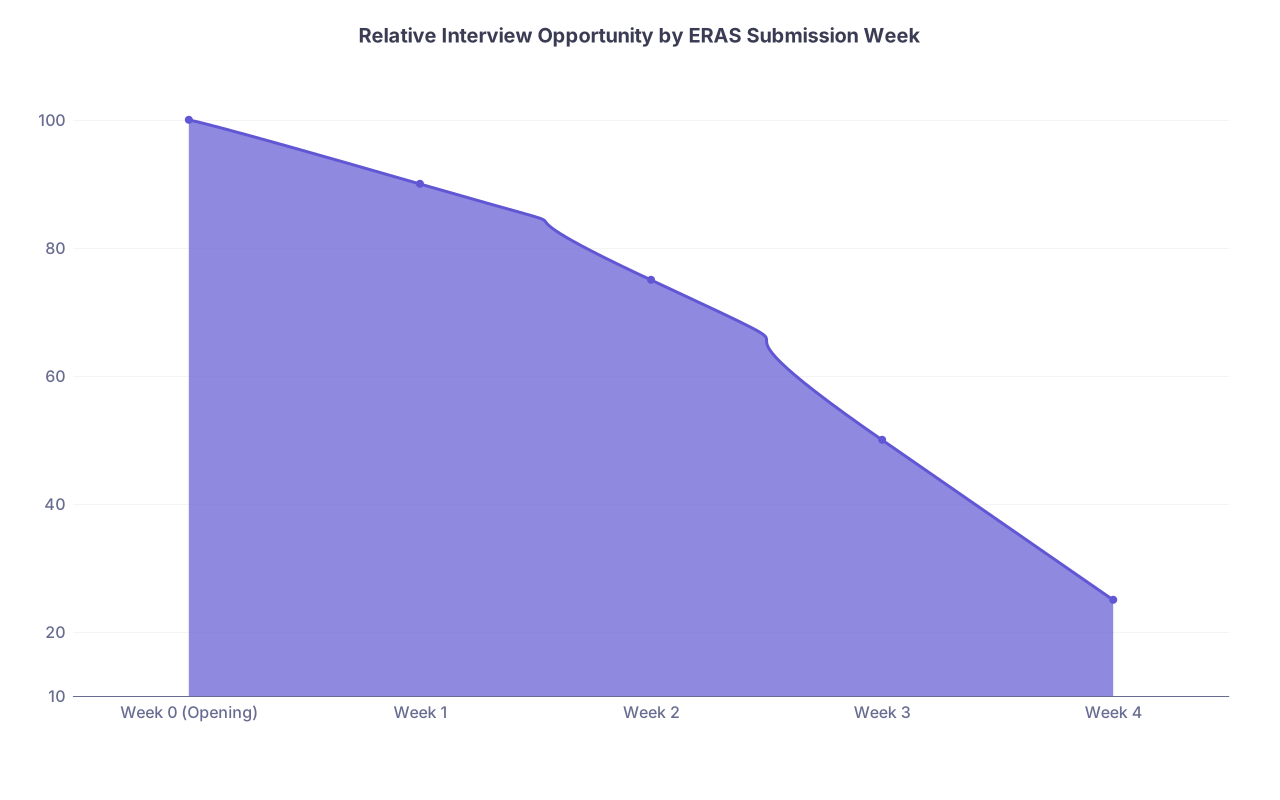
A Quick Visual: How Much Does Timing Matter Over the First Month?
| Category | Value |
|---|---|
| Week 0 (Opening) | 100 |
| Week 1 | 90 |
| Week 2 | 75 |
| Week 3 | 50 |
| Week 4 | 25 |
This is not exact data for every specialty, but it reflects what PDs informally report:
- Early applications have maximum opportunity.
- By week 3–4, many interview spots are already tentatively allocated.
How to Make the Call Today
Do this in the next 30 minutes:
List what would actually improve if you waited 7–10 days.
- Step 2 score?
- Strong letter?
- Repaired weak PS and activities?
Score the Value vs. Cost using the simple point tool from above.
Commit:
- If submitting early: choose your submission day and lock it.
- If waiting: set a firm later date and create a 5–7 day rewrite schedule.
Do not keep floating in indecision. That limbo is worse than either choice.
Key Takeaways
- Early matters, but not enough to submit a sloppy or self-sabotaging application. Minor polishing? Submit early. Major structural fixes or key scores/letters? A short, planned delay is justified.
- Your decision should be based on objective gains, not anxiety: only wait if the delay will clearly change your tier as an applicant or repair genuinely harmful content.
- Once you choose—early or delayed—commit fully. Execute a focused 3–7 day plan to sharpen what you have, submit, and move on to the next phase of the Match.