
You can absolutely submit ERAS too early and too late—and most people are aiming at the wrong target.
Everyone hears, “Submit on day one or you’re dead.” That is wrong. The opposite camp says, “It’s fine, just take your time and make it perfect.” Also wrong.
Here is the reality:
You are managing a trade-off between speed and polish. There is a point where more editing helps you. Then there is a point where more editing does nothing except push you down the review queue.
This article gives you a clear decision framework so you know:
- When to prioritize speed
- When to hold back for polish
- How to decide your exact submission day
No vague “as early as possible” nonsense. Concrete thresholds, checklists, and examples.
1. The Three Hard Truths About ERAS Timing
Let me be blunt about what actually matters for “when” you submit.
1. Programs batch-review early applications
Most programs:
- Download ERAS files the first day they are available
- Run an initial filter by:
- USMLE / COMLEX scores
- Visa status
- Graduation year
- Sometimes home state / school
Then they start inviting from that pile.
So if you:
- Submit after that first major download,
- And you are borderline stats-wise,
You just made your life harder.
Not impossible. Just harder.
2. Being first is not better than being early-enough and solid
Submitting at 9:00 a.m. vs 6:00 p.m. on the first day?
Zero difference.
Submitting:
- Day 1–3 with excellent, coherent content → Strong
- Day 1 with sloppy, error-filled, incoherent content → Weak
Programs do not give bonus points for being timestamped at 9:02 a.m. They care if you:
- Clear basic filters
- Look like a reasonable doctor they can work with
- Have a clear story that fits their program
Speed without basic polish is just faster rejection.
3. After a certain date, you are playing catch-up
Let me draw a line.
For most specialties and U.S. MD/DO graduates:
- “Early”: Submitted in the first 3–5 days after ERAS is first transmitted to programs
- “On time”: Submitted within the first 2 weeks
- “Late”: After that
Late applications can still match. I have seen it. But your margin for error shrinks, especially if:
- You are an IMG
- You have exam failures
- You are switching specialties
So the game is:
Get to “early” or at worst “on time” without trashing your application quality.
2. The Core Framework: Speed vs. Polish Matrix
You need a simple mental model: When should I hit “submit” with what I have vs. wait to improve?
Think in terms of two axes:
- Speed pressure: How much does timing matter for you?
- Polish gap: How far is your application from “good enough”?
The Four Quadrants
| Quadrant | Speed Pressure | Polish Gap | Action |
|---|---|---|---|
| 1. Launch | High | Small | Submit as soon as basic checks are done |
| 2. Fix & Fire | High | Large | Focus on minimum viable polish, submit by a hard deadline |
| 3. Optimize | Low | Small | Use available time for targeted refinements, still submit early window |
| 4. Rebuild | Low | Large | Consider delaying within cycle or accepting being late for quality |
Now translate that into your actual situation.
How to assess “Speed Pressure”
You are under high speed pressure if:
- You are an IMG or non-U.S. grad
- You have below-average scores for your specialty
- You are applying to a competitive specialty (Derm, Ortho, ENT, Plastics, etc.)
- You have gaps or red flags you need time to explain in person (meaning you especially need enough interviews)
You are under lower speed pressure if:
- You are a U.S. MD/DO with solid scores and no failures
- You are applying to a less competitive field (Family, Psych, Peds, IM, Neurology) with average or above stats
- You have strong home institution support and likely home interviews
How to assess “Polish Gap”
You have a small polish gap if:
- Your personal statement has gone through at least two serious edits
- Your experiences are:
- Specific, outcome-focused
- Free of obvious repetition
- Not full of fluff
- Your CV entries are internally consistent (dates, titles, locations)
- You have done a basic grammar and clarity pass
You have a large polish gap if:
- You are still drafting your personal statement
- You have incomplete or placeholder experience descriptions
- Your CV has missing dates, overlapping jobs you have not reconciled, or unclear roles
- Faculty reviewers are giving you comments like “confusing,” “unclear story,” or “too generic”
3. A Concrete Timeline: What To Finish By When
Let us anchor this to a realistic ERAS calendar. Years change, but the structure is similar:
- June: ERAS opens for applicants to start working
- Mid–late September: ERAS first transmits to programs
You want a backward plan from transmission day.
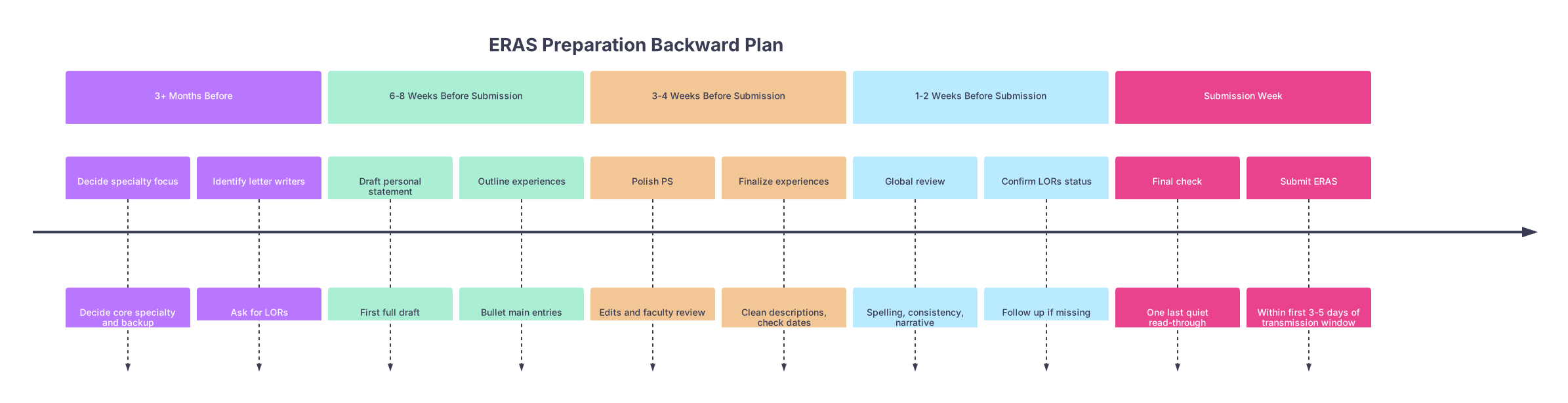
| Period | Event |
|---|---|
| 3+ Months Before - Decide specialty focus | Decide core specialty and backup |
| 3+ Months Before - Identify letter writers | Ask for LORs |
| 6-8 Weeks Before Submission - Draft personal statement | First full draft |
| 6-8 Weeks Before Submission - Outline experiences | Bullet main entries |
| 3-4 Weeks Before Submission - Polish PS | Edits and faculty review |
| 3-4 Weeks Before Submission - Finalize experiences | Clean descriptions, check dates |
| 1-2 Weeks Before Submission - Global review | Spelling, consistency, narrative |
| 1-2 Weeks Before Submission - Confirm LORs status | Follow up if missing |
| Submission Week - Final check | One last quiet read-through |
| Submission Week - Submit ERAS | Within first 3-5 days of transmission window |
Now let’s translate that into minimum viable standards.
4. Minimum Viable ERAS vs. Over-Polished ERAS
You are not writing a novel. You are shipping a product that must go live on time.
What a “Minimum Viable” ERAS Must Have Before You Click Submit
Put a literal checklist next to you and do not submit until these are true:
Personal Statement
- One page, clearly structured:
- Why this specialty
- What you bring (strengths, evidence)
- What kind of training you want
- No:
- Typos
- Generic clichés piled one after another (“ever since I was a child…”)
- Reference to the wrong specialty or program
- At least one other human (advisor, resident, trusted peer) has read it carefully
- One page, clearly structured:
Experience Entries
- Each significant entry has:
- Clear, concrete description (what you did, not just titles)
- At least one outcome or impact line
- No obvious copy-paste repetition across multiple roles
- No missing months/years that raise avoidable questions
- Clinical experiences are clearly distinguished from research and leadership
- Each significant entry has:
Scores and Exams
- All available USMLE/COMLEX scores accurately entered
- Plan for pending Step 2 / Level 2 clearly shown where applicable
Letters of Recommendation
- At least:
- 3 letters uploaded or confirmed in progress from reliable attendings
- You have:
- Assigned letters appropriately to each program group
- Avoided assigning a clearly weak or lukewarm letter when not necessary
- At least:
Program List Strategy
- You have a reasonable number of programs for your risk level:
- U.S. MD, solid stats, non-ultra-competitive specialty: ~30–50 programs
- U.S. DO or below-average stats or IMG: ~60–100+ programs (depending on the field)
- You have:
- A mix of reach / realistic / safer programs
- Geographic spread unless you are very location-constrained
- You have a reasonable number of programs for your risk level:
No Catastrophic Errors
- No wrong specialty names in the PS
- No glaring factual inconsistencies (e.g., working 60 hours/week in three different roles simultaneously)
- No obvious professional red flags in wording (“hated my attending,” “to prove others wrong,” etc.)
If you have all of that done and it is day 1–3 of ERAS transmission:
Stop fussing. Submit.
What Is “Over-Polish” That Can Cost You Time For Minimal Gain
Stop delaying your application for:
- Tiny word swaps that do not change meaning
- Rewriting the same PS paragraph 10 times because it “does not sound like me”
- Trying to make every experience description sound “unique” and “memorable”
- Waiting for the “perfect” LOR when you already have 3 decent ones
- Adding one more minor poster or abstract that will not move any needle
Once your application is:
- Clear
- Coherent
- Error-light
You gain much less from extra weeks of tinkering than you lose by sliding into “late” territory.
5. Specialty-Specific Timing: When Speed Matters More
Some people absolutely must prioritize speed. Others have a small buffer.
| Applicant Type | Specialty Example | Timing Pressure | Comment |
|---|---|---|---|
| U.S. MD, high stats | IM, Peds | Medium | Can afford a few extra days for polish |
| U.S. MD, average stats | Psych, FM | Medium-High | Aim for early window, do not be sloppy |
| U.S. DO | IM, Neuro | High | Early submission strongly preferred |
| IMG with decent scores | IM, Peds | Very High | Submit as early as responsibly possible |
| Any applicant | Derm, Ortho, ENT, Plastics | Very High | First wave submission is critical |
If you are:
- IMG or DO in a moderately competitive field
- Any applicant in a very competitive field
Then your rule is:
- Once you reach minimum viable quality, you submit in the first 1–3 days.
- You do not delay a week to smooth out trivial phrasing.
6. What To Do If You Are Not Ready By Submission Day
Now the uncomfortable part: what if you are clearly not there?
You are a week out from transmission day and:
- Your personal statement is half-drafted
- Experiences are skeletal
- Letters are missing
You have three options. None are fun.
Option 1: Prioritize ruthlessly, accept “good enough,” and still submit early
This is what I tell most people:
If you are even close, cut scope, not timing.
Concrete tactics:
- Pick one primary specialty. If you are flirting with two, pick one and write that PS now. You can write a second PS later for a smaller program list if needed.
- Limit your perfectionism to:
- First paragraph of PS
- Top 5–7 experiences
- Use simple, direct language instead of clever prose. Clarity beats creativity under time pressure.
You then:
- Submit within the early window
- Accept that this is not your magnum opus, it is a professional application
This works better than people think.
Option 2: Delay a few days to fix true weaknesses, but set a hard stop
Set a firm submission date:
- E.g., “I will submit no later than Day 5.”
Use those extra days for:
- Fixing real problems:
- Unclear chronology
- Major grammar / language issues
- Half-finished PS
- Ensuring LORs are at least in progress
What you do not do:
- Keep moving the deadline
- Keep rewriting for style rather than clarity
Option 3: Accept being late—only when quality is truly catastrophic
This is the nuclear option. There are rare times when:
- Your PS is incoherent or truly damaging
- You listed experiences that are inaccurate or ethically problematic
- There are major structural issues that will guarantee rejection
In those cases, a late but non-disastrous application beats an early, self-sabotaging one.
But be honest with yourself:
- “Not as polished as I like” is not catastrophic
- “Embarrassingly unprofessional / misleading / incomprehensible” might be
7. How Programs Actually Read Your Application (So You Stop Over-Optimizing the Wrong Parts)
You should organize your effort based on what gets read first and most carefully.
Roughly, this is how it usually goes once you have passed the score filters:
Program director or coordinator scrolls through:
- Exam scores and attempts
- Medical school + graduation year
- Personal statement opening
- Top experiences
- LOR authors / brief look at content
Only after that initial vibe check do they:
- Look more deeply at research
- Scan other entries
- Notice smaller honors / awards
So your priority order for polish should be:
- Score reporting (accuracy, no surprises)
- Personal statement (first half especially)
- Top 3–5 experiences (especially clinical and leadership)
- LOR selection and assignment
- Everything else
Stop burning hours formatting minor extracurriculars while your PS opener is still generic mush.
8. A Simple Decision Tree: Should You Submit Today?
If you need a straight yes/no: use this.

| Step | Description |
|---|---|
| Step 1 | Today is within first 5 days of transmission |
| Step 2 | Submit ERAS today |
| Step 3 | Fix critical items, submit by Day 5 |
| Step 4 | Submit by Day 10, accept on time |
| Step 5 | Delay, rebuild key sections, accept late |
| Step 6 | Minimum viable checklist complete? |
| Step 7 | Can you fix major issues in 48 hours? |
| Step 8 | Is application dangerously weak? |
Translate that:
If you are in the first 3–5 days and:
- You meet the minimum viable standards → Submit.
- You are close but not quite there → Fix the big stuff in 1–2 days, then submit.
If you are already past day 5 but before day 14:
- Get to minimum viable as fast as possible. You are aiming to be “on time,” not early.
- Do not waste further days on over-polish.
If you are past week 2:
- Assume you are “late.”
- Make sure that what you send is clean enough not to waste the remaining opportunities.
- Strongly consider widening your program list.
9. Example Scenarios: What You Should Actually Do
Scenario 1: U.S. MD, Internal Medicine, Average Stats
- Step 2: 238
- One small research project, solid clinical evaluations
- PS is 90 percent done, some awkward sentences
- It is Day 2 of ERAS transmission
You should:
- Spend one evening cleaning obvious grammar and tightening the intro
- Make sure your top 5 experiences read clearly
- Check LORs are assigned
- Submit by Day 3
You do not:
- Spend another week obsessing over style
- Rewrite the entire PS because it does not sound “unique”
Scenario 2: IMG, Pediatrics, Decent Scores, Not Many U.S. LoRs
- Step 2: 245
- 1 U.S. pediatric letter, 2 home country letters
- Experiences are outlined but not polished
- It is one week before transmission day
You should:
- Aggressively polish:
- PS (clear why Peds, why you, why here in the U.S.)
- Clinical experiences, especially any U.S. work
- Confirm all 3 letters will be uploaded
- Submit on Day 1 or 2, even if a few minor entries feel plain
You do not:
- Delay into week 2 to chase one more minor CV line
- Wait for a “maybe” fourth letter from someone who is slow and non-committal
Scenario 3: Switching Specialties Late
- Applied last year to Surgery, now switching to Anesthesia
- PS is barely started
- Experiences are mostly surgery-heavy descriptions
- It is 3 days before transmission
You should:
- Focus on:
- New PS clearly explaining switch
- Revising top 5–7 experiences to highlight skills relevant to Anesthesia (teamwork, acute care, critical thinking)
- Accept that some of your older entries will still sound surgery-oriented
- Submit within first week, not chasing total perfection
You do not:
- Delay three weeks to reword every single past entry
10. Final Calibration: How To Stop Second-Guessing Your Submission Date
Here is how you know you are ready to click submit:
- You can articulate, in one sentence, why you are applying to this specialty and your PS reflects it.
- Your top experiences would make sense to a stranger who knows nothing about you.
- Another human has looked at your PS and at least a few main entries.
- You are still within the first 10 days of ERAS transmission (ideally first 3–5).
Once these are true, delaying is usually ego, not strategy.
One last thing:
People love to torture themselves with “What if I had submitted 2 days earlier?” after the season starts. That is wasted energy.
Your job right now:
- Hit early or on-time
- Avoid self-inflicted wounds
- Then move on to the next fight: interview preparation
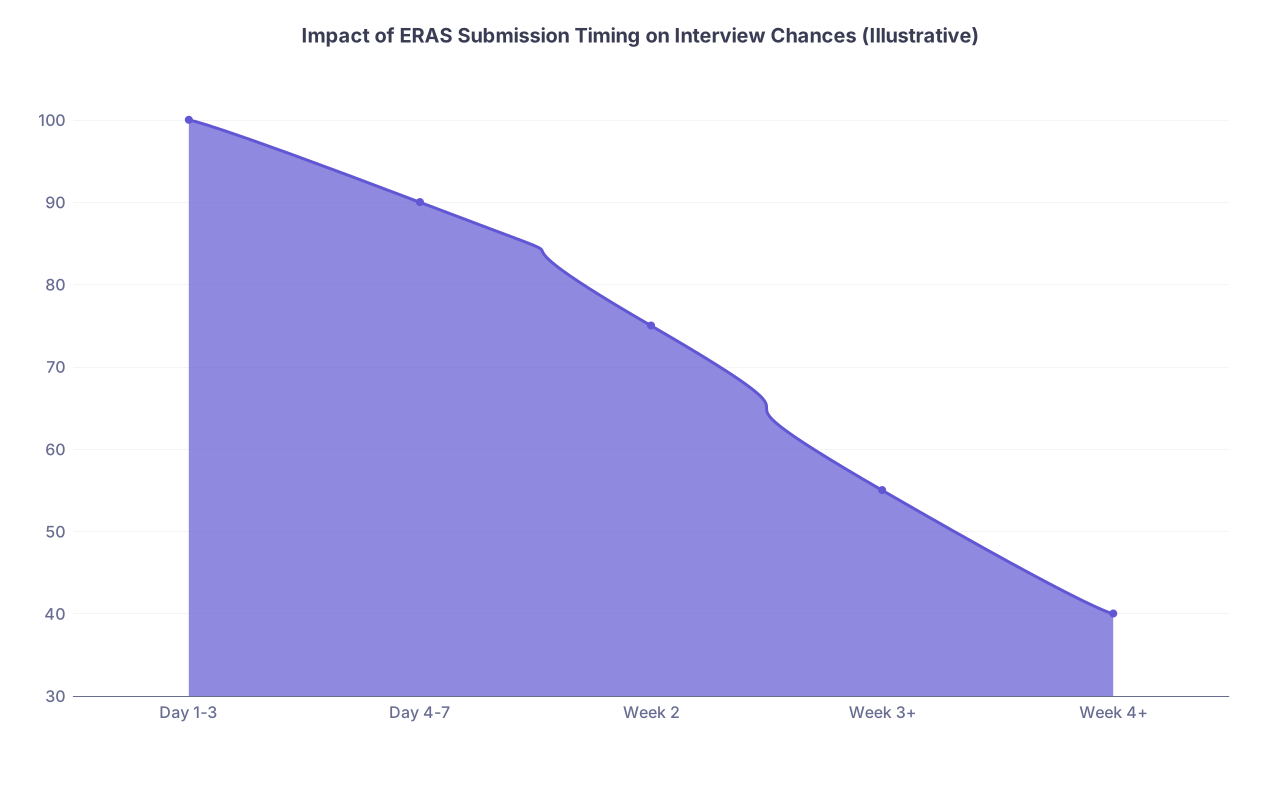
| Category | Value |
|---|---|
| Day 1-3 | 100 |
| Day 4-7 | 90 |
| Week 2 | 75 |
| Week 3+ | 55 |
| Week 4+ | 40 |
This is not exact data from one study. It mirrors what I see season after season:
Early vs. on-time matters. On-time vs. late often matters more than people want to believe.