
You submitted ERAS a week late. The internet tells you you are dead in the water. That is wrong.
Is it ideal? No. Does it permanently ruin your chances? Also no—if you stop spiraling and start executing an actual damage-control plan.
What matters now is not the timestamp on your submission. What matters is how deliberately you respond in the next 2–4 weeks.
1. First: Get Your Situation Crystal Clear (No Fantasy Thinking)
Before you decide what to fix, you need a brutally honest snapshot of where you stand. One week “late” means very different things for different specialties and profiles.
1.1 Define “late” for your context
- ERAS opens: typically early September
- Programs can start downloading: typically mid to late September
If you submitted:
- 1 week after programs could download: You are slightly behind the first wave, but still inside a reasonable window.
- 2–3+ weeks after: Now you are in “meaningful disadvantage” territory, especially in competitive specialties.
You said a week. So you are not done. You are just behind.
Now layer in your specific profile.
| Specialty Type | Impact of 1-Week Delay | Notes |
|---|---|---|
| Hyper-competitive (DERM, Ortho, Plastics, ENT) | High | Early screens brutal; need aggressive outreach |
| Competitive (EM, Gen Surg, Anesthesia) | Moderate | Still salvageable with smart strategy |
| Mid-competitive (IM, Peds, Neuro, OB) | Low–Moderate | More about overall app strength |
| Less competitive / Community-heavy | Low | Timing matters less than overall fit |
If you are applying:
- Dermatology with 240s and weak research: The timing hurts a lot.
- Internal Medicine with 250s and strong letters: Mild annoyance, not catastrophe.
- FM/Peds with solid, average stats: You are likely fine if you handle the rest correctly.
1.2 Audit the rest of your application in 20 minutes
Take a short, disciplined inventory. No drama.
Write down:
- Step 1: Pass/Fail status (and if failed, how many attempts)
- Step 2 CK: Score and number of attempts
- Clinical performance: Honors / HP / Pass pattern; any fails or remediation
- Letters of recommendation:
- How many in hand
- From what specialties
- Strength (if you have any sense of it)
- Research & extracurriculars:
- Number of pubs/posters (if any)
- Leadership, volunteering, longitudinal activities
- Red flags:
- LoA, professionalism issues, extended leave, failed rotations
Now rank yourself:
- Green-light applicant: Strong scores, clean record, solid letters.
- Yellow-light applicant: Average scores or a minor blemish.
- Red-flag applicant: Exam failures, professionalism concerns, big gaps.
A one-week late ERAS for a green-light applicant in a non-insane specialty is usually survivable. For a red-flag applicant in a hyper-competitive field, the delay is just one more reason PDs can screen you out. You will need to work harder.
2. Lock Down Every Missing Piece Immediately
You submitted a week late. You cannot afford anything else to be late, incomplete, or sloppy. Zero tolerance.
2.1 Letters of recommendation: move them from “requested” to “uploaded”
If you hit “submit” but still have missing letters, you are compounding the problem.
Do this today:
- Log into ERAS and list:
- All letter writers
- Which letters are received vs. pending
- Decide your minimum target:
- Most core specialties: 3 solid letters
- Some (like EM): 2 SLOEs minimum; 3–4 preferred
- For any missing letter older than 7–10 days since request:
- Send a short, respectful nudge email:
- Subject: “ERAS Letter of Recommendation – [Your Name] – Time Sensitive”
- Body: 3–4 lines, max. Thank them, remind them of timeline, offer a CV + draft if helpful.
- Send a short, respectful nudge email:
- If a writer is slow / unreliable:
- Identify a backup faculty member now
- Ask them directly: “If Dr. X is unable to submit, would you be willing to write a letter this week?”
Do not wait and hope. Letters pending for weeks sink a borderline application.
2.2 USMLE/COMLEX scores: no delays, no confusion
Make sure:
- All relevant exams are released to ERAS:
- Step 1 (if not auto-released)
- Step 2 CK (if taken and score available)
- COMLEX equivalents if applicable
If Step 2 CK is pending and your Step 1 is pass-only:
- If you are a strong test taker and expect a high score:
- You can reference “Step 2 CK scheduled for [date]” in your communications.
- If you are weak on exams, be realistic: a low CK hurts more than a late application.
But right now, the move is: make sure any already-available score is in ERAS. Programs will not wait for you.
2.3 Personal statement and experiences: tighten them post-submission
Yes, you already submitted. No, that does not mean you are done editing everything forever.
You can still:
- Refine future versions of specialty-specific personal statements for:
- SOAP
- Future re-application
- Any program that allows updated uploads (rare, but exists in some systems / email supplements)
- Correct glaring issues for any applications that can still be edited or uploaded to new programs (depending on ERAS cycle rules for the year).
If you catch:
- Major typos
- Confusing phrasing
- A missing key activity
You fix what is still editable and live with the rest. The big mistake: doing nothing because “it is already submitted.”
3. Expand and Rebalance Your Program List Intelligently
You lost some advantage on timing. Your counter-move is broadening and recalibrating your list. Not randomly—strategically.
3.1 You probably need more programs than you planned
If your original plan was “I’ll apply to 30 programs in General Surgery” and you submitted a week late, I have seen that movie. The ending is bad.
You should strongly consider increasing your program numbers, especially if:
- Your Step 2 CK is < 240 in competitive fields
- You have any failures or red flags
- You are an IMG or DO applying to MD-heavy specialties
Use rough targets like this (these are not absolute, but they are reality-based):
| Applicant Type | Less Competitive Specialty | Competitive Specialty |
|---|---|---|
| Strong US MD | 25–40 | 40–60 |
| Average US MD | 35–50 | 60–80 |
| DO / US-IMG | 50–80 | 80–120 |
| Non-US IMG | 80–120 | 120+ |
If you are already above these ranges, you may not need to expand—focus on targeting and outreach instead.
3.2 How to rebalance: not all programs are created equal
Your late submission hurts most at:
- Big-name, academic-heavy, highly sought-after programs that fill interviews quickly.
You should actively increase:
- Community programs
- Mid-tier academic programs in less popular cities
- Programs historically more IMG/DO-friendly if that fits you
Look up:
- Program-specific Step 2 CK averages (from websites, FREIDA, program presentations)
- Whether they sponsor visas (for IMG applicants)
- Past match lists from your med school to see which programs routinely take your grads
A brutal but useful rule: if your school has never matched anyone at a certain program and you are not an outlier superstar, maybe do not waste energy chasing it—especially with a late application.
4. Direct Outreach: When and How to Email Programs
This is where many applicants either:
- Do nothing and silently sink.
- Or spam 80 programs with generic “please consider my application” emails that PDs delete instantly.
You can do better than both.
4.1 When outreach helps vs. when it does nothing
Outreach can help when:
- You have a genuine connection:
- Rotated there
- Grew up nearby
- Have a mentor/faculty connection
- You are at least a borderline-fit on paper:
- Within ~10–15 points of their average CK
- No catastrophic red flags
Outreach usually does nothing when:
- You are wildly below their usual metrics
- You send mass, generic emails
- You ignore their specific instructions (like “do not contact us about application status” on their website)
If a program clearly says “No emails about your ERAS application,” believe them.
4.2 Who to contact and what to say
Priority targets for emails:
- Programs where you rotated (home or away)
- Programs in your geographic region of interest
- Programs that are lower/medium tier that align with your stats
People to email:
- Program Coordinator (PC)
- Program Director (PD) only if:
- Small to mid-size program
- You have a genuine connection or strong reason
Sample structure for a tight, 5–7 line email:
- Subject: “ERAS Application – [Your Name] – [Specialty] – Late Submission Explanation”
- Line 1–2: Who you are (school, graduating year, specialty)
- Line 3: Acknowledge the late submission, 1 sentence max
- Line 4–5: Very brief highlight (Step 2 score, strong rotations, geographic tie)
- Line 6: Express genuine interest in their program
- Line 7: Thank them, no ask for “interview,” just “review”
Bad: “I would be honored for an interview.”
Better: “I appreciate any consideration you are able to give my application.”
You are trying to get your file opened, not to emotionally blackmail them.
5. Adjust Your Expectations and Your Match Strategy
You are not just applying anymore. You are also actively managing risk.
5.1 Decide early if you need a parallel plan
If you are in a high-risk category:
- Step 2 < 225 in competitive specialty
- Failed boards
- IMG with no US clinical experience
- Hyper-competitive specialty + late ERAS + average stats
You should strongly consider:
- Parallel applying to a less competitive specialty
- Or being realistic about preparing to reapply or go through SOAP
Parallel applications are messy but sometimes necessary. I have seen EM applicants add IM or FM late and end up happily matched in those fields, rather than unmatched and scrambling.
5.2 SOAP is your emergency parachute—treat it like one
You do not plan to use a parachute, but you sure as hell pack it correctly. This is the same.
What you can do now:
- Draft a SOAP-ready personal statement for a backup specialty
- Identify:
- Less competitive fields you would actually be willing to train in
- Geographic areas where you are flexible or have ties
- Keep a running list:
- Community programs with historically unfilled positions
No, this does not “jinx” you. It keeps you from writing a SOAP personal statement at 2 a.m. in full panic mode.
6. Execute a Short, Focused 4-Week Plan
You lost a week. Fine. Now you run a sprint, not a marathon.
Here is a simple, brutally practical 4-week plan.

| Step | Description |
|---|---|
| Step 1 | Week 1: Stabilize File |
| Step 2 | Week 2: Expand & Target |
| Step 3 | Week 3: Outreach & Follow-Up |
| Step 4 | Week 4: Reassess & Adjust Strategy |
Week 1: Stabilize your file
- Confirm:
- ERAS successfully submitted
- All programs assigned correctly
- USMLE/COMLEX scores released
- MSPE and transcript requested / uploaded
- Hit your letter writers:
- Nudge emails
- Backup writers if needed
- Clean your personal workflow:
- Dedicated email folder for application responses
- Spreadsheet of applied programs with columns:
- Program name
- City/state
- Type (academic/community)
- Notes (connections, emails sent, response)
Week 2: Expand and target your list
- Add additional programs where:
- Your stats are aligned or slightly below their usual range
- You actually would go if accepted
- Prioritize:
- Community-heavy and IMG/DO-friendly programs when relevant
- Regions you have ties to (always mention these later)
Week 3: Targeted outreach
- Send tailored emails to:
- Rotations sites
- Home program (if applicable and you have not already)
- 10–30 carefully chosen programs where you are a solid or near-fit
Keep track of who you emailed and when. Do not email weekly. That is pestering, not professionalism.
Week 4: Reassess your situation
By this point, you will start seeing a pattern:
- Some interviews
- Or complete silence
- Or mixed
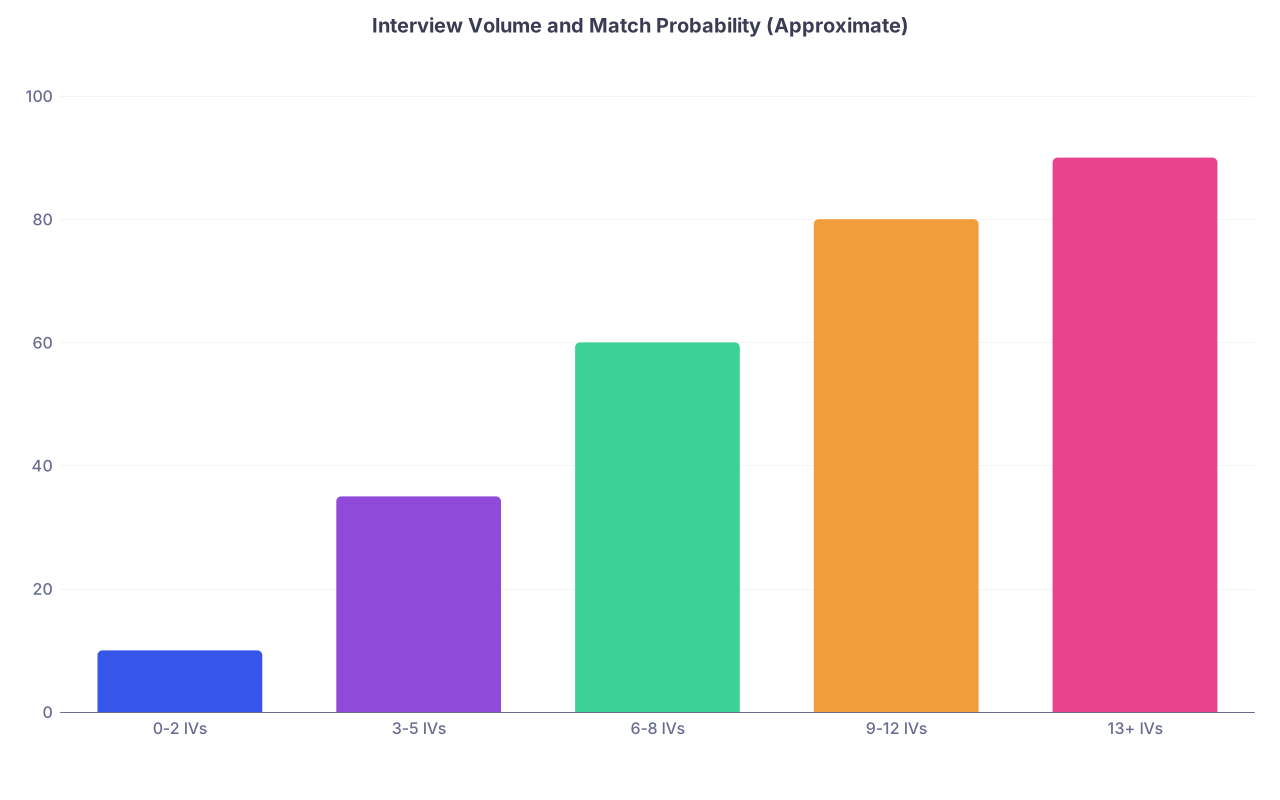
Use hard numbers:
- If by 4–6 weeks after download date you have:
- 0–2 interviews in a competitive specialty with average/weak stats
- You must think seriously about SOAP / parallel path.
- 3–5 interviews in a less competitive field and some pending, you are in the game.
- 8+ interviews in most specialties, you are likely fine.
| Category | Value |
|---|---|
| 0-2 IVs | 10 |
| 3-5 IVs | 35 |
| 6-8 IVs | 60 |
| 9-12 IVs | 80 |
| 13+ IVs | 90 |
(Those percentages are rough, but they reflect what I have seen play out across many cycles.)
7. Fix the Underlying System That Made You Late
I am going to be blunt. A one-week late ERAS is rarely just “bad luck.” There is usually a pattern behind it:
- Chronic procrastination
- Overcommitting to rotations/ECs during application month
- Perfectionism paralysis: rewriting the personal statement 14 times
- Avoidance because of fear about your stats
If you do not fix that system, you will repeat the same behavior for:
- Interview scheduling
- Thank-you/interest letters
- Rank list decisions
- Future board exams, licenses, and job applications
7.1 Diagnose what actually caused the delay
Take 10 minutes and write down the actual reasons your ERAS was late. Be specific:
- “I underestimated how long it would take to enter experiences.”
- “I waited for one last letter instead of submitting on time.”
- “I kept editing my personal statement instead of calling it good enough.”
- “I did not block out time in September and was on an away rotation.”
You will probably see 1–2 recurring themes: time mismanagement or perfectionism.
7.2 Install simple, boring systems
You do not need an app or a new personality. You need a checklist and a calendar.
For everything coming next (interviews, rank list, SOAP, licensing), use:
- A deadline that is 3–5 days earlier than the real one.
- Treat your fake deadline as the real one.
- A written task breakdown.
- Example for interviews:
- Respond to invite within 4 hours
- Block travel dates immediately
- Create one-page program notes
- Example for interviews:
- Accountability.
- One friend/classmate where you say:
- “I will have my rank list draft done by Sunday 5 p.m. If I do not, I owe you dinner.”
- One friend/classmate where you say:
It is unglamorous. It works.
8. Mental Game: Stop Catastrophizing, Start Operating
You are in medicine. You are going to have real crises: crashing patients, unexpected bad scans, complications. This is training ground.
A one-week late ERAS is annoying, not fatal.
Here is the mindset that actually helps:
- “I am behind. That means I compensate with volume, targeting, and professionalism.”
- “Some doors are harder to open now. There are still plenty of doors.”
- “My job is to give myself as many realistic chances as possible this cycle, and to build systems that prevent repeat mistakes.”
You do not get extra points for suffering. You get results for executing a plan.
9. Clear, Direct Answers to What You Are Probably Thinking
You are likely holding a few specific questions in your head. Let me hit them quickly.
“Should I mention the late submission in my personal statement?”
No. Do not center your entire pitch around your timing error.
If a PD brings it up in an interview, you can address it briefly:
- Short, factual explanation (not a sob story)
- Immediate pivot to what you did to correct course and stay on top of everything else
“Should I ask my dean or advisor to call programs for me?”
Only if:
- You have a truly strong relationship with them
- You are a legitimately strong applicant whose late application was clearly out of character
- They actually know specific PDs personally
Do not ask for generic “calls to programs” as a Hail Mary. That just irritates people.
“Do programs literally sort by time submitted?”
Some do, some do not.
- Many places start reviewing the first batch they download and keep working forward. Early files get more attention.
- But I have seen late September files get interviews when the content was strong and the fit was obvious.
Your job is not to guess their exact internal sorting tool. Your job is to make your file too reasonable to ignore.
10. What Actually Matters from This Point Forward
Strip all of this down and the essentials are simple:
A complete, clean application file
No missing letters, no missing scores, no sloppy errors.A wide, realistic program list
Especially including community and mid-tier programs aligned with your profile.Targeted, non-desperate outreach
To programs where you have a credible shot and a genuine connection.A backup plan you are not ashamed of
SOAP prep or parallel specialty, thought through calmly, not in panic.Fixed systems so this is the last time a major career step is “late.”
| Category | Value |
|---|---|
| Application Content | 45 |
| Program List Strategy | 30 |
| Outreach & Networking | 15 |
| Original Submission Timing | 10 |
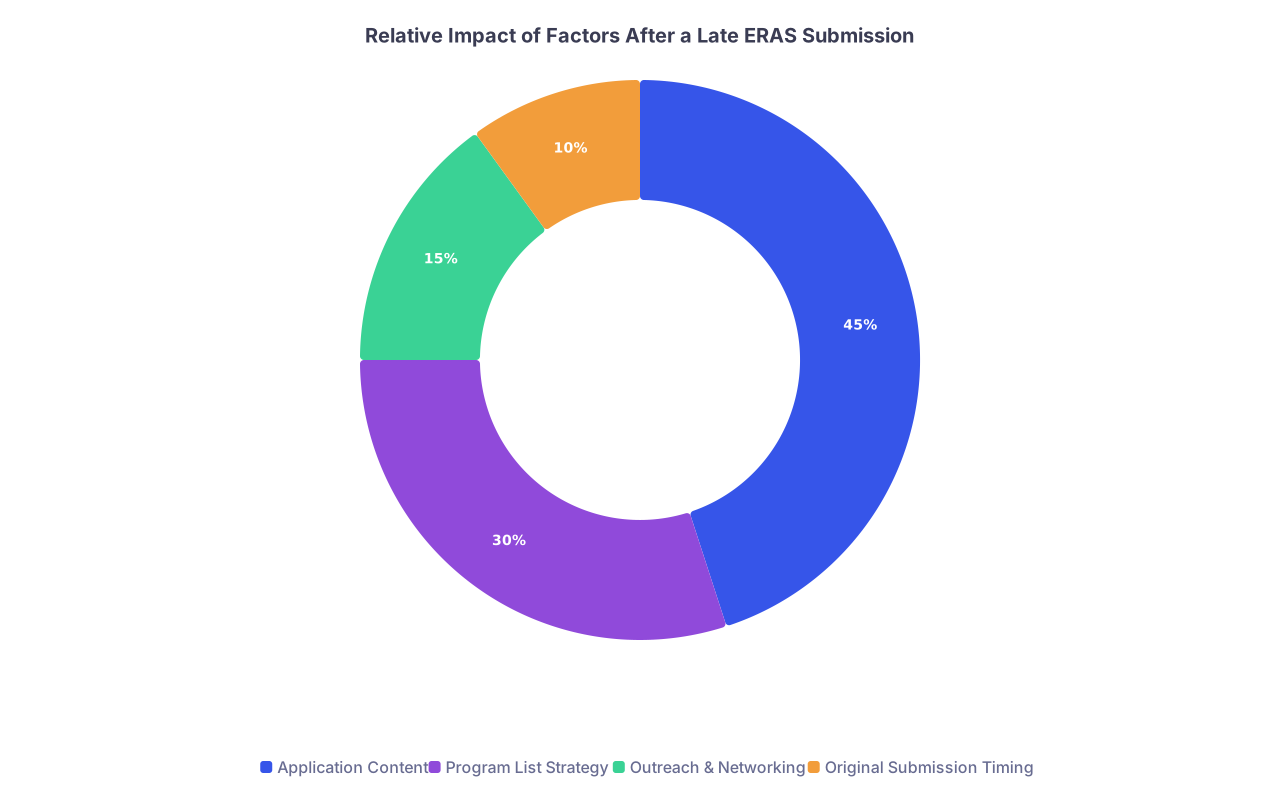
The punchline: One week late is not the thing that will sink you if you respond well. Sloppy follow-through will.

Key points to walk away with:
- A one-week late ERAS hurts most in hyper-competitive specialties, but it is rarely a death sentence.
- Your counter-move is a complete file, a broadened and realistic program list, and smart, restrained outreach.
- Fix the underlying systems that made you late, or you will repeat the same mistake at the next critical career step.