
It is early September. You are staring at your ERAS dashboard.
Your personal statement is “good enough,” letters are in, programs list mostly set.
But Step 2 CK?
Still pending. Score release is in 2–3 weeks. And now you are stuck on the one question nobody gives you a straight answer to:
“Do I submit ERAS now without Step 2 CK, or do I wait for my score?”
Let me be clear: timing this wrong can absolutely hurt you. Not because programs are evil, but because the ERAS machinery is rigid and first-come-first-reviewed is very real at a lot of places.
You need a decision-making protocol, not vague advice like “earlier is better” or “it depends.” So that is what I am going to give you.
Step 1: Understand How Programs Actually See Your Application
You cannot time anything until you understand the mechanics.
What happens when you hit “Submit” on ERAS
Once you submit:
- Your application is locked (you cannot change most content).
- ERAS begins transmitting your application to programs starting on the official “release” date.
- Your USMLE/COMLEX transcript gets sent as it exists that day:
- If Step 2 CK is not available, programs see only Step 1 (and possibly CS/COMLEX etc.).
- When Step 2 CK posts, you must re-release your transcript so programs can see the new score.
Programs vary in how often they pull new score updates. Some update automatically, some periodically, some lazily. Assume nothing gets magically fixed for you.
What programs prioritize early
Most programs:
- Batch review a huge chunk of applications during the first 2–3 weeks after ERAS opens.
- Send the majority of interview invites in September and early October.
- Use basic filters:
- USMLE attempts
- Score thresholds
- Visa status
- Grad year
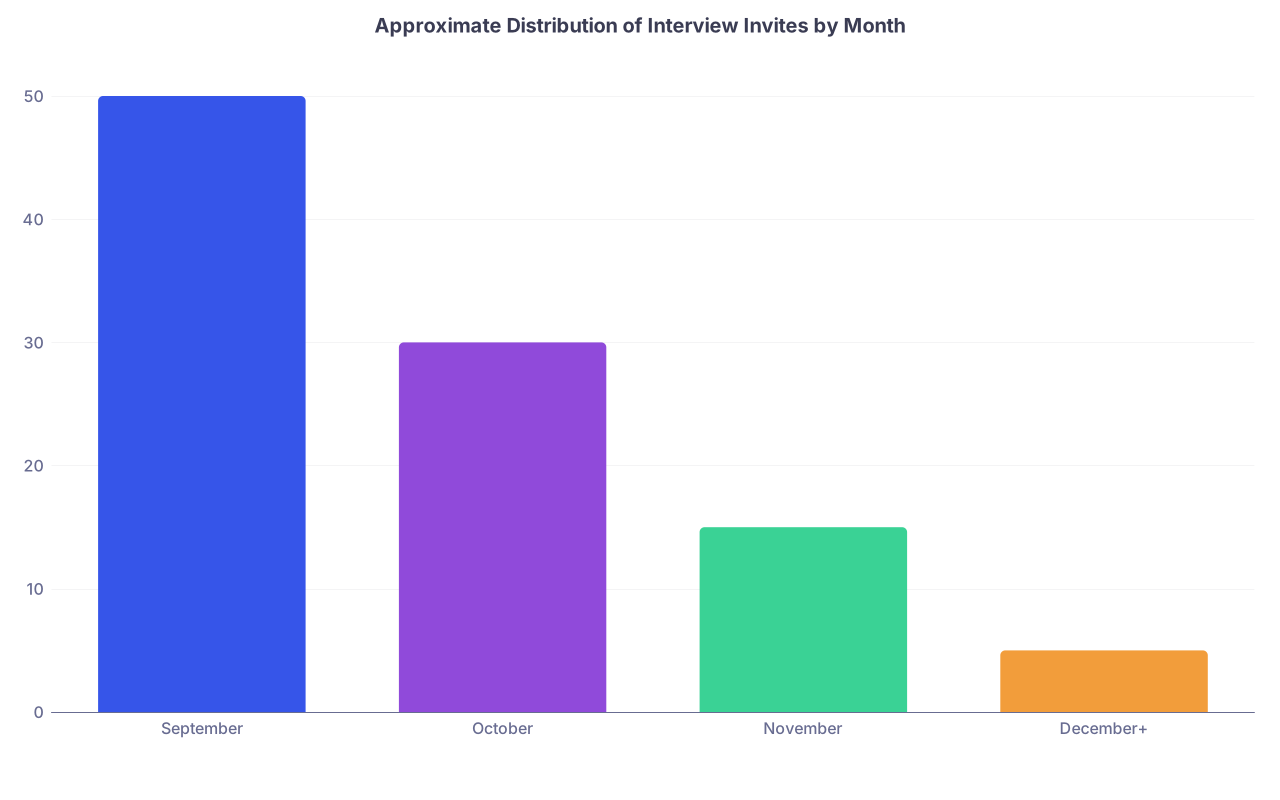
| Category | Value |
|---|---|
| September | 50 |
| October | 30 |
| November | 15 |
| December+ | 5 |
If your file is incomplete or weaker at that moment, you may never make it into the “let us review this carefully later” pile.
So you are balancing:
- The penalty of being late
vs. - The penalty of looking weaker without Step 2 CK.
Step 2: Classify Yourself Into One of Three Risk Categories
Do not overcomplicate this. You are in one of three buckets based on scores and target specialty.

Category A: Low-Risk Applicant
You are low-risk if:
- You are applying to a less competitive specialty (e.g., IM community programs, FM, Psych, Peds, Path, PM&R)
AND - Your Step 1 is:
- Pass (for P/F era) with a clean attempt, and you are from a U.S. MD/DO school or a strong IMG profile
OR - A solid 23x–24x or above if still numerical
- Pass (for P/F era) with a clean attempt, and you are from a U.S. MD/DO school or a strong IMG profile
- No red flags: no repeats, no professionalism issues, no big gaps.
For you: early submission nearly always beats waiting. Step 2 CK pending is not fatal.
Category B: Moderate-Risk Applicant
You are in the gray zone if any of these match:
- Applying to relatively competitive but not insane specialties:
- Categorical IM in good academic centers
- OB/GYN
- Anesthesia
- EM (depending on year)
- Step 1 is:
- Slightly below what your target programs usually like
- Or Pass when your school advisors are “a bit nervous” about your overall application
- You have some strengths (research, solid clerkship evaluations, strong letters) but nothing that screams automatic interview.
For you: timing is nuanced. You might need a split strategy: early submission for safer programs, delayed or selective for aspirational ones.
Category C: High-Risk / Step 2-Dependent Applicant
You are high-risk if:
- Your Step 1 is:
- Borderline low for your specialty
- A fail on first attempt
- Or from a school that tells you explicitly: “You must prove yourself on Step 2.”
- You are aiming for:
- Competitive IM (university / big academic)
- EM at busy academic sites
- Surgical fields of any kind
- Radiology, Derm, Ortho, ENT, etc. (in which case Step 2 pending at ERAS opening is already a problem)
- You are an IMG with:
- Average or below-average exams
- Limited U.S. clinical experience
For you: Step 2 CK may be the difference between “auto-screened out” and “we will actually read this”.
Step 3: Use This Decision Framework Based on Your Category and Timing
Now we get practical.
First: Know your score release date
Pull up your NBME/USMLE account and find your expected score release date. It is usually:
- About 2–4 weeks after your test date
- Wednesday mornings
Write down:
- Test date
- Expected score release Wednesday
- ERAS opening and program download dates for your cycle
Now look at the gap.

| Step | Description |
|---|---|
| Step 1 | Step 2 CK Pending |
| Step 2 | Submit ERAS with Step 2 |
| Step 3 | Depends on risk category |
| Step 4 | Usually submit without Step 2 |
| Step 5 | Submit on time, update score later |
| Step 6 | Submit on time, hold reach programs if needed |
| Step 7 | Consider waiting for score or adjusting list |
| Step 8 | How close to ERAS release? |
| Step 9 | Risk Category |
Scenario 1: Step 2 CK Score Releases Before ERAS Transmission Date
If your Step 2 CK result is out ≥ 7 days before programs receive applications:
- Submit ERAS as early as you can.
- Include Step 2 CK in your transcript from day one.
- No dilemma. You win on both counts: early and complete.
If your Step 2 releases 1–3 days before programs download applications:
- Still submit on time.
- As soon as the score is out:
- Re-release your USMLE transcript in ERAS.
- Confirm with your school’s dean’s office or advisor that your transcript update will reach programs in the first batch.
Scenario 2: Step 2 CK Score Releases 0–10 Days After Program Download Date
This is the most painful zone.
Here is what to do by category:
If you are Category A (Low Risk)
- Submit ERAS as early as allowed. Do not hold.
- Your application will go out without Step 2 CK.
- When Step 2 posts:
- Re-release transcript.
- Optionally send a brief, targeted update email to a small number of priority programs if your score is clearly strong (e.g., “Just wanted to share that I scored 252 on Step 2 CK, which I believe reflects my clinical performance well.” No essay.)
You gain more by being in the early review pile than you lose by not having Step 2 CK in that first week or two.
If you are Category B (Moderate Risk)
You need to be deliberate.
Ask yourself two questions:
- Is your Step 1 so weak that some programs will auto-screen you out without Step 2?
- How late is your score relative to the start of interview invites?
If your score releases:
- Within 7 days of ERAS transmission:
- I still favor submitting on time.
- Reason: Most programs are not done screening in the first week. If you re-release the transcript quickly, many will see the improved picture before finalizing invites.
- 7–14 days after ERAS transmission:
- Use a split strategy:
- Submit ERAS on time.
- For your most competitive “reach” programs where Step 1 is marginal:
- Consider whether those places historically require Step 2 (check their website, ask recent grads).
- If they clearly emphasize Step 2, you can:
- Either still apply on time but accept lower odds
- Or delay applying to just those few programs until your score posts.
- Personally, I have seen more students succeed with early but honest applications than with perfectionist delays.
- Use a split strategy:
- More than 14 days after:
- You cannot afford to delay your entire cycle.
- Submit on time.
- Let Step 2 CK act as a mid-season boost:
- Transcript re-release
- Targeted emails to higher-tier programs once you know the score
If you are Category C (High Risk / Step 2-Dependent)
Here is where the advice changes.
If your Step 1 has:
- A fail
- Or is significantly below the usual range for your specialty
Then Step 2 CK is essentially your redemption exam.
If your Step 2 score releases:
- 0–7 days after ERAS transmission:
- Submit on time, but:
- Expect that some places will initially screen you based on Step 1 alone.
- You must re-release the transcript the day scores are available.
- Have a short, professional update email ready to send to critical programs once the score is in, especially where you have any connection (home program, away rotation, mentor contact).
- Submit on time, but:
- 7–21 days after ERAS transmission:
- You need to be brutally realistic.
Here are your options:
- If you expect a strong Step 2 (practice NBMEs support this):
- I lean toward submitting on time anyway, especially for:
- Safety and mid-tier programs
- For the most competitive or realistic target programs where Step 1 would trigger auto-screen:
- Consider delaying those few until your score posts.
- You are taking a calculated risk: smaller number of later applications to those programs, but with a far better first impression.
- I lean toward submitting on time anyway, especially for:
- If you are unsure or your practice exams are mediocre:
- Do not wait for a miracle score that may not arrive.
- Submit on time.
- Aggressively adjust your program list toward:
- Less competitive regions
- Community programs
- Backup specialties if needed
If Step 2 score releases more than 3 weeks after ERAS transmission:
- The cost of late application usually outweighs the benefit of waiting for the score.
- Exception: if you have a serious red flag (Step 1 multiple fails) and you know from practice scores that Step 2 will be dramatically higher, you might discuss with an advisor whether to:
- Sit out this cycle
- Or massively narrow your target programs and apply late with a much stronger story
This is where real, individualized advising matters. I have seen applicants in this situation match—but only after they rethought specialty, location, and program tier.
Step 4: Adjust Strategy by Specialty Competitiveness
Different specialties tolerate incomplete or pending scores differently.
| Specialty Type | Sensitivity to Pending Step 2 | Timing Priority |
|---|---|---|
| Primary Care (FM, Peds) | Low–Moderate | Early submission |
| Community IM/Psych | Moderate | Early with update |
| Academic IM/Anesthesia | High | Early + strong Step2 |
| EM, OB/GYN | High | Prefer Step2 ready |
| Surgical, Rads, Derm, etc. | Very High | Step2 before apply |
Primary Care and Community Programs
- More likely to:
- Be flexible with pending Step 2 CK.
- Consider your whole story, letters, and clerkship grades.
- Strategy:
- Submit early.
- Do not obsess over Step 2 timing unless Step 1 is a major problem.
Academic IM, Anesthesia, EM, OB/GYN
- More likely to:
- Use Step 2 CK as a key discriminator.
- Care about trends (did you improve from Step 1?).
- Strategy:
- Aim for Step 2 CK to be in by early screening (September).
- If it is not, use transcript re-release + targeted emails.
- Do not delay everything hoping to look “perfect.” You will just look late.
Surgical and Very Competitive Specialties
If you are still waiting on Step 2 CK when ERAS opens and you want Ortho, Derm, ENT, PRS, etc.:
- You are already behind.
- You usually need:
- A stellar Step 1 (if numeric) and/or
- Strong Step 2 CK in hand
- Plus high-impact research, strong home program support.
If Step 2 CK is pending:
- Submit ERAS early anyway, but:
- You must be realistic about your odds.
- Use the score (once available) mostly to:
- Salvage a pivot (e.g., backing up with IM or another specialty).
- Strengthen your case at a small number of highly connected programs.
Step 5: Concrete Timeline Scenarios (Walkthroughs)
Let me walk you through a few real-world style examples. This is usually where things click.
Example 1: U.S. MD, Applying IM, Step 1 = Pass, Step 2 release Sept 21
- ERAS programs start receiving apps: Sept 15
- Your Step 2 CK result: Sept 21
- You are moderate risk.
What I would do:
- Submit ERAS as early as allowed (by Sept 14–15).
- Your Step 2 is pending at transmission.
- On Sept 21:
- Check your score.
- Re-release USMLE transcript immediately.
- If Step 2 is solid (let us say 245+), send a short update email to:
- Home program
- Away rotation programs
- Top 10–15 IM programs where you are borderline on paper
You are early. Programs will still be actively reviewing when your updated score hits.
Example 2: IMG, Applying IM, Step 1 = 214, Step 2 release Oct 12
- ERAS apps sent mid-September.
- Your Step 2: almost a month later. High-risk category.
My recommendation:
- Do not delay the entire application.
- Submit ERAS to a broad list of programs early:
- Heavy emphasis on community, IMG-friendly programs.
- When Step 2 posts:
- If the score is high (e.g., 245+), re-release transcript.
- Then send selective emails to:
- Programs where your profile might now be competitive academically.
- Accept that some early auto-screen decisions were made before Step 2.
If your Step 2 is only modestly higher (e.g., 225):
- Same steps (re-release, limited emails)
- But your main leverage will be:
- Volume of applications
- Geographic diversity
- Any networking/USCE connections
Example 3: U.S. DO, Applying FM, Step 1 = Pass, COMLEX 1 okay, Step 2 CK release Sept 28
- You are essentially low-risk.
- FM is more forgiving.
Do this:
- Submit ERAS on day one.
- Mark Step 2 CK as “taken, score pending.”
- When it posts:
- Re-release transcript.
- That is it. No need for a big update campaign unless your score is unusually high and you are trying to impress a few academic FM programs.
Step 6: Avoid These Common Mistakes
I keep seeing the same unforced errors every year.
Mistake 1: Waiting to submit ERAS because “I want everything to be perfect”
Bad idea. Programs do not reward perfectionism; they reward being on time and competitive.
- Submitting 2–3 weeks late just to have Step 2 in the initial file?
Often worse than being early without Step 2, especially for primary care and community-heavy lists.
Mistake 2: Not re-releasing USMLE transcript after Step 2 posts
This one is deadly and shockingly common.
- Your Step 2 score does not automatically appear in programs’ ERAS inboxes unless you re-release or your school triggers it.
- Double-check with:
- ERAS dashboard (status of USMLE transcript).
- Your dean’s office or registrar if they manage the release.
Mistake 3: Sending long, emotional update emails to every program
Do not.
- Keep any update short:
- One paragraph.
- Concrete: “Step 2 CK: 248, taken on X date. I remain very interested in your program because… [one concise reason].”
- Send only to:
- Programs where it could move the needle.
- Places where you have a connection or realistic chance.
Mistake 4: Ignoring backup strategies
If you are heavily Step 2-dependent and your timing is late:
- Build in backup:
- More community programs.
- Wider geographic net.
- Another specialty as a genuine parallel plan if your advisor strongly suggests it.
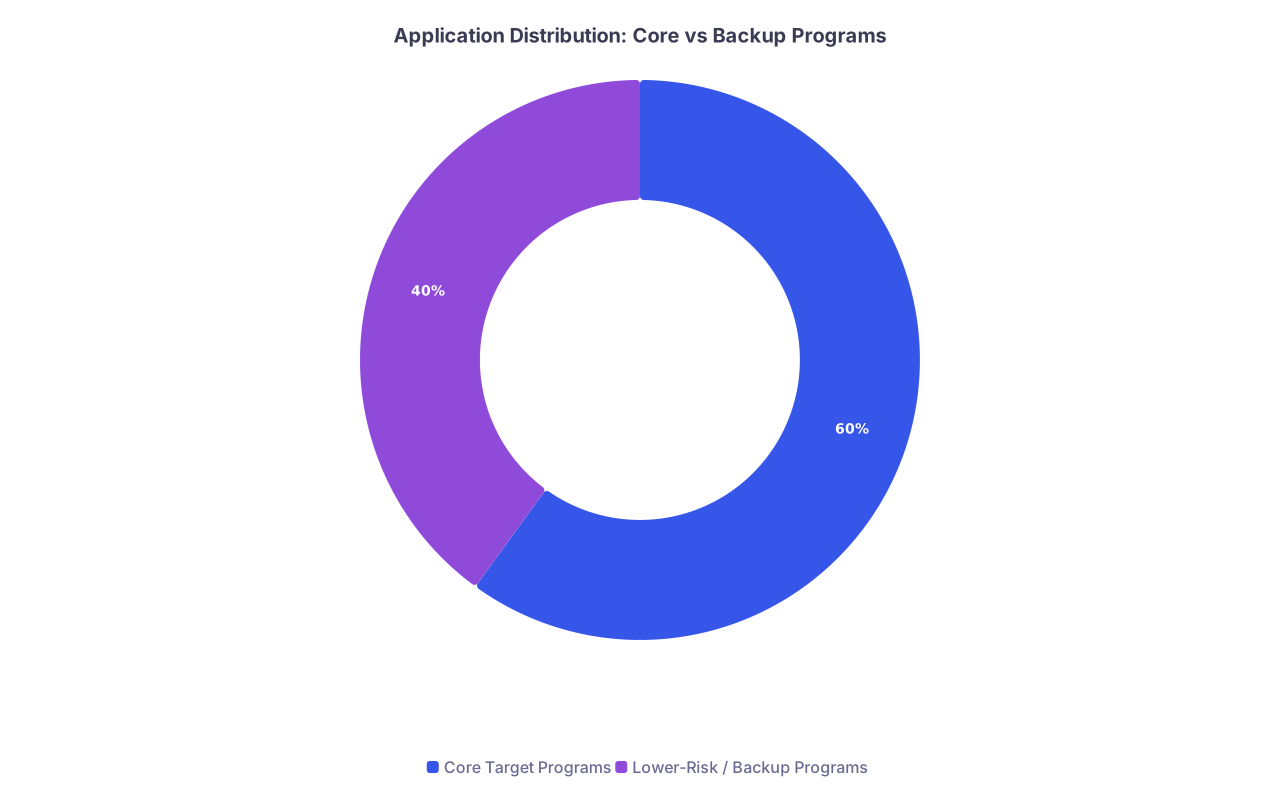
| Category | Value |
|---|---|
| Core Target Programs | 60 |
| Lower-Risk / Backup Programs | 40 |
Step 7: Checklist: How to Execute This Week
Here is what you can do literally today to get out of limbo and into action.

Confirm your Step 2 CK score release date
- Log into your NBME/USMLE account.
- Write down your expected Wednesday release.
Identify your risk category (A, B, or C)
- Look at your Step 1 (and COMLEX if applicable).
- Compare to your specialty’s typical ranges (use NRMP Charting Outcomes, talk to advisors).
- Be honest, not optimistic.
Decide your default plan:
- Category A: Submit on time. Do not delay.
- Category B: Submit on time; possibly delay a few select reach programs if Step 2 is very late and absolutely critical.
- Category C: Submit on time but radically manage expectations and broaden your list. Consider delaying a small subset of high-tier programs if your Step 2 is imminent and likely strong.
Prepare your Step 2 update template
- Draft a 3–4 sentence email now:
- Subject: “USMLE Step 2 CK Score Update – [Your Name], ERAS ID [#######]”
- Body: brief intro, new score, one sentence on continued interest.
- Draft a 3–4 sentence email now:
Set a calendar reminder for Step 2 score day
- Two reminders:
- Morning: Check score and re-release transcript.
- Same day afternoon: Send selected update emails if warranted.
- Two reminders:
Confirm with your school how USMLE transcripts are handled
- Ask:
- “Do I need to manually re-release my transcript once Step 2 CK posts?”
- “How fast does that update go to programs?”
- Ask:
Your Next Concrete Step Today
Open your ERAS account right now and look at your Certification and Submission page.
Then:
Write your actual Step 2 CK score release date on a sticky note and stick it to your laptop.
Based on everything above, commit to one sentence:
“I am going to submit ERAS on [date] even though Step 2 CK is [pending / expected in X days], because I am a [low / moderate / high]-risk applicant targeting [specialty], and early submission is the best move in my situation.”
If you cannot fill in that sentence clearly, that is your problem to solve tonight. Once that sentence is honest and specific, the rest of your timing decisions fall into place.