
The idea that “as long as ERAS is in by the deadline, I’m fine” is dangerously wrong.
If you’re planning to hit submit on deadline day, you’re playing a game you do not control. And the system does not care that you meant well, worked hard, or “just needed one more day.” I’ve watched strong applicants quietly sabotage their season by assuming ERAS works like a college homework portal. It doesn’t.
Let me walk you through the 7 hidden risks of waiting until the last day to submit ERAS, what actually happens behind the scenes, and how to avoid being the person refreshing their email in November wondering why nothing’s coming in.
1. The Myth of “Deadline Day Is Fine”
Here’s the first mistake: thinking “ERAS deadline” is the same as “ERAS open date.”
Programs don’t sit around waiting for a final deadline. They start:
- Screening
- Pre-filtering by USMLE/COMLEX scores, school, visa status
- Sending invites to their “easy yes” pile
long before the date you’re circling on your calendar.
Many competitive programs effectively make most of their interview decisions in the first wave. You show up at the end? You’re walking into a room that’s already 70–80% full.
| Timing | How Programs Commonly Treat You |
|---|---|
| First week | Strong signal of interest; full slate |
| First 2–3 weeks | Still good; many interview spots open |
| 1–2 months later | Lower priority; fewer spots left |
| On final deadline | Last-pass review, if they even get to you |
No one announces this on their website. But program coordinators say it out loud on the phone: “We’ve already sent most of our invites.”
Do not confuse “last day to accept applications” with “best time to submit.” They’re not even remotely the same.
2. Technical Failure: When the System Breaks You
You’re assuming ERAS, MyERAS servers, and your internet connection will all behave perfectly. On the busiest day of the entire season.
You know what I’ve actually seen?
- The website timing out on final review
- Credit card issues when paying ERAS fees
- Two-factor authentication glitches
- PDFs (like LORs or MSPEs) that mysteriously don’t attach
- Applicants locked out because they mistyped a password too many times
Imagine this: it’s 11:20 PM, you hit “certify and submit,” and the page freezes. You refresh. You’re logged out. You log back in. It asks you to re-enter payment details. The bank flags it as unusual activity. Now you’re on hold with a call center that closed 20 minutes ago.
This is not dramatic fiction. I’ve watched a student with a 260+ Step 2 send me a screenshot of a frozen ERAS payment page at 11:58 PM. They submitted. The timestamp? Next day. The program’s portal marked them as late.
If you must be close to the deadline (and you shouldn’t), you need a buffer. At least:
- 24 hours of buffer for the actual submission
- 48–72 hours if you’re changing cards, addresses, or banking details
Thinking “I’ll just submit that night” is how savvy, otherwise competent people end up crying in front of their laptop.
3. Document Desynchronization: When Your File Is Incomplete and You Don’t Realize
Here’s a sneaky one: just because you hit submit doesn’t mean your application file looks complete to programs.
There are multiple moving parts:
- ERAS Common Application
- Personal statements (plural, if specialty-specific)
- Program lists
- USMLE/COMLEX transcripts
- Medical school transcript
- MSPE (Dean’s Letter)
- Letters of recommendation
When you submit on the last day, three things go wrong:
LORs don’t all make it.
That “almost done” letter from your away rotation? The attending uploads it late, or labels it wrong, or it doesn’t get assigned to the right programs. Programs see 1–2 letters instead of 3–4 and filter you out without thinking twice.Transcripts and scores lag.
Your USMLE transcript request can fail if your authorization isn’t set up correctly or your name doesn’t match. You won’t know instantly. Programs don’t chase you. They move on.Assignments mistakes stick.
I’ve seen applicants assign:- The wrong personal statement to the wrong specialty
- No personal statement to half their programs
- Only 1 LOR assigned to 40 programs
They only noticed because invites weren’t coming, and they finally checked how they looked from the program side. Too late.
Submitting at the last minute means:
- You have no chance to fix broken LOR uploads
- You have no time to correct misassigned documents
- You don’t see how your application actually appears after processing
If you submit a week earlier and something breaks, you have room to repair it. On deadline day, any error is permanent.
4. Screening Order: The “Back of the Stack” Problem
Here’s what applicants underestimate: order of review matters.
Most programs don’t sit down and calmly, methodically read every single application. They triage.
- Step/COMLEX screens
- Filters (IMG vs AMG, visa needed, home school, couples match)
- Priority lists (rotators, home students, specific schools)
Then? They go in order. Usually starting with whatever ERAS gave them first.
If you submit on deadline day, you’re not arriving to a clean inbox. You’re landing on top of a mess that’s already been partially drained.
Remember:
- Faculty get burned out reviewing.
- PDs have a mental quota for how many applications they’ll seriously consider.
- The later they get to you, the more likely they are to skim and say, “Pass, we already have enough.”
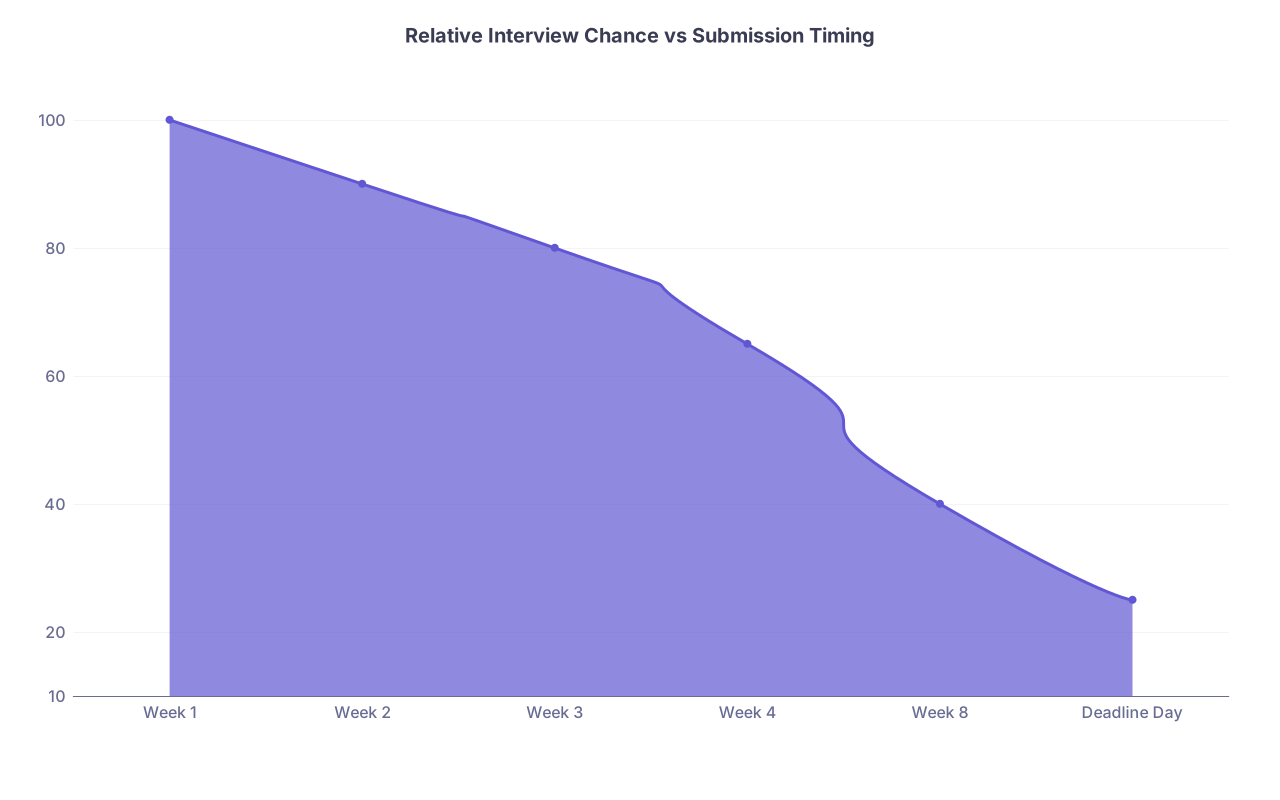
| Category | Value |
|---|---|
| Week 1 | 100 |
| Week 2 | 90 |
| Week 3 | 80 |
| Week 4 | 65 |
| Week 8 | 40 |
| Deadline Day | 25 |
Is this exact data? No. But that ratio matches what I’ve seen repeatedly across multiple cycles: earlier submissions consistently correlate with more invites, even among similar profiles.
The hidden risk: You think you’re being compared fairly to everyone. You’re not. You’re being compared to people who were seen first, when more interview slots were available and reviewers were less mentally exhausted.
5. Emotional and Cognitive Overload: You Make Dumb Mistakes When You’re Rushed
Let me be blunt. The last 24–48 hours before a deadline is when smart, high-achieving people suddenly start behaving like amateurs.
I’ve reviewed “final” ERAS applications submitted on the last day with:
- Misspelled program director names
- Wrong hospital names
- “Seeking a career in neurosurgery” in a family medicine personal statement
- Dates that make no sense (research in 2032, graduation in 2018 then clerkships in 2019–2023)
- Activities copied and pasted with leftover references to another project
Do programs reject you purely because of a typo? Usually no. But:
- Sloppy work is an easy tiebreaker against you.
- Big inconsistencies raise red flags for honesty and attention to detail.
- Confusing or contradictory timelines can trigger additional scrutiny.
When are you most likely to make these errors?
- After 14 hours of editing in one day
- At midnight
- With your phone buzzing from classmates asking “Have you submitted yet??”
- While second-guessing every word you wrote
Submitting on deadline day almost guarantees you’re operating in this headspace. Your judgment is off, not because you’re lazy, but because you’re human.
What follows from that:
- You don’t proofread well.
- You hit “certify” on something you’d be embarrassed to show your future PD.
- You underestimate the permanent nature of what you’re locking in.
ERAS certification is final. You can’t un-send it. You can’t rewrite descriptions. You can’t swap out personal statements for programs you already applied to.
You really want to do that final irreversible step when you’re exhausted and rushed?
6. Letters and MSPE Timing: The Slow Pieces You Can’t Control
The single most common reason people slip to the deadline is this line:
“I’m just waiting on one more letter.”
Here’s the harsh truth: faculty and Deans’ offices do not share your sense of urgency.
- Attendings forget.
- Department admins are juggling 100 things.
- Your school’s records office may batch-upload MSPEs and transcripts on their schedule, not yours.
When you anchor your entire submission date on other people’s punctuality, you expose yourself to several risks:
The “It’ll be up later today” lie.
I’ve heard attendings tell students this at 3 PM on the last day. The letter gets uploaded two days later. The student submitted late because they waited. That letter didn’t magically compensate for the timing hit.Incomplete but early beats complete but late.
Being at 3 letters instead of 4 but in that early review window is often better than having 4 letters but showing up at the bottom of the stack. Programs rarely say, “Oh, they only had 3 letters, no thanks.” They do say, “We’re done sending invites; we’re full.”MSPE and transcript delays.
Most U.S. schools release MSPEs on a fixed date. But that doesn’t mean everything else is synced perfectly. If your transcript upload is delayed, or your exam transcript fails, and you’re also submitting on the deadline? You just became the easiest file to skip.
The smart move:
- Set your personal ERAS submission deadline before the official one.
- Decide how many letters is “enough” (often 3 strong, timely letters > 4 with one perpetually “in progress”).
- Submit with what you have once you hit that threshold, especially if it’s near the front end of the season.
Waiting until deadline day so you can squeeze in one more maybe-letter is usually a bad trade.
7. The Silent Penalty: Perception and Professionalism
Program directors rarely say this out loud, but timing sends a signal.
If your application shows up on deadline day, especially for competitive fields, some PDs read that as:
- Disorganized
- Procrastinating
- Less interested in their specialty or program
Is that always fair? No. But do you want to bet your future on what’s “fair” in a system where 800 people apply for 8 spots?
Here’s what I’ve heard in actual PD or selection committee rooms:
- “They submitted really late, and we already have so many strong early applicants.”
- “Late app, no home rotation, and borderline scores—pass.”
- “If they’re this last-minute with their application, what are they like on service?”
Again, they might not reject you because you were late, but when they’re looking for reasons to narrow the pile, your timing becomes one more subtle ding.
Contrast that with:
- Early, clean, well-proofed application
- LORs already in place
- Scores uploaded, no missing pieces
You feel organized before they even read your first word. That matters.
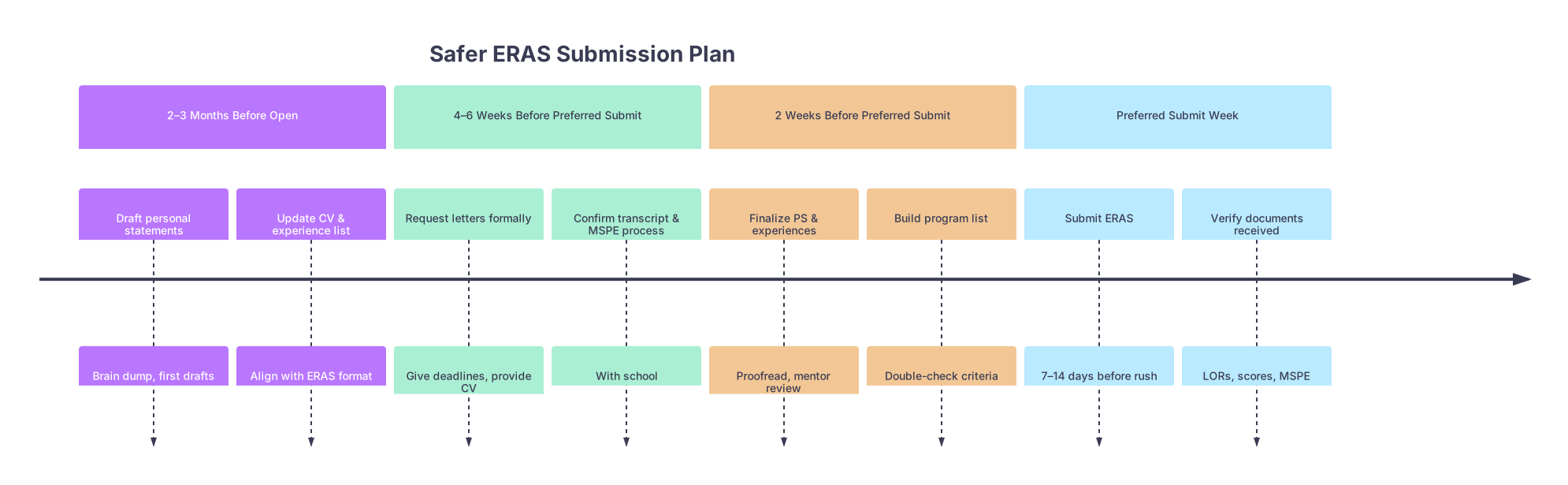
| Period | Event |
|---|---|
| 2–3 Months Before Open - Draft personal statements | Brain dump, first drafts |
| 2–3 Months Before Open - Update CV & experience list | Align with ERAS format |
| 4–6 Weeks Before Preferred Submit - Request letters formally | Give deadlines, provide CV |
| 4–6 Weeks Before Preferred Submit - Confirm transcript & MSPE process | With school |
| 2 Weeks Before Preferred Submit - Finalize PS & experiences | Proofread, mentor review |
| 2 Weeks Before Preferred Submit - Build program list | Double-check criteria |
| Preferred Submit Week - Submit ERAS | 7–14 days before rush |
| Preferred Submit Week - Verify documents received | LORs, scores, MSPE |
Notice that “actual ERAS deadline” is not even on this timeline. That’s the whole point.
So When Should You Submit ERAS?
This depends a bit on specialty and year-specific dates, but here’s the general principle:
- Submit as close to the opening transmission date as your application can be solid and complete enough.
- For most applicants, that’s within the first week of applications being transmitted to programs.
- If you can’t hit that, aim for the first 2–3 weeks, not the posted “final” deadline.
You don’t get bonus points for extreme earliness if your application is half-baked. But there is a very real penalty for being among the latest.
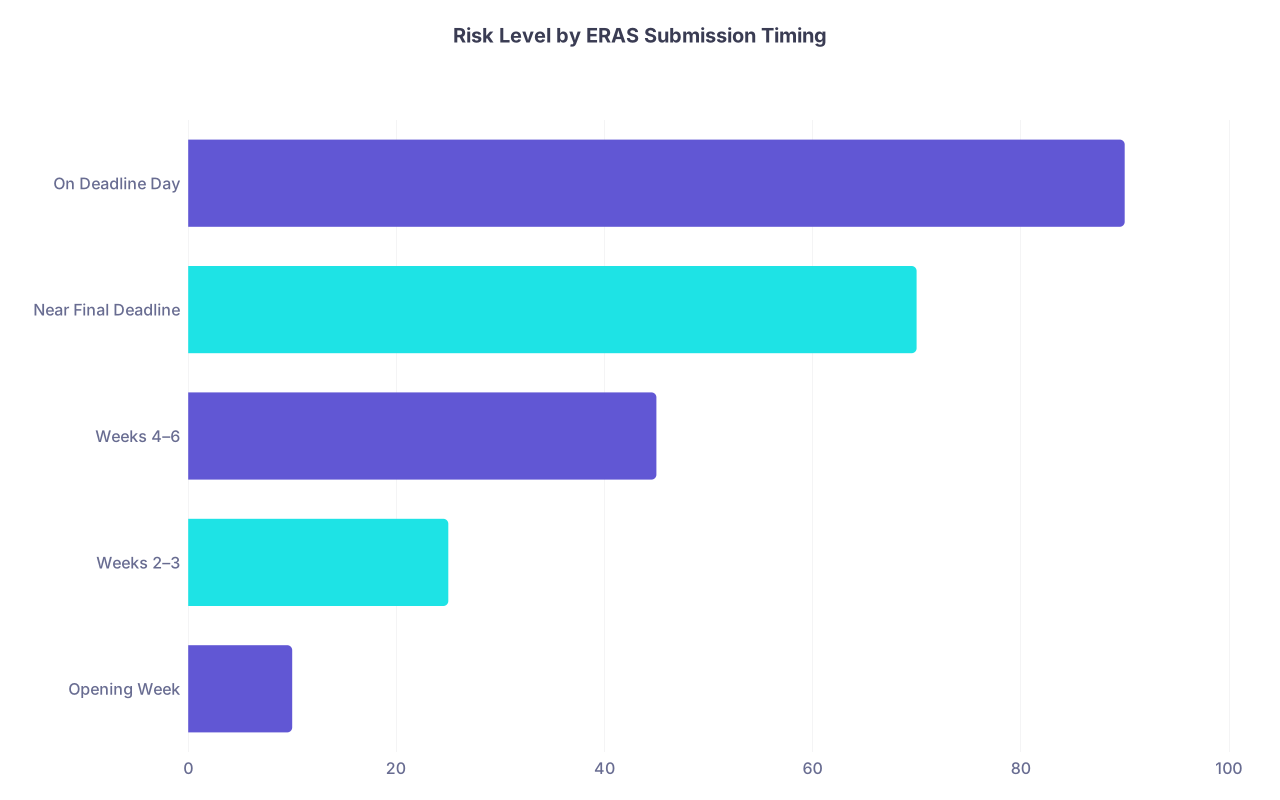
| Category | Value |
|---|---|
| Opening Week | 10 |
| Weeks 2–3 | 25 |
| Weeks 4–6 | 45 |
| Near Final Deadline | 70 |
| On Deadline Day | 90 |
Think of it this way:
- Opening week: Low technical + review risk
- Weeks 2–3: Still fine; moderate competition but healthy
- Weeks 4–6: Rising risk; some programs already “full”
- Near final deadline: High risk, fewer seats, more burnout
- Deadline day: You’re gambling with your entire year
How to Avoid Being the “Deadline Day” Applicant
If you’re reading this early in the cycle, good. You have options. If you’re already close to the line, you still have choices—just fewer.
Concrete steps to avoid the trap:
Set your own deadline at least 7–10 days before the official cutoff.
Treat the real one as a disaster backup only.Lock your personal statement and experience descriptions 1–2 weeks before your self-imposed deadline.
No major rewrites in the final 48 hours—only micro-edits.Confirm all technical pieces at least a week in advance:
- ERAS account access
- Payment method works
- USMLE/COMLEX transcript authorization is correct
- Your name matches across systems
Chase letters early and decisively.
If someone is dragging, have a backup. A solid letter from someone reliable beats a ghost letter from a big name.Do a full dry run of assignments 2–3 days before submitting.
Make sure:- Every program has a personal statement
- Correct LORs attached to each program
- No orphan programs without documents
Schedule your submission time like you would a major exam.
Not at midnight. Not between shifts. Sit down, rested, with 2–3 quiet hours.
The Bottom Line
If you remember nothing else, remember this:
- The ERAS deadline is not your deadline. It’s the system’s legal cut-off, not the optimal time to show up.
- Submitting on deadline day quietly cuts your chances through technical risk, review order, and perception—even if your scores and CV are great.
- A solid, slightly earlier application beats a “perfect” last-minute one almost every time.
Do not let laziness, wishful thinking, or one slow letter writer drag your entire season to the last day. You worked too hard to let timing—not talent—be the thing that takes you out.