
Hyper-competitive programs don’t just “review ERAS later.” They weaponize timing. And if you apply to them like you’re applying to a community IM program, you’ve already lost.
You’re not playing the same game anymore once you cross into the realm of top dermatology, plastics, ortho, ENT, neurosurgery, IR, rad onc, or the elite IM/EM/Anesthesia shops. The rules around ERAS submission timing shift in ways almost nobody explains to students honestly.
I’m going to tell you what actually happens behind the screens in September and October. The filters. The Zoom meetings. The “soft holds.” The pile you never escape if you’re late by a week.
You can decide how early you think early is. They already have their own definition.
The Myth: “As Long As You Submit By the Dean’s Letter, You’re Fine”
You’ve heard this line. Usually from people who haven’t sat in front of ERAS sorting 1,500 applications for 10 categorical spots.
Hyper-competitive programs function on a completely different clock.
Here’s the key distinction nobody spells out:
For normal programs, “on time” means “before they start sending interview invites.”
For hyper-competitive programs, “on time” means “before they build their initial review stack.”
Guess when that happens?
Not when you think.
| Category | Value |
|---|---|
| ERAS Release Day | 10 |
| End of Week 1 | 45 |
| End of Week 2 | 70 |
| End of Week 3 | 85 |
| End of Week 4 | 100 |
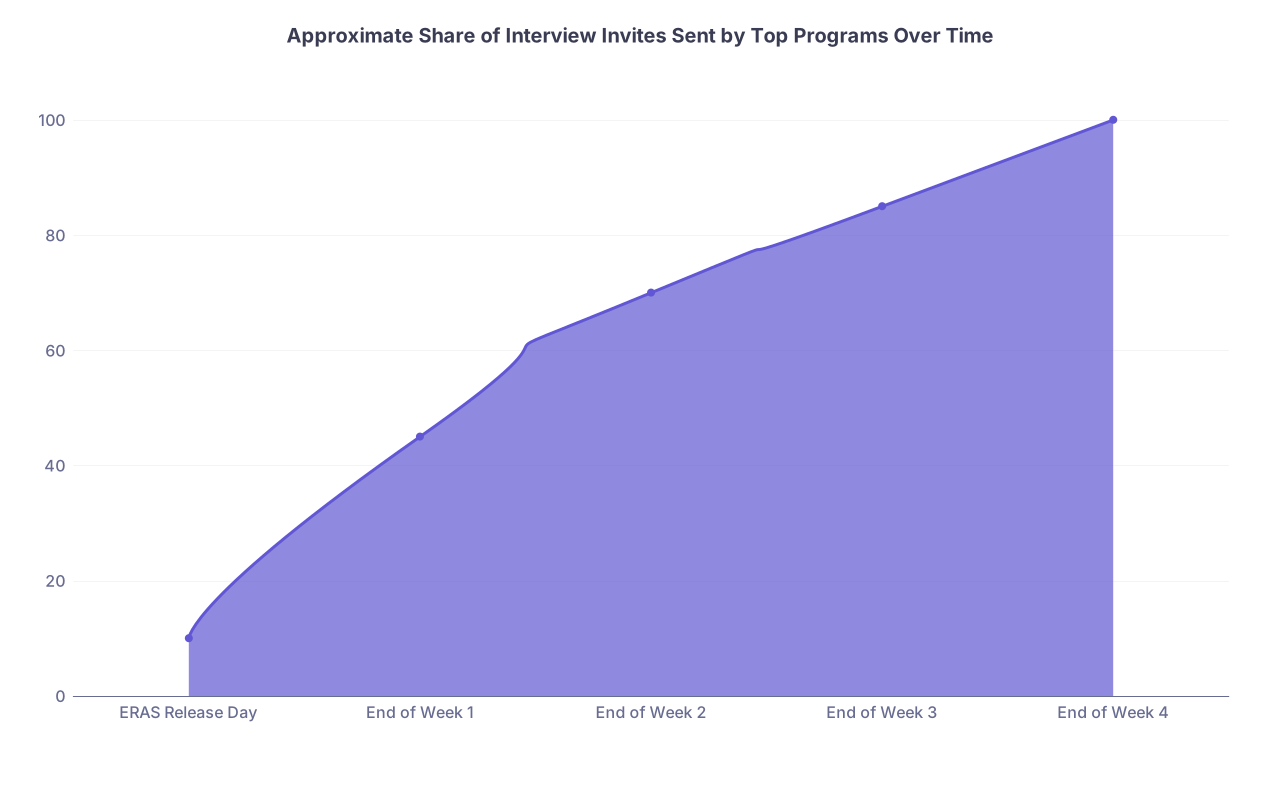
By the end of week two after ERAS opens to programs, many hyper-competitive programs have already sent half or more of their interview invites. They might say “we will continue to review applications,” but that’s largely PR.
There are exceptions, sure. But you do not build a strategy around exceptions.
What Actually Happens in the First 72 Hours
Let me walk you through the first three days inside a hyper-competitive program after ERAS applications drop.
I’ve seen this at big-name derm, ortho, integrated plastics, and elite IM programs. Slight variations, same core pattern.
Day 0 (ERAS opens to programs):
- Program Coordinator pulls the full list of applicants. The number is ugly. 800 for 4 spots. 1,200 for 8 spots. 1,600+ for IM at a name-brand.
- PD and a couple of faculty meet on Zoom or in the office and define their filters. These are usually frozen before anyone even looks at a single full application.
Common filters:
- US MD vs DO vs IMG (and yes, many hyper-competitive programs absolutely filter by this, even if they’re polite about it publicly)
- Step 1 (if it’s still numeric in your year) and Step 2 CK cutoffs
- Class rank / AOA / school reputation
- Whether all required letters and scores are in already
Then ERAS gets sorted.
What matters for you:
The initial filtered set is created in the first 24–72 hours. That group is what the PD and faculty will actually read.
Apply after that, or apply incomplete when that pull happens, and you rely on someone re-running filters later for the “latecomers.” Many do not. Or they do only once, briefly, and half-heartedly.
“Early” Has a Different Meaning for Hyper-Competitive Programs
For generic advice, people say: “Submit your ERAS on opening day or within a week; it doesn’t matter much.”
For hyper-competitive programs? The timing windows are tighter and more unforgiving.
Let’s define what “early” really looks like:
| Timing Label | When You Submit | How PDs Actually Treat You |
|---|---|---|
| Prime Early | By ERAS opening day | Fully in first-pass pool |
| Early | Within 3–4 days | Usually still first-pass |
| Borderline | Days 5–10 | Some programs, second-tier |
| Late for Hyper-Comp | After Day 10 | Rarely truly considered |
If you’re applying to derm at a place like Penn or UCSF, or integrated plastics at big academic centers, your effective deadline for a fully complete application is not “by October 1” or “before MSPE.” It’s basically: be locked and loaded on day 1.
And I mean complete:
- Personal statement final
- Programs selected
- Letters assigned
- Step 2 CK score in (for this era of pass/fail Step 1, this matters a lot more)
- No placeholder personal statement “to fix later”
The whole “I’ll submit and then swap in a better letter later” move? At hyper-competitive programs, by the time you “improve” your application, they’ve already made 70–80% of their interview decisions.
How Hyper-Competitive Programs Actually Screen
Here’s the part students usually don’t believe until someone on the inside tells them.
The majority of applications to hyper-competitive programs are never truly read. They are scanned, filtered, and triaged.
And timing interacts with this triage in a specific way.
Step 1: Filtered Pile vs. Everything Else
On day 1–3, they run filters and then pull a list of “meets basic metrics.” That might be:
- US MD
- Step 2 > 245 (varies by specialty / program)
- No red flags
- Complete application (letters in, no missing exams they care about)
That becomes the “core read pool.” This pool gets the real attention from faculty.
If you’re not in that initial filtered pool because:
- You were incomplete
- You hadn’t assigned a crucial letter
- Your Step 2 CK wasn’t back yet
- You submitted late
You’re now in the “maybe later if we have time” group. At busy, popular programs, that group is essentially invisible.
Step 2: Faculty Review Sprints
What you don’t see: PDs and faculty are doing short reading sprints early on. They get lists of 50–200 applicants at a time with all “green checkboxes” (filters met, complete), and they marathon through them over a few days.
Typical behavior:
- A derm PD might personally glance at every Step 2 > 250, AOA, heavy-research applicant in the first week.
- Ortho faculty will skim all the home institution and “feeder school” applicants early and flag their top 30–40 each.
- Top IM programs will have faculty assigned “pods” of applications (e.g., “you take all US MD applicants from Midwest schools”).
Those “flagged early” people are disproportionately the ones who get first-round invites.
If your app appears after those lists have been constructed, you’re not in any pod or “favorited” list. You’re just another late file.
Step 3: Rolling Invite Waves – But Front-Loaded
Hyper-competitive programs don’t send every invite on the same day. But the first and second waves often go out only 7–14 days after ERAS opens.
Inside those first waves, who dominates?
- Early, complete applicants from target schools
- Early, complete applicants with strong scores and research
- Home rotators and known quantities
Yes, there might be a “second look” wave later, especially if yield is weird. But that’s often a salvage operation, not the main show.
How Submission Timing Interacts With Strength of Application
Now the nuance. Timing doesn’t erase major weaknesses. But in hyper-competitive programs, timing can be the difference between:
- Being seen as “strong but slightly below our typical bar — still intrigues me”
- Versus never being seriously looked at
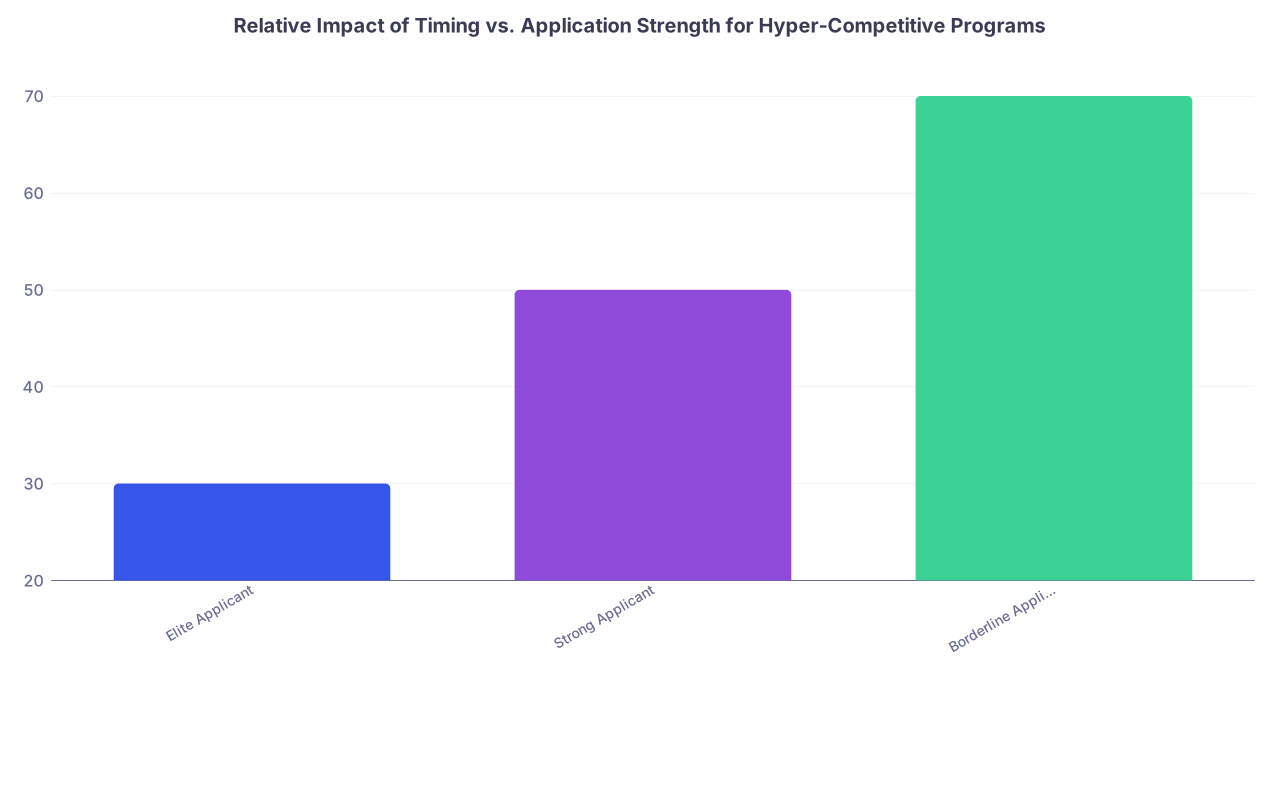
Here’s how program directors really think about timing versus applicant strength.
| Category | Value |
|---|---|
| Elite Applicant | 30 |
| Strong Applicant | 50 |
| Borderline Applicant | 70 |
Interpretation, from the PD’s perspective:
- Elite profile (250+ Step 2, top med school, publications, honors): Timing helps, but they’ll probably look at you even if you’re slightly later. You’re on their radar no matter what. You can get away with being “early-ish,” not perfect-day-1.
- Strong but not elite (solid scores, decent research, good letters): Timing is massive. Submitting in the first 2–3 days can be the difference between invite vs no invite. You’re not such an obvious “yes” that you get rescued from the late pile.
- Borderline for that tier (slightly below their usual step range, or not from a typical feeder school): If you’re late, you’re invisible. If you’re extremely early and complete, you might get a 5-second benefit of the doubt and a real look.
Bottom line: the less obviously elite your application is, the more timing matters.
The MSPE Myth and Why It Matters Less for Hyper-Competitive Programs
Old guard advice: “Programs wait for the MSPE (Dean’s Letter) before serious review.”
That’s historically more true for mid-tier or primary-care-heavy programs. At the top, many are already building their preference lists long before MSPE day.
Here’s what actually happens with hyper-competitive programs:
- They absolutely know the MSPE will not radically change how they view the 250+ with 3 derm pubs and strong letters from derm faculty they already know.
- They might revisit a very small number of uncertain applicants after the MSPE drops (concern about professionalism, grade patterns, etc.).
- For the bulk of their stack? The MSPE is a check box. A courtesy read. Not a decision-maker.
I’ve been in ranking meetings where faculty literally skim MSPEs on a second monitor while saying things like, “Anything weird? No? Okay, leave them on the list.”
If you wait to submit “around MSPE time,” at a hyper-competitive program you’re already late to the party.
Think of MSPE timing as relevant for:
- Flag detection
- Mild tie-breakers
- Context for weird transcripts
Not as the starting pistol.
Specialty-Specific Timing Differences: Hyper-Competitive vs “Normal”
Each specialty plays by slightly different timing rules. Hyper-competitive ones front-load harder, and they’re more brutal about late files.
Here’s how things tend to break down.
| Specialty Type | Timing Sensitivity | Behavior Pattern |
|---|---|---|
| Hyper-competitive surgical (plastics, ortho, ENT, NSGY) | Extreme | Heavy early filtering, front-loaded invites |
| Hyper-competitive lifestyle (derm, rad onc, IR) | Extreme | Small programs, high volume, early sifting |
| Elite IM / Anesthesia / EM | High | Big volume, structured early review |
| Mid-tier categorical IM/FM/Peds | Moderate | More rolling, less brutal early bias |
| Community / smaller programs | Low–Moderate | Review continues longer, more flexible |
If you’re targeting:
- Derm, plastics, ortho, ENT, neurosurgery, IR, rad onc: treat “opening day submission” as mandatory unless you have a truly elite application.
- Top 10–20 IM / Anesthesia / EM at brand-name places: you still want to be in that first week max.
- More standard primary care programs or community-heavy fields: you have more leeway. Still better early, but you won’t be discarded just for being a week or two later.
Incomplete Applications: The Silent Killer
This is the part that sinks more good candidates than any Step score ever did.
Hyper-competitive programs often do an initial filter on complete vs incomplete.
Common mistakes that quietly destroy early timing:
- Submitting on opening day but with 1 or 2 key letters missing, assuming “they’ll just add in later.”
At some places, that means you never make it past the first filter because your app wasn’t in the “completed” pool that got actually read. - Waiting on Step 2 CK score, especially post–Step 1 pass/fail, and submitting “to get in the system” without it.
For many hyper-competitive programs now, Step 2 is a hard filter. No score = not in the main pile. - Updating your personal statement later. The one that gets cached on day 1 is the one they read in the sprint. They don’t circle back just to see if your prose improved.
From the inside, the coordinator’s mentality is simple:
“I have 1,200 applications. I’m going to send the PD only the ones that are complete and meet preset filters. I’m not re-running this every day.”
If your “early” submission wasn’t complete, it wasn’t really early.
Timing Strategy If You’re Aiming for Hyper-Competitive Programs
Let’s talk tactics. Not generic platitudes — the actual sequencing that gives you a real shot.
1. Lock Your Application Before ERAS Even Opens
If you’re targeting hyper-competitive programs, your personal statement, experiences, and program list should be frozen at least 1–2 weeks before ERAS submission day.
Why?
Because the week before ERAS opens, you’re not unique. Everyone is panicking and editing. PDs don’t care about your last-minute fine-tuning. They care that your app hits their queue polished and complete on day one.
2. Step 2 CK Timing: Do Not Gamble
For hyper-competitive specialties in the current era, Step 2 CK is the de facto numeric gatekeeper.
If you take Step 2 too late and your score isn’t back by the time they start reviewing, your application gets one of two fates:
- Ignored during early waves
- Put in a low-priority pile “to revisit once all scores are in,” which may never realistically happen
You’re far better off:
- Taking Step 2 early enough that your score is posted by ERAS opening
- Or, if you know it’s going to be borderline, still having a definitive score rather than a mysterious “pending”
Hyper-competitive programs don’t like unknown variables.
3. Letters of Recommendation: Pre-Commit Deadlines
Here’s something I’ve heard PDs say in real life:
“If the student doesn’t have their letter from us by ERAS opening day, it’s rarely our top applicant anyway.”
Harsh but telling.
Your strategy:
- Give letter writers a hard internal deadline 2–3 weeks before ERAS opens.
- Harass politely but consistently. Remind them that hyper-competitive programs treat incomplete apps like non-apps.
- If a letter is clearly not coming in time and that writer isn’t a “big name” for your target specialty, move on and lock the others.
A “perfect” letter that arrives 3 weeks late is functionally worse than a solid letter that’s there on day 1.
Red Flags, Recovery, and Late Submissions: Any Hope?
Yes, there’s nuance. A few scenarios where timing interacts with other factors in interesting ways:
Home program / Sub-I / Known quantity:
If you’re well known to a hyper-competitive department because you rotated there, did research, or they know your PD, you have slightly more leeway. They may manually look for your file and advocate for you even if you were a bit later. But that’s relationship-based, not policy-based.Legit extenuating circumstances:
Serious illness, family emergency, major institutional delay — sometimes a PD will personally override the timing factor if they know the story and someone advocates for you. But you can’t count on that at scale.Extremely elite applicant applying a few days “late-ish”:
If you’re truly a superstar on paper (think multiple first-author specialty publications, insane scores, elite med school), faculties will occasionally go back and pull your app even if you submitted around day 7–10. But they find you because your numbers jump off the filter lists, not because they’re generous.
For the average strong but not unicorn applicant? Late and incomplete are almost always fatal at hyper-competitive programs. Not in a moral sense. In a practical, bandwidth sense.
The Real Takeaway About Timing for Hyper-Competitive Programs
Here’s the unvarnished reality:
Hyper-competitive programs are not looking for reasons to “keep you in the pool.” They’re looking for ways to shrink 1,500 applications down to 200 read-worthy ones as fast as possible.
Timing is one of their bluntest tools.
Apply early. Apply complete. Plan so you’re fully locked and loaded on day one, not “early-ish in September.” That’s how you get into the stack that actually gets read — and therefore into the pool that actually gets interviews.
Because years from now, you won’t remember the exact date you clicked “submit” on ERAS.
You’ll remember whether you treated this process like a casual formality, or like the one narrow window when the right timing could open doors that might never open again.