
The biggest reason strong applicants quietly tank their Match chances isn’t a bad Step score or a weak letter. It’s a “perfect” ERAS application submitted too late.
You’re not losing to smarter people. You’re losing to people who hit “submit” while you were still wordsmithing your third bullet point.
Let me be blunt: over-editing in September is one of the most avoidable, most damaging mistakes in the entire residency application process. And almost nobody thinks they’re the one doing it.
Let’s fix that.
Why Late ERAS Submission Hurts You More Than You Think
Programs don’t sit around politely waiting for everyone to apply and then review all ERAS files at once like a college committee. That fantasy hurts applicants every single year.
Here’s what actually happens:
- Programs start downloading applications the moment ERAS opens for programs.
- Coordinators and PDs skim early applications first.
- Interview invites start going out much earlier than applicants realize.
- Once interview spots are mostly filled, late applications get a much colder look.
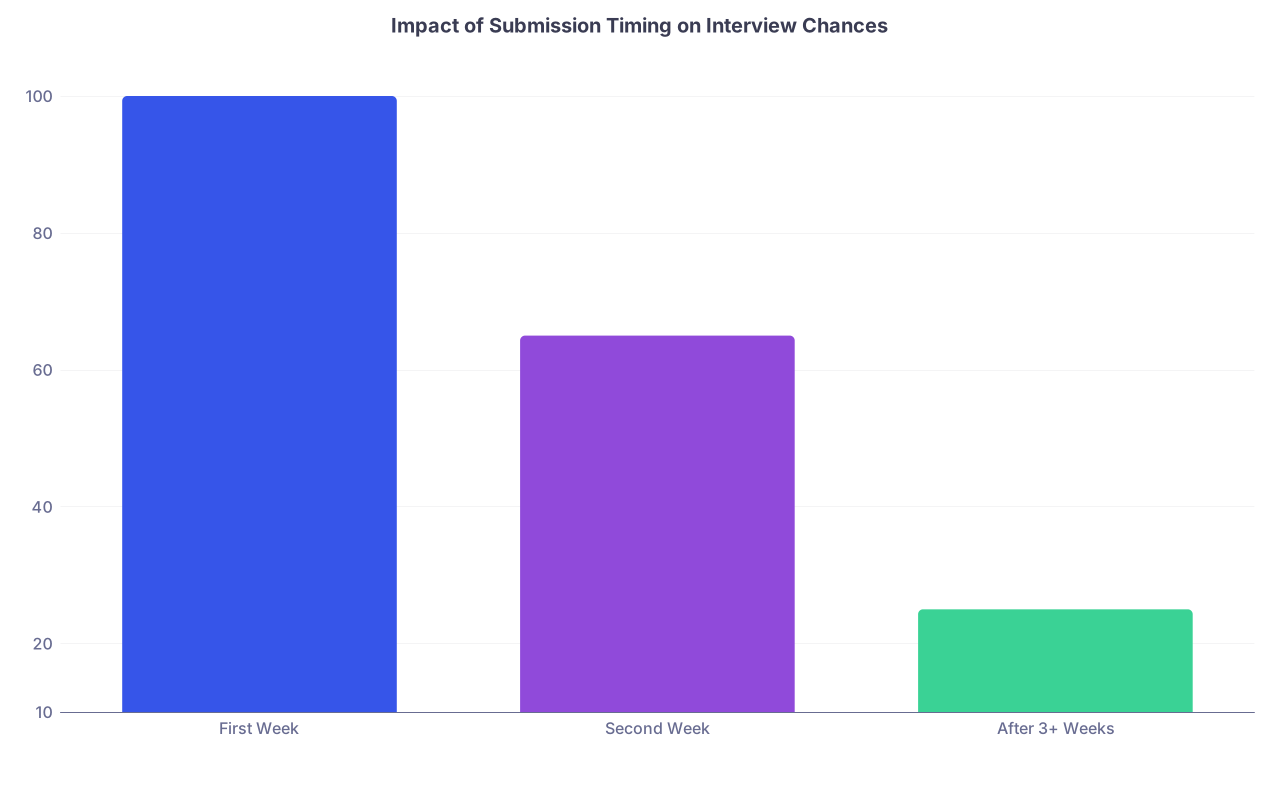
| Category | Value |
|---|---|
| First Week | 100 |
| Second Week | 65 |
| After 3+ Weeks | 25 |
Are there exceptions? Sure. Are you planning your career around exceptions? I hope not.
The earlier your complete ERAS reaches programs (application + MSPE/letters when they release), the more:
- Eyes are available to actually read it
- Interview slots are still open
- Benefit of the doubt you’ll get as they’re still building their list
If you submit:
- First 1–3 days after ERAS opens to programs → You’re in the first wave. Strong position.
- Week 2 → Still competitive, but not ideal for competitive specialties.
- After that → You’re voluntarily playing on “hard mode.”
The tragedy is that most people who submit late didn’t start late. They suffocated in September editing.
The Hidden Trap: “Just One More Round of Edits”
Over-editing doesn’t look like a mistake while you’re doing it. It looks like “being thorough.”
Here’s how I’ve seen this play out way too many times:
- You have a solid draft by late August.
- September hits, and now:
- Friend A suggests a different angle for your personal statement.
- Mentor B wants you to reorder bullets in every experience.
- Attending C says, “You really need a theme that ties your whole app together.”
- You start rewriting:
- Personal statement v6 → v9 → v12
- Experiences reordered three times
- Every word debated like a hostage negotiation
Suddenly it’s:
- September 17: “I just want one more person to look at it.”
- September 22: “I’m almost there, I just need to tighten a few things.”
- September 27: “I can’t submit yet; what if there’s a typo?”
Meanwhile, your classmates with “good enough” applications:
- Submitted September 5–7
- Already got their first interview invites
- Are sleeping at night
The Psychology That Wrecks Your Timeline
Let’s call out the mental traps:
Perfectionism
“If my ERAS isn’t flawless, I won’t match.”
No. Most people match with imperfect applications. They do not match with invisible ones.Comparison paralysis
You see someone’s PS on Reddit / Google Drive and now you’re convinced yours is trash.
So you keep rewriting instead of finalizing.Fear-based procrastination
Submitting feels like locking in your worth as an applicant. So you stall. You tell yourself you’re ‘editing’ when you’re really just avoiding.
None of this makes your application meaningfully stronger after a certain point. It just makes it later.
What “Over-Editing in September” Actually Looks Like
You might think, “That’s not me; I only edited a normal amount.” Let me be clear on what over-editing actually is.
If you’re doing any of this in September, you’re heading into danger:
- Rewriting your entire personal statement from scratch after August 31
- Changing the theme/story of your PS multiple times
- Constantly rearranging the order of your experiences
- Tweaking bullet wording daily (“managed” vs “coordinated” vs “led”)
- Waiting to submit until 3+ different people have given feedback on every section
- Holding your application “just a few more days” after it’s already 95% solid

Here’s the piece applicants misunderstand:
Programs do not care that your third bullet in your second research entry isn’t poetry. They care that your:
- Application is there early
- Story is coherent
- Red flags are addressed
- Scores/grades/letters are competitive for them
Minor wordsmithing in late September does nothing for those four pillars. Nothing.
The Critical Timeline You Shouldn’t Ignore
Let’s be concrete. Assuming a typical ERAS schedule:
- Early June – ERAS opens for applicants to start working
- Mid-late September – ERAS opens for programs to start downloading applications
- Late October – MSPE (Dean’s Letter) releases
Most specialties start inviting interviews long before MSPE releases, based on:
- Your ERAS content
- Your letters already in the system
- Your scores
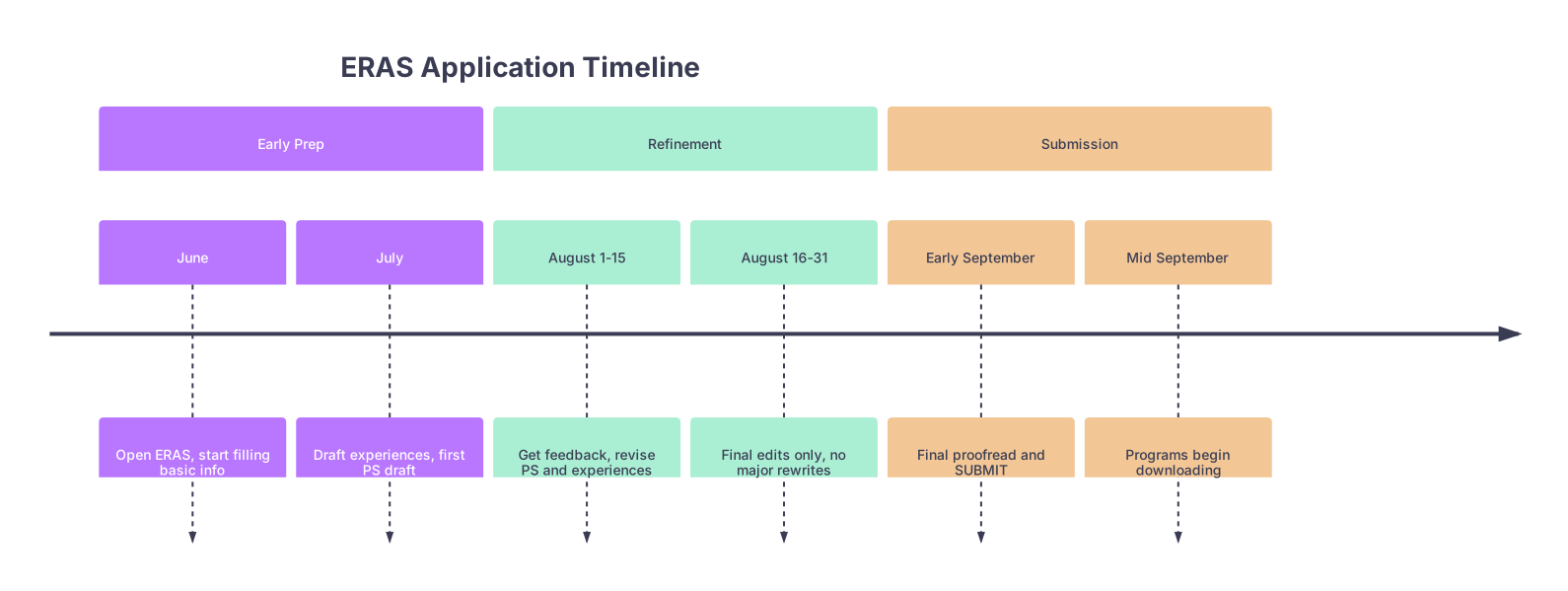
| Period | Event |
|---|---|
| Early Prep - June | Open ERAS, start filling basic info |
| Early Prep - July | Draft experiences, first PS draft |
| Refinement - August 1-15 | Get feedback, revise PS and experiences |
| Refinement - August 16-31 | Final edits only, no major rewrites |
| Submission - Early September | Final proofread and SUBMIT |
| Submission - Mid September | Programs begin downloading |
Here’s the mistake: people keep treating early September like “drafting season” instead of “submit season.”
By the time programs can download, you want:
- Application already submitted
- Letters uploaded (or at least requested early)
- You just…waiting. Not frantically editing.
False Beliefs That Keep You Editing Instead of Submitting
These are the lies I see applicants tell themselves every year.
1. “Programs don’t look at apps until the MSPE is out.”
Wrong. Plenty of programs start reviewing and sending invites long before MSPE release. Especially in:
- Internal Medicine
- General Surgery
- Pediatrics
- Family Medicine
MSPE might refine their ranking later, but it doesn’t need to be there for an interview invite.
2. “Submitting one or two weeks later doesn’t really matter.”
It does.
| Submission Timeframe | Competitiveness Impact | Typical PD View |
|---|---|---|
| First 1–3 days | Ideal | 'Serious, organized' |
| Within first week | Strong | 'On top of things' |
| End of second week | Acceptable | 'Fine, but later wave' |
| After 3 weeks or later | Risky | 'Late or disorganized' |
Is a September 28 submission an automatic death sentence? No. But if you’re an average or slightly above-average applicant, you can’t afford self-inflicted handicaps.
3. “It’s better to submit perfect than early.”
This is the most dangerous one.
You are vastly overestimating the difference between:
- A B+ application and an A– application
and - An A– application submitted early vs late
Programs see hundreds or thousands of applications. They will not notice the two synonyms you debated for an hour. They will notice if you are late in their download queue.
Signs You’re Editing Productively vs Self-Sabotaging
Not all editing is bad. The trick is knowing when to stop.
Productive Editing (Good)
This usually happens in July and August:
- Fixing obvious grammar and spelling
- Cutting rambling paragraphs
- Improving clarity and structure of your experiences
- Getting 1–2 trusted mentors to review your personal statement
- Making sure your story and specialty choice are aligned
This has a clear endpoint.
Self-Sabotaging Editing (Bad)
This usually happens in September, when you should be finalizing:
- Second-guessing your entire specialty choice based on one person’s comment
- Rewriting your PS because “someone from Reddit said I need a hook”
- Changing all your bullets to fit some template you just saw yesterday
- Panicking about font spacing or whether you said “passionate” too many times
- Holding the whole application because one letter writer is late, instead of submitting and adding the letter later
If your edits are driven by anxiety more than actual content improvement, it’s time to stop.
How to Protect Yourself From Over-Editing in September
You avoid this mistake now, not “when September comes.” You set guardrails in advance.
1. Set a Non-Negotiable Personal Deadline
Decide now:
- “I will submit my ERAS between [Date Range] and I will not push this unless something truly major changes (like an unexpected Step score release).”
For most people, that should be:
- Submission goal: Within the first 1–3 days after ERAS allows you to submit
- Latest acceptable: Within the first week
Write it down. Tell a friend. Tell your advisor. Make it real.
2. Limit the Number of Editors
Too many cooks destroy ERAS.
Pick:
- 1–2 people for your personal statement
(e.g., one attending in your specialty + one mentor who actually knows you) - 1 person for a final proofread of the whole application
- That’s it.
If you’re sending your PS to 5+ people, you are not “being thorough.” You are signing up for conflicting advice and last-minute rewrites.

3. Establish an Editing Cutoff Rule
You need a rule for yourself like:
- “After August 31, I change only:
- Typos
- Clear grammar issues
- Factual errors (dates, titles, etc.)
- Major red-flag clarifications if advised by someone I trust”
No structural rewrites. No changing themes. No reinventing your entire narrative in September unless a mentor spots a serious problem.
4. Separate “Drafting” Time From “Submission” Week
If you’re still drafting during submission week, you’re behind.
Aim for:
- By August 15
- Personal statement: at least v2–3, close to final
- Experiences: entered and reasonably polished
- August 15–31
- Get final feedback
- Implement targeted edits
- Fix formatting and typos
- First week of submission
- Spot-check for errors
- Confirm letters loaded/assigned
- Submit
The goal: by the time programs can download, your application has been sitting safely in the system for days, not on your laptop “almost done.”
Special Note for Competitive Specialties
If you’re going into:
- Dermatology
- Orthopedic Surgery
- ENT
- Plastic Surgery
- Neurosurgery
- Integrated Vascular / CT
- Certain ROAD specialties (especially at top programs)
You can’t play games with timing. These programs:
- Get flooded with qualified applicants
- Pre-screen hard
- Often start offering interviews early
For you, a late ERAS isn’t “suboptimal.” It’s often fatal.
I’ve seen objectively strong applicants (260+ Step 2, multiple pubs, AOA) submit late and get a fraction of the interviews weaker early submitters got. Same year. Same programs.
And then they spend months thinking they misjudged their competitiveness. They didn’t. They misjudged the calendar.
When It Is Reasonable to Delay Submission Briefly
Let’s be adults—there are a few legitimate reasons to delay a little:
- You just learned your Step 2 score is significantly different than expected and need to adjust strategy.
- A mentor found a major red flag in your PS (e.g., unclear explanation of a leave of absence).
- You discover factual inconsistencies (wrong dates, positions, etc.) that require a careful pass.
But even then:
- We’re talking days, not weeks.
- The bar should be high. “I want it to sound better” doesn’t qualify.
The One Thing You Absolutely Should Not Do
Do not sit on a nearly complete application in late September because you’re nervous.
If your ERAS is:
- 95% done
- Factually accurate
- Free of glaring typos (you’ve proofread it)
- Cohesive enough that a reasonable mentor said, “This looks good”
Submit.
Do not:
- Hold it waiting for one more opinion from someone who’s “busy but promised to look.”
- Rewrite your PS because you saw some “ultimate template” on a blog yesterday.
- Try to “game the system” by timing submission to some imaginary perfect day.
Programs can’t consider what they can’t see.
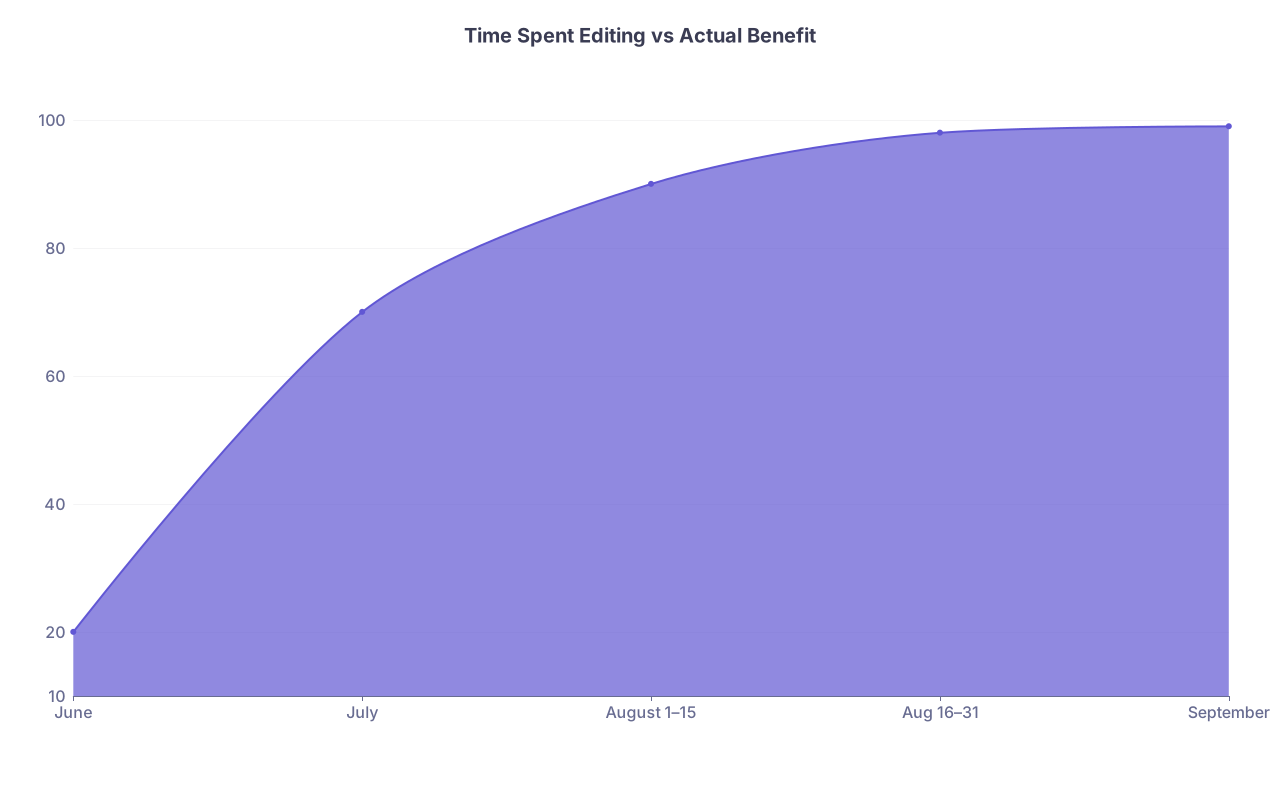
| Category | Value |
|---|---|
| June | 20 |
| July | 70 |
| August 1–15 | 90 |
| Aug 16–31 | 98 |
| September | 99 |
See that last jump? Hours of extra editing in September typically buy you maybe 1–2% more polish. And cost you far more in timing.
Quick Checklist: Are You About to Over-Edit?
Ask yourself these questions honestly:
- Have I already had at least one competent person in my specialty read my PS and say it’s good?
- Am I mainly changing style rather than substance?
- Am I delaying submission because I’m scared, not because of a concrete problem?
- Is there any evidence that this extra editing will change my interview chances more than submitting earlier?
If you’re mostly answering “yes” to those—you’re not improving your application anymore. You’re just soothing your anxiety. At a cost.
FAQ (Exactly 4 Questions)
1. If I submit ERAS on the first day it opens to applicants, is that too early? Should I wait?
Submitting on the first day applicants are allowed to submit (before programs can download) is fine, as long as your application is truly ready. There’s no bonus for waiting once you’re done. The key is: submit before programs start downloading, not after. What you shouldn’t do is rush a sloppy application just to hit day one; it’s better to be clean and early in the first download window than absurdly early with obvious errors.
2. What if one of my letters isn’t in yet—should I wait to submit until it’s uploaded?
Do not hold your entire ERAS hostage for one lagging letter. Submit your application on time and assign the letters you already have. When the last letter arrives, you can assign it afterward. Programs will see new letters as they’re added. A late letter is less harmful than a late application. The only exception is if you literally have zero letters in your core specialty—then you may need a short, targeted delay while you aggressively chase that writer.
3. How many drafts of my personal statement are “normal” before it’s over-editing?
If you’re going beyond 5–6 meaningful drafts, you’re probably not making it better anymore—just different. Most strong statements are built like this: rough draft, structural revision, content polish, mentor feedback, final cleanup. After that, edits tend to be cosmetic. If you’re on version 14 and still not happy, the problem isn’t the statement; it’s perfectionism and anxiety driving endless tweaks.
4. I submitted in late September already—did I ruin my chances? What should I do now?
No, you didn’t automatically ruin everything, especially in less competitive specialties or if your application is strong. But you did remove one advantage you could’ve had. At this point, the solution is not to spiral. Instead: apply broadly, respond to interview invites instantly, be flexible with dates, and consider signaling programs (formal or informal) where appropriate. Learn the lesson now: if you need a reapplication year or a fellowship later, you won’t repeat the “late submission by perfectionism” mistake again.
Takeaway: Don’t let “perfect” in September quietly murder “submitted on time.”
Lock your timeline early, cap your editors, and accept that a strong, on-time application beats a “perfect” late one almost every time.