The Unspoken Cutoff: When PDs Stop Seriously Reading New ERAS
It’s 11:37 p.m. on a random Tuesday in October.
You just hit “submit” on your ERAS application, three weeks after the opening date. Your friends submitted on day one. You tell yourself, “It’s fine. Programs review applications all season. If they like me, they’ll read it.”
Let me tell you what actually happens on the other side of that screen.
By the time your ERAS pings into the inbox of a mid-tier internal medicine program, the PD has already reviewed 400+ applications, sent 80% of their planned interview invites, and handed the rest of the pile to the APD and chief residents with: “Skim for any absolute standouts or weirdly strong locals. Otherwise, just flag red flags.”
That’s the “unspoken cutoff” no one writes in official policies or NRMP guides. Not when ERAS opens. Not when “deadlines” hit. The real cutoff is when programs mentally stop treating new applications as equal.
And you need to understand exactly when that happens and how different specialties handle it.
What PDs Actually Do When ERAS Drops
I’ll be blunt: the day ERAS opens, most PDs are not “carefully reading” your application. They’re triaging a flood.
Internal email you never see, from a PD to the coordinator on day one:
“Total apps? Filter by Step 2 > 240 and no fails. Send me that list first. I want 60% of interviews out by Friday.”
This is the part no one says to students because it sounds awful. But it’s the truth.
Here’s the internal cycle:
Wave 1: Early Pool (Week 1–2)
These are the applications that matter the most. Almost every program has some version of:- Initial filters (scores, fails, visa, graduation year, sometimes school list)
- PD/APD reviews early pool
- 50–70% of interview slots are filled out of this group
Programs love early applicants. It makes planning easy. They can send out their first big batch of invites and feel “ahead.”
Wave 2: Normal Latecomers (Week 3–4)
Still in the game, but now you’re being compared against the early pool that already got the easy yeses. You don’t need to be superhuman, but you do need something sharper: higher scores, stronger letters, home rotation, geographic fit, or a hook (research, leadership, niche interest).Wave 3: Background Noise (After ~4 weeks)
At this point, most mid-to-upper tier programs have sent the majority of invites. New applications are “checked,” but they’re not read the same way. They’ll get:- Quick scan for obvious standouts
- Maybe flagged if you’re from their med school, from their region, or personally known
- Otherwise, parked in the “if we need back-ups” pile
No, they’re not literally deleting late applications. But the seriousness level changes. Drastically.
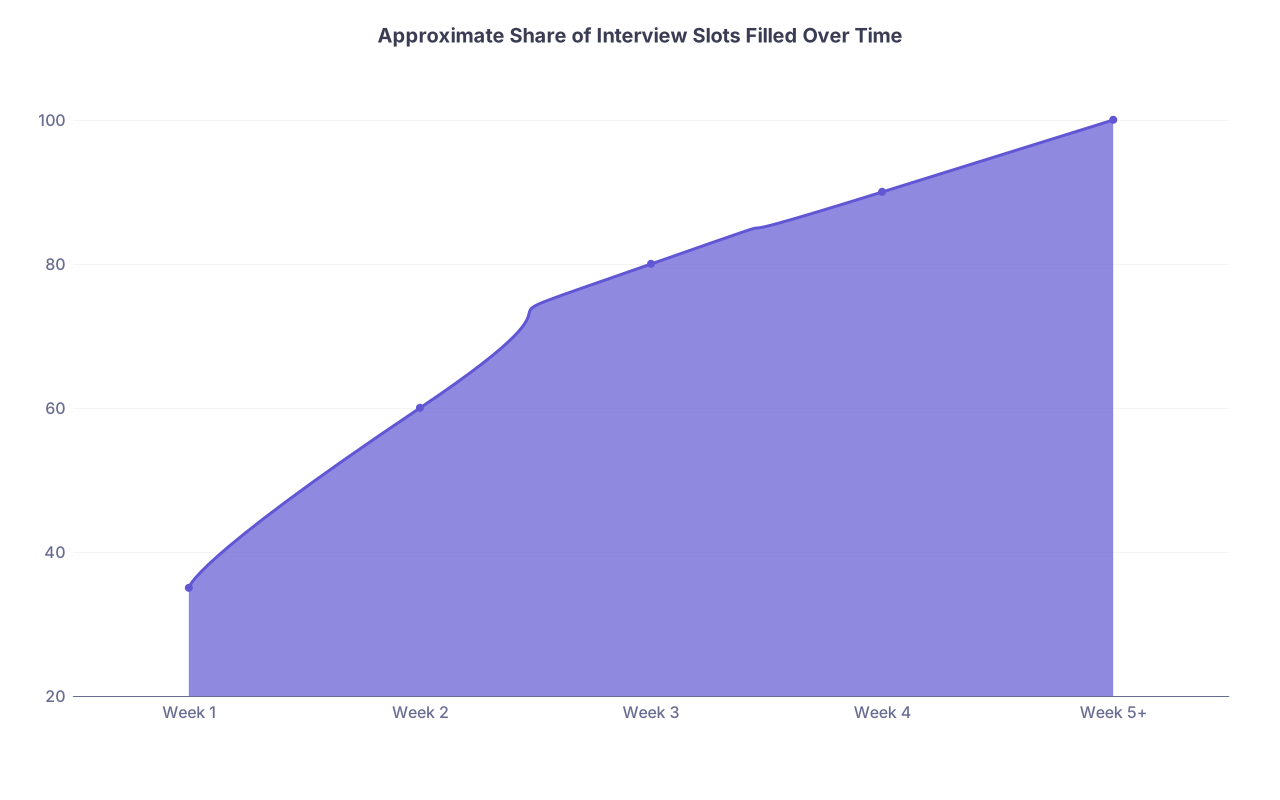
To see the pattern more clearly:
| Category | Value |
|---|---|
| Week 1 | 35 |
| Week 2 | 60 |
| Week 3 | 80 |
| Week 4 | 90 |
| Week 5+ | 100 |
Those numbers vary by specialty and competitiveness, but the shape is the same almost everywhere.
The Real “Cutoff”: It’s Not a Date, It’s a Mindset
Program directors will never email you, “By October 10, we stop seriously considering new apps.”
But internally, they absolutely act like there’s a soft deadline.
In practice, the unspoken cutoff is when:
- The PD has filled at least 70–80% of interview slots
- Their calendar is basically full through January
- They feel they have enough “good” candidates and are now just fine-tuning
After that point, new applications must clear a much higher bar.
Let’s break it down by category, because this is where students get burned by naive advice like “ERAS deadline is in December, you’re fine.”
Highly Competitive Specialties (Derm, Ortho, Plastics, ENT, Neurosurg, Rad Onc, etc.)
These are brutal. You already know that.
What you might not know:
- Many programs in these specialties finish building their interview lists out of the first 1–2 weeks of applications.
- If you submit 3–4 weeks late, you are functionally applying in a completely different tier.
One derm PD’s exact line to a chief last year:
“Anything coming in after the first two weeks is either people who didn’t plan properly or people hoping for a miracle. If they’re not an obvious superstar on page one, I’m not pulling another file.”
Do late apps occasionally get interviews? Yes. Usually because:
- They’re from the home institution
- They’re known to faculty
- They rotated there as a sub-I
- Their metrics are so off-the-charts the PD feels compelled to look
Everyone else? Window dressing.
Moderately Competitive (EM, Anesthesia, Gen Surg, OB/GYN, Cards fellowship level programs in IM, etc.)
These fields pretend to be more forgiving. They aren’t, really.
Pattern I’ve seen over and over:
- First 2 weeks: majority of interview offers decided
- Weeks 3–4: still real consideration, especially for regional fits or slightly non-traditional candidates
- After week 4: you’re basically hunting for cancellations, expansions of interview numbers, or a PD who is disorganized
In several surgery programs I know, the PD literally sends an email around week 3:
“We’re essentially full. Keep an eye out for any absolute standouts in new apps, but otherwise we’re good.”
“Absolute standout” is code for:
- 260+ score equivalent
- Top-tier school plus strong letters
- Major research or clear niche that fits program interests
- Protected categories (veterans, special institutional ties, etc.)
Less Competitive Fields (FM, Psych in non-hot markets, Peds in many regions, community IM)
These are more forgiving, but even here there is a real soft cutoff.
What actually happens:
- Community FM or IM programs may keep reviewing “seriously” for longer because they need to fill more slots and often get a more heterogeneous pool.
- But the best interview slots—and frankly, the higher enthusiasm—still go to earlier applicants.
One FM PD told me flat-out:
“We flag late apps as ‘maybe’ but we’re much more cautious. Late often equals disorganized or dual applying or they used us as backup. We can smell that.”
So you don’t just fight timing. You fight the story your timing tells.
How Different Programs Quietly Filter Late Applications
Nobody on a website will tell you this. But in meetings and selection committees, they do it openly.
Here’s how late apps get mentally sorted at a lot of places:
| Application Timing | Internal Attitude | Typical Review Style |
|---|---|---|
| Week 1–2 (Earliest) | Prime pool | Full review, generous |
| Week 3–4 (On time) | Still solid | Full but more selective |
| Week 5–6 (Late) | Secondary/back-up | Quick scan for standouts |
| Week 7+ (Very late) | Desperate or backup | Rare exceptions only |
| Just before “deadline” | Mostly ignored unless known | Checked for red flags |
You might think this is unfair. PDs don’t care. They care about filling their class with people who will not be disasters.
And one of their proxies—right or wrong—is: who had their act together to hit submit early?
What “Seriously Reading” Actually Means
There’s a myth that “programs carefully review every application.”
No. They don’t. They can’t.
Typical mid-sized IM program: 3–5 categorical spots, 1–2 prelim spots. Applications? 2,000–4,000.
Do the math.
Here’s how “serious reading” and “late skim” actually differ in practice.
Serious review (early apps):
- Scores checked in context (low Step 1 but strong upward Step 2? That’s a plus, not auto-cut).
- Personal statement actually read, at least enough to get a sense of you.
- Letters scanned for specific praise, not just generic “hard-working.”
- Research/activities looked at for real fit with the program.
- Leadership, work history, gaps examined and often discussed in committee.
Late skim (after cutoff mindset sets in):
- Step scores: glance.
- Red flags: search. Fail, remediation, gap, professionalism issues, weird graduation year.
- If no obvious hook in the first 10–15 seconds? Next.
I’ve literally watched APDs go:
“Late applicant, no connection, 220, middle-of-the-road school, generic psych interest. Pass.”
That’s the read. Ten seconds.
How Much Does a Few Days vs Weeks Actually Matter?
Students always ask, “Is submitting on day 1 vs day 5 a big deal?”
No. That’s noise.
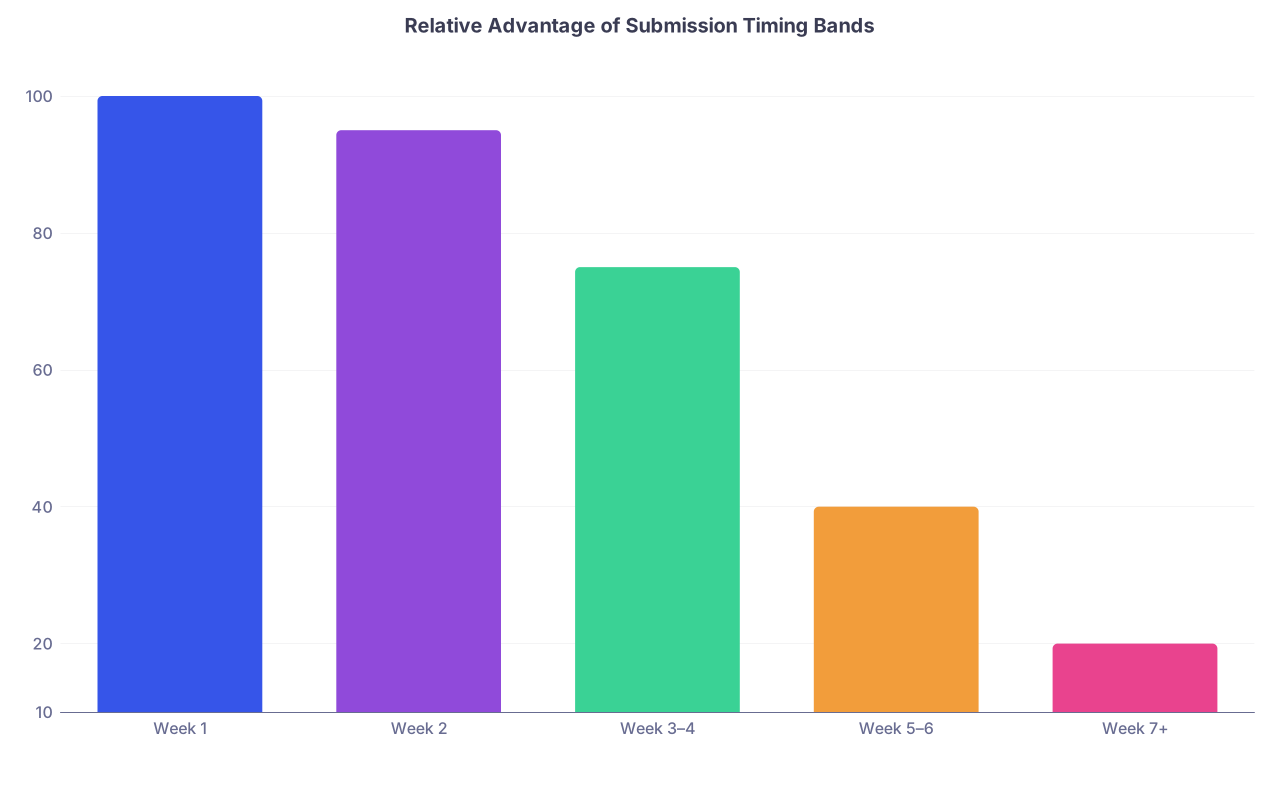
What matters is bands of time, not the exact day.
| Category | Value |
|---|---|
| Week 1 | 100 |
| Week 2 | 95 |
| Week 3–4 | 75 |
| Week 5–6 | 40 |
| Week 7+ | 20 |
Interpretation (rough, but matches how PDs actually think):
- Week 1–2: You’re in the core pool. Tiny difference between day 1 and day 10.
- Week 3–4: Still viable, but you’ve lost the “easy yes” advantage.
- Week 5–6: You’re now asking them to reconsider when they already feel “full.”
- Week 7+: Exception-only territory, unless it’s a low-volume or desperate program.
So if you’re the person obsessing over hitting “submit” at 8:01 a.m. vs 3 p.m. on opening day? Relax. That’s not the game.
The game is: do not drift into that late band unless you have a very clear reason and a compensating strength.
Specific Pitfalls: Who Gets Crushed by the Unspoken Cutoff
Some groups are especially vulnerable to this soft deadline.
Dual Applicants
You know who you are. The EM–IM crowd, the IM–Neuro crowd, or the “I tried for Derm and now I’m pivoting to IM in late October.”
From the program side, your late pivot looks like:
- Disorganized
- Not genuinely interested
- Backup mentality
Programs absolutely smell that. I’ve been in the room when PDs say, “We’re not going to be someone’s safety catch this late in the game.”
If you must pivot late, you better:
- Have clear story in your personal statement/letters
- Use advisors or faculty to directly contact programs
- Accept that many places are already mentally closed
Reapplicants and Non-traditional Applicants
These folks often hesitate. They want one more letter, one more advisor read, one more edit. That hesitation pushes them into the late band.
From our side of the table? Late, older grad year, and reapplicant in combination can look like drifting and indecisive.
If you’re in this category, you should aim to be earlier than average, not later. You’re already triggering extra scrutiny. Don’t add timing against you.
IMG / FMG / Caribbean Grads
You live and die by filters. Many places:
- Filter by US grad year
- Filter by Step scores
- Filter by visa needs
If you come in late:
- Many interview slots are already assigned to US grads the program is more familiar with.
- They often have a fixed mental quota for IMGs, even if they won’t say it publicly.
Late and IMG rarely works out unless you have:
- Direct connection to the program
- Worked there
- Strong inside advocate
The One Exception: Chaotic or Undersubscribed Programs
Not every program is hyper-organized and flooded. Some are a mess. Some aren’t popular.
You’ve got:
- New programs just starting out
- Programs that recently lost accreditation and then regained it
- Programs in less desirable geographic locations
- Malignant reputations that spread through student grapevines
Those places will look at late apps more seriously because they have to. They’re still building an interview roster in weeks 4–8.
But think hard before relying on this. You can match there. You may not be happy there.
If You’re Already Late: What Actually Helps
Let me be realistic. Some of you are already beyond week 3–4 on the calendar. You can’t undo that.
What you can do is change which bucket you fall into once your late app hits their pile.
You need to look like an exception, not background noise. That means:
- A clearly aligned story with that specialty. No hedging. No vague “I love all of medicine.”
- Signals of real commitment: sub-Is, strong home letters, tangible work.
- Geographic or institutional ties to the program whenever possible.
- Faculty actually emailing or calling on your behalf. Yes, that still moves the needle.
A late app with a direct email from a respected faculty member attached? That gets read. A late app with no context? Much less so.
When You Should Not Rush Early
There’s one twist: sometimes rushing to submit “day 1” with a weak or incomplete application is worse than waiting 5–7 days to fix real issues.
If waiting a week:
- Gets you a significantly stronger Step 2 score uploaded
- Allows an obviously weak personal statement to become coherent
- Lets a crucial letter (like from your sub-I) arrive
Then yes, waiting that short time is usually worth it. Within that first 2-week window, quality beats speed.
But once you drift past that 2–3 week mark without a serious reason? You’re now sacrificing opportunity, not refining it.
How PDs Talk About This Behind Closed Doors
I’ll give you a few lines I’ve actually heard in PD meetings:
From an EM PD flipping through late apps:
“Anything new this late is probably an afterthought. If they didn’t prioritize us in the first wave, why am I bending over backwards now?”
From an IM PD at a university program:
“We’re basically done building the interview list. We can add a few if someone we know emails us.”
From a gen surg PD:
“The late apps drawer is mostly people scrambling. If we’re stuck in January with cancellations, we’ll go fishing there.”
Notice what those have in common. Late = backup, scramble, low priority, or rare exception.
You do not want to live in the “late apps drawer.”
Bottom Line: The Real Best Time to Submit ERAS
Forget the official deadlines. Ignore the fantasy that “programs review all applications equally.”
If you want the version PDs won’t put on their websites but will say after their third coffee in the workroom, it’s this:
- Best window: First 1–2 weeks after ERAS opens for submission
- Still okay: Weeks 3–4, but you’ve lost some free goodwill
- Now you’re fighting uphill: Weeks 5–6
- Exception-only territory: Week 7+ unless you have major connections or are applying to very undersubscribed programs
Plan your exams, rotations, and letters around landing in that first band with your application polished and complete. Not perfect. But complete and professional.
Because once PDs feel “full” on their interview list, your application is no longer a candidate. It’s insurance.
And that’s not where you want to sit.
With that timing truth in your pocket, you’re ready to think more strategically—about signaling, program lists, and how to make sure that when they do seriously read your ERAS, it’s impossible to ignore. But that’s a story for another day.