
The biggest advantage in ERAS isn’t your Step score or your research. It’s your timestamp.
Why submitting before MS4 orientation quietly changes everything
Let me tell you something most deans never say out loud: by the time your MS4 orientation happens, a non-trivial chunk of residency spots are already psychologically “spoken for” in the minds of program coordinators and some faculty.
Not officially. Not on paper. But in practice.
I’ve sat in rooms in July where the coordinator pulls up ERAS, filters for “completed applications,” and the PD says, “Start by flagging the early birds with decent stats.” You know who isn’t in that list?
The people who waited “until after orientation.”
Submitting ERAS before MS4 orientation gives you three quiet but very real advantages:
- You get into the first-pass review at more programs.
- You control the narrative before your school’s chaos starts.
- You buy yourself mental bandwidth when everyone else is melting down in September.
No one is going to put this in an official handbook because it exposes how chaotic the review process actually is. But I’ll walk you through how it really plays out.
What programs actually do with timestamps
Here’s the dirty little secret: programs claim to review “holistically” and “continuously,” but on the inside, many operate on “waves” of review. And the first wave often happens before your orientation week is over.
I’ve watched it.
The coordinator exports an applicant list. She sorts by Step score, or school, or “date complete,” depending on the program’s culture. Then they apply their crude “first cut” rules.
Early submission means you’re in that first batch. Late submission means you’re competing for the crumbs.
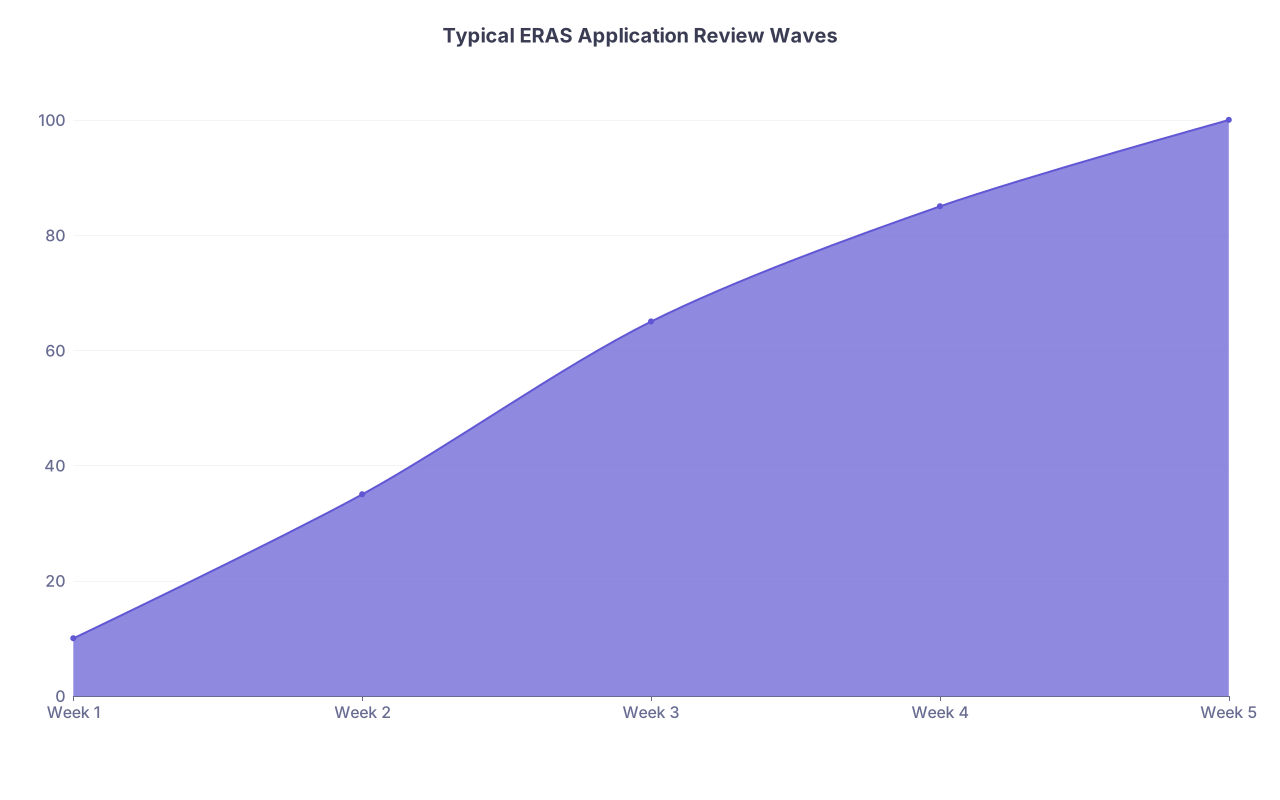
To make this real, here’s how timeline pressure really looks at a mid-tier IM or EM program.
| Category | Value |
|---|---|
| Week 1 | 10 |
| Week 2 | 35 |
| Week 3 | 65 |
| Week 4 | 85 |
| Week 5 | 100 |
By the time most schools finish MS4 orientation (usually late July or early August), many programs have already:
- Reviewed the first wave of fully complete apps
- Pre-flagged strong candidates
- Sent out informal or even formal first-round interview invites, especially in more aggressive specialties and community programs that fear being “left behind”
If your ERAS isn’t complete (LORs, photo, personal statement, experiences, all of it) when that first filter run happens, you’re invisible.
No one comes back later just to make sure they didn’t miss the person whose dean told them “it’s fine to submit in mid-September.” That person just gets processed in the second or third wave, when the PD is more tired, pickier, and already has 30 names they like.
Submitting before MS4 orientation doesn’t magically make you a rockstar. But it gets you in the room early. And in this game, that’s huge.
The real ERAS calendar vs the one your school sells you
Your med school will give you some nice-looking “ERAS timeline” slide at orientation. It will usually say something like:
- ERAS opens in June
- Programs see applications mid-September
- Interviews run Oct–Jan
What they don’t tell you clearly is the distinction between:
- When you can start working on ERAS
- When programs can see your application
- When programs start building their interview list
Here’s the part most MS4s misunderstand: the “submit early” advantage isn’t about pressing the button in June just to be first in line. It’s about having your entire application complete and locked well before the September release day — and preferably before your school derails your life with MS4 orientation, sub-I chaos, and random required “professionalism” sessions.
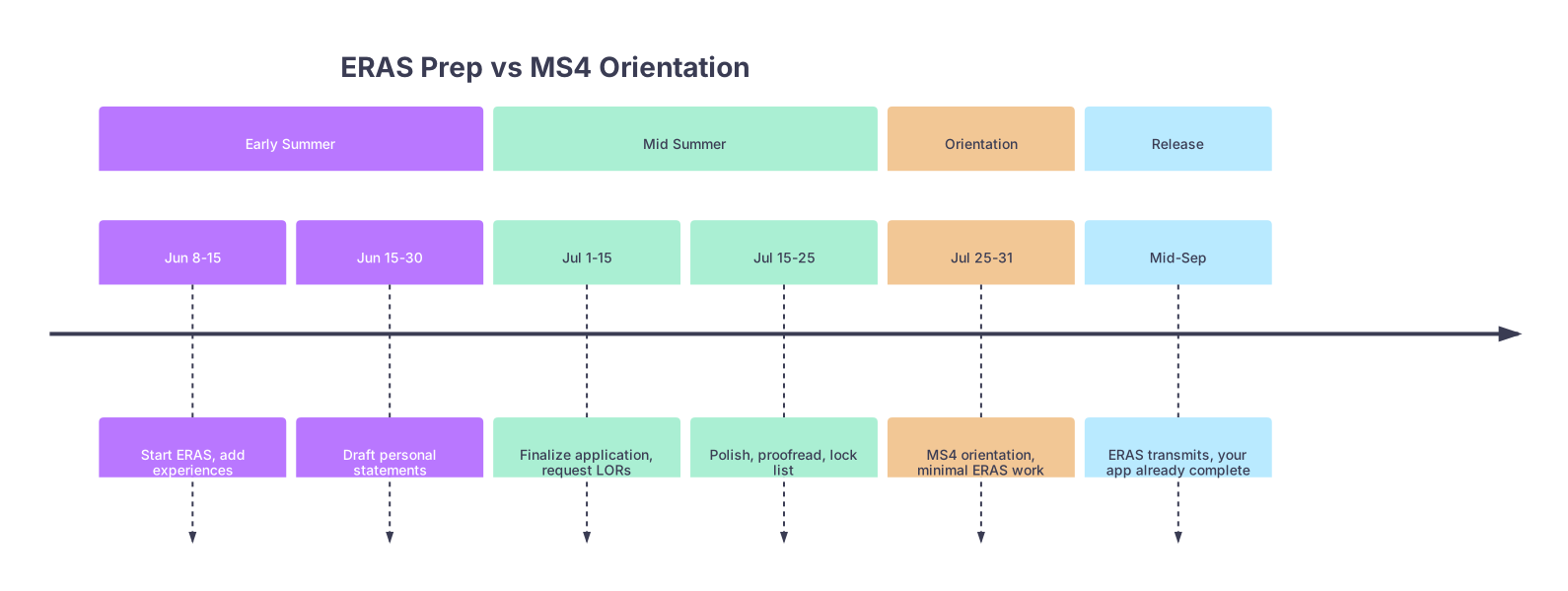
So when I say “submit before MS4 orientation,” I really mean:
- Your ERAS is built and ready in June/early July
- Letters requested early, most already uploaded
- You’re tweaking, not constructing, in the week or two before orientation
Then, on ERAS release day (when apps go live to programs), you’re already polished and in the first wave — not frantically editing a personal statement in the call room.
| Period | Event |
|---|---|
| Early Summer - Jun 8-15 | Start ERAS, add experiences |
| Early Summer - Jun 15-30 | Draft personal statements |
| Mid Summer - Jul 1-15 | Finalize application, request LORs |
| Mid Summer - Jul 15-25 | Polish, proofread, lock list |
| Orientation - Jul 25-31 | MS4 orientation, minimal ERAS work |
| Release - Mid-Sep | ERAS transmits, your app already complete |
Here’s what I see every year:
- The students who treat June–early July as their application season are calm, early, and get earlier interviews.
- The ones who treat orientation as the “start” of ERAS season spend August and September in blind panic.
Orientation is not the starting gun. It’s a distraction.
The three specific advantages of being done before orientation
1. You get into more first-pass piles
Programs don’t all review applications the same way, but there are only a few common patterns.

Here are the three models you’ll actually see:
| Review Model | When Early Apps Win Most |
|---|---|
| Batch / Wave Review | First 1–2 weeks |
| Rolling Quick Scan | Daily, first 2–3 weeks |
| Hybrid (batch + rolling) | Entire first month |
In batch review models, all the “complete on day 1” apps get sorted and reviewed together. PDs are fresh, enthusiastic, and open-minded. By the time they reach the apps that came in “a little later,” they’ve already mentally built their interview cohort.
In rolling models, coordinators look early and often. They start starring applicants. They draft their “A list” quietly. If you’re not in those first few thousand apps sorted on day 1 or 2, you’re just... less exciting.
I’ve literally heard:
“He looks solid, but we already have 40 invites out and 20 backups flagged. Let’s circle back if we need more.”
Do they circle back? Sometimes. Not always. You really want to be in that first conversation.
2. You look organized and serious — especially to borderline programs
Another behind-the-scenes truth: “Early = serious and organized” is an unconscious bias. Nobody writes that in their official selection criteria. But faculty notice.
When we see a complete, polished, high-quality application on day one, the thought pattern is simple: “This person has their act together. They care about this.”
When we see an app trickle in half-complete or clearly rushed late in the game, especially with typos or generic personal statements, it signals the opposite, even if it’s not fair.
This bias is especially powerful for applicants who are:
- Slightly below a program’s usual Step score
- From a less-known or newer med school
- Switching specialties late
- Applying without home program support
That early timestamp and clean app buys you goodwill you wouldn’t get if you slide in after the PD is already fatigued and jaded.
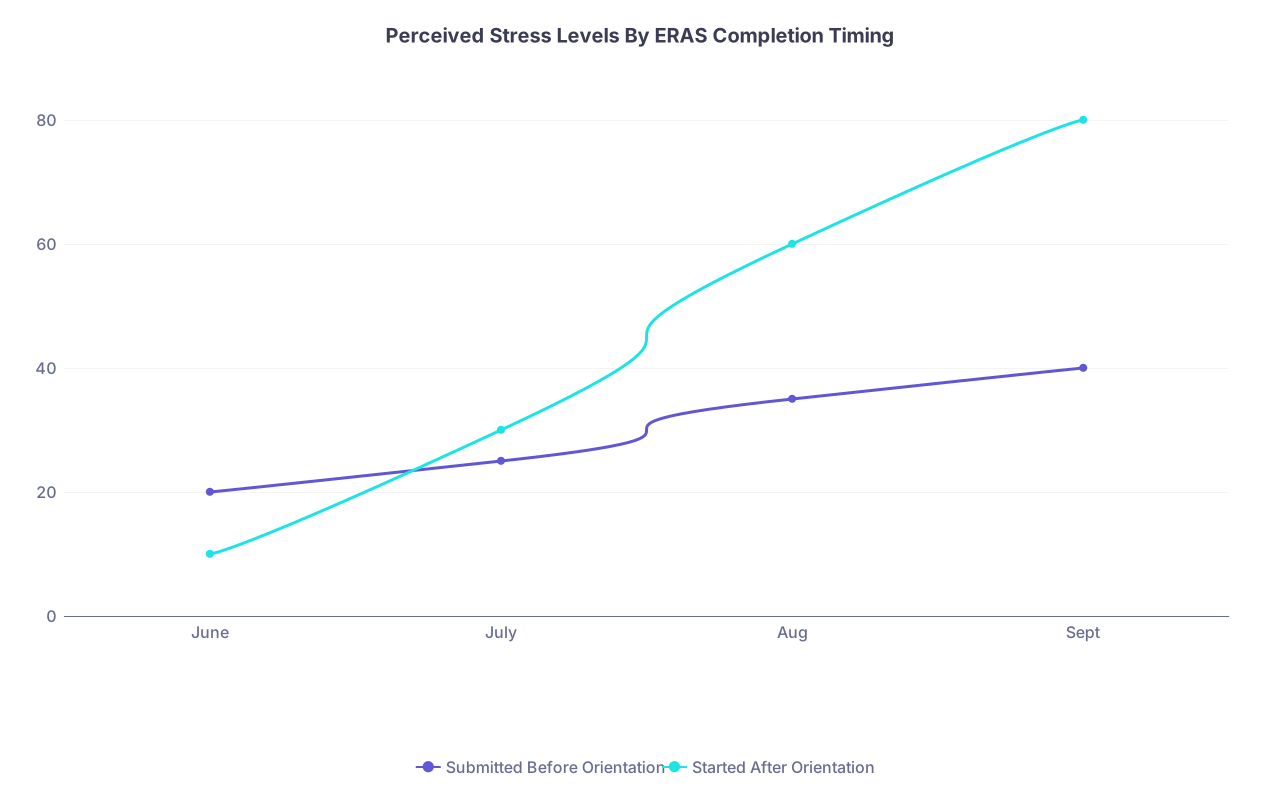
3. You protect your sanity when everyone else starts panicking
The third advantage is quieter but maybe the most important. Bandwidth.
By the time your classmates are:
- Still tweaking personal statements
- Arguing in GroupMe about how many programs to apply to
- Realizing one of their LOR writers vanished on vacation
…you’re done. You’re just checking occasionally, updating one or two things, and focusing on being a good MS4 and a normal human.
| Category | Submitted Before Orientation | Started After Orientation |
|---|---|---|
| June | 20 | 10 |
| July | 25 | 30 |
| Aug | 35 | 60 |
| Sept | 40 | 80 |
Every year I watch the same mess: people delaying ERAS until “after orientation,” and then orientation plus a busy sub-I wipes out their available time. Suddenly they’re proofreading their personal statement between pages on night float.
That’s how big mistakes get baked into your application. Misspelled program names. Wrong city. Generic statements that show zero insight.
Submitting before orientation doesn’t just help the PD. It protects you from your own future chaos.
What you actually need done before orientation
Let’s turn this from theory into something actionable. If you want that quiet advantage, here’s what realistically needs to be locked in before your orientation week.
Personal statement(s)
Single biggest time sink. And the most overthought, over-edited document in the whole process.
You do not need a Pulitzer-level essay. You need:
- A clear story about why this specialty
- Some concrete clinical examples
- Zero red flags
- Zero clichés like “ever since I was a child…” or “medicine is both an art and a science”
If you’re dual-applying or doing a prelim + advanced combo, you need separate, tailored statements. That’s where people get burned if they wait too long.
ERAS experiences and descriptions
This part always takes longer than students expect.
You’re not just listing jobs and research. You’re:
- Picking which things matter
- Deciding what to cut
- Writing 1–3 line impact statements that don’t sound like LinkedIn fluff
Trying to “just knock this out in a weekend” while starting an AI-heavy sub-I is how people end up with nonsense like:
“Demonstrated leadership, teamwork, and communication skills in a fast-paced clinical environment.”
That sentence means nothing. And I see it 500 times a year.
You want these written, edited, and sanity-checked by early July. Then you can refine, not invent, in the days before orientation.
Letter requests (and gentle harassment)
The actual LOR uploads will always be a little unpredictable — attendings are chronically late. But you control when you ask.
By the time orientation rolls around, you should have:
- Asked your letter writers in person or via a strong email
- Sent them your CV + draft personal statement
- Entered them into ERAS to generate letter requests
Then you can nag politely in late July and August knowing they’ve had time.
If you wait until after orientation to start this process, you’re gambling that busy surgeons and outpatient attendings will drop everything in August/September to write you a thoughtful letter. They won’t.

Program list draft
You don’t need a perfect list. But you absolutely need:
- A working range of how many programs you’ll apply to
- A core list of obvious target programs
- A sense of geographic or family constraints
If you build this in June with a clear head, you’ll avoid adding random programs in September at 2 a.m. just because someone in your class said, “I heard this one is chill.”
The myths that keep students from submitting early
Let me dismantle a few lies that get repeated every year.
Myth 1: “If I submit later, I can include more updates and get stronger”
Reality: no program is sitting there comparing two apps and saying, “Well, this one was complete on day 1, but this later one has one extra line of research — let’s throw out the early one.”
Unless you have a major late-breaking achievement (national first-author paper, huge award, clear Step jump), the idea that waiting gives you a significantly “stronger” app is fantasy.
And you can still include updates later through PD emails or during interviews if they’re truly important.
Myth 2: “Programs can’t see anything until mid-September, so timing doesn’t matter”
Half-truth. Yes, programs don’t see your app until ERAS opens the floodgates. But you control whether your app is in the pile on that day 1 or not.
A complete, error-free application sitting in the system on day 1 is different from an app still being tweaked while everyone else’s is already visible. When the coordinator hits export that morning, are you in that file or not? That’s the timing that matters.
Myth 3: “My school said submitting anytime in September is fine”
Your school has one priority: getting most of their students matched. The bar is low: “fine” means 90–95% match rate and no scandals.
They’re not optimizing for you getting your dream program. They’re certainly not optimizing for you getting first-pass review at highly desired places. The official line they give you is calibrated to avoid panic and legal risk, not to maximize your strategic advantage.
I’ve sat in dean’s offices where they explicitly avoid emphasizing early submission because, “We don’t want to stress them more.” So they underplay the advantage.
I’m not your dean. I’m telling you it plainly: early, complete, polished beats “fine” timing. Every year. In every specialty.
How to actually pull this off without burning out
The obvious question: how do you balance late MS3 clerkships, Step 2, and getting ERAS done before orientation?
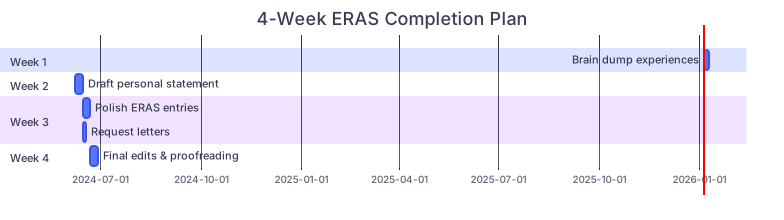
You do it by treating ERAS like another rotation. A short one, early summer, that you can actually pass with honors if you respect it.
Here’s a simple breakdown that works for most people.
| Task | Details |
|---|---|
| Week 1: Brain dump experiences | a1, 2024-06-01, 5d |
| Week 2: Draft personal statement | a2, 2024-06-08, 7d |
| Week 3: Polish ERAS entries | a3, 2024-06-15, 7d |
| Week 3: Request letters | a4, 2024-06-15, 3d |
| Week 4: Final edits & proofreading | a5, 2024-06-22, 7d |
You don’t need 8 weeks of full-time work. You need 3–4 weeks of consistent, focused effort while the rest of your class tells themselves, “I’ll do it after orientation.”
A few specific tactics I’ve seen work:
- Set two “ERAS evenings” per week in June. Non-negotiable, like call days.
- Book one half-day with no clinical responsibilities (or a lighter day) purely for personal statement and experience editing.
- Get a trusted resident, faculty member, or recent grad to sanity-check your app by July 1. Not for grammar. For red flags.

You’re not trying to be perfect. You’re trying to be ready.
Who benefits most from early submission (and who it won’t save)
Let’s be honest: early submission doesn’t magically erase major application problems. If you failed multiple Steps, tanked third year, or have professionalism issues, you still have an uphill climb.
But some groups get disproportionate benefit from being done before orientation:
- IMGs and FMGs — you’re fighting recognition bias; early, complete apps are gold.
- Students from lower-ranked or new schools — you need the “this person looks sharp” first impression.
- Borderline Step scores — you want every tiny edge in getting past automated or informal cutoffs.
- People dual-applying — multiple personal statements and program lists are exponentially easier with early work.
And who doesn’t need to obsess over being first but still benefits from being early?
- High-stat, home-program-protected students in less competitive specialties. You’ll probably match either way. But early apps still mean more interview options and less stress.
The part no one tells you: PD memory and early names
One last thing from behind the curtain.
PDs and faculty remember the early names. Not because they’re consciously biased toward them, but because they discuss them in earlier meetings, bring them up when building interview schedules, and often refer back to those initial lists of “interesting” applicants.
If you’re in that very first Excel export the coordinator prints in September, your name gets circled in pen. Someone mumbles, “Let’s keep an eye on her.” Those casual comments stick.
And when the interview season thins out, and slots open unexpectedly because someone cancels, it’s those early “interesting” names that people revisit. I’ve watched an early, solid-but-not-brilliant applicant get added in November because someone said, “What about that guy from Iowa we flagged early on?”
You can’t buy that visibility. You earn it by being ready when the gate opens — not wandering in weeks later with “just one more update.”