
You roll over, it’s 7:59 a.m. on ERAS opening day. Your laptop’s open, ERAS page refreshed, finger hovering over “Certify and Submit.” Group chat is split: half say “submit the second it opens or you’ll be at the bottom of the pile,” the others say “chill, it doesn’t matter as long as it’s before the deadline.”
Here’s the real answer.
Short Answer: No, That Exact Morning Doesn’t Magically Help You
If programs have a common application release date (which they do in recent cycles), there is no meaningful benefit to submitting at 9:00 a.m. vs 3:00 p.m. that same day.
What does matter is this:
- Submitting before ERAS transmits apps to programs (the official “release” date).
- Submitting complete (LORs, personal statement, experiences, photo, everything).
- Avoiding obvious mistakes because you were rushing to be “first.”
So if your question is literally:
“Do I gain any advantage by submitting ERAS the exact morning it opens versus later that day or a couple days before the release date?”
No. You don’t.
Let’s break down where timing actually matters and where it’s just anxiety theater.
How ERAS Timing Actually Works (Not the Rumor Version)
Programs don’t sit there at 9:01 a.m. refreshing like eBay bidders.
Here’s the real flow:

| Step | Description |
|---|---|
| Step 1 | You submit ERAS |
| Step 2 | ERAS holds until release date |
| Step 3 | Applications released to programs |
| Step 4 | Program auto-filters run |
| Step 5 | Faculty/PD review |
Key points:
- You can submit before the “applications released to programs” date.
- On that release date, ERAS dumps all submitted apps at once into program inboxes.
- Programs then apply filters (scores, US/IMG, visa, etc.).
- Only after that do humans start reading.
So if you submit:
- 3 days before release date
- 3 hours before release date
- Or at 9:00 a.m. the day ERAS opens (but still before that release date)
…you’re functionally treated the same when that batch goes out.
Where timing did used to matter more was years ago, when programs got apps as they came in and some started screening immediately. ERAS has moved away from that model with standardized release dates for most specialties.
Where Timing Actually Matters
So if “the exact morning” isn’t the key, what is?
There are three timing windows that matter:
| Window | Impact Level | Main Goal |
|---|---|---|
| Before release date | High | Be in the first batch sent to programs |
| First 1–2 weeks after release | Medium | Still early enough for most invites |
| After 3–4 weeks | Low | Many interview spots already allocated |
1. Being in the First Batch (High Yield)
You want to submit before ERAS sends applications to programs. That’s the key date.
If the release date is, say, September 25:
- Submitting on September 1 vs September 24? No real difference.
- Submitting on September 26? You’re now late. Programs may already be screening.
Programs often start reviewing within days of that first release. Some competitive ones start sorting and inviting very fast.
So your priority:
- Be fully submitted and certified a few days before the release date.
- Not obsess over the exact hour the portal opens.
2. The First Couple of Weeks After Release (Medium Yield)
Some applicants miss the release batch for legit reasons (late scores, late LORs, couples match logistics).
If you submit during the first 1–2 weeks after release, you’re not dead. You’re just not ideal “Day 1,” but plenty of programs are still reading and issuing invites.
After about 3–4 weeks, especially in competitive specialties, you start to see a real drop-off in interview chances.
3. After 3–4 Weeks (Low Yield for Most Applicants)
Submitting a month or more after release?
- For highly competitive specialties (derm, ortho, ENT, etc.) → this is basically “very late.”
- For mid-competitiveness specialties (IM, peds, FM, psych) → you might still land some interviews, especially at community or less competitive programs, but you’ve lost the “early” edge.
So yes, timing matters in weeks, not in hours.
Common Myths About Submitting “Right When ERAS Opens”
Let’s kill the common myths one by one.
Myth 1: “If I’m not one of the first submitted, I’ll be buried at the bottom.”
Wrong model.
With the batch-release system:
- Everyone who submitted before release hits the program’s inbox at once.
- Programs filter by criteria, not by timestamp order:
- Step 2 score cutoffs
- US vs IMG
- Visa needs
- Geographic filters
- Specialty-specific filters
You’re not “at the bottom” because you clicked submit at 11:00 a.m. instead of 8:00 a.m.
Myth 2: “Programs start reviewing literally the second ERAS opens.”
No. Program staff have lives. And meetings.
What actually happens:
- Programs plan a start date for screening (often around or just after release date).
- Many will batch-sort, run filters, assign apps to screeners, then start reading.
- Some don’t seriously review for days to a week+ after release.
So that “I submitted at 9:01, I’m in the first 10 apps they see” fantasy doesn’t really map to how they operate.
Myth 3: “Earlier timestamp = more serious / interested applicant.”
I’ve never seen a PD say, “We ranked them higher because they submitted at 8:03 a.m. instead of 3:15 p.m.” That’s not a thing.
What does signal seriousness?
- Thoughtful personal statement that isn’t generic.
- Program-specific signals (visiting rotations, emails that aren’t spammy, preference signals if your specialty uses them).
- Geographic connections or expressed interest that make sense.
Not your ERAS timestamp.
When You Shouldn’t Submit That Exact Morning
Here’s where I’ll be blunt: rushing to submit first thing can actually hurt you, not help you.
You should not click submit that morning if:
- Your application still has typos, awkward phrasing, or misordered experiences.
- You haven’t had at least one person proofread your:
- Personal statement
- Experience descriptions
- CV content
- You’re missing:
- A key LOR you know is coming in a day or two
- A final Step 2 score that’s significantly stronger than your Step 1 situation
- You’re emotionally fried and just want it over, but haven’t done a final pass.
What I’ve actually seen hurt applicants:
- Wrong personal statement uploaded for the specialty.
- Wrong program list because someone didn’t realize filters reset.
- Obvious copy-paste errors in experiences (“At [Institution Name] I did…” left blank).
- Mismatched dates, gaps that look like red flags but are just typos.
These errors matter more than a hypothetical 2–3 hour timing micro-advantage that doesn’t really exist.
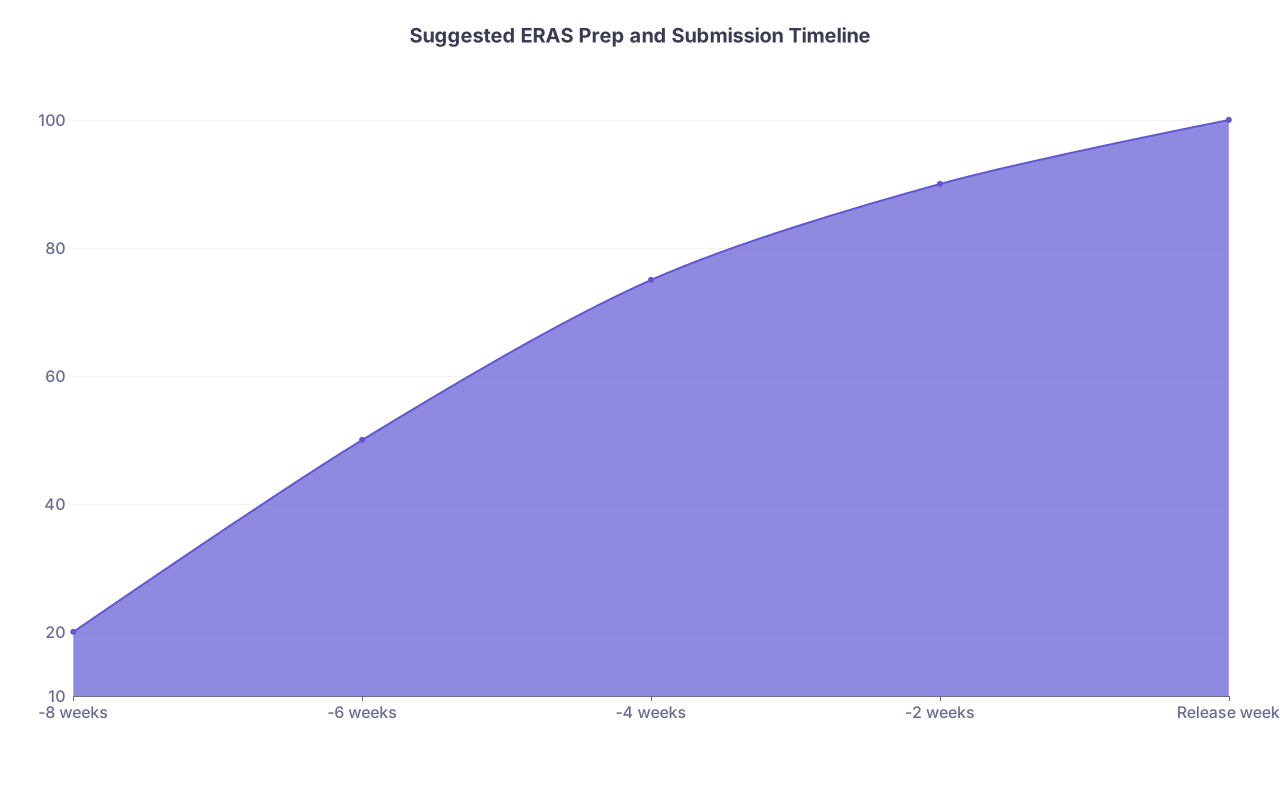
A Sensible Timeline: What I Recommend
Here’s the practical play if you want to do this right without losing your mind.
| Category | Value |
|---|---|
| -8 weeks | 20 |
| -6 weeks | 50 |
| -4 weeks | 75 |
| -2 weeks | 90 |
| Release week | 100 |
Think in weeks, not minutes.
6–8 weeks before release:
- Draft ERAS entries and personal statement.
- Nail down your letter writers and give them deadlines.
- Build a working program list.
2–3 weeks before release:
- Finalize personal statement.
- Polish experiences (clear, concise, result-focused).
- Make sure most or all letters are uploaded or confirmed.
3–5 days before release:
- Do a slow, line-by-line review of your entire ERAS:
- Dates
- Spelling
- Program list
- USMLE/COMLEX numbers
- Have someone else look at it like they’re trying to catch you making a mistake.
1–2 days before release:
- Submit. Certify. Be done.
Could you submit earlier? Sure. But there’s zero added benefit from obsessively timing it to the minute the portal allows certification.
Special Situations Where Timing Can Shift a Bit
There are a few edge cases where I do pay attention to timing, though still not down to “this exact morning.”
1. You’re Waiting on Step 2
If Step 1 is pass/fail or low and Step 2 is your strength:
- Submitting after your Step 2 score releases can be smart.
- But don’t push this past a few days after release date unless absolutely forced.
- Some people submit with Step 2 “pending” if the score is coming soon; that’s specialty-dependent and risk-tolerance-dependent.
2. Late LORs
If you’re waiting on a killer chair letter or a sub-I letter:
- For a strong, meaningful letter, I’d absolutely wait a few extra days (still close to release date).
- You can submit ERAS and then assign the letter later as it arrives, but for some competitive programs, early completeness still helps.
3. Couples Match / Multiple Specialties
If you’re coordinating:
- Multiple specialties (e.g., IM + neuro)
- Couples match with different fields or locations
The planning complexity goes up. But again, this is about accuracy and strategy, not trying to be the 7th person to submit.
How Programs Actually Think About “Early” vs “Late”
If you talk to PDs and coordinators honestly, they’ll break timing down like this:
- “On-time and in the first batch”
- “Reasonably early in the season”
- “Late, but we’ll still look at it”
- “Very late; we’re already basically full”
No one is drilling down to: “Oh, they certified at 9:07 a.m. — clearly a go-getter.”
Some programs will literally tell you in info sessions:
“We don’t see any difference between apps submitted a few days or weeks before release — just don’t wait until October.”
They care about:
- Your scores
- Your letters
- Your clinical record
- Your fit with their program
Not the exact timestamp on your submission.
FAQ: “Is There Any Benefit to Submitting ERAS the Exact Morning It Opens?”
1. Is there any real advantage to submitting ERAS the exact morning it opens?
Functionally, no. As long as you submit before ERAS releases applications to programs, you’re treated as part of that first batch. Programs don’t meaningfully distinguish between 9:00 a.m. vs 4:00 p.m. submission timestamps that day.
2. What’s more important: being super early or being 100% polished?
Being polished. Every time. A clean, accurate, well-written ERAS submitted a few days before release is better than a rushed, sloppy one submitted the minute the portal opens. A glaring typo or wrong program list will hurt you more than any imaginary advantage of being “first.”
3. How late is “late” for ERAS?
“Late” for real impact is usually several weeks after the application release date, especially in competitive specialties. Submitting a day or two after release is fine. Submitting three or four weeks after? Now you’re cutting into your interview odds, particularly at popular or competitive programs.
4. Do all specialties follow the same timing rules?
Most major specialties use a similar ERAS release structure, but competitiveness changes how unforgiving timing is. Derm, ortho, ENT, ophtho, plastics, etc. are less forgiving of late applications. IM, peds, FM, and psych have more leeway, but earlier is still better — again, we’re talking in weeks, not hours.
5. Should I wait to submit if I’m expecting a stronger Step 2 score?
If your Step 2 will significantly improve your application (especially if Step 1 was weak or just pass), it can be worth waiting a short time so the score is included. I wouldn’t delay past a few days after release if you can help it. There’s a trade-off: earlier complete vs stronger application. For many, waiting a week for a clearly better score is reasonable.
6. What’s your ideal ERAS submission strategy in one sentence?
Have your application polished, proofread, and fully complete, then submit a few days before the ERAS release date, and stop stressing about whether you clicked “certify” at 8:59 a.m. or after lunch — programs won’t care, and you’ve already done what actually matters.
Key points to walk away with:
- There’s no real advantage to submitting ERAS the exact morning it opens compared with later that day or a few days before release, as long as you’re in the first transmitted batch.
- Focus on being early and complete by the release date, not on minute-level timing that only fuels anxiety without improving your match chances.