
What actually happens if you submit ERAS without all your letters of recommendation—do programs toss your application, or is that something people just say to scare you?
Let me be blunt: waiting for every single letter before you hit “submit” is one of the fastest ways to quietly kneecap your application.
You can (and usually should) submit your ERAS before all your letters of recommendation (LoRs) are in. And if you wait for that one slow faculty member, you may slide from “early and competitive” to “late and ignored.”
Let’s walk through how this really works and what you should do.
The Short Answer
Yes, you can submit ERAS before all your letters arrive.
And for almost everyone, that’s the right move.
Here’s the rule that actually matters:
Programs can start reviewing you once your application is submitted, certified, and you’ve assigned the letters that are already uploaded.
Letters can be added and reassigned later. Your submission date does not depend on having every LoR in place.
Where people get confused is they mix up these questions:
- Can I submit without all letters?
- Will programs review me without all letters?
- When does it hurt me to be missing letters?
Those are different questions. Let’s separate them.
How ERAS Handles Letters (And Why Submission Timing Is Separate)
Think of ERAS in two pieces:
- Your core application – personal info, experiences, personal statement, exams, etc.
- Your LoRs library – a pool of letters you can assign to each program.
You submit your core application once. After that, you can:
- Add new LoRs as they arrive.
- Change which letters are assigned to which programs (with some timing caveats).
- Continue sending new programs your application using the same core file.
Your LoRs don’t lock your application clock. Programs see:
- Application submission date
- What letters are assigned to them at the time they download/review your file
So if you submit on Day 1 with two letters, and a third letter comes in on Day 10, you can assign that new letter to all your programs on Day 10. No need to re-submit the whole application.
So When Should You Actually Submit?
Here’s the practical framework I tell people:
- Aim to submit as early as reasonably possible once:
- Your application is complete and polished
- You have at least 2 solid, specialty-relevant letters uploaded (for most fields)
- Do not delay submission just because:
- One “dream” letter hasn’t come in yet
- A non-essential extra letter is pending
For many specialties, programs like to see 3–4 letters total, often including:
- 1–2 specialty-specific letters
- 1 from your department chair or a similar “institutional” letter (depending on specialty)
- Possibly another from a trusted mentor, research PI, or sub-internship attending
But here’s the real-world dynamic:
Programs don’t sit there waiting for a magical moment when your fourth letter appears. They deal with waves of applications. If you’re in their early pile with 2–3 strong letters, you’re in the game.
Wait until late September or October because Dr. Famous hasn’t uploaded yet? That hurts you way more than being briefly short one letter.
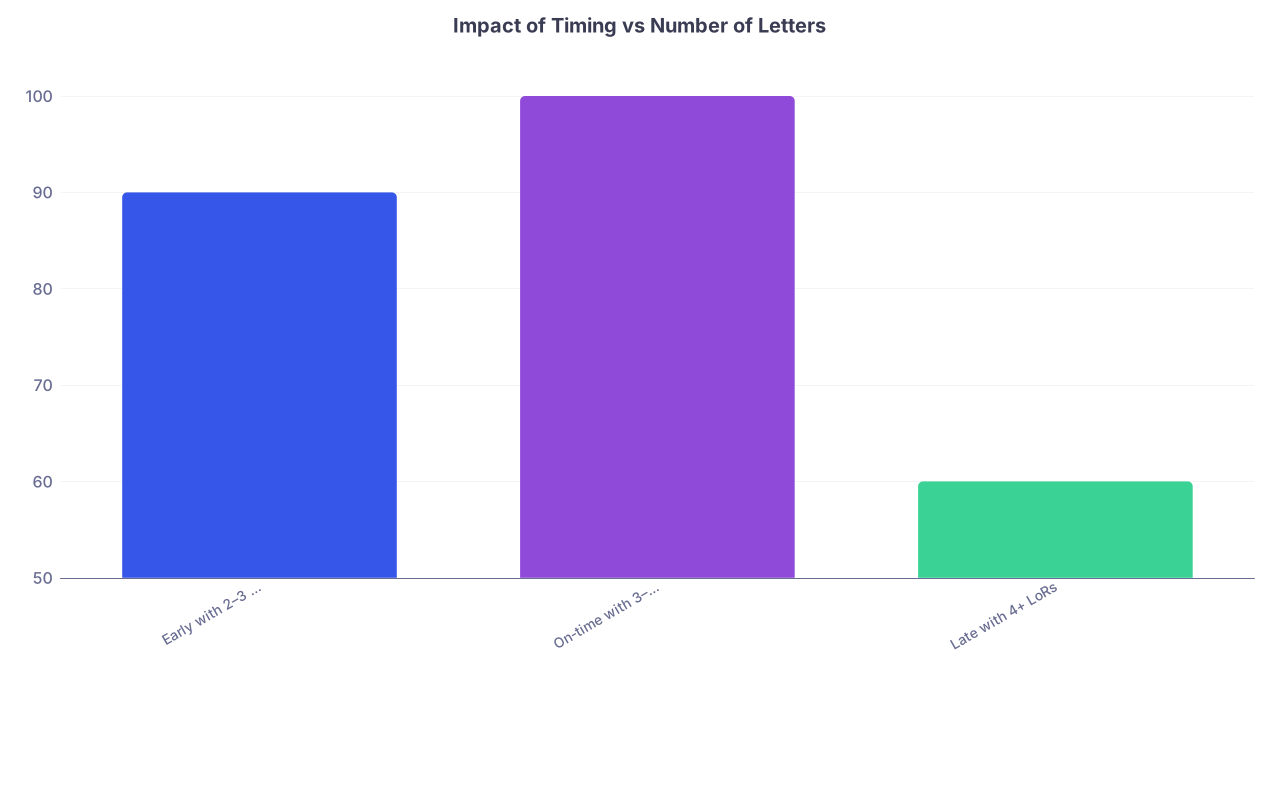
| Category | Value |
|---|---|
| Early with 2–3 LoRs | 90 |
| On-time with 3–4 LoRs | 100 |
| Late with 4+ LoRs | 60 |
Interpretation: you’re much better off early with slightly fewer letters than late with “perfect” letter coverage.
What Programs Actually Care About
Programs care about three things when they open your file:
- Timing – Are you in the early / on-time review batch, or the late pile?
- Completeness to a functional level – Do they have enough data to judge you?
- Letter quality and relevance – Who wrote them, and what do they say?
They do not obsess over whether you had 3 vs 4 letters the first day they saw your file, as long as you meet their minimum requirements by the time they seriously review you.
Minimum vs ideal
Most programs require at least 3 letters by the time they rank or interview you. Some state that explicitly. But that doesn’t always mean they refuse to even look at someone with 2 letters early on—especially in less hyper-competitive fields.
Here’s a good rule of thumb:
- You want at least 2 specialty-relevant letters uploaded before submitting.
- You want to hit 3 letters (with at least 2 specialty letters) by the time interviews are being offered in bulk.
- That 4th letter is usually “nice to have,” not make-or-break.
| Specialty | Common Target # | Must-Have Type |
|---|---|---|
| Internal Med | 3–4 | 2+ IM attendings |
| General Surgery | 3–4 | 2+ Surgery attendings |
| EM | 2–3 | 1–2 SLOEs (EM standardized letters) |
| Pediatrics | 3 | 2+ Peds attendings |
| Psychiatry | 3 | 1–2 Psych letters preferred |
Local variations exist, but this gives you a sense: they care more about the right type than the sheer number.
When Submitting Early With Missing Letters Is Smart
Here are situations where you should absolutely submit even if you’re not “letter complete”:
You’re waiting on one slow faculty member.
They’re traveling. They “swear” they’ll get to it. You already have 2–3 other letters in. Submit. Assign what you have. Add theirs later if it ever materializes.You have your specialty letters, but not your chair letter.
For fields like IM or surgery where chair letters are common: you can still submit early, especially if your school/department historically uploads chair letters a bit later. Assign it when it drops.You’re strong on everything else (scores, experiences, PS) and only missing a 3rd or 4th letter.
You gain nothing by waiting weeks just to convert from 2 letters to 3. While everyone else gets sorted into “interview likely” and “probably no,” you’re stuck in limbo.You’re applying to a competitive specialty and volume is huge.
EM, derm, ortho, plastics, etc. These programs start initial screening very early. Being in that first wave matters more than having one more letter later.
When You Might Actually Wait (A Little)
There are a few narrow situations where I’d say: you can wait a few days (not weeks) for a specific letter.
The missing letter is from your strongest, most involved mentor, and:
- They’ve explicitly committed to a date within the next 3–7 days
- Their letter will likely be substantially better than your weaker existing letter
- You’re still within the window to be considered “early”
A required standardized letter type isn’t in yet (e.g., EM SLOE) and:
- Programs explicitly say they need it to review you
- You’re waiting a short, defined amount of time, not “sometime this month”
Even then, my bias is toward submitting early and assigning as letters come in—especially if the delay takes you past initial review dates.

| Step | Description |
|---|---|
| Step 1 | Is core application ready? |
| Step 2 | Fix app first |
| Step 3 | Do you have 2+ specialty letters? |
| Step 4 | Push writers, consider 1-week wait |
| Step 5 | Submit ERAS now |
| Step 6 | Assign current letters |
| Step 7 | Add/assign new letters as they arrive |
Strategy: How To Handle Letters Without Sabotaging Your Timeline
Here’s what a sane, efficient strategy looks like.
1. Lock in who is writing your letters early
By the end of your core clerkships or away rotations, you should have:
- Identified 3–4 attendings you’ll ask
- Asked them directly and explicitly
- Submitted ERAS LoR requests with plenty of time
Do not wait until September to beg for letters. That’s how you end up in a panic.
2. Treat letters and submission as parallel tracks
You polish your ERAS while your letters are being written.
You do not:
- Freeze your whole application because one writer is dragging
- Hold your submission hostage to someone else’s schedule
You do:
- Submit on your target early date with what you have
- Add letters as they arrive
- Assign them strategically (e.g., your strongest specialty letters to your most competitive programs)
3. Over-request letters, under-assign the weak ones
Ask for more letters than you’ll ultimately use. ERAS allows you to:
- Store multiple LoRs per specialty
- Assign up to the program’s allowed maximum (usually 3–4)
If you end up with a mediocre letter, you’re not forced to send it anywhere. You choose which letters each program sees.

Special Situations: EM SLOEs, Chair Letters, Transitional Year
A few unique scenarios deserve separate mention.
Emergency Medicine (SLOEs)
EM is different because SLOEs (Standardized Letters of Evaluation) are heavily weighted.
Here’s the pattern I’ve seen:
- Many EM programs want at least 1 SLOE to offer interviews.
- A second SLOE helps, but one strong early SLOE is often enough to get on the radar.
Do you submit before your SLOE(s) are in? Usually, yes—especially if:
- You know the SLOE will be uploaded by the time programs start serious review
- You’re not weeks behind the main cohort
- You assign it immediately once available
Again: don’t sit on your whole application waiting, but do aggressively track your SLOE and stay in contact with your EM faculty.
Chair letters (IM, Surgery, etc.)
Chair letters are often:
- Template-like
- Uploaded on a standardized schedule for your school
- Less personalized than strong rotation letters
Programs know this. They don’t expect every chair letter to be in on Day 1. Submit your application with your strong faculty letters; assign your chair letter when it shows up.
TY/Prelim vs Categorical
If you’re applying:
- To both categorical and preliminary/TY programs
- With a mix of specialty and non-specialty letters
You can:
- Submit ERAS once
- Use different letter sets for different program types
- Start with what you have for both, then refine later as more letters come in
How Late Is “Too Late” To Be Missing Letters?
Programs vary, but if you’re still missing key letters by:
- Late September / early October – you’re starting to handicap your chances
- Mid to late October – you’re probably off the radar for many programs unless they interview late or are less competitive
Notice: the problem here isn’t “you submitted too early without letters.”
The problem is “your letters never came in.” Fix the real problem:
- Email polite reminders.
- Loop in coordinators if appropriate.
- Have backup writers ready if someone ghosts you.

Bottom Line: What I’d Actually Tell You To Do
Here’s the direct, no-hand-holding version.
Do not wait to submit ERAS for a perfect letter lineup.
Early, solid, and slightly incomplete beats perfect and late 9 times out of 10.Submit once your application is strong and you have ≥2 relevant letters uploaded.
Ideally 2 specialty letters. The rest can follow.Aggressively track and assign letters as they arrive.
That’s part of the job. You’re managing a moving target.Recognize that programs know letters arrive in waves.
They care more that you’re in their early stack than that your 4th letter showed up on September 12 instead of September 2.
FAQ (Exactly 5 Questions)
1. Will programs see if a new letter is added after they first look at my application?
Yes—if you assign a new letter to that program, it becomes visible in their system. Some programs may re-download or re-open files, others may not bother if they’ve already decided. That’s why you don’t want to count on late letters saving a weak early read. But they can help for programs that review in waves or revisit applicants before finalizing interviews or rank lists.
2. Can I change which letters go to which programs after submission?
Yes. You can change letter assignments until you’ve assigned the maximum number of letters a program allows. Once a program has, for example, 4 letters assigned, you can’t swap one out for a different one for that program. So assign carefully once you hit the cap. But in the early stages, you can add as letters arrive.
3. What if I only have 1 letter ready by the time applications open?
That’s a problem. I’d push hard to get at least a second letter—ideally specialty-specific—within days. If that’s impossible, you may still submit with 1 to avoid being very late, but you’re going in underpowered. The real fix is earlier planning and earlier asks. If you’re already in crisis, get backup writers immediately (sub-I attendings, core clerkship faculty, research mentors).
4. Do all programs require exactly 3 letters, or can I apply with just 2?
Most programs list a minimum required number, commonly 3. Some will not consider your application “complete” for review until that minimum is met. Others will start screening with 2 and finalize decisions once the 3rd comes in. You should assume 3 is the real baseline and aim to reach that quickly—even if you submit with 2 initially.
5. How do I decide which letters to send if I have more than 4?
Prioritize in this order:
- Strongest specialty-specific letters from attendings who know you well.
- Required or expected letters (e.g., chair, SLOE).
- Strong non-specialty or research letters that show work ethic, integrity, or unique strengths.
If a letter is lukewarm or generic, don’t use it. The name on the letter matters less than how clearly it endorses you as someone they’d trust in their program.
Key points:
Submit ERAS once your core app is strong and you have at least 2 good, specialty-relevant letters—not when every last LoR finally appears. Then keep pushing writers, add letters as they arrive, and assign them strategically. Early and slightly imperfect beats late and “complete” almost every time.