
The honest answer: most people submit ERAS too late and don’t realize it.
They think “I submitted on opening day, I’m fine.” But “fine” in ERAS timing is not the same as “maximizing your chances,” especially in competitive specialties.
Let’s dissect exactly how late is too late, specialty by specialty, and what you should do if you’re already behind.
The Real Timeline: What “On Time” Actually Means
First, anchor the basic ERAS calendar (for MD/DO, not SF Match):
- ERAS opens for applicants to start working: mid June
- You can start submitting: early September
- Programs receive and can start reviewing: around Sept 25–30 (varies slightly by year)
- Interview invitations: mostly late Sept–early Nov
- Rank lists due: Feb
- Match Day: March
Here’s what matters for competitiveness: when your application is “complete and viewable” to programs on the day they first download applications.
That means:
- ERAS submitted
- All letters of recommendation uploaded (or at least 2–3 core ones)
- Personal statement(s) done
- USMLE/COMLEX scores released (except sometimes pending Step 2 is okay in low- to mid-competitive specialties)
You don’t get bonus points for hitting “submit” at 9:01 am versus 3:00 pm on the same release day. But you absolutely lose ground if you’re not in the first big batch that programs download in late September.
Rule of Thumb: Dates That Start Hurting You
Here’s the framework I use with students:
- Ideal (maximal competitiveness):
ERAS submitted 3–7 days before programs can view applications (so if programs see apps Sept 25, you submit around Sept 18–22). - Safe / On time:
Submitted by the day before programs download (e.g., Sept 24). - Starting to hurt (depending on specialty):
Submitted within the first 1–2 weeks after programs can view (e.g., Sept 26–Oct 7). - Significantly harmful in most competitive fields:
Submitted after mid-October. - Late enough that you need a real strategy discussion:
Submitted after Nov 1.
Is it impossible to match if you submit in October or November? No. I’ve seen people match even with November submissions — but almost always in:
- Less competitive specialties
- Home or known-away programs
- Strong connections or significant “hook” (unique experience, prior career, PhD, etc.)
Specialty-Specific Timing: How Much Does It Matter?
Some specialties are hypersensitive to early submission. Others are more forgiving.
| Specialty Level | Examples | Latest to Submit Without Major Hit* |
|---|---|---|
| Ultra-Competitive | Derm, Plastics, Ortho, ENT | By program release day |
| Very Competitive | Rad Onc, Neuro, EM (many), Urology (ERAS prelims) | Within 3–5 days of release |
| Mid-Competitive | Internal Med, Gen Surg, Anesth, OB/GYN | Within 1 week of release |
| More Forgiving | Peds, FM, Psych, Path | Within 2 weeks of release |
| Backup / SOAP-heavy | Prelim-only, TY-only | Later possible, but still risky |
*Assuming average to solid stats. If you’re below-average, your timing needs to be earlier, not later.
Let’s be blunt:
- Applying to Derm/Plastics/ENT/Ortho and submitting after the day programs first download? You’re already handicapping yourself.
- Applying to IM/FM/Peds/Psych with a reasonably strong app? Submitting within the first 1–2 weeks is usually fine, though earlier is still better.
- Applying with red flags (fails, leaves, big gaps, major specialty change)? Early submission matters more, not less.
Why Late Hurts You More Than You Think
Programs don’t wait politely for everyone’s application before they start screening. They:
- Download the first big batch (day 1–3)
- Start pre-screening right away
- Send a chunk of interview invites rapidly (especially in competitive specialties)
By the time your late application shows up:
- Many interview spots are already gone
- Reviewers are mentally “full” on candidates they already like
- You’re now compared to a smaller pool of leftovers and latecomers
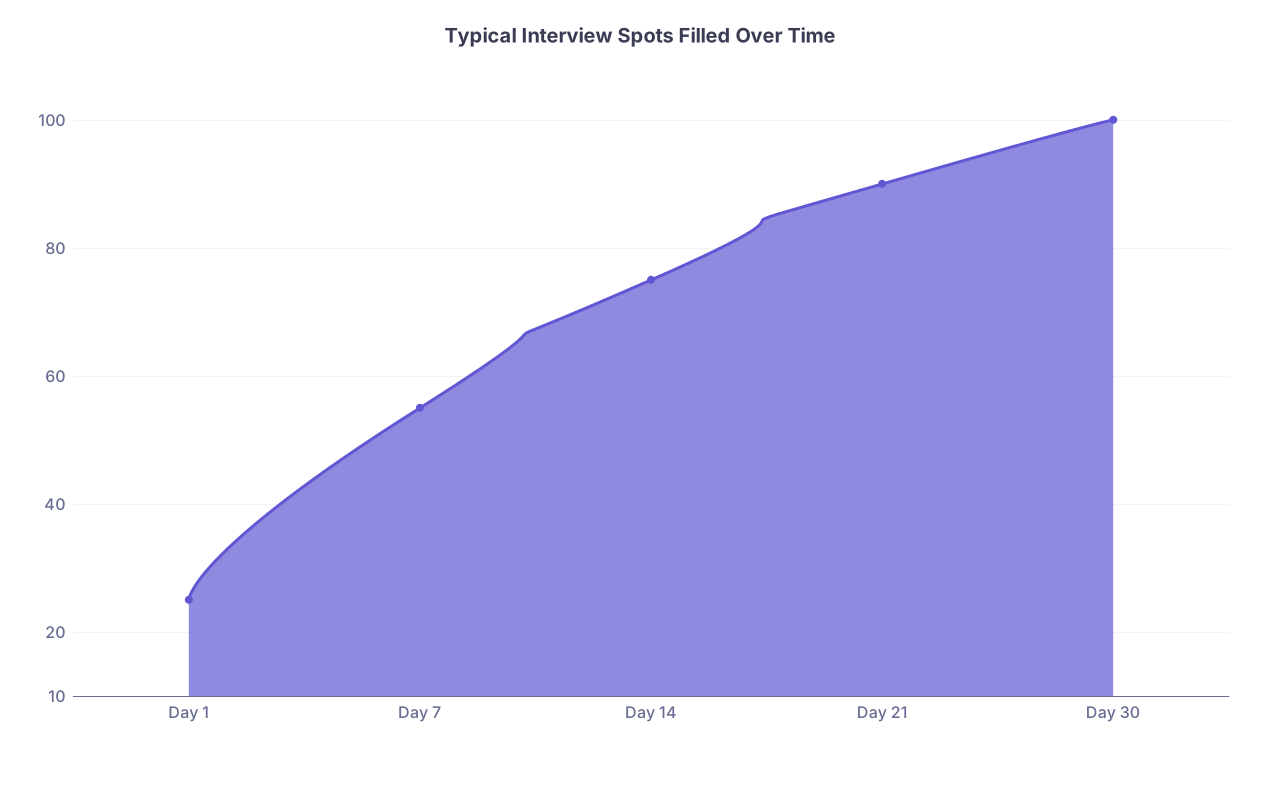
| Category | Value |
|---|---|
| Day 1 | 25 |
| Day 7 | 55 |
| Day 14 | 75 |
| Day 21 | 90 |
| Day 30 | 100 |
This is exaggerated, but not by much for some high-demand programs. By day 14, a lot of competitive programs have already sent most of their invites.
So the question “How late is too late?” is really:
At what point have so many interview spots gone out that you’re only catching scraps?
For most people and most specialties, that inflection point is somewhere between 1–3 weeks after applications are released to programs.
Common Scenarios: Where You Actually Stand
Let’s walk through the most common timing questions I get.
Scenario 1: “I’m submitting the morning applications open to programs. Is that OK?”
Yes. That’s fine.
Submitting on the release day (before programs download) is considered on time. You’re essentially in the first batch. No one cares if your timestamp is 9:00 am or 3:30 pm.
Strategy if you’re here:
- Make sure letters and scores are actually in
- Don’t hold submission for one “maybe” letter—better to be complete early
Scenario 2: “I submitted 3–7 days after programs could see apps.”
Translation: Late September to first few days of October.
This is mildly late but often salvageable:
- Highly competitive specialties: This can hurt, especially if you’re not a top-tier applicant on paper. You may still get interviews, but expect fewer and from less selective programs.
- Mid / low-competitive specialties: Usually acceptable if your app is solid; you might just miss out on some early, most competitive programs.
Action items:
- Make sure everything else is tight: no typos, strong PS, clear experiences
- Email a very small, targeted list of programs where you have genuine ties (home, away rotation, hometown) to let them know you applied
Scenario 3: “I’m going to submit in mid-October. Is it worth it or should I wait a year?”
Now we’re in the danger zone.
Reality:
- You will absolutely miss a significant chunk of interview spots at many programs.
- But that doesn’t automatically mean “don’t apply.”
This is where context matters:
You might still apply this year if:
- You’re aiming for FM, IM (community), Peds, Psych, or Pathology
- Your stats are solid for that field
- You’re aiming heavily at home program or places where you have connections
- You understand you may need a backup plan: prelim year, TY, or SOAP
You should seriously consider delaying if:
- You’re targeting Derm, Ortho, ENT, Plastics, Neurosurgery, competitive Radiology
- You don’t have a home program that knows and supports you strongly
- Your Step scores / clerkship performance are average or below for the specialty
In ultra-competitive fields, mid-October isn’t just late. It’s a near self-sabotage unless you’re a unicorn candidate.
Scenario 4: “It’s November or later. Should I still apply?”
Let me be direct: for most first-time applicants, November = functionally a reapplicant year in disguise.
Programs have:
- Already sent most invites
- Already created their “waitlist” of potential backups
- Filled many interview schedules
Applying in November or December might still make sense if:
- You had a last-minute change to a less competitive specialty and just pivoted
- You’re applying almost exclusively to your home program and maybe 10–15 others, acknowledging the odds
- You’re prepared—mentally and financially—to go through the cycle again if it doesn’t work
If you’re in this zone, I’d strongly recommend:
- Talking to your dean’s office or specialty advisor
- Strategically deciding: apply now vs. regroup and apply early and strong next year
What If My Letters or Step 2 Are Delayed?
This is the big stress point: “Should I wait for everything to be perfect or submit on time with some pieces pending?”
Here’s the blunt framework:
Letters of Recommendation
- You do not need all 3–4 letters uploaded to hit submit.
- You should have at least 2 solid letters in by the time programs download apps.
- A missing 3rd or 4th letter is less harmful than delaying submission by 1–2 weeks.
So:
- Submit your ERAS on time with the letters you have.
- Have additional letters added as they come in.
- You can assign new letters to programs later.
Waiting for “that big name” letter often costs more in timing than it gains in clout.
Step 2 CK (or COMLEX Level 2)
- For competitive specialties, many programs want Step 2 by interview season, but not always by the exact day apps open.
- For less competitive or primary care specialties, a pending Step 2 is usually fine if Step 1/Level 1 is strong.
General advice:
- If Step 1 is good or excellent: Don’t delay ERAS waiting for Step 2.
- If Step 1 is weak or marginal: Step 2 can rescue you—but not if the timing kills your application.
In borderline cases:
- Submit ERAS on time.
- Email certain programs after Step 2 posts to flag improved performance.
Decision Flow: Should You Submit Now or Wait?
Use this quick mental flow (or throw it on a whiteboard):

| Step | Description |
|---|---|
| Step 1 | What month is it? |
| Step 2 | Submit when ready, aim for complete app |
| Step 3 | Submit ASAP, dont hold for minor items |
| Step 4 | Realize its late, target less competitive + connections |
| Step 5 | Strongly consider waiting a year |
| Step 6 | Submit selectively, manage expectations, plan backup |
| Step 7 | Before or on release day? |
| Step 8 | Within 2 weeks of release? |
| Step 9 | After mid-October? |
| Step 10 | Specialty highly competitive? |
If you’re reading this in:
- August / early September: aim to submit at or slightly before the release date.
- Late September / early October: submit immediately; stop chasing “perfect.”
- Mid to late October+: get personalized advice. The wrong move here can waste a full year and a lot of money.
Strategic Moves If You’re Already Late
If the damage is done and you’re submitting after the ideal window, then you don’t get perfection. You get triage:
Narrow and smart list
Don’t shotgun 100 programs if you’re late; that just wastes money. Focus on:- Home program
- Places where you rotated
- Programs in your geographic region or where you have strong ties
- Slightly-less competitive programs
Personal outreach (but not spam)
Email:- Program coordinators of places where you rotated
- Your home program PD
- A small group (5–15) of programs where you have a real connection
Content: short, respectful, and specific—no begging.
Backup planning
If you’re late and in a tough specialty, you should:- Consider a parallel application in a less competitive field (if genuine interest)
- Think ahead about possible SOAP strategies
- Use the “off” year (if you ultimately wait) to fix what’s weak: research, Step scores, letters, meaningful work
Stop sinking time into cosmetic tweaks
At some point, cutting one more adjective from your personal statement doesn’t matter as much as hitting “submit.” If you’re beyond release day, that point is now.
Quick Reality Check by Date
Assume ERAS release to programs is late September (adjust a couple days for the actual year):
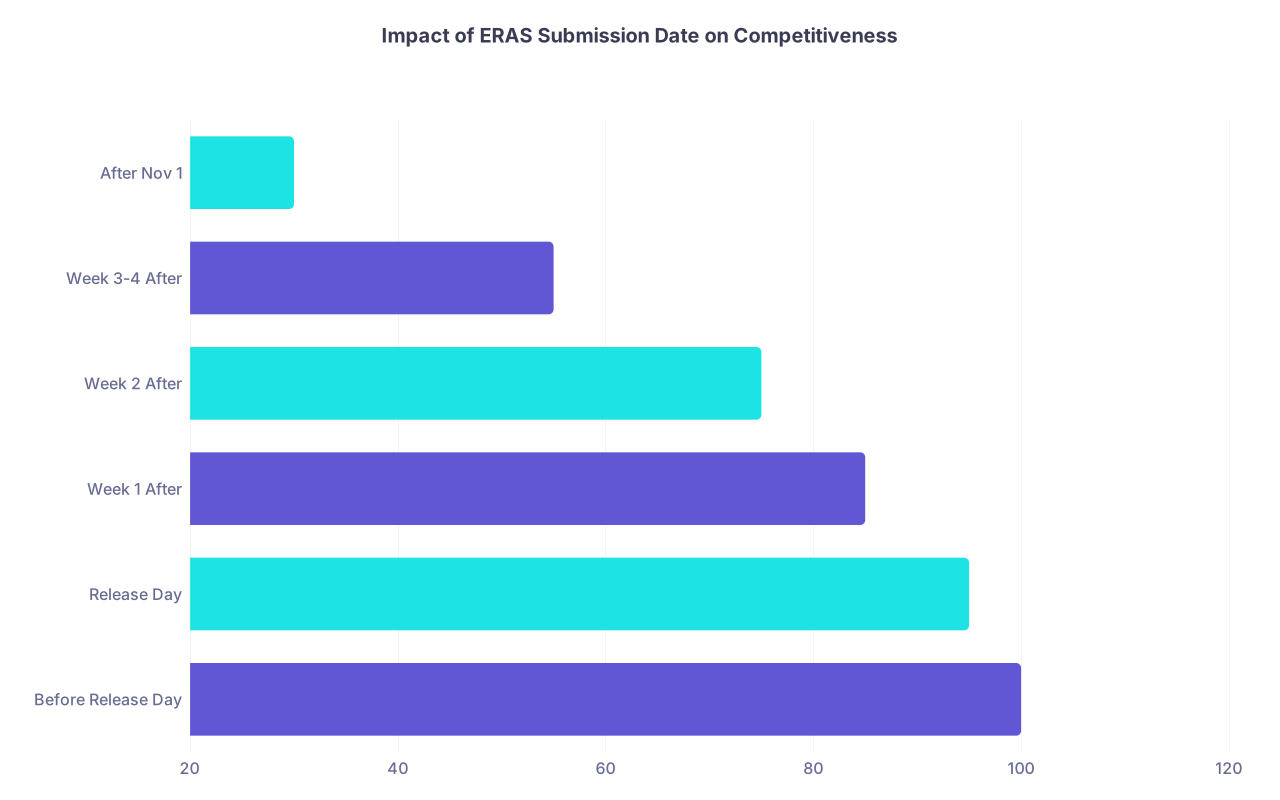
| Category | Value |
|---|---|
| Before Release Day | 100 |
| Release Day | 95 |
| Week 1 After | 85 |
| Week 2 After | 75 |
| Week 3-4 After | 55 |
| After Nov 1 | 30 |
These numbers aren’t exact, but the trend is real. Earlier strongly helps. Late seriously hurts.
If today is:
- Sept 1–release day: You’re fine. Focus on completeness and quality.
- Release day–Oct 7: Submit now; don’t hold for minor things.
- Oct 8–Oct 31: Late, but not always fatal. Be strategic, targeted, and realistic.
- Nov 1+: Consider whether this cycle is actually a dress rehearsal for next year.
FAQs
1. Is submitting ERAS one or two days after programs can see applications a big deal?
Not really, especially for mid- to low-competitive specialties. One or two days isn’t the issue. The problem starts when you’re a week or more behind the initial download. For hyper-competitive fields, even a few days can hurt at the top-tier programs, but it’s not an automatic death sentence.
2. Should I delay submitting ERAS to wait for a strong “big-name” letter?
Usually no. Being in the first batch of applications is more valuable than swapping a decent existing letter for a slightly stronger one from a fancy name. Submit with at least 2 solid letters. Let the big-name letter upload later and add it then.
3. I don’t have Step 2 yet. Will submitting on time with only Step 1 hurt me?
It depends on your Step 1 and specialty. If Step 1 is strong, submit on time and let Step 2 follow. If Step 1 is weak and your practice Step 2 scores are clearly higher, there’s an argument for taking and releasing Step 2 as early as possible—but not at the cost of sliding into October/November.
4. Is it better to apply late this year or wait and apply early next year?
If you’re going into a very competitive specialty and you’d be submitting in mid-October or later, waiting and applying early next year is often the smarter move. For less competitive fields, a late application can still be reasonable, especially if you’re okay with a wider or less selective set of programs and have strong ties or a home program.
5. If I’m already late, will emailing programs help me get interviews?
It can help a little, but only if done surgically. Emails to:
- Home program
- Places where you’ve rotated
- Programs where you have a genuine tie
Keep it brief, professional, and focused. Mass-emailing 80 programs with a generic “please look at my file” message won’t save your season and can irritate people.
Bottom line:
- “On time” for ERAS means in the first batch when programs download, not “sometime in October.”
- Once you’re more than 1–2 weeks past release, the penalty ramps quickly, especially in competitive specialties.
- If you’re late, stop chasing perfection, submit strategically, leverage your real connections, and be brutally honest about whether this is your real shot or a practice run for next year.