
It’s mid-September. ERAS just opened for program download this morning, and you’re staring at your screen wondering: “If I submit today… is that still considered on time? Did I just screw myself by not hitting submit on the first possible second?”
Here’s the blunt answer you’re looking for.
The Core Answer: What Counts as “On Time” for ERAS?
If we’re talking about being considered “on time” and competitive at most programs, the standard is:
- Submit ERAS by the time programs can first download applications
- Have USMLE/COMLEX, letters, and MSPE in as close to that date as possible
- After that date, every week you delay makes things a little worse, but you’re not dead in the water until you’re 3–4+ weeks late (depending on specialty)
The specifics change slightly each year, but the pattern is the same:
- There’s a date when applicants can start submitting ERAS (your “submit” button activates).
- There’s a separate date when programs can first download applications.
That’s the one that really matters for “on time.”
You are considered on time if:
- Your application is certified and submitted on or before the program download date,
OR - You’re within about 3–5 days after that date for most non-ultra-competitive specialties.
For very competitive specialties (derm, ortho, plastics, ENT, ophtho, neurosurg, some road specialties like rads/gas at top places), you want to be submitted on or before the download date, not “a few days after.”
Bottom line:
“On time” = by the program download date.
“Still okay but not ideal” = within the first week after.
“Late” = >2–3 weeks after download date (earlier for competitive fields).
Why the Download Date Matters So Much
Programs don’t sit around waiting for your application to trickle in one by one. They batch this.
Here’s how it usually works:
- Morning of the download date
Coordinators pull the first big batch of applications. - First 1–2 weeks after download
Screening happens. Faculty and PDs start flagging people for invites. Calendars open. The first wave of interview invites is built mostly from this initial pool. - Later apps trickle in
They get looked at when someone has time. Which is rarely a priority.
If you’re not in that first batch, you’re:
- Competing for fewer interview spots
- Trying to get noticed after many programs already built their A-list
That doesn’t mean you’re doomed if you’re a week or two late. But you’re making your life harder for no good reason.
A Simple Rule by Specialty Competitiveness
Let’s make this concrete.
| Specialty Type | Ideal Submission | Still Reasonable | Functionally Late* |
|---|---|---|---|
| Ultra-competitive (DERM, ENT, Plastics, Ortho, NSGY, Ophtho**) | 1–3 days BEFORE download | By download date | >3–5 days after download |
| Competitive (EM, Rads, Anes, GI prelims, top IM/FM) | By download date | Within 7 days after | >2 weeks after download |
| Less competitive (many IM, FM, Psych, Peds, Neuro, Path) | By download date | Within 2 weeks after | >3–4 weeks after download |
*“Late” doesn’t mean impossible. It just means your odds drop materially.
**Yes, some of these use separate application systems (e.g., SF Match), but the timing principle is identical.
If you’re applying to a mix of specialties (e.g., prelim medicine + advanced anesthesiology), you time things for the most competitive of the bunch.
What Actually Needs to Be Ready by “On Time”?
This is where a lot of people quietly panic:
“I can submit ERAS, but two letters are missing, my Step 2 just posted, and my PD letter isn’t in yet. Does that still count as on time?”
Here’s how programs see it.
1. Core Application Pieces
To be truly “on time,” you want all of this in by the program download date:
- ERAS application certified and submitted
- Personal statement uploaded
- Program list chosen and assigned statements
- USMLE/COMLEX scores released to ERAS
- Transcript requested from your med school
That’s the backbone.
2. Letters of Recommendation
Perfect world: you’ve got 3 letters (or 4 if your specialty expects it) in by the download date.
Real world: you’re still okay if:
- You have at least 2 strong letters in when programs first download
- The others trickle in during the first 1–2 weeks after
Programs understand letters lag. Most don’t reject you out of hand for having 2 instead of 3 on day 1, as long as the missing one(s) come reasonably soon.
The exception:
Specialties that treat a specific letter as essential (e.g., EM SLOEs, surgery PD/chair letters). Those really should be in as early as possible.
3. USMLE Step 2 / COMLEX Level 2
If Step 2/Level 2 is mandatory or heavily weighted in your specialty (it is, practically, for almost all now), then:
- If scores are ready → release them before the download date
- If scores are pending → still submit on time, then auto-release when available
Don’t hold your whole ERAS hostage waiting for one score if that means you’ll be weeks past when programs start building their lists. I’ve watched people tank their cycle doing exactly that.
Practical Timeline: What “On Time” Looks Like Week by Week
Let’s map this to an actual ERAS season structure.
Use this as a rough template; plug in the exact dates for your year.
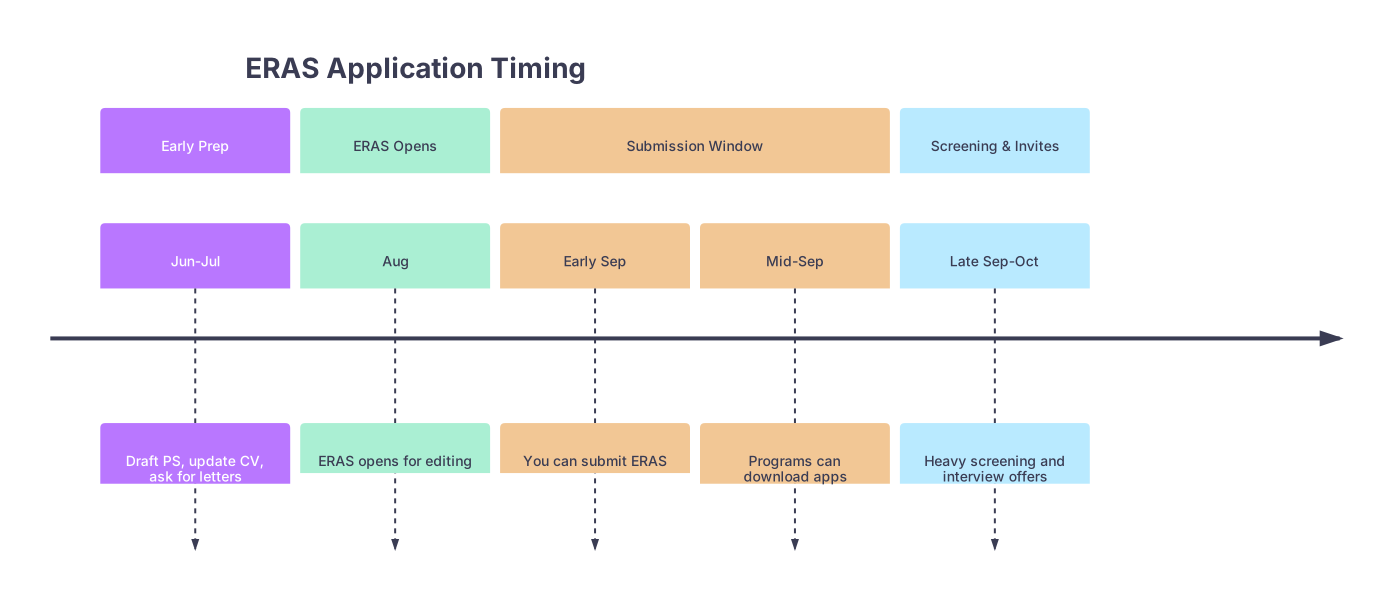
| Period | Event |
|---|---|
| Early Prep - Jun-Jul | Draft PS, update CV, ask for letters |
| ERAS Opens - Aug | ERAS opens for editing |
| Submission Window - Early Sep | You can submit ERAS |
| Submission Window - Mid-Sep | Programs can download apps |
| Screening & Invites - Late Sep-Oct | Heavy screening and interview offers |
How this translates to your behavior:
June–July
Get letters requested. Build your CV section. Outline personal statements.August (ERAS opens to applicants)
Treat August as “build and polish” month. This is where you fill in ERAS, final draft PS, and nag letter writers.Early September (submission opens)
Once the submit button is live, your internal deadline should be:
Submit no later than 3–5 days before program download date, OR at absolute worst, by that download date.Mid-September (program download date)
If you’re hitting submit on this day or a couple of days after, you’re still “on time” by most reasonable standards. Especially for non-ultra-competitive specialties.Late September onward
Every week after the download date is a little more painful.
Two weeks late? Noticeable disadvantage.
Four weeks late? At that point you’re fishing for scraps unless you’re a 260+ / AOA type or applying very broadly to less competitive fields.
How Much Does Being a Little Late Actually Hurt?
Let me quantify this in a way you can use.
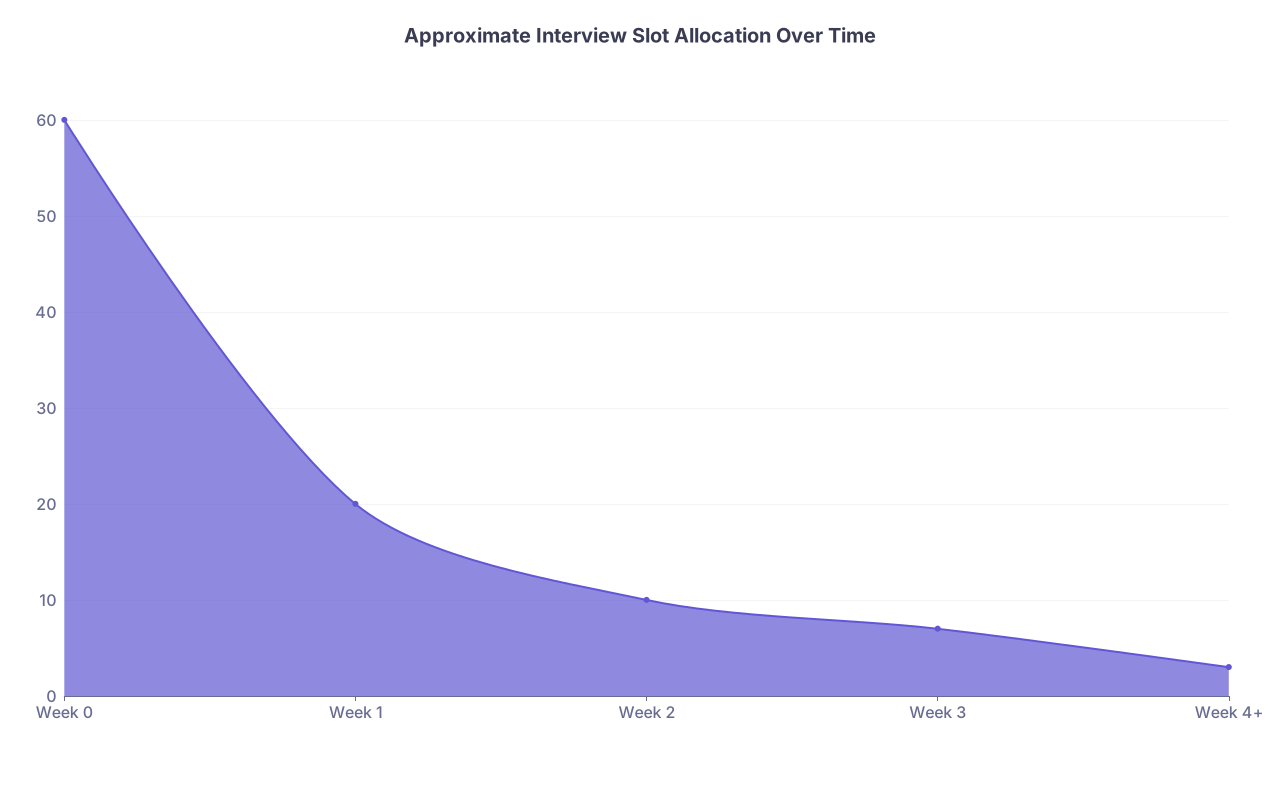
Assume the program opens 100 interview slots.
Programs often do something like this (not written, but it’s how behavior looks):
| Category | Value |
|---|---|
| Week 0 | 60 |
| Week 1 | 20 |
| Week 2 | 10 |
| Week 3 | 7 |
| Week 4+ | 3 |
- Week 0 (download week):
50–70% of interview slots are effectively “decided” or at least strongly considered. - Week 1–2:
Another 20–30% of spots filled from later reads, faculty requests, home students, and flagged applicants. - Week 3–4+:
Programs are mostly filling cancellations, no-shows, and a few late add-ons.
So:
- Submit on time → You’re in that big initial pool.
- Submit 1–2 weeks late → You’re in the smaller secondary pool.
- Submit 3+ weeks late → You’re hoping someone cancels or they misjudged how many invites to send.
Can you still match with a late app? Absolutely. I’ve seen someone submit 3 weeks after download, still land 8 interviews in IM, and match fine. But they had great scores, strong home support, and applied widely.
Most people don’t have margin for that kind of gamble.
“I’m Not Ready by the Ideal Date. What Should I Do?”
Here’s the decision framework I’d use if I were in your shoes.
Scenario 1: One small section isn’t perfect
Example: One PS isn’t amazing yet, or you’re missing one letter, or one research entry needs cleanup.
→ Submit on time anyway.
Fix small stuff fast, but don’t slip past the download date for polishing adjectives. Programs don’t care if your PS is 5% better.
Scenario 2: A major required piece is missing but will be ready in 3–7 days
Example:
- A critical letter (like EM SLOE, surgical PD)
- You just finished an away and the letter writer promised end-of-week
- Your Step 2 score is posting in 3 days
→ If you’re still before the download date:
Submit as soon as you can, ideally 1–3 days before download. Letters and scores will attach when they’re ready.
→ If delaying 3–7 days means you’ll be a tiny bit after the download date:
I’d still lean toward submitting by the download date, then letting that letter/score come in late—especially if the rest of your application is strong.
Scenario 3: You’re weeks behind (personal issues, late rotations, poor prep)
You’re looking at being 2–4 weeks after the download date no matter what.
Ask yourself:
- Are you applying to a less competitive specialty and/or extremely broadly?
- Do you have strong metrics or strong home institution support?
- Is delaying a year absolutely not an option for you?
If yes to those, you can still submit and take your swing, but be realistic:
- Expect fewer interviews
- Add more programs than you originally planned
- Lean on your school’s advising and any PDs you know to help flag your app when appropriate
| Category | Value |
|---|---|
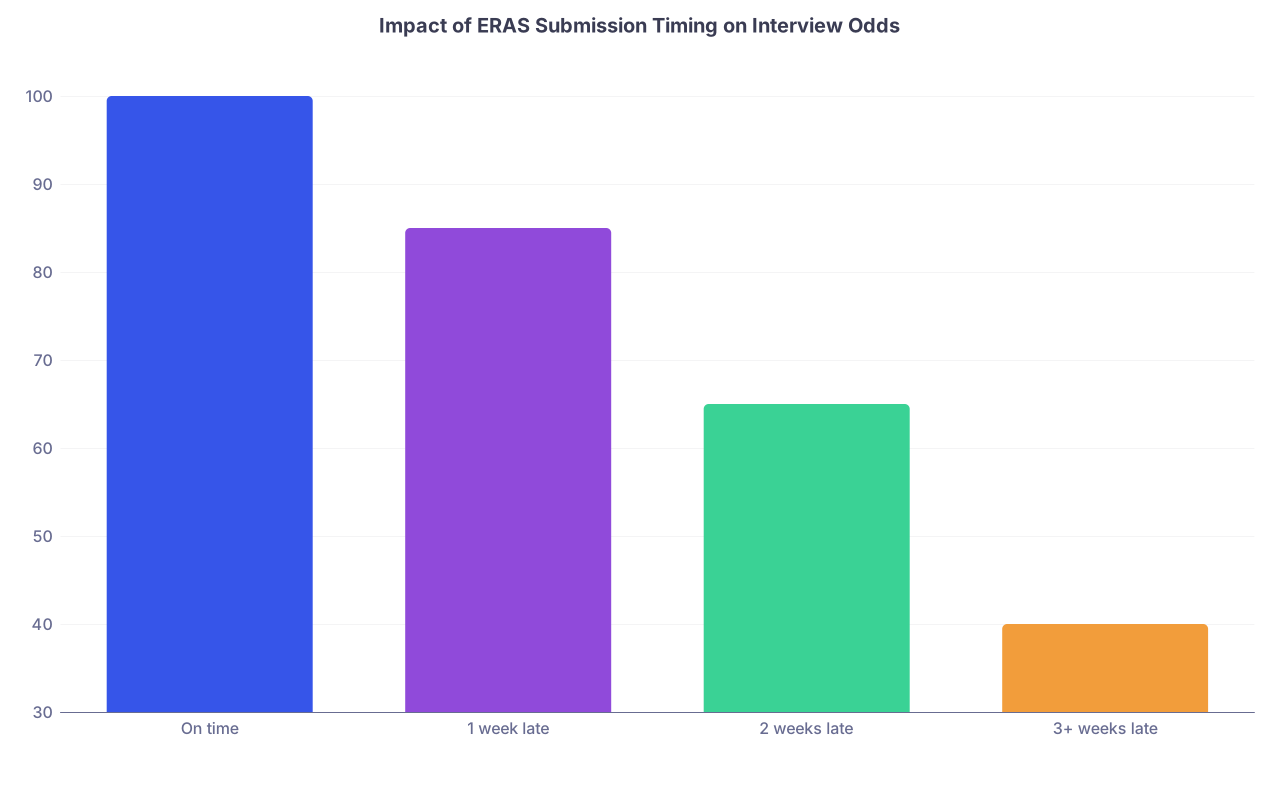
| On time | 100 |
| 1 week late | 85 |
| 2 weeks late | 65 |
| 3+ weeks late | 40 |
(Think of this as a rough “relative odds” picture, not exact percentages.)
Common Myths About ERAS Timing
Let’s kill a few bad takes I hear every year.
“If I don’t submit on the first possible day, I’m screwed.”
Wrong. Submitting anywhere from a few days before to a few days after the download date is functionally the same at most programs.“I should wait until all my letters are in before submitting.”
Usually wrong. Submitting on time with 2–3 letters beats submitting late with all 4.“My PD told me timing doesn’t really matter.”
Sometimes PDs say this to reduce anxiety. In practice, timing absolutely affects how often your app actually gets read and how early it gets into the “offer interviews” pile.“I can ‘stand out’ by applying later so they see my app when things calm down.”
No. By then they’ve already fallen in love with 80–90% of their interview list.
Quick Checklist: Are You “On Time”?
By the program download date, you want this mostly true:
- ERAS certified and submitted
- Personal statement(s) uploaded and assigned
- Transcript requested and/or uploaded
- USMLE/COMLEX scores released
- At least 2 letters of recommendation in (3+ is better, 4 if your specialty expects it)
- Program list selected and PS correctly assigned
If you’re missing one item but it’s coming within a few days, you’re fine.
If you’re missing half of this… you’re drifting into “late” territory even if the calendar says otherwise.
FAQ (Exactly 7 Questions)
1. If I submit ERAS the day programs can download applications, is that still considered on time?
Yes. Submitting on the download date is still “on time” for almost every specialty. For very competitive fields, I’d rather see you submitted a day or two before, but same-day submission is still acceptable.
2. How bad is it if I submit one week after programs can download applications?
One week late is not ideal, but it’s far from catastrophic. You’ll still be in the game for most programs, especially in less competitive fields. You might lose out on a few early interview spots, but you’re not “too late.”
3. Do all my letters of recommendation need to be in before I submit?
No. Submit on time with what you have, as long as you’ve got at least 2 solid letters already in. The remaining letters can follow within 1–2 weeks. The only time I’d seriously consider waiting is when a required letter (e.g., EM SLOE) isn’t in and will be within a few days.
4. Should I delay submitting my ERAS so it includes my Step 2 score?
Usually no. If delaying for Step 2 means you miss the download date or are more than a few days behind it, that’s a bad trade. Submit on time, let the score update when it’s ready. Programs are used to that.
5. Is it better to submit a “perfect” application late or a “good enough” one on time?
“Good enough” on time wins. Every time. Programs aren’t grading your prose. They’re looking at content—scores, grades, letters, experiences. Polishing your personal statement or slightly rewording activities is not worth being late.
6. If I’m 3–4 weeks late, should I still apply this year or wait?
That’s individual. If you’re aiming for a very competitive specialty and your app is average, 3–4 weeks late is a serious handicap. You might want to talk honestly with advisors about waiting a cycle. If you’re going into a less competitive specialty, willing to apply broadly, and have solid metrics, it can still be reasonable to apply—just temper expectations.
7. Do programs actually look at submission date when screening applications?
Some do, some don’t, but here’s the key: even if they don’t explicitly filter by date, earlier apps are simply more likely to be read carefully and considered for the first wave of interviews. So the submission date indirectly affects your chances, even when it’s not a formal criterion.
Key takeaways:
- “On time” for ERAS means submitted by the program download date, or at worst within a few days after.
- Don’t hold your application hostage for tiny improvements—submit on time with an 85–90% polished app, not late with a 100% polished one.
- Every week after the download date quietly lowers your odds, so treat timing like it matters—because it does.