
Most applicants think ERAS timing is just about personal statement and scores. The real bottleneck is your letters.
If you mis-time your ERAS submission around your chair letter and Sub-I letters, you quietly sabotage your own application. I have watched excellent applicants lose interview spots because they waited for the “perfect” letter… and their file sat incomplete for 3–4 critical weeks.
Let me break this down specifically: when to submit ERAS relative to
- a department chair letter, and
- Sub-I letters (home and away),
and how the timing shifts depending on specialty competitiveness.
Chair Letters vs. Sub-I Letters: What They Actually Do For You
First, stop treating all letters as interchangeable. Programs do not.
Chair Letter: Currency of “Are You Safe to Interview?”
In many core specialties, the chair letter is a gatekeeper. It answers two questions:
- Is this applicant safe for us to interview?
- Does their own department stand behind them?
Where chair letters are traditionally expected:
- Internal Medicine
- General Surgery
- Neurology (many places)
- Psychiatry (often)
- OB/GYN (many programs)
- Some medicine subspecialty-fast track or categorical tracks
Where chair letters are less central / not standard:
- Emergency Medicine (SLOR/SLOE ≫ chair)
- Dermatology, ENT, Ortho, Neurosurgery, Plastics (departmental support matters, but “chair letter” has different weight and structure; often a PD or division chief letter plays that role)
- Pathology, PM&R, Radiology (program style varies, but Sub-I letters and research mentors can be equally or more valuable)
What chair letters actually add:
- Department-level endorsement (“We know this person, we’re not embarrassed by them.”)
- Professionalism / no-major-issues assurance
- Summary of clinical performance across clerkships and home electives
- Context: any leaves, remediation, or nontraditional paths
What chair letters do not usually add:
- Detailed, day-to-day clinical observations
- Rich, procedure-level commentary
- Very individualized texture (many are semi-templated, especially at large programs)
Sub-I / Acting Internship Letters: The Real Performance Data
Sub-I / AI letters do the heavy lifting on “How will this person function as an intern here tomorrow?”
They show:
- Reliability: showed up on time, didn’t disappear, answered pages
- Work ethic: pre-rounded, followed up on results, owned patients
- Team function: worked with residents, nurses, consultants without drama
- Clinical reasoning: can synthesize and present, not just regurgitate UpToDate
And crucially:
- Away Sub-I letters tell programs: “This person came to a different system, with different EMR and culture, and still performed.”
If you’re in a competitive specialty (surgical fields, Derm, ENT, Ortho, EM, Neuro, etc.), your Sub-I / SLOE / away letters often carry more practical weight than the chair letter.
So why does this matter for timing? Because these letters are generated on totally different clocks.
The ERAS Timeline: What Programs Actually See and When
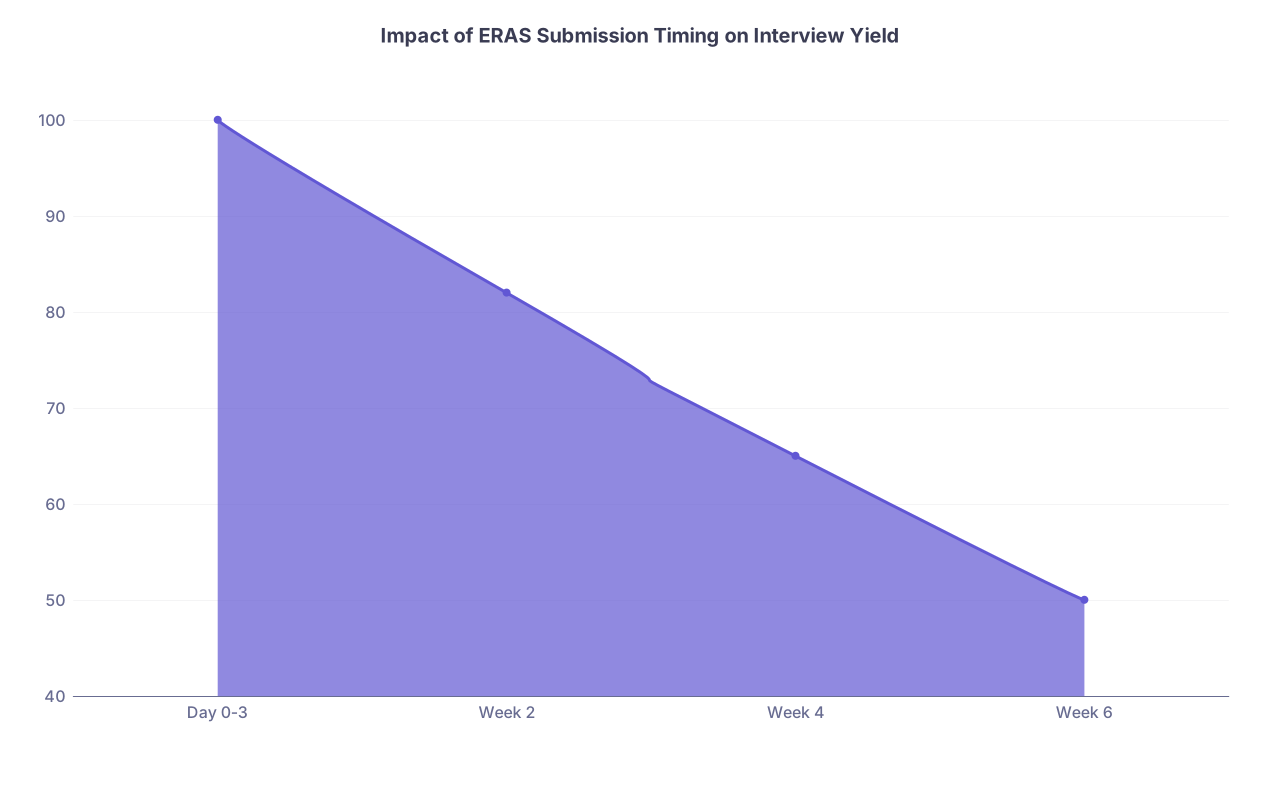
| Category | Value |
|---|---|
| Day 0-3 | 100 |
| Week 2 | 82 |
| Week 4 | 65 |
| Week 6 | 50 |
Here is the part students underestimate: there is a massive difference between being complete on Day 0–3 and on Week 3–4.
Broad outline (for a typical September ERAS opening for residency):
- Early September: ERAS opens for applicant submission.
- ~Mid to late September: Programs get access to applications.
- Late September–October: Most interview invites for competitive specialties go out.
- November–January: Interviews occur; late invites trickle.
Programs triage thousands of applications. They batch:
- Auto-screen by scores, school, red flags.
- Pull complete files meeting their filters.
- Select interview offers from that complete batch.
If your file is incomplete—missing key letters—when they do this first-pass sort, you get:
- Dropped to “incomplete – review later” queue
- Or never robustly reviewed at all
You must separate two decisions:
- When to hit “Submit” on ERAS.
- When your application becomes truly “Complete” at target programs (i.e., all required and high-impact letters uploaded).
Those are not the same day. Nor should they be.
General Rule: Submit ERAS Early, Accept Incomplete Letters… but Only Up to a Point
Let me be blunt: you should almost always submit your ERAS the first week it is allowed, even if a chair or Sub-I letter is pending.
Why?
- ERAS submission date establishes you in the system.
- You can assign letters as they arrive.
- Programs see your application as soon as they download pool files; if your essentials are there, you get into their first-pass consideration.
But there is a catch: what counts as “essential” shifts by specialty and letter type.
Part 1: Aligning ERAS with Chair Letters
Chair Letter Timing Realities
Chair letters are notoriously slow for a few structural reasons:
- Chairs are busy, clinically and administratively.
- Many use a committee or vice-chair to draft, then edit.
- Offices batch them: “We’ll write them all after our August promotions meeting.”
Typical patterns I have seen at multiple institutions:
- Request window: May–July
- Internal deadline to request: often June-ish
- Actual upload: anywhere from mid-August to mid-October (yes, really)
So you face a classic trade-off:
- Submit ERAS with strong Sub-I + core clerkship letters, chair pending
vs. - Wait 2–3 extra weeks for chair letter so your file is “complete” before submission
In most cases, waiting is the worse choice.
When Chair Letter is Required vs. Strongly Preferred
First, you need to know the policy of the specialties and target programs.
Three categories:
- Chair letter explicitly required for your specialty at many programs (classic IM/GS style).
- Chair letter strongly preferred but not formally required.
- Chair letter optional / mainly for home program signaling.
Your strategy must match which category you are in.
| Specialty | Chair Letter Role |
|---|---|
| Internal Medicine | Often required/expected |
| General Surgery | Frequently required |
| Neurology | Common, sometimes required |
| Emergency Med | Optional; SLOEs dominate |
| Dermatology | Variable; PD/research key |
Category 1: Chair Letter Truly Required
If programs in your specialty explicitly state “Chair letter required” or your dean’s office says “All serious applicants in X specialty must have a chair letter,” treat it as a structural requirement.
Strategy:
- Request chair letter as early as your school allows. Push politely for an upload date.
- Submit ERAS in the first submission window with:
- Personal statement
- CV complete
- USMLE/COMLEX scores
- At least 2 strong clinical letters (e.g., core clerkship attendings, early Sub-I, research mentor if clinical)
- Assign the chair letter to all programs in that specialty the moment it uploads.
The key nuance: Programs know chair letters are often late. Many will start screening you with your existing letters and then update when the chair letter comes in. What kills you is not the chair letter being late; it is the whole file being late.
If your chair letter is absurdly delayed (e.g., mid-October), then:
- For the most competitive programs, some interview spots may be gone.
- But you still have a better shot than if you submitted everything October 10 just to have a “complete” day-0 file.
Category 2: Chair Letter Strongly Preferred
Here, chair letters matter, but they are not the make-or-break structural requirement.
Your priority becomes:
- Two to three excellent clinical letters from people who have actually watched you function at intern-level responsibility.
- Then chair letter.
In this setting, I generally recommend:
- Make sure at least:
- One strong core clerkship letter (or equivalent senior elective) is in.
- One Sub-I / AI or away letter (if you have done one before ERAS submission) is in.
- Submit ERAS on time regardless of chair letter status.
- Assign chair letter later; programs see it as an added endorsement.
Do not hold ERAS submission to wait for a “nice but not mandatory” chair letter. That is how strong applicants end up in the “late complete” pile for no good reason.
Category 3: Chair Letter Optional
For EM, some radiology programs, pathology, PM&R, and many highly subspecialized fields, the chair letter is nice but does not structurally change your application.
You treat it as “bonus signal,” not as a critical path item.
In these cases:
- Your EM SLOEs, Sub-I letters, and possibly research PI letters are the core.
- Submit ERAS with those in; never delay for a chair letter.
- If you get a chair letter, assign it very selectively—where you know it will actually be read and valued.
Part 2: Aligning ERAS with Sub-I and Away Letters
Here is where most applicants get into trouble. They finally do the high-yield Sub-I or away rotation in August or September, and then panic because the letter will not be back in time for Day 0 ERAS.
The Reality of Sub-I Letter Turnaround
Typical turnaround (when not explicitly rushed):
- Rotation ends: late July, August, or September
- Student submits ERAS letter request: last week of rotation or just after
- Attending writes letter: 2–4 weeks after rotation (if you are lucky)
- Upload to ERAS: often mid- to late September, sometimes October
That means your single best letter might not exist on September 10.
The instinct is to “wait until that letter is in, then submit.” That is the wrong instinct 90% of the time.
High-Yield Rule: Early Submission + Staggered Letter Completion
You must stop thinking in binary: “complete vs not complete.” Think staged optimization:
Phase 1 (ERAS submission week):
- ERAS submitted with:
- Completed experiences and personal statement
- All scores in
- At least 2 letters already uploaded:
- 1 solid core clerkship (medicine/surgery/primary specialty-related)
- 1 additional: research mentor, another core, early Sub-I if available
Phase 2 (first 2–3 weeks after submission):
- Sub-I and away letters trickle in.
- You assign them immediately to your program list.
- Programs that have not yet fully finalized their interview list will catch that stronger signal.
Does this protect you 100% at every hyper-competitive program that batch-screens in the first 3 days? No. But it protects you at far more places than waiting 3–4 weeks just to submit “with all letters present.”
Specialty-Specific Nuances for Sub-I / Away Letters
Let’s be concrete.
Internal Medicine
Ideal letter mix by October:
- Chair or PD letter (home)
- 1 Sub-I/AI letter (preferably inpatient medicine) – home or away
- 1 additional clinical letter (another medicine rotation, ICU, or subspecialty where you functioned like an intern)
If your medicine Sub-I is in August:
- Submit ERAS when allowed.
- Aim to have at least one non-Sub-I medicine letter plus any one decent clinical letter.
- Let the August Sub-I letter arrive late September; assign immediately.
If your Sub-I is in September:
- You will not have that letter for first-pass reviews at many places.
- So load up your early application with:
- A high-quality medicine core clerkship letter
- Strong non-medicine but clinically rich letter (e.g., ICU, surgery if relevant)
- Then use your late Sub-I letter as a “booster” for programs that are slower to decide or that you know make later offers.
General Surgery
Surgery is less forgiving with late letters at some big-name places, but the same fundamental rule holds: do not hold ERAS to wait.
By mid-October, a strong surgery applicant ideally has:
- Chair letter (or PD letter, depending on school structure)
- 1 home Sub-I in surgery
- 1 away Sub-I (if did one) or ICU/trauma letter from someone who watched you take call
If your away Sub-I is in August:
- You might get that letter before or soon after ERAS submission—great, but do not wait for it if the timeline slips.
If your away is in September:
- Assume that away letter will arrive too late to be part of first-pass screening at some top programs.
- You still go early with:
- Home Sub-I (if earlier in the year)
- Strong surgery core
- Any trauma/ICU letter if available
- Away letter then becomes a selective tool:
- Assign to that away program (obviously)
- Assign to places where you know the letter writer is recognized or where you have regional ties.
Emergency Medicine (SLOE Reality Check)
EM is its own animal. SLOEs > everything.
Minimum functional strategy:
- At least 1 SLOE uploaded by the time programs start reviewing.
- 2 SLOEs by early-to-mid interview season ideally.
If your first EM rotation (home or away) is in July:
- You push hard to have that SLOE in by early/mid-September.
- Submit ERAS on time with other letters, then assign SLOE the second it hits.
If your first EM rotation is in August/September:
- You still submit ERAS in early September.
- But you accept that you might not be pulled early at the most competitive places without a SLOE.
- As soon as the SLOE drops, you can get picked up on a second wave of reviews. Happens every year.
Balancing Letter Types: How Many, and Which First?
You get room for up to 4 letters per program in many specialties (some look at 3 more closely than 4, but fine).
You do not need all 4 present on Day 0.
Think hierarchy:
- Required structural letter
- Chair, PD, or SLOE if demanded by specialty/program.
- Anchor clinical performance letter
- Someone who saw you do intern-level work.
- Best Sub-I / away letter
- Particularly relevant for competitive specialties.
- Supplemental letter
- Research mentor (if clinically relevant), second Sub-I, or other strong clinical rotation.
Your early ERAS submission should include at least #1 and #2 wherever possible. #3 and #4 can follow later.
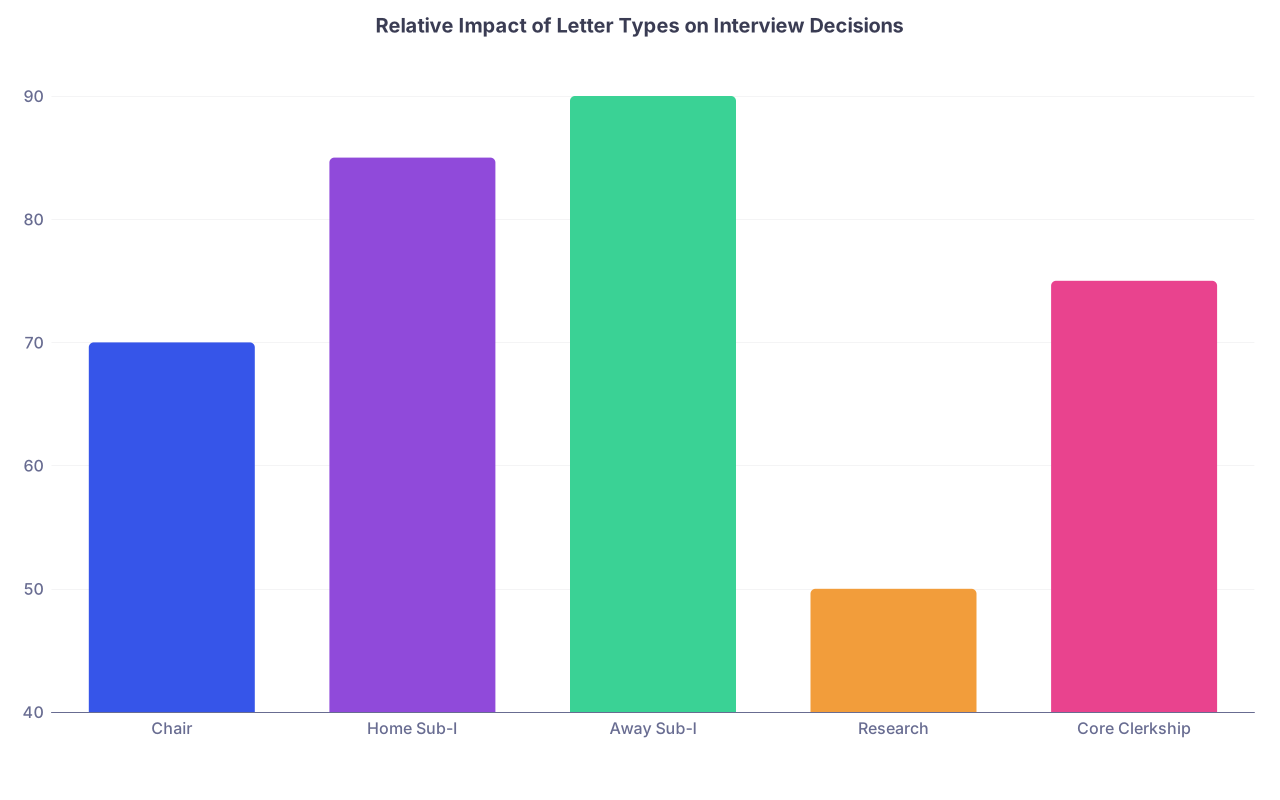
| Category | Value |
|---|---|
| Chair | 70 |
| Home Sub-I | 85 |
| Away Sub-I | 90 |
| Research | 50 |
| Core Clerkship | 75 |
(Scale here is conceptual: higher = typically more weight in interview decisions for clinical fields.)
Tactical Scenarios: What You Should Actually Do
Let me walk through the scenarios I hear constantly.
Scenario 1: “My chair letter will not be ready until late September. Should I delay submitting?”
No. Submit:
- ERAS in the first allowed window.
- With 3 letters: two solid clinical + one other (could be research if clinically meaningful).
Then:
- Assign chair letter to all programs in that specialty the day it hits.
- For hyper-competitive programs, send a brief, professional update email if your school’s culture allows:
“My chair letter has now been uploaded to ERAS and assigned to your program. I remain very interested in [Program].”
Scenario 2: “My best Sub-I is in September. I want that letter in before programs see me.”
You cannot have it both ways at most places.
Better strategy:
- Submit early.
- Use a strong earlier clinical letter as your anchor.
- Let the September Sub-I letter serve as a mid-season strengthener.
For a few absolute dream programs that you know batch-review late (some community or smaller academic places do this):
You can strategically delay assigning them until the Sub-I letter drops, but only if their stated review date is later. Do not guess—ask your dean’s office or mentors who know those programs.
Scenario 3: “I am dual-applying. One specialty wants a chair letter, the other does not.”
Classic example: IM + another field, or EM + IM.
Strategy:
- Submit ERAS once, early.
- For IM programs: prioritize getting chair + at least one medicine-focused clinical letter.
- For the second specialty: prioritize their “anchor” letters (SLOEs for EM, Sub-I letters for surgery, etc.).
You can assign different letter combinations to different programs within ERAS. Use that. For the “non-chair” specialty, do not clog your 3–4 letter slots with weak or generic chair letters if they add little.
When Is It Actually Reasonable To Delay ERAS Submission?
There are only a few legitimate reasons to delay beyond the first week:
- You have zero strong clinical letters uploaded yet (not “none of my ideal ones,” I mean truly zero).
- Your school releases MSPE and letters late for everyone and you know your main region’s programs traditionally do not start reviewing until that date.
- There is a catastrophic error in your ERAS content that you must fix before submission (transcript issue, missing score reported incorrectly, etc.).
Delaying 2–3 weeks solely because “my August Sub-I letter is not in yet and I really want them to see it” is almost always a net negative move.
Pressure Points by Competitiveness Level
You need to calibrate how aggressively you chase early completeness based on specialty competitiveness.
High-competition fields (Derm, Ortho, ENT, Plastics, NSGY, EM at top programs):
- Early application completeness matters more.
- A missing key letter (e.g., SLOE in EM, flagship away Sub-I letter) can hurt you at the top 10–15 programs.
- Still do not hold ERAS entirely, but push hard on letter writers early, and build your whole calendar to front-load those rotations.
Mid-competition (IM, Gen Surg, OB/GYN, Neuro, Anesthesia, PM&R):
- Early application still important, but more room for letters to trickle.
- Many programs send invites in waves; a stronger letter in week 2–3 can still yield an invite.
Less-competitive fields or those with more spots (Psych, Peds, FM in many regions):
- Timing remains relevant, but one late Sub-I letter will not usually sink you.
- Focus more on fit, geographic breadth, and coherent story across letters.
FAQs
1. If I submit ERAS with only 2 letters and add more later, do programs automatically see the new ones?
Yes. Once a program has downloaded your application, newly assigned letters become visible to them through ERAS. They do not need to “re-download” your whole file. However, whether they revisit your application in depth later is program-dependent, which is why you want at least 2 solid letters present at the time of their first serious review.
2. Should I ever replace a weaker letter with a stronger Sub-I letter mid-season?
You cannot “un-send” a letter from a program once assigned. ERAS does not allow you to un-assign. You can choose which letters to assign up front, but once a program has them, they keep access. So plan your initial assignments carefully; do not assign lukewarm letters you do not actually want read unless you truly need them to meet a program’s structural requirement.
3. How many total letters should I aim to have written, even if I only assign 3–4 to each program?
For most core specialties, 4–5 total letters gives you flexibility: chair, 1–2 Sub-I/AI, 1 strong core clerkship, and possibly 1 research or additional clinical mentor. You can then mix and match per program. More than 6 often just produces redundancy and letter fatigue, unless you are in a hyper-specialized research track where multiple PI letters matter.
4. My chair or Sub-I letter writer is very delayed. When is it appropriate to nudge them?
If it has been 2 weeks since your rotation ended or since they agreed to write, a short, respectful reminder is entirely appropriate. Example: “Dear Dr. X, I hope you are well. I wanted to kindly check in regarding the residency letter of recommendation for ERAS. Programs will begin reviewing applications shortly, and your letter would be extremely valuable for my application to [specialty]. Please let me know if there is any additional information I can provide.” If no response after another 1–2 weeks, you can involve your student affairs office quietly to assist.
Key Points:
- Submit ERAS early; do not hold your entire application hostage to a late chair or Sub-I letter.
- Distinguish structural letters (chair, SLOE) from performance letters (Sub-I); get at least one of each into the system as early as you can, then let stronger ones trickle in.
- Use your letter slots strategically by specialty and program—different combinations for different targets—rather than trying to force one “perfect” universal lineup on Day 0.