
Only 41% of applicants who plan to “wait for away evals” before certifying ERAS actually get those evaluations uploaded in time to matter for interview offers.
That number shocks people every year. They assume everything will line up neatly: away rotation ends, eval drops, ERAS gets updated, programs “re-review” their file. That is not how it works.
Let me break this down specifically: ERAS timing and VSLO timing run on almost parallel but not perfectly aligned tracks. If you do not understand where they cross—and where they do not—you can absolutely hurt your application by trying to be “strategic” and instead just being late.
This is about one thing: how to coordinate ERAS submission with your VSLO away rotation schedule and end-dates without shooting yourself in the foot.
The Real Timeline: ERAS vs VSLO vs Programs
First, the hard structure. You cannot negotiate with this.
, Week 1, Week 2, Week 3, Week 4](https://cdn.residencyadvisor.com/images/articles_svg/chart-typical-eras-application-volume-over-time-1434.svg "Typical ERAS Application Volume Over Time")
| Category | Value |
|---|---|
| [Day 1](https://residencyadvisor.com/resources/best-time-submit-eras/what-program-directors-infer-from-eras-submitted-on-day-one) | 1000 |
| Week 1 | 15000 |
| Week 2 | 30000 |
| Week 3 | 38000 |
| Week 4 | 42000 |
ERAS (for a typical September release specialty, think IM, EM, gen surg, etc.):
- Early Sept: Programs gain access to applications.
- First 3–7 days: Heaviest initial screen. Many interview invites decided here.
- Weeks 2–4: Additional waves of invites as Step 2 scores, MSPE drafts, occasional updates land.
- Nov 1: MSPE officially released (important, but less relevant for early interviews).
VSLO (away rotations):
- Rotations usually run on 4-week blocks, most commonly:
- July block: early July – late July / early August
- August block: early August – late August / early September
- September block: early September – late September / early October
Now match that with reality:
- Most “interview offer decisions” for competitive programs in competitive specialties:
Heavily front-loaded to the first 1–3 weeks after ERAS opens to them. - Most away rotation evaluations and letters:
- Are not uploaded the day the rotation ends.
- Often take 2–6 weeks to appear as a polished LOR in your ERAS.
So your assumption “I will wait until my September 25 EM away ends so I can include that LOR before submitting ERAS” is fantasy. Even if the attending loves you, getting a full letter drafted, signed, and uploaded through your home school before mid-October is already “fast.”
The obvious implication: For most people, ERAS has to move on a slightly earlier timetable than your away rotations. You let letters trail behind; you do not hold the entire file hostage waiting for them.
The One Decision That Actually Matters: When You Click “Certify and Submit”
You want a rule-of-thumb? Here it is:
If you are applying to a moderately or highly competitive specialty and your ERAS is not submitted in the first 3–5 days after applications can be transmitted to programs, you are giving up ground you will not easily regain.
People hate that sentence, but I have watched it play out every year.
What programs actually see and do
They do not “wait until everything is in.” They do this:
- Filter by minimal criteria (Step 2, sometimes Step 1 pass, sometimes class rank).
- Run quick passes in the first week:
- Auto-screen-outs (red flags, very low scores).
- Identify “interview no-brainers” (great stats + strong home letters + recognized schools).
- Fill a shocking proportion of their interview slots early.
- Use later file updates to add a few more interview offers, not to redesign their entire interview list.
So if you wait an extra 2–3 weeks so you can add “1 more away rotation grade” before submitting ERAS, here is what you are actually doing:
You are taking yourself out of that early, big sort. To maybe get a marginal improvement in a small part of your file that committees may never closely re-evaluate.
The VSLO-Away–ERAS Coordination Problem: Concrete Scenarios
Let us run through the common setups. Because vague advice here is useless.

Scenario 1: July away, August away, ERAS in September
This is the classic “I loaded my summer with aways” plan.
- July away in target specialty at dream program
- August away at another mid to high-tier site
- ERAS opens for editing in June, transmits to programs in September
What you want out of this:
- Ideally 2 strong away LORs
- At least one of them from a “name” program or famous faculty
- Maybe a comment in your MSPE referencing strong away performance
Here is the realistic timing:
- July rotation ends late July / early August
- Best-case: attending dictates letter in the last week, your school processes in 1–2 weeks → ERAS sees it by late August or very early September.
- August rotation ends late August / early September
- Best-case: letter mid–late September. Commonly October.
What you should do:
- Submit ERAS on or very close to the first day programs can see applications, even if only the July-away letter is in, or even if neither away letter is in yet but your home-subspecialty letter is decent.
- Mark the away attendings as letter writers in ERAS early (July / early August) so when the letters arrive they automatically attach without you doing anything.
Do not hold the entire ERAS file waiting for the August letter. Great if it appears early. But your interview chances depend much more on being in that first application wave than on squeezing in the second away letter at launch.
Scenario 2: Single critical away in September
This is where people get into trouble.
Example:
- You are applying ortho / derm / ENT / EM / neurosurg.
- You could only secure one key away at a “reach” place.
- That away runs September 1–28. ERAS transmits to programs early September.
You are tempted to think:
“I will crush this away, get a glowing letter and maybe a home-program advocate, then submit ERAS with that letter in early October, when my application will look much stronger.”
Here is the problem: Many programs in those specialties will have sent the majority of their interview invites before your letter even exists. I have sat in rooms where 70–80% of interview slots were assigned based on a single early ERAS sort plus home-program advocacy, weeks before September aways ended.
Correct move here:
- Submit ERAS on time, early September, without that September-away letter.
- Use:
- Home specialty letter(s)
- Any July/August aways you did manage to get
- Strong non-specialty clinical letters (IM, gen surg) if they showcase your work ethic and responsibility.
When your September-away letter finally comes:
Upload to ERAS immediately.
Send a very brief, targeted update email to that away program and a small, realistic subset of others that might actually care:
- “I recently completed an away rotation at X where I received Y feedback; an updated letter from Dr. Z has been added to my ERAS. I remain very interested in your program.”
Do not spam 80 programs with this.
Could you pick up a few extra interview offers from that update? Yes. But only if your ERAS file was already sitting in their system from Day 1.
Scenario 3: EM with SLOEs timing
Emergency Medicine has its own chaos because of SLOEs (standardized letters). Programs love them. Applicants obsess about them.
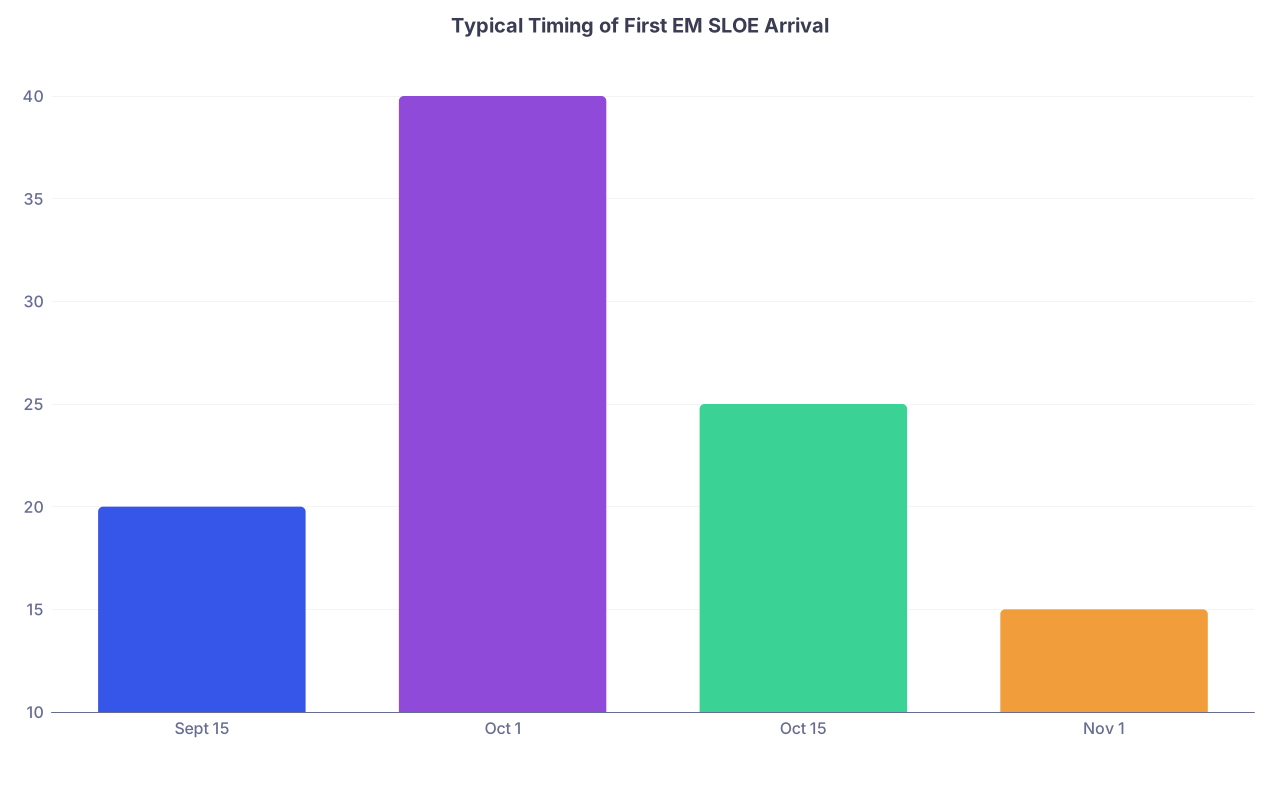
| Category | Value |
|---|---|
| Sept 15 | 20 |
| Oct 1 | 40 |
| Oct 15 | 25 |
| Nov 1 | 15 |
Rough pattern:
- July EM rotation SLOE: Often arrives mid-September to early October.
- August EM rotation SLOE: October to early November.
- September EM SLOE: November (or later) is very common.
Applicants ask: “Should I wait to submit ERAS until I have at least one SLOE?”
No. Submit ERAS as early as possible. Then:
- Make sure at least one “placeholder” non-SLOE clinical letter (IM, surgery) is in the file when it goes out.
- Have your EM letter writers identified in ERAS early, so SLOEs attach automatically when uploaded.
- When your first SLOE drops:
- Many EM programs do a second, SLOE-based pass in October. You want to be in their system for that.
- If the SLOE is particularly strong or from a big-name site, you can send targeted updates to your highest-priority programs.
The only people who should consider delaying ERAS significantly for SLOEs are those in extreme situations (catastrophic Step 2, giant red flag) who need the SLOE to demonstrate that they are not a disaster clinically. And even then, you better know exactly which programs are realistically in play.
How Programs Use Away Rotations, Honestly
There is another myth you need to clear out: that the written eval / LOR from the away rotation is the main currency. Often it is not.

Here is what I have actually heard in committee rooms:
- “I worked with her on our August away, she was fantastic. Rank bump.”
- “He did an away here and was not a disaster, I am fine interviewing him.”
- “Honestly, I do not even remember him from his away. That tells me something.”
Notice what is missing? “Her faculty letter was glowing, so we radically reevaluated her.”
The real power of the away rotation is:
- Face-time with faculty and residents.
- Getting a human advocate in that room when applications come up.
- Not screwing up.
The letter is secondary. Helpful, yes. But the timing of that letter is rarely what makes or breaks you. The timing of your ERAS submission, though—that absolutely can.
So coordinate VSLO with that in mind:
- Priority 1: Do your aways early enough (July/August) that the programs have seen you before their interview lists are mostly set.
- Priority 2: Have at least one of those at a program that commonly writes prompt, meaningful letters or SLOEs.
- Priority 3: Line up your ERAS submission to be early, and let the letters slot in as they arrive.
Specific Coordination Rules by Rotation End-Date
Let us get more granular. You want to know: “My away ends on X; how do I handle ERAS?” Here is the practical version.
| Away End-Date | Letter Likely Ready | ERAS Submission Advice |
|---|---|---|
| Late July | Late Aug–Early Sept | Submit ERAS on time; letter may be in at launch |
| Late August | Mid–Late Sept | Submit ERAS on time; letter will follow after launch |
| Late Sept | Oct–Nov | Never delay submission; treat letter as later booster |
| Late Oct+ | Nov–Dec | Letter mostly influences later invites / rank, not early invites |
If your last key away ends by late July
You are in the best position.
- Add that attending as a letter writer in ERAS during the rotation.
- Politely tell them you are submitting early and a letter by late August would help.
- In many cases that letter will be queued up in ERAS before programs can even see your file.
In this setting, you can realistically aim to have:
- 1 home specialty letter
- 1–2 away specialty letters
- 1 strong core clinical letter
…all visible on Day 1. Then you are done. Submit as early as technically allowed.
If your last key away ends late August
Your letter timing will be borderline for ERAS launch.
Strategy:
- Do not delay submission waiting for this letter.
- Make sure your home specialty letter and any earlier-away letters are in place.
- Tell the August attending explicitly: “I will be submitting my ERAS in early September; if your letter comes in after that, it will still attach to my application.”
- Accept that for many programs, this letter will be more of an incremental bump than a gate-opener.
If your key away ends late September or later
This is where people get most anxious.
You must separate two questions:
- “Will this away help me get an interview?”
- “Will this away help me move up the rank list after I already have an interview?”
Late September / October aways are much better at #2 than #1.
So:
- Lock in ERAS submission early, before that away even starts.
- Treat the rotation as:
- A chance to impress faculty and residents who might advocate for you to get an interview even late in the season.
- A way to strengthen your hand once you are already on a program’s radar.
- When the letter eventually appears:
- It still matters, especially for rank-list discussions.
- But you cannot plan your entire application strategy around its timing.
Using Updates Without Looking Desperate
Once you accept that ERAS must go out early and VSLO letters will dribble in later, the question becomes: when should you update programs?
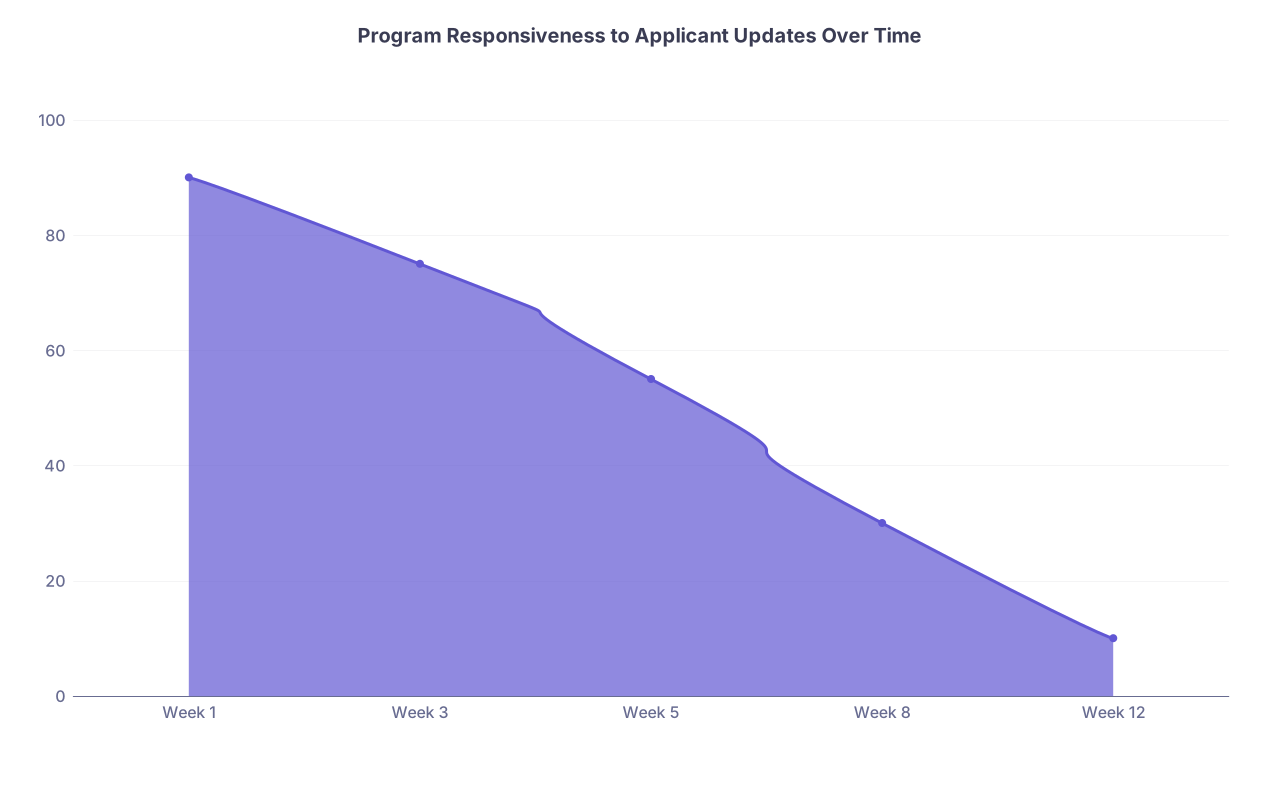
| Category | Value |
|---|---|
| Week 1 | 90 |
| Week 3 | 75 |
| Week 5 | 55 |
| Week 8 | 30 |
| Week 12 | 10 |
Reality: Responsiveness decays quickly. By November, many programs have essentially locked in 80–90% of their interview list.
Use updates when:
- You added a substantial new letter (key away, first EM SLOE, big-name subspecialist in your field).
- Your Step 2 score came back significantly stronger than expected.
- You had a major achievement relevant to your specialty (publication in the field, national award).
How to do it correctly:
- Short email. Four sentences or less.
- No attachments; everything should be in ERAS.
- Only send to:
- The away site where you rotated (if not yet offered an interview).
- Programs where you have a specific, genuine interest and at least a plausible shot.
Example template:
Subject: ERAS Update – [Your Name], [Specialty] Applicant
Dear Dr. [PD Last Name],
I wanted to briefly share an update on my application. I recently completed an away rotation in [Specialty] at [Institution], and a new letter from Dr. [Name] has been added to my ERAS. I remain very interested in [Program Name] given its [1 specific reason].
Sincerely,
[Name], [Med School], AAMC ID [ID]
Do not send “just checking on my status” emails. They waste everyone’s time and do not help you.
Coordinating With Your Home School Efficiently
A hidden bottleneck is not the attending; it is your own institution’s letter office. I have seen programs sit on perfectly good LORs for three weeks because one admin was on vacation.

| Step | Description |
|---|---|
| Step 1 | Attending Writes Letter |
| Step 2 | Sent to Home School |
| Step 3 | Processed by Deans/Records Office |
| Step 4 | Uploaded to ERAS by School |
| Step 5 | Visible to Programs |
To avoid this:
- Identify letter writers early and enter them into ERAS before they write.
- Know your school’s exact process:
- Do attendings upload directly to ERAS?
- Or do they email a PDF to the Dean’s Office, which then uploads?
- If there is an intermediate step, you must buffer extra time.
Explicit actions that help:
- For July and August aways, ask the attending in week 3 or 4: “Would you be comfortable writing a letter of recommendation for my application to [specialty]? If so, I can send the ERAS link today.”
- Notify your dean’s office that letters from X and Y are coming and that you are planning to submit ERAS on [date].
- After 7–10 days, if you see the letter is not in ERAS and your attending said they finished it, follow up with the dean’s office. Not the attending (unless you know they never uploaded it at all).
You are not being annoying. You are being organized in a system that will otherwise forget you.
When (If Ever) You Should Actually Delay ERAS for VSLO
I will give you the rare exceptions, because there are a few.
You might delay ERAS submission modestly (a week or two, not a month) for an away rotation / VSLO–related reason if:
- You have essentially no specialty letter at all yet (no home specialty, no away, nothing) AND
- You have a July-away at a strong site whose letter is nearly complete AND
- You are not applying to the most cutthroat specialties, AND
- Your school / advisor confirms that your specific target programs start interview review a bit later.
Example: Med student applying to Neurology or PM&R with:
- One July-away at a well-known site whose letter is promised by late August.
- No meaningful home specialty letter.
- ERAS release date early-ish September.
Delaying submission by 5–7 days so that one solid specialty letter is present on Day 1 might be rational here.
But that is an exception. For surgery, EM, ortho, ENT, derm, neurosurg, ophtho (SF Match, slightly different timeline but same principle), delaying 2–3 weeks for one more letter is almost always a losing trade.
How to Plan M4 Year Backwards From ERAS, Not VSLO
The best coordination is done months earlier—when you pick your rotation blocks.

If you are still able to adjust your M4 schedule, this is the ideal structure for competitive specialties:
- May/June: Home specialty rotation (or sub-I) to create a “baseline” specialty letter.
- July: High-priority away #1 (ideally at a realistic reach or upper-mid-tier program).
- August: High-priority away #2 (same logic).
- September: Either a “nice if it helps” away OR a strong sub-I in a core field that shows you can function like an intern.
- October+: Other interests, research, teaching, interview season–friendly electives.
Why this works:
- You walk into ERAS season with at least:
- 1 home specialty letter
- 1 July-away specialty letter likely to appear on time
- Possibly 1 August-away letter depending on your institution’s speed
- Your September and later experiences still generate letters, but those letters feed:
- Late interview offers
- Rank list upgrades
- Backup specialty strength, if needed
The worst setup is:
- No specialty rotation until August
- First away in September
- Maybe a second away in October
Then you panic in September, try to delay ERAS for letters that do not exist yet, and end up late everywhere.
Two Final Clarifications That Cut Through a Lot of Noise
Programs do not “re-pull” your entire file every time a new letter arrives.
- They see updated documents.
- But unless someone actively advocates for you, they are not continuously re-reviewing every update from hundreds of applicants.
Being slightly “incomplete” on Day 1 is almost always better than being “perfect” three weeks late.
- 2–3 strong letters + solid personal statement + complete CV early beats 4–5 letters + extra away eval late.
- The main gate is: Were you in their first-pass review window?
If you internalize that, your ERAS–VSLO coordination becomes a lot simpler.
Key Takeaways
- Submit ERAS early, even if your latest away rotation or SLOE is not ready. Being in the first review wave matters more than squeezing in one more letter.
- Plan aways so that at least one strong specialty letter (home or July-away) is ready by early September; treat September/October aways as boosters for late invites and rank list strength, not as prerequisites for submission.
- Use updates selectively: upload new letters as they come, send brief targeted emails to a small set of priority programs, and stop believing that one late VSLO eval will magically rescue a late ERAS file.