
Most applicants get ERAS timing wrong because they treat MSPE release as the starting gun instead of the choke point.
Let me break this down specifically. Your ERAS timing, your MSPE (Medical Student Performance Evaluation) release, and your dean’s letter cycles do not operate independently. They interact in ways that quietly decide:
- How many interview invites you get
- How early in the season you’re seen
- Whether you are evaluated with a full file or a half-finished one
If you ignore that interaction, you handicap yourself. If you understand it, you can time your submission so programs see the strongest possible version of you, as early as possible, without waiting around for perfection that never comes.
1. The Core Reality: ERAS Is Rolling, MSPE Is Not
Here is the single most important structural fact:
- ERAS applications are released to programs on one date, then reviewed on a rolling basis.
- The MSPE is released nationally on a single date (October 1 in recent cycles). No one gets it early. No one.
That means:
- Before MSPE release: programs see your ERAS file without the MSPE/dean’s letter.
- On MSPE release date: every program suddenly gets a massive batch of MSPEs for all applicants at once.
If you apply early but your school delays uploading documents, or you misunderstand what needs to be ready, programs may see you for weeks as the applicant with “missing stuff.” That matters.
Let me map the usual timeline.
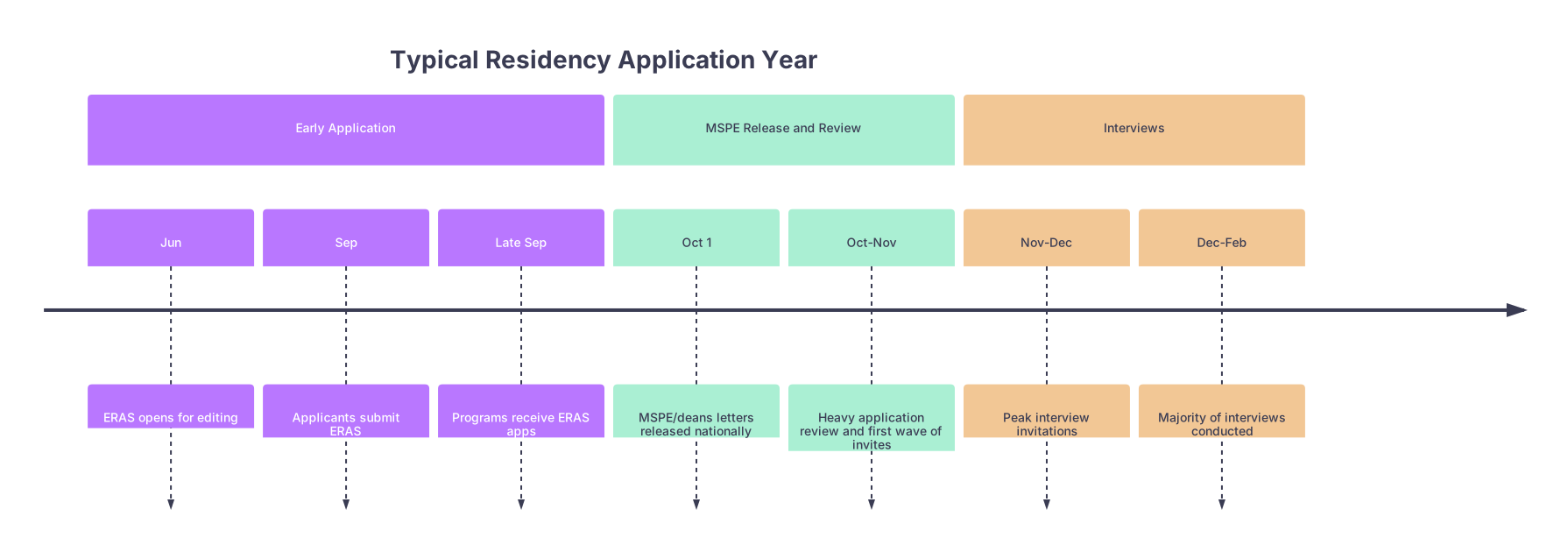
| Period | Event |
|---|---|
| Early Application - Jun | ERAS opens for editing |
| Early Application - Sep | Applicants submit ERAS |
| Early Application - Late Sep | Programs receive ERAS apps |
| MSPE Release and Review - Oct 1 | MSPE/deans letters released nationally |
| MSPE Release and Review - Oct-Nov | Heavy application review and first wave of invites |
| Interviews - Nov-Dec | Peak interview invitations |
| Interviews - Dec-Feb | Majority of interviews conducted |
So the tension is:
- You want your ERAS submitted and complete by the program download date.
- But your MSPE will not show up until October 1, no matter what you do.
This is not a contradiction if you plan correctly. It becomes a problem when students assume, wrongly, that they should “wait until my MSPE is ready” to submit.
2. What Programs See Before and After MSPE Release
Let me be clear about what a PD (program director) or reviewer actually sees at each stage.
Before MSPE release (late September up to Oct 1)
When programs first download applications, they typically see:
- ERAS Common Application
- Personal statement(s)
- Program-specific experiences and entries
- USMLE/COMLEX scores (if released)
- Letters of recommendation that have been uploaded and assigned
- Medical school transcript (if your school has uploaded it)
- MSPE: placeholder only (no content yet)
So in late September, one of three things is happening with your file:
Fully “ERAS-complete” minus MSPE
Common app done, PS attached, transcript uploaded, 2–4 letters in, scores in.
Programs can absolutely start screening and sometimes even invite you without the MSPE, especially in high-volume specialties.Partially complete
Missing key letters, missing transcript, missing scores, scattered content.
You are technically submitted but functionally low priority. You fall into the “come back later when they are complete” pile.Not submitted at all
You do not exist in the system yet. Period.
Programs differ:
- Some will screen aggressively as soon as ERAS downloads open, even without MSPE.
- Others will tag applications as “wait for MSPE” and hold decisions until after October 1.
- High-volume fields (IM, FM, peds) often start sorting early just to manage volume.
- Ultra-competitive fields (derm, ortho, PRS) sometimes do deep reads later, post-MSPE, because they can.
After MSPE release (Oct 1 onward)
On October 1:
- Every MSPE in the country drops into programs’ ERAS inboxes at once.
- Many programs have a review queue already populated with pre-screened applicants. They now open the MSPE to confirm or refine that early impression.
- Some programs will not touch applications at all until MSPE release, then sprint through hundreds of files in 2–3 weeks.
So your file on Oct 1 will be in one of three states:
Already pre-screened and favorably tagged
PDs or coordinators have you on some internal list: “strong candidate, pending MSPE” or even “likely interview.”
MSPE confirms (or rarely undermines) that.Pre-screened and deprioritized
Maybe your scores, experiences, or letters are weaker; they saw your file early and were underwhelmed. MSPE would have to meaningfully change their impression to bump you up.Never screened yet
Because you submitted late or were incomplete at first pass, you join the October 1 flood as just another “new” complete file.
If you want a visual of where the real decision work clusters, it looks more like this:
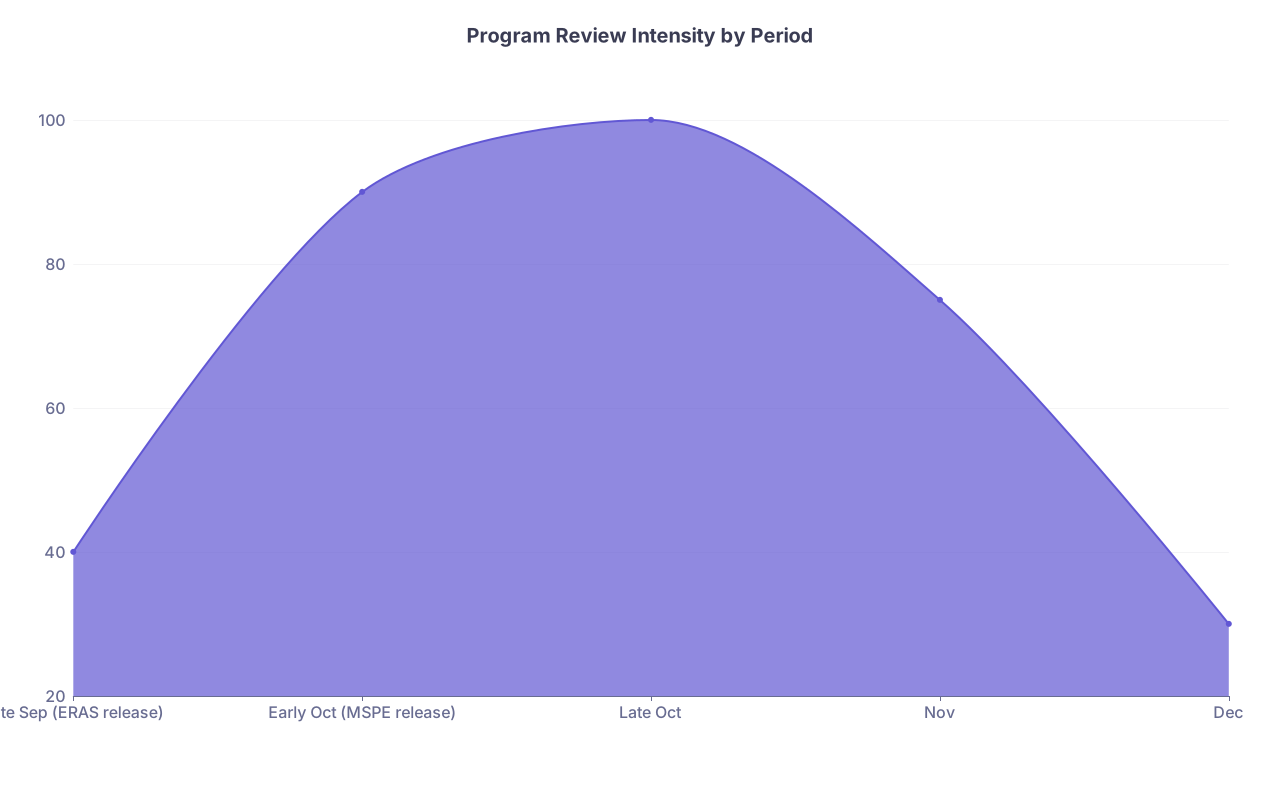
| Category | Value |
|---|---|
| Late Sep (ERAS release) | 40 |
| Early Oct (MSPE release) | 90 |
| Late Oct | 100 |
| Nov | 75 |
| Dec | 30 |
That huge spike right after MSPE release is where the interaction actually lives. Your goal is simple: be fully ready to be read when that spike hits.
3. Practical Timing: When To Submit ERAS Relative to MSPE
Let me be explicit here.
You should submit ERAS as early as you can reasonably have a strong, mostly complete application – even though the MSPE comes later.
Not perfect. Strong.
There are three main timing patterns I see:
| Strategy | ERAS Submission | MSPE Release | Impact |
|---|---|---|---|
| Early-Complete | Within 1–3 days of ERAS submission opening to programs | Oct 1 same for all | Max time in queue, best for most |
| On-time but Sloppy | Submitted near deadline with missing letters/transcript | Oct 1 | Technically early but functionally late |
| Late-Submitter | After Oct 1, sometimes mid-late Oct | Already released | Competing with fully screened cohort |
The Early-Complete strategy is correct for 90%+ of applicants. Here is what it means:
- Submit ERAS on or very shortly after the date applications can first be transmitted to programs (not just when the site opens in June, but the mid-September date when you can actually click submit for programs to receive).
- Have:
- Final or near-final personal statement
- Scores available (Step 1 pass, Step 2 CK ideally reported or scheduled)
- At least 2, preferably 3+ letters uploaded and properly assigned
- Transcript uploaded by your school
You do not wait for:
- The MSPE (because you cannot accelerate this)
- That one “maybe” letter from an away where the attending is notoriously slow
- Absolute final polish on every comma in your PS
Programs will get your file in the first wave. They will either:
- Pre-screen and flag you before MSPE
- Or hold you, but you are still in their system, in the main pool when MSPE drops
The “wait for everything” trap
Some students, especially from schools with later rotations, get anxious:
“I’m waiting for my Sub-I grade before my school finalizes my MSPE, maybe I should delay ERAS until everything is fully updated?”
That is the wrong axis of optimization. Your MSPE is not under your control once your school’s internal deadline has passed. Your ERAS timing still is.
Programs will get your MSPE on Oct 1 whether you submit in mid-September or October 10. What changes is:
- Whether they have already seen and tagged your application
- Whether you are in the “first wave” stack or the “late addition” stack
You want first wave.
4. How Different Schools Handle MSPE and Dean’s Letters
Now the messy part. Schools do not all play the same game behind the scenes.
Most US MD and DO schools:
- Have a fixed internal deadline for you to submit CVs, narratives, draft experiences for MSPE compilation (often spring of MS3 or early summer).
- Prepare the MSPE over several months.
- Freeze updates (late clerkship grades, late Sub-I evals) at some arbitrary date so they can finalize and QC the letter.
- Upload the MSPE to ERAS before October, but ERAS holds it and releases to programs only on the official date.
You, the student, see “MSPE uploaded” in ERAS, but that is just to the system. Programs see nothing until release day.
Some variations I have actually seen:
- Schools that will add one last clerkship grade up through early September, then freeze.
- Schools that refuse to change anything after a published “MSPE lock” date, even if a big grade posts.
- Schools that include a short late-addendum letter for major changes (leave of absence explanation, remediation, etc.), but this is rare.
The important downstream effect for you:
Your opportunity to influence the MSPE is months earlier than your ERAS submission date.
If your MSPE is weak or incomplete, trying to time ERAS around it is useless. That ship has sailed.
What you can still control is:
- Making sure your transcript is up to date in ERAS.
- Making sure away rotation letters are in if you need them for competitive fields.
- Making sure your common app narrative complements, not duplicates, the MSPE narrative.
5. How PDs Actually Use the MSPE (Dean’s Letter) in Context
Here is where applicants dramatically overestimate and underestimate at the same time.
The MSPE is:
- Very important for some fields and programs.
- Overrated as a “magic unlock” in others.
Most PDs I have talked to use the MSPE for:
- Red flags and context
- Failures, remediation, leaves of absence, professionalism concerns.
- Narrative about improvement: “early struggles with time management, subsequent strong performance,” etc.
- Comparative language
- Quintiles or deciles.
- “Outstanding”, “excellent”, “very good”, “good” coded language.
- Clerkship consistency
- Pattern of clinical performance across rotations.
- Narrative comments that confirm or conflict with your letters and personal statement.
They do not typically use the MSPE to:
- Decide whether to open your file. That’s scores, school, experiences, background.
- Weigh minutiae of pre-clinical grades (especially in pass/fail curriculums).
- Replace a strong specialty-specific letter. A good IM letter for an IM applicant beats a generic MSPE comment any day.
What this means practically:
- If your file is otherwise strong (good scores, strong letters, good experiences), the MSPE is usually confirmatory. It nudges but does not overhaul.
- If you have a non-traditional path, interruptions, or red flags, the MSPE can be determinative. It can either poison the well or rehabilitate you, depending on how it is written.
For timing, though:
- A PD will not avoid inviting you in October just because they did not see your MSPE in September. They could not have; nobody did.
- A PD might deprioritize you in late October if, once the MSPE appears, it contradicts everything else.
Again, the interaction is not “submit after MSPE.” It is “be in the stack when they start processing MSPEs.”
6. Specialty-Specific Nuances: Who Cares Most About MSPE Timing?
Different specialties weight MSPE differently and review at different speeds. Let’s be specific.
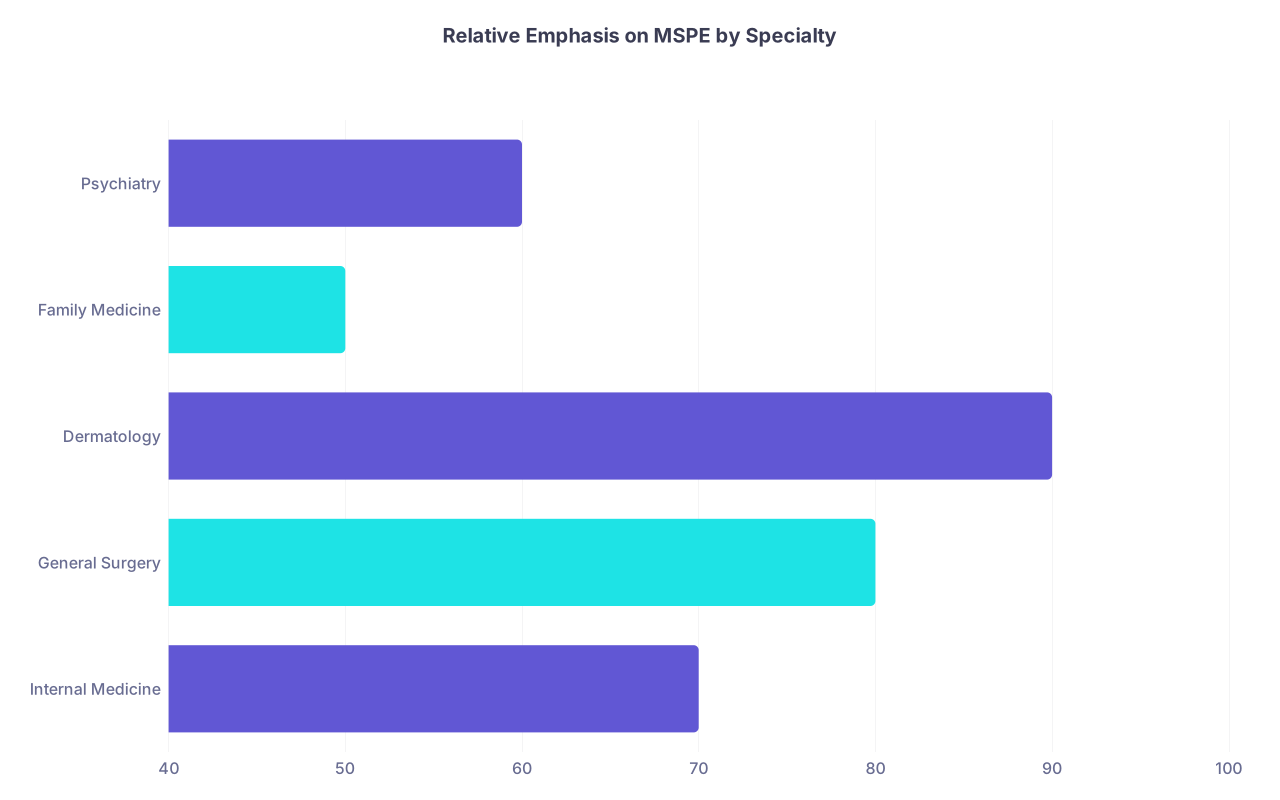
| Category | Value |
|---|---|
| Internal Medicine | 70 |
| General Surgery | 80 |
| Dermatology | 90 |
| Family Medicine | 50 |
| Psychiatry | 60 |
This is rough, but you get the idea. The higher the bar, the more deeply they typically read the MSPE.
Derm, Ortho, PRS, ENT:
Hypercompetitive, smaller programs, often smaller applicant pools per program. They have the luxury of reading everything. MSPE read thoroughly, but ERAS submission timing still matters because interview slots fill quickly. These PDs often watch your early letters and scores closely.General Surgery, OB/GYN, EM:
MSPE matters for narrative and red flags. But they also lean heavily on away rotation performance and specialty-specific letters. They do not want you submitting late. Surgery in particular is unforgiving about late or incomplete apps.IM, Peds, FM, Psych, Neuro:
Volume is massive. Some programs triage by scores and school first, read MSPE later.
Early submission helps you get swept into that first screening pass.
The pattern across all of them: early + complete beats “wait until everything is perfect and miss the first cut.”
7. International Grads, DOs, and Non-Standard Applicants
The interaction between ERAS timing and MSPE is completely different for some groups.
IMGs (including Caribbean)
- Many IMGs do not have a formal MSPE in the US style. They may have a dean’s letter or summary letter, but the format is different.
- Programs know this. For IMGs, timing and completeness of ERAS, plus scores, plus ECFMG status, dominate.
For IMGs:
- Submitting on the first possible day of ERAS release is almost mandatory in competitive programs.
- The MSPE/dean’s letter is less critical than:
- US clinical experience letters
- Scores
- Visa status
DO students
- DO schools now almost universally produce MSPE equivalents. Same national release.
- Osteopathic students are competing in two environments: ACGME programs that are used to MSPEs, and some programs with more variable familiarity.
- Strategy is the same: early-submitted ERAS, MSPE arrives Oct 1.
Dual-degree, LOA, remediation
Non-standard routes are where MSPE timing and content matter most because:
- Your school uses MSPE to explain what happened.
- Programs use MSPE to decide if the risk is acceptable.
Here, you want:
- Early ERAS submission, yes—but
- Even more, advanced, active engagement with your dean’s office in the spring/summer to ensure your MSPE narrative is accurate and contextualizes your path.
8. Concrete Action Plan: Month-by-Month
To tie this all together, here is how I would advise a typical MS4 who wants to optimize timing.

Late Spring / Early Summer (MS3 → MS4)
- Meet with dean’s office or student affairs about MSPE process and deadlines.
- Provide updated CV, draft narrative if requested, preferred specialty, key experiences.
- Clarify:
- What date grades “freeze” for MSPE
- Whether late grades can be added
- Any ability to review MSPE for factual accuracy (not editorializing)
Summer Before ERAS Submission
- Finish Step 2 CK early enough that your score posts before ERAS is released to programs, if possible.
- Secure at least 2–3 letters from core rotations, mentors, and aways. Push attendings politely but firmly.
- Polish your personal statement to ≥90% final.
Early September
- Confirm:
- All letters you care about are uploaded to ERAS.
- Transcript is in.
- Scores are in or will be in by release.
- Finalize ERAS experiences and common app sections.
Mid-September (ERAS submit date to programs)
- Submit ERAS on or very close to the first day programs can receive applications. Do not wait for MSPE.
- Double-check that letters are assigned properly to each program.
Late September (between ERAS release and Oct 1)
- Monitor your ERAS application status to ensure there are no missing documents your school forgot to upload.
- Do not obsess over the MSPE; you cannot accelerate its release.
October 1 and After
- Assume programs are reading you now with the full file.
- Respond rapidly and professionally to interview invites.
- Any real-time updates (new publication, award) can be sent as a short, professional email to selected programs, not a full application overhaul.
9. Common Myths and Bad Advice About ERAS vs MSPE
Let me call out a few things that keep circulating in group chats and Reddit threads.
Myth 1: “Programs will not look at my file until MSPE is in, so timing ERAS does not matter.”
Wrong. Many programs triage early due to volume. Being in their system on day 1 still matters a lot.
Myth 2: “I should wait to submit ERAS until my dean’s letter is finalized.”
No. The timing of MSPE finalization at your school is not the same as release. Programs cannot see it until national release, regardless.
Myth 3: “Submitting a week or two late is fine; they will wait until the MSPE arrives anyway.”
I have watched programs start sending interview invites within 48–72 hours of application release. Those seats do not wait for your “perfect” file.
Myth 4: “The MSPE will rescue my weak application.”
Occasionally it can soften red flags. But PDs trust objective data, patterns of performance, and specific letters more than generic dean’s praise.
10. Summary: How To Think About the Interaction
Strip away all the noise and it comes down to this:
ERAS is your entry ticket, MSPE is your context.
Get the ticket in early and complete so that when context arrives on Oct 1, programs are ready to actually read it.You cannot time around MSPE release because it is fixed.
The only controllable variable is whether you are in the first review batch when that release happens.Most students should prioritize early, strong-enough ERAS over waiting for perfection.
That means: complete letters, transcript, scores, and a solid PS by the first program download date.
FAQ (Exactly 6 Questions)
1. If my school’s MSPE has an error, should I delay ERAS until it is corrected?
No. Submit ERAS on time. Work with your dean’s office in parallel to correct factual errors in the MSPE before Oct 1. Programs will not see the MSPE until then. Delaying ERAS submission only guarantees you miss the first review wave.
2. What if one of my key letters is not uploaded by the ERAS release date?
Submit ERAS anyway if you have at least 2–3 solid letters already uploaded. Add the late letter as soon as it appears and assign it to programs. Many programs will re-check for new letters later, especially before ranking. Waiting to submit until the letter posts is usually worse than adding it later.
3. Do programs actually invite without the MSPE?
Yes, some do. I have seen IM and FM programs start inviting based on scores, letters, and experiences before they even open MSPEs. That is more common in high-volume specialties. Others will mark you as “pending MSPE” but still pre-screen you early. Either way, you are better off in the system early.
4. Does being from a pass/fail preclinical curriculum change how my MSPE is used?
Slightly. PDs in that scenario focus much more on clinical grades, narrative comments, Step 2 CK, and letters. The MSPE still matters for deciles, red flags, and patterns, but they know there are fewer granular data points. Timing strategy remains the same: early ERAS, MSPE arrives on Oct 1.
5. How late is “too late” for ERAS submission if I want a reasonable shot?
For most fields, submitting more than 1–2 weeks after programs first receive applications starts to hurt you. Submitting after MSPE release (post–Oct 1) usually puts you at a disadvantage, especially in competitive specialties and desirable locations where interview spots fill quickly.
6. Should I email programs when my MSPE is released or updated?
Generally no. Programs know the national MSPE release date and receive all MSPEs automatically from ERAS. The only time an email is appropriate is if your school issues a formal corrected MSPE after a substantive error or major update; even then, coordinate through your dean’s office rather than spamming programs yourself.