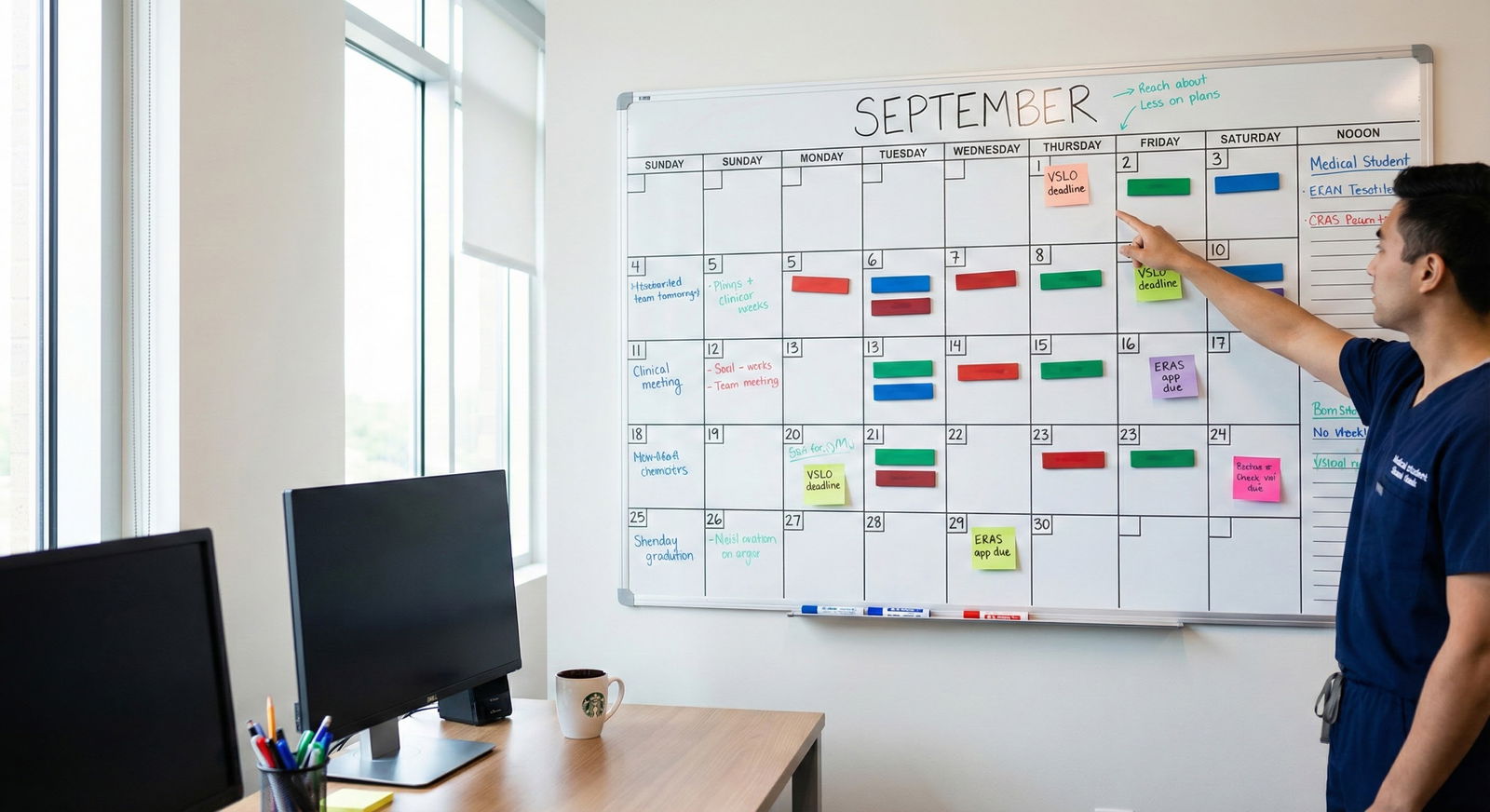
The worst ERAS mistake is not a weak personal statement. It’s bad timing.
You can have strong scores, solid letters, and still quietly kill your chances by submitting late, missing small internal deadlines, or failing to line things up before programs start screening. The calendar matters more than most applicants want to admit.
I’ll walk you from ERAS opening to the thick of interview season, step by step: what to be doing this month, this week, this day. And when “early” actually starts to matter.
Big-Picture ERAS Timeline: What Actually Matters
At this point you need a mental map of the year, not just random dates you saw on Reddit.
Here’s the core reality:
- ERAS opens for applicants: late May
- You can start submitting: early September
- Programs can start downloading applications: usually about 1 week after submission opens
- Interview offers: heavy from late September through November
- Interviews conducted: October–January
- Rank list deadline: late February
- Match Day: mid-March
The myth: “As long as I submit before programs download apps, I’m fine.”
The truth: People who finish everything on day 1 are not the same people frantically uploading letters the night before. Programs can tell.
Let’s go chronologically.
Late May–June: ERAS Opens – You Set the Foundation
At this point you should be logging into ERAS within 48 hours of it opening.
Week 1 (ERAS Opens)
Your goals this week:
- Create your account and:
- Enter your basic info (name, contact, AAMC ID, medical school)
- Start the Experiences section
- Start the Publications/Presentations section
You’re not submitting anything yet. You’re building scaffolding.
Checklist for this week:
- Log into ERAS and click through every tab once
- Dump a rough list of all activities into a document:
- Research projects (with role, dates, PI)
- Leadership positions
- Teaching/tutoring
- Volunteering/clinics
- Employment
- Make a “letters of recommendation” tracker (simple spreadsheet works)
- Columns: Writer name, specialty, strength (1–10), requested date, sent, uploaded
Do not obsess about perfect wording yet. Just get everything in one place.
Weeks 2–4 (June): Lock in Letters & Strategy
By the end of June, your letters and overall application strategy should be mostly decided.
At this point you should:
- Decide your specialty target list:
- Primary specialty (e.g., Internal Medicine)
- Backup specialty (if any)
- Confirm your program reach:
- “Dreams,” realistic, safety programs
| Category | Percentage of Applications | Example Count (80 total) |
|---|---|---|
| Reach | 20% | 16 |
| Target | 50% | 40 |
| Safer | 30% | 24 |
Letters of Recommendation (LoRs)
By end of June, you should:
- Identify 3–4 strong letter writers for your main specialty
- Identify 1–2 for backup specialty (if different)
- Ask in person or via a thoughtful email:
- Explicitly ask: “Can you write a strong letter of recommendation for [X specialty]?”
- Enter their info into ERAS so they get the upload link
If you’re waiting for a late rotation with a “perfect” letter writer in August, fine—but you still need 2–3 letters already in progress now.
July: Drafting, Polishing, and Finishing Core Content
July is where serious applicants separate from the procrastinators.
At this point you should be treating ERAS as a part-time job.
First Half of July (Weeks 1–2): Personal Statement & Experiences
Personal Statement
By mid-July, your main specialty personal statement should be on Draft 3 or 4, not Draft 1.
Week 1–2 tasks:
- Write a terrible first draft. Do not overthink.
- Define your 2–3 key themes:
- Why this specialty
- What you bring (skills, traits, values)
- Where you’re headed (goals)
- Send draft to:
- One attending in your specialty
- One peer who writes well
- One non-medical friend for clarity
If you’re doing a backup specialty, plan a second statement, but you don’t have to finish it this early unless you’re sure you’ll use it.
Experiences Section
By mid-July:
- All activities entered in ERAS with:
- Clear role descriptions
- Bulleted impact statements (2–4 per major activity)
- Meaningful experiences flagged (depending on cycle rules)
- No random padding—weak entries drag the whole thing down
Second Half of July (Weeks 3–4): CV, Filters, and Researching Programs
At this point you should be pivoting to program research and application targeting.
Program Research Tasks:
- Make a master program list with columns:
- Program name
- City, state
- Minimum USMLE/COMLEX cutoffs (if stated or known)
- Visa policy (if applicable)
- Past residents’ med school backgrounds
- “Vibe” / notes from residents or forums
- Cross-check your stats against typical ranges:
- If you’re below average, apply more broadly
- If you’re above, you can be slightly more selective but not arrogant
August: Precision Work – LoRs, MSPE, Final Decisions
August is where people either quietly finish early or quietly self-sabotage.
At this point you should be polishing, not building from scratch.
Early August (Weeks 1–2): Lock Letters & Backup Plans
By the first week of August, you should:
- Follow up with all letter writers:
- Gentle reminder email with:
- ERAS instructions
- Updated CV
- Personal statement draft
- Gentle reminder email with:
- Confirm at least 2 letters are already uploaded or will be in the next 1–2 weeks
- Decide definitively:
- Are you applying to a backup specialty or not?
If you’re still “thinking about” backup specialties in mid-August, you’re behind.
Mid–Late August (Weeks 3–4): Final Application Structure
At this point you should be tightening everything.
Critical tasks for this 2-week window:
Finalize:
- Personal statement(s)
- Experiences descriptions
- Publications list (no obvious errors or inflated claims)
Clean up:
- Typos
- Inconsistent dates
- Awkward phrasing
Double-check:
- USMLE/COMLEX scores are correctly entered
- Any red flags (leaves, failures) have a consistent explanation
MSPE (Dean’s Letter)
You don’t control when it’s released (usually Oct 1), but you do control accuracy.
- Confirm your school has the right name, specialty interest, and any updates
- Correct any factual mistakes early, not in October
Early September: Submission Window Opens – When to Click Submit
This is the part everyone obsesses about: “What’s the best time to submit ERAS?”
Here’s the blunt answer:
You should be ready to submit your ERAS application within the first 24–72 hours of the submission window opening.
Not 2 weeks later. Not “when my last letter is in.” Early.
Programs usually can’t download applications until a set release date about a week later. But here’s what happens if you wait:
- You get caught fixing last-minute errors at 2 a.m.
- Letters get uploaded late
- You miss the initial surge when programs pre-screen and shortlist
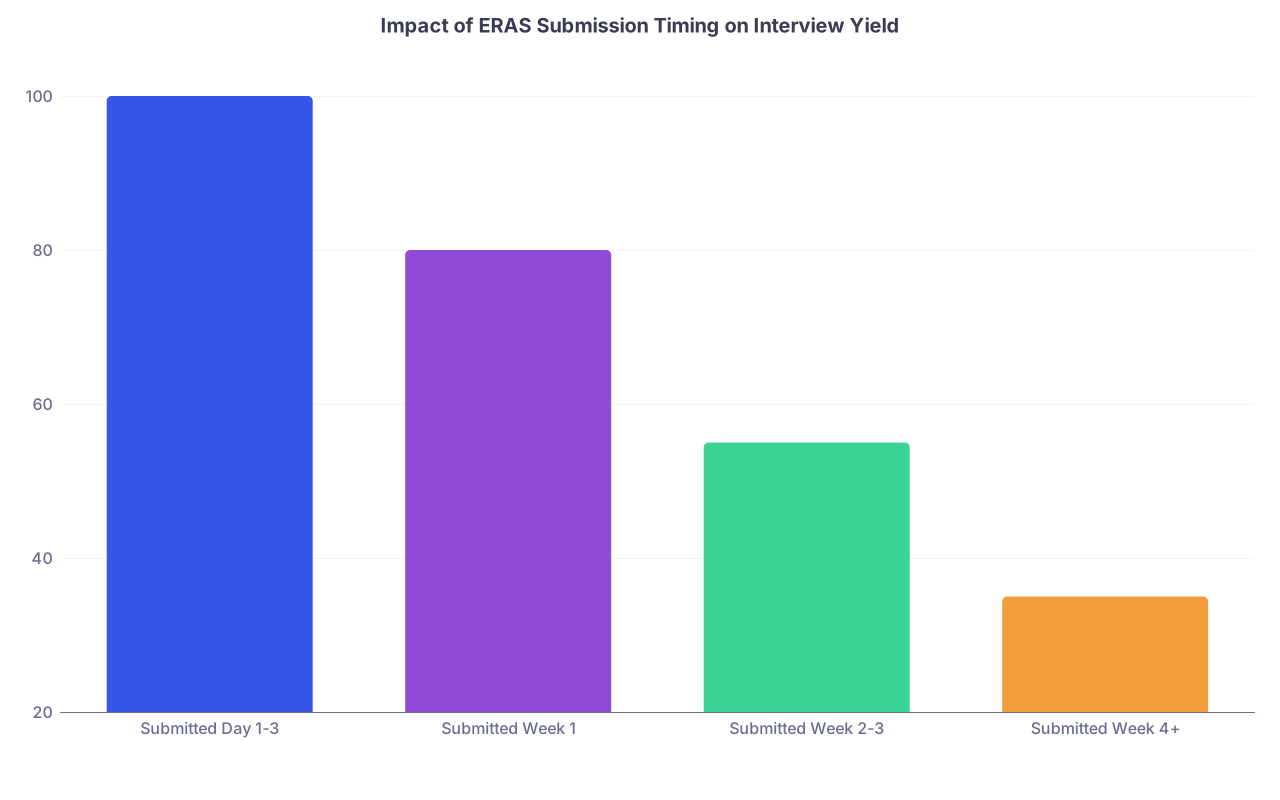
| Category | Value |
|---|---|
| Submitted Day 1-3 | 100 |
| Submitted Week 1 | 80 |
| Submitted Week 2-3 | 55 |
| Submitted Week 4+ | 35 |
(Think of 100 as your potential maximum interview yield. The later groups are the real-world trend I’ve seen.)
What to Have Ready Before Submission Day
At this point—before the submit button appears—you should:
- Have PDFs of your application saved (run the preview function)
- Verify:
- Name matches ID on board exams
- Contact info current
- Programs list built and filtered
- Check that:
- At least 2–3 letters for your main specialty are uploaded
- USMLE/COMLEX scores requested
If one letter is missing but the writer is reliable and confirmed, submit anyway. ERAS lets letters be assigned after submission.
Submission Day (Day 1–3 of Window)
On the actual day applications open for submission:
At this point you should:
- Submit your core application and program list in the morning or early afternoon
- Recheck assigned personal statements and letters for:
- Correct specialty
- No mix-ups between main and backup specialty
- Pay and get the receipt
Then stop. Don’t tinker with it for fun.
Application Release to Programs: The Quiet but Critical Week
After submission, there’s usually a several-day gap before programs can download applications.
This “dead” week is not dead.
At this point you should be:
Week Between Submission & Program Download Date
- Double-check letters:
- Any still missing? Nudge writers once, politely.
- Create your email/calendar system for interviews:
- Make a folder or label: “ERAS/Interviews”
- Turn on phone notifications for that email
- Sync a calendar (Google, Outlook) you actually use
- Draft quick-response templates for interview offers, e.g.:
- “Thank you for the interview invitation. I’d like to confirm [date/time]. Looking forward to meeting the team.”
Late September–October: The Interview Invite Surge
This is where timing becomes minute-to-minute, not just week-to-week.
Late September (First 2–3 Weeks After Programs Download Apps)
At this point you should:
- Assume interview offers may hit your inbox any day between 8 a.m. and 8 p.m. local time of the program.
- Understand many programs overbook within minutes of sending invitations.
Your system this month:
- Email:
- Notifications ON
- No “promotions” tab hiding messages
- Phone:
- Voicemail set up and not full
- Professional greeting (no silly recordings)
- Calendar:
- Pre-block dates you cannot interview (exams, weddings, etc.)
- Pre-plan max number of interviews per week (for sanity)
You don’t need to camp on your inbox 24/7. But in the first 4–6 weeks after programs get applications, you cannot disappear for 12 hours with your phone on silent.
October: Interview Season Ramps Up
By mid-October, you should have a sense of how your season is going.
At this point you should:
- Track:
- Programs applied
- Responses (no response, interview, rejection, waitlist)
- Triage:
- If invites are sparse by late October, start:
- Expanding your program list (if deadlines not passed)
- Emailing a small number of programs with a concise, respectful note expressing interest (especially if you have a geographic tie or update like a new score)
- If invites are sparse by late October, start:
Do not spam 50 programs with a generic “I’m very interested in your program” email. That screams desperation.
October–January: Interview Execution and Scheduling Strategy
Interviews are their own timeline inside the bigger ERAS calendar.
Before Each Interview Week
At this point you should be doing a 3–4 day mini-prep cycle for each program:
3–4 days before:
- Research:
- Program size
- Tracks (categorical, prelim, physician-only)
- Unique features (clinics, research, patient population)
- Prepare:
- 3–4 specific questions about the program
- 2–3 stories that highlight your strengths (teamwork conflict, challenging patient, mistake you learned from)
Day before:
- Confirm:
- Time zone (virtual interviews will burn you if you don’t)
- Whether it’s Zoom, Thalamus, or a proprietary system
- Set up:
- Backup device if virtual
- Quiet space reserved
During Peak Interview Months (November–December)
At this point you should:
- Maintain a maximum interview load per week that lets you still be functional. Example:
| Rotation Intensity | Max Interviews / Week |
|---|---|
| Light Elective | 4–5 |
| Moderate Inpatient | 3–4 |
| Heavy ICU / Surgery | 2–3 |
- After each interview:
- Write down:
- People you met
- Program strengths/concerns
- Your gut feeling (out of 10)
- Send a concise thank-you email within 24–48 hours if the program culture seems to expect it (many IM/FM don’t care; some surgical subspecialties still do)
- Write down:
January–February: Interview Wrap-Up and Rank List Timing
By January, interviews taper. Now timing shifts to ranking.
At this point you should:
Late January
- Make a first-pass rank list:
- Rough order based on:
- Fit
- Location
- Training quality
- Support/benefits
- Rough order based on:
- Revisit your notes from each interview:
- Eliminate any program with obvious dealbreakers
- Move up ones that surprised you in a good way
Early–Mid February
Do not wait for the literal last day to certify your rank list.
At this point you should:
- Lock a near-final list 1 week before the NRMP deadline
- Ask:
- One trusted mentor
- One resident you know well
to briefly look at your list for sanity (not to control it)
Then:
- Log in
- Enter/certify your list a few days before the deadline
- Take screenshots/confirmations
Servers crash. Wi-Fi dies. Life happens. Don’t be the person trying to certify at 8:55 p.m. on deadline day.
Visual Summary: From ERAS Open to Interview Season
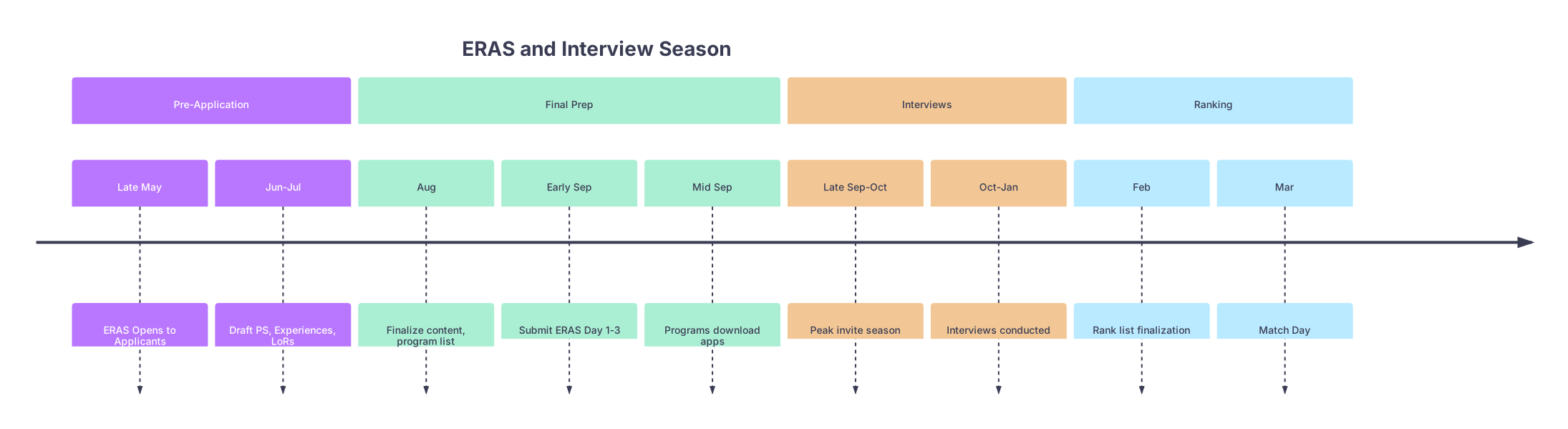
| Period | Event |
|---|---|
| Pre-Application - Late May | ERAS Opens to Applicants |
| Pre-Application - Jun-Jul | Draft PS, Experiences, LoRs |
| Final Prep - Aug | Finalize content, program list |
| Final Prep - Early Sep | Submit ERAS Day 1-3 |
| Final Prep - Mid Sep | Programs download apps |
| Interviews - Late Sep-Oct | Peak invite season |
| Interviews - Oct-Jan | Interviews conducted |
| Ranking - Feb | Rank list finalization |
| Ranking - Mar | Match Day |
The Core Timing Rules You Actually Need
Let me boil this down.
Be truly ready by early September.
Not “almost.” Application drafted, letters mostly in, program list set. Submit in the first 24–72 hours of the window.Treat late September–October as critical territory.
You must be reachable, responsive, and organized when interview offers go out. A missed email at 10:04 a.m. can literally cost you a spot.Front-load your thinking, not your panic.
Do the heavy thinking—specialty choice, program tiers, letter writers—in June and July. Use August for refinement, September for execution, and the fall for interviews, not for putting out fires.
Follow the calendar with intent, not superstition, and you dramatically improve your odds—without changing a single test score.