
Most students think ERAS is one deadline. They are wrong—and they pay for it in interview invites.
You are not competing on personal statements or Step scores first. You are competing on calendar management. The students who get hammered in the Match are usually the ones who “started their ERAS in June” and realized too late that three critical dates already passed.
Let me walk you, step by step, through a personal ERAS calendar built around the real deadlines: the ones that never show up in a red font on the AAMC site but absolutely change your interview season.
Big Picture: Your ERAS Year at a Glance
At this point you should stop thinking “ERAS opens in June” and start thinking in phases:
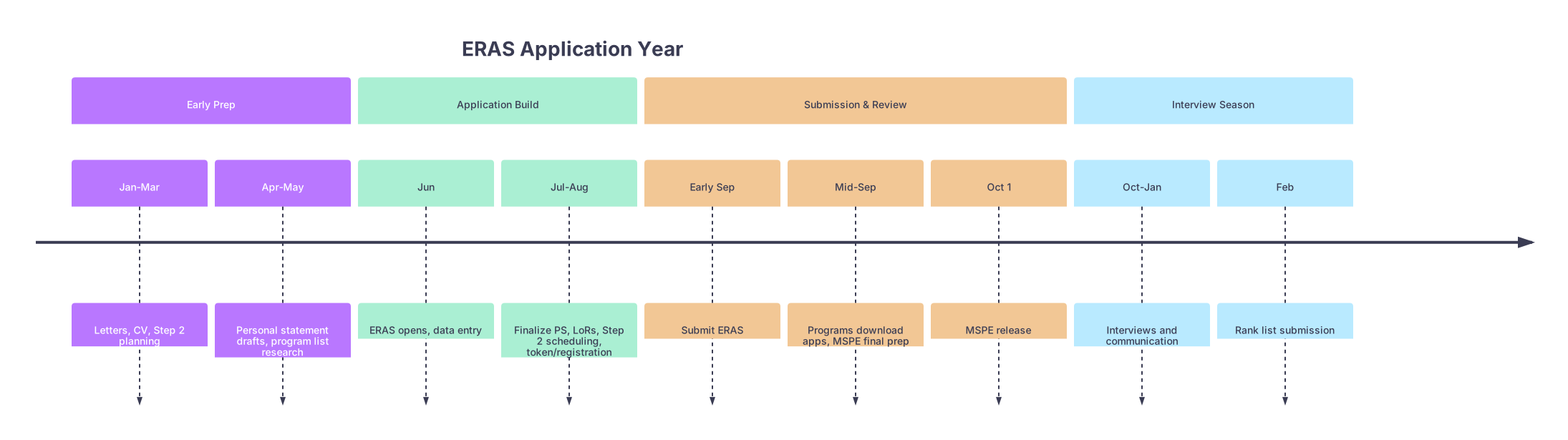
| Period | Event |
|---|---|
| Early Prep - Jan-Mar | Letters, CV, Step 2 planning |
| Early Prep - Apr-May | Personal statement drafts, program list research |
| Application Build - Jun | ERAS opens, data entry |
| Application Build - Jul-Aug | Finalize PS, LoRs, Step 2 scheduling, token/registration |
| Submission & Review - Early Sep | Submit ERAS |
| Submission & Review - Mid-Sep | Programs download apps, MSPE final prep |
| Submission & Review - Oct 1 | MSPE release |
| Interview Season - Oct-Jan | Interviews and communication |
| Interview Season - Feb | Rank list submission |
Now we zoom in. Month-by-month, then week-by-week when it matters, with the key dates most students miss flagged clearly.
January–March: The “Invisible” Start of ERAS
At this point you should not be “waiting until ERAS opens.” You should be quietly building the parts that will bottleneck later.
January
Focus: Letters and testing.
By late January, you should:
- Identify 3–4 core letter writers you want (not who is easiest to ask).
- Check:
- Will they still be at your institution in the fall?
- Are they known to write strong letters in your specialty?
- Decide: Will you need Step 2 CK as a strength, or just as a formality?
Most-missed dates in January:
- Internal deadlines for away rotation applications (VSLO/VSAS) in competitive specialties.
- School-specific policies about how many LoRs can go to each program and any internal forms your letter writers need.
February
Focus: Locking in letters and rotations.
By mid–February, you should:
- Ask letter writers in person or by email with:
- CV
- Draft personal statement (even a rough one)
- Bullet list of specific things you hope they mention
- Confirm they are comfortable saying they can write a strong letter. If they hesitate, move on.
At this point you should also:
- Map out your M3/M4 schedule to ensure:
- At least one home rotation in your chosen specialty is done by June–July to secure a specialty-specific letter.
- If needed, an away rotation is scheduled June–September, not October–January when it is useless for ERAS.
Most-missed date: the lead time for letters. Strong attendings are busy. If you first ask in August, you will end up with a generic three-paragraph letter written by a fellow.
March
Focus: Step 2 CK and CV groundwork.
By late March, you should:
Decide your Step 2 CK test window:
- If you need Step 2 to rescue a low Step 1 → test by late July so your score posts before heavy screening.
- If Step 1 was strong → testing by mid–August is usually fine, but do not push into September unless there is a specific reason.
Start your CV master document:
- All activities since college
- Roles, dates, hours (even rough estimates)
- Leadership, research, teaching, QI, community work
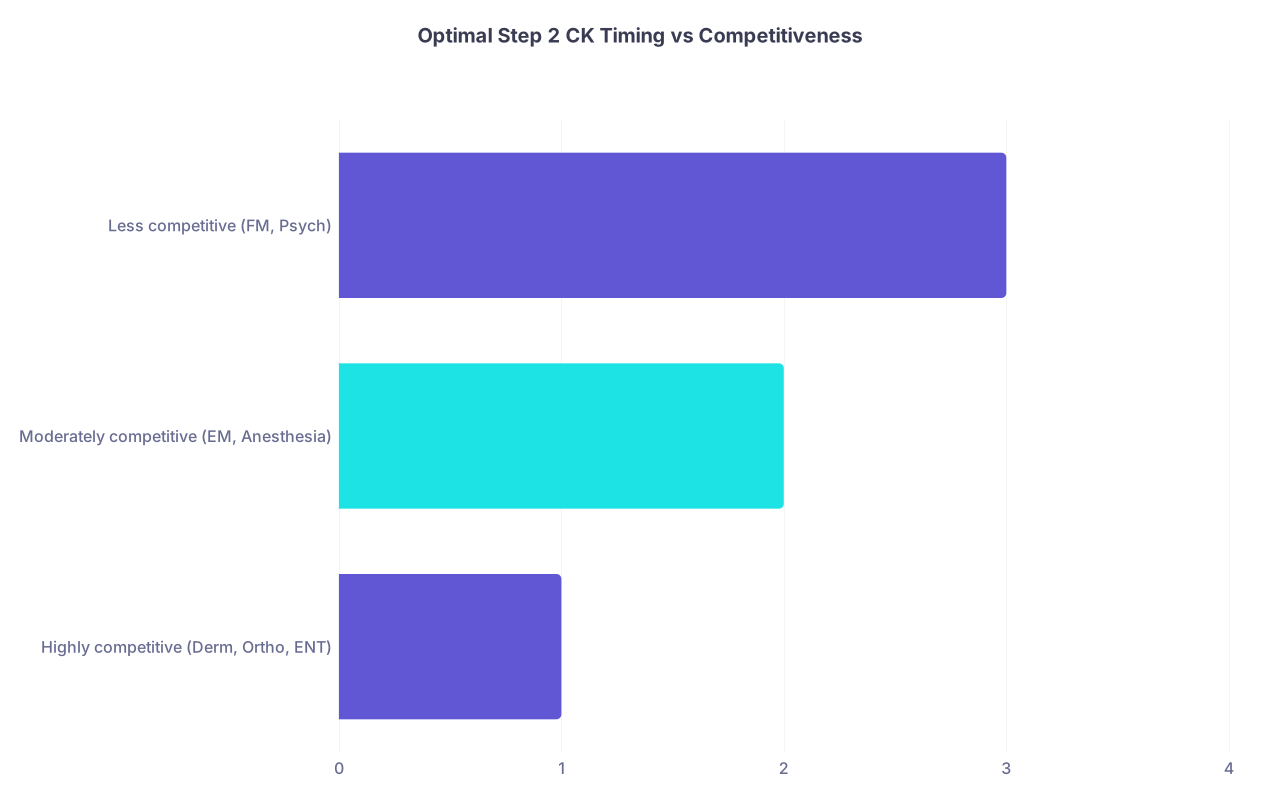
| Category | Value |
|---|---|
| Highly competitive (Derm, Ortho, ENT) | 1 |
| Moderately competitive (EM, Anesthesia) | 2 |
| Less competitive (FM, Psych) | 3 |
Interpretation:
1 = Take by late July
2 = Take by early August
3 = Can reasonably push to late August if needed
Most-missed issue: Students scheduling Step 2 for mid–September “to get more study time” and then discovering half their desired programs require a score before offering interviews.
April–May: Drafting Season, Not “I’ll Think About It Later” Season
At this point you should be writing, not just “planning to write.”
April
Focus: Early drafts and program intel.
By mid–April, you should:
- Write ugly first drafts of:
- Personal statement (general version)
- Specialty-specific variations if you are dual-applying
- Start a program tracking spreadsheet with:
- Program name
- Location
- Program size
- Required number of LoRs
- Step 2 policies (required before ranking / before interview / not specified)
- Any red flag notes
| Month | Main Deliverable |
|---|---|
| Jan | Identify letter writers & away needs |
| Mar | Step 2 CK window chosen |
| Apr | First PS draft + program spreadsheet |
| Jun | ERAS account created & sections skeleton-filled |
| Early Sep | Final ERAS submission |
Most-missed work: program research this early. Students who wait until August to build a list end up applying to 80 programs blindly because they did not have time to be strategic.
May
Focus: Refinement and reality checks.
By late May, you should:
- Have at least one personal statement draft that:
- Has been read by 1–2 residents or attendings in your specialty
- Has been stripped of clichés (“I have always wanted to help people”)
- Check in with:
- Letter writers → confirm planned completion by August 15–31
- Your dean’s office → confirm MSPE upload timeline and internal deadlines
Most-missed date: your school’s internal MSPE material deadline (often July). If you miss giving them your CV/achievements, your MSPE becomes generic and weak.
June–July: ERAS Opens Long Before You Feel Ready
At this point you should treat June 1 (or whenever ERAS opens for that cycle) as a hard start, not “I will wait until I have every detail perfect.”
June: ERAS Opens
Focus: Building the skeleton.
In the first 7–10 days after ERAS opens, you should:
- Create your ERAS account as soon as tokens are available.
- Fill in:
- Demographics
- Education history
- USMLE/COMLEX information
- Work/activities placeholder entries from your master CV

You do not need perfect wording yet. But you must:
- Claim your space.
- See how the application actually looks.
- Realize which sections are more annoying than you expected.
Most-missed detail: character limits and the number of experiences allowed. Students regularly discover in August that they cannot list every activity and then panic-edit under time pressure.
July
Focus: Serious content finishing and Step 2 execution.
By July 15–31, you should:
- Have:
- Final or near-final personal statement(s)
- Tightened activity descriptions in ERAS (impact-focused, not “job descriptions”)
- Take Step 2 CK if:
- You need it to strengthen your application, or
- Your specialty screens heavily on it
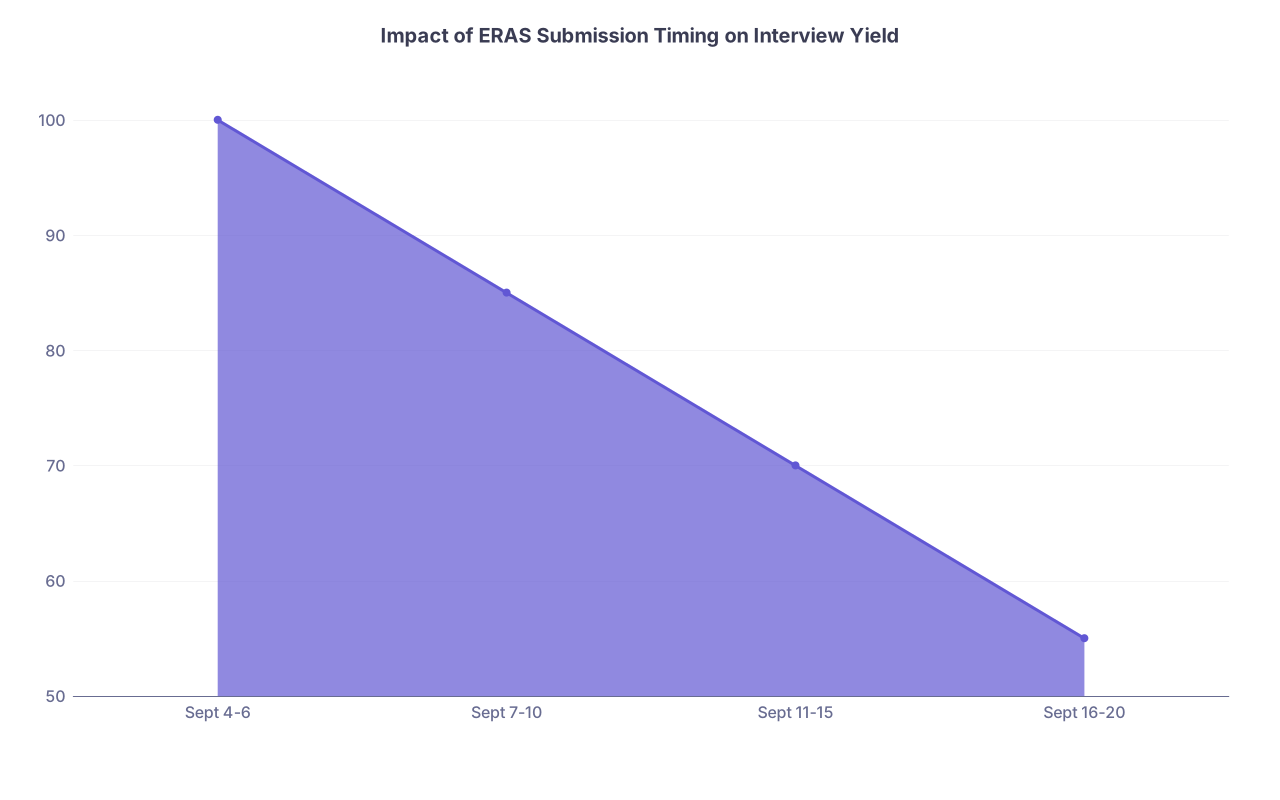
| Category | Value |
|---|---|
| Sept 4-6 | 100 |
| Sept 7-10 | 85 |
| Sept 11-15 | 70 |
| Sept 16-20 | 55 |
(Think of 100 as your baseline chance if you are in the first group. Sliding later costs you interviews.)
Most-missed July landmine: not checking Step score release timelines. It generally takes about 2–3 weeks after your test date. If a program “strongly prefers” a Step 2 score up front, missing that window matters.
August: The Critical “Ready Before Submission” Month
At this point you should be functionally done with your ERAS content by the third week of August, not scrambling on Labor Day weekend.
August 1–15
Focus: Final content and letter confirmation.
By mid–August, you should:
- Confirm with letter writers:
- They know to upload to ERAS, not to you.
- They understand your target date: all letters in by August 25–31.
- Finalize:
- Personal statement (only tiny edits from here)
- Activity entries
- Program list draft (with reach/target/safety categorization)
Most-missed date: the practical LoR deadline. Yes, ERAS will accept letters later. No, that is not good enough if you want early looks.
August 16–31
Focus: Lock it down and cross-check.
By the end of August, you should:
- Do a full ERAS walkthrough review:
- Name, identifiers, contact info, NRMP ID plan
- Education dates, degree types, expected graduation
- Experience dates accurate and non-overlapping in impossible ways
- Run your personal statement and ERAS entries by:
- 1–2 trusted reviewers who are detail-oriented
- Someone who will tell you if your writing sounds generic or arrogant

At this point you should also:
- Have at least 3 letters uploaded (ideally 4) and assigned in ERAS to each program “shell,” even if you have not officially applied yet.
Most-missed mistake: students think “letters just need to be in by October 1 when MSPE releases.” Wrong. Programs start looking as soon as they download applications in September.
Early September: The Real “Best Time to Submit ERAS”
Here is the blunt truth:
You want your ERAS submitted within the first 24–72 hours of the opening of application transmission to programs. Not two weeks later. Not “by the end of the month.”
Week-by-Week Breakdown
Assume, for example, ERAS allows submission around September 4–6 (dates shift slightly by year; check the current cycle).
Week 1 (ERAS Submission Opens to Programs)
At this point you should:
- Submit ERAS on Day 1 or 2 of the transmission window.
- Have:
- 3–4 letters attached to each program
- Personal statement assigned correctly to each specialty
- Program list finalized (you can add 1–2 more later, but bulk should be done)
Programs will download a first wave of applications as a batch. Many will start screening from this pile. You want to be in that first pile.
Most-missed fact: Programs rarely wait until October 1 MSPE release to pre-screen. They flag people early based on scores, experiences, and school.
Week 2
Focus: Patchwork and follow-ups.
By the end of Week 2, you should:
- Confirm:
- All letters you were promised are actually uploaded.
- Any late-breaking Step 2 scores are now in ERAS.
- Add any last-minute programs if:
- Your advisor strongly recommends them.
- You had a sudden change in geographic priorities.
October–January: MSPE, Interviews, and the Second Wave of Missed Dates
At this point you should not relax. The calendar still matters.
October 1: MSPE Release
On October 1, programs get your MSPE (Dean’s Letter). Some programs intentionally wait until this date to issue another wave of invites.
You should:
- Check your email + ERAS message center obsessively the first 3–5 days after MSPE release.
- Keep a live spreadsheet of:
- Invites
- Rejections
- No response

Most-missed practice: updating your program list strategy after you see your early response pattern. If you get almost no invites by mid–October, you might need to expand your list in real time.
October–January: Interview Booking Windows
At this point you should understand: many interview offers are first-come, first-served within minutes.
So during this period:
- Turn on push notifications for:
- ERAS (if available)
- Any third-party scheduling platforms (Interview Broker, Thalamus, etc.)
- Respond to invites within 30–60 minutes when possible. Those prime dates disappear fast.
Most-missed “date”: not a single day, but the response window. I have seen strong applicants lose out just because they checked email once in the evening.
February–March: Rank Lists and Match Week
By this late phase, the dates are more obvious—but some students still drift.
Early–Mid February
At this point you should:
- Have a draft rank list one week before the official NRMP deadline.
- Run your list by:
- A mentor in your specialty
- Someone who understands your personal constraints (partner, family, etc.)
Most-missed nuance: Applicants get swayed by late-season “love letters” from programs. Unless it is a clear top choice and they explicitly say they will rank you very highly, do not let a single email completely reorder your list the night before.
Match Week
By Match Week, the calendar is out of your hands. But your earlier management of invisible dates is exactly what determined how chaotic (or calm) this week feels.
Quick Reference: Personal ERAS Calendar Core Dates
Here is a compressed version you can literally paste into your calendar app.
| Timeframe | What You Should Have Done |
|---|---|
| Jan–Feb | Identify letter writers, plan away/home rotations |
| March | Choose Step 2 CK window, start master CV |
| April | Draft PS, start program spreadsheet |
| May | PS revision, confirm MSPE/Dean's office deadlines |
| June | Open ERAS, fill all sections in skeleton form |
| July | Finalize content, take Step 2 (if needed by early fall) |
| Aug 1–15 | Confirm LoRs, refine program list |
| Aug 16–31 | Final ERAS proofread, all letters targeted by Aug 25–31 |
| Early Sep | Submit ERAS within first 24–72 hours of transmission |
| Oct 1 | MSPE release; watch for second wave of invites |
FAQ (Exactly 3 Questions)
1. Is it really that bad to submit ERAS a week or two after the first day?
Yes, for many specialties it is. I have watched borderline applicants in EM, Ortho, and Anesthesia lose interview spots because their application landed after programs already pre-screened hundreds of early files. Strong applicants with stellar scores can sometimes “get away with” a later submission. Everyone else is quietly punished for it.
2. What if one of my letters is late—should I delay submission until it arrives?
Usually no. Submit on time with the letters you have if you already have at least 3 solid ones, especially a specialty-specific letter. Most programs will auto-update your file when a fourth letter appears. The lost time from waiting is often more damaging than submitting with one missing letter that shows up a week later.
3. When is the best time to schedule Step 2 CK in relation to ERAS?
If your Step 1 is mediocre or your specialty is competitive, you want Step 2 CK taken no later than late July so your score is back before or right around the time programs are downloading applications in September. If your Step 1 is strong, you have a bit more flexibility, but I still consider mid–August the latest “comfort zone” for most applicants.
Key takeaways:
- ERAS is not one deadline; it is a year-long sequence of invisible dates that start in January.
- The best time to submit is within the first 24–72 hours of transmissions opening to programs, with letters and core pieces already in place.
- The applicants who match best are not always “better.” They just built a smarter calendar and hit the quiet deadlines everyone else ignored.