
You are here
It is 30 days before ERAS opens for applicants.
Your friends are saying, “I’ll just clean everything up in September.” Bad plan. Programs will see whatever is in your application the moment they start reviewing, and some will screen within hours of release.
At this point you should be treating the next month like a launch sequence. Every day you leave things “for later” is a day you are gambling with timing, polish, and letters.
Here is a day‑ and week‑based countdown for the final 30 days before ERAS opens, focused on submitting as early and as cleanly as possible.
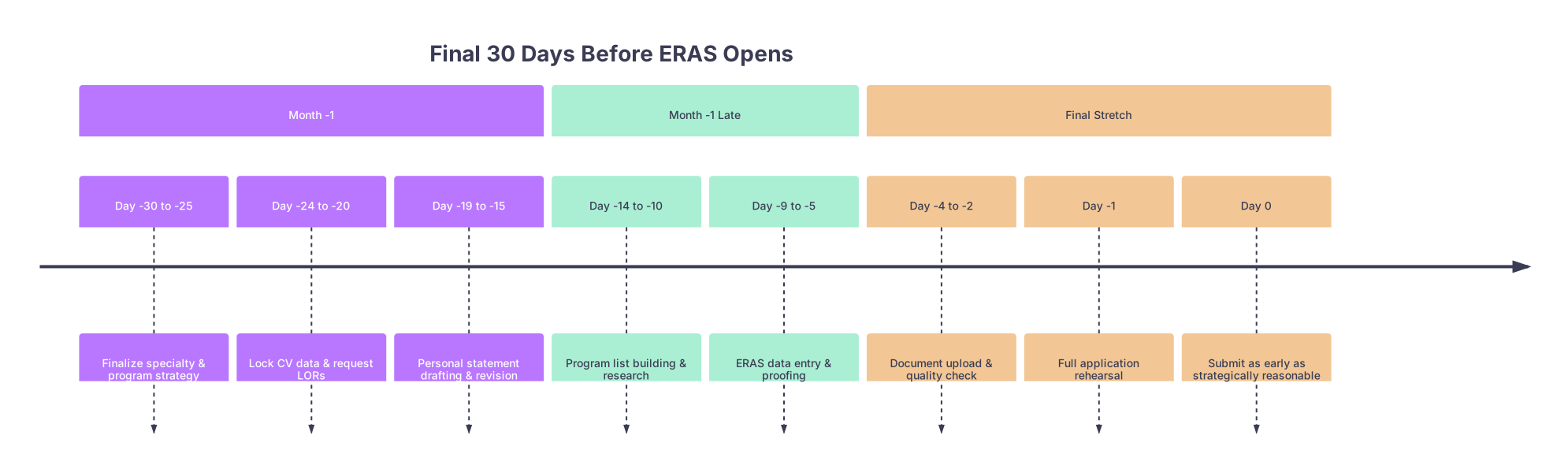
| Period | Event |
|---|---|
| Month -1 - Day -30 to -25 | Finalize specialty & program strategy |
| Month -1 - Day -24 to -20 | Lock CV data & request LORs |
| Month -1 - Day -19 to -15 | Personal statement drafting & revision |
| Month -1 Late - Day -14 to -10 | Program list building & research |
| Month -1 Late - Day -9 to -5 | ERAS data entry & proofing |
| Final Stretch - Day -4 to -2 | Document upload & quality check |
| Final Stretch - Day -1 | Full application rehearsal |
| Final Stretch - Day 0 | Submit as early as strategically reasonable |
Days −30 to −25: Lock your overall strategy
At this point you should not still be “deciding between three completely different specialties.” That chaos leaks into your application. The first 5 days are about strategy and big decisions.
Day −30: Choose your primary specialty (and backup, if needed)
You need to be clear on:
- Primary specialty (e.g., Internal Medicine, EM, General Surgery).
- Whether you are running a dual-application strategy (e.g., EM + IM, Ortho + Prelim Surgery).
If you are still torn, today you:
- Email or meet:
- Your specialty advisor.
- A trusted attending who knows your work.
- If applicable, your dean’s office / career advisor.
- Ask directly:
- “With my scores (Step 1 P/F, Step 2 236) and my application, is [specialty] realistic this year?”
- “If I dual apply, what is the smarter pairing for me?”
By the end of Day −30, you commit to:
- 1 primary specialty.
- 0–1 backup specialties with a clear plan (not “maybe I’ll throw in a few FM programs for fun”).
Day −29: Decide your submission timing window
You are targeting: Submit on or very near the first day ERAS applications can be transmitted to programs. Early = good. Panic‑rushed early = bad.
Today:
- Look up this year’s:
- ERAS applicant opening date.
- First day programs can download applications.
- Pick a target submission day:
- Recommended: Day 0 (opening) or Day +1.
- Avoid: waiting a week “to polish a bit more” unless something major is missing (like a Step 2 score that meaningfully changes competitiveness).
Write it down: “Target ERAS submission date: ______.”
Day −28: Map your program tiers and competitiveness
You need a sober view of where you stand.
Create a simple sheet with columns:
- Program name
- City / Region
- Tier (Reach / Target / Safety)
- Minimum Step 2 if known
- Requires Step 2 by interview / rank?
- Research heavy? (Y/N)
- Personal tie? (Y/N)
Today:
- Look up 10–15 programs in your chosen specialty and roughly tier them. Use:
- Program websites.
- NRMP Charting Outcomes / specialty reports.
- Reddit / SDN selectively (for patterns, not gospel).
- Get a feel for:
- Whether you are realistically competitive for your “dream” programs.
- How many reach programs you will include vs. solid target/safety.
You are not fully building the list today. Just building instincts.
Day −27: Confirm your letters of recommendation (LOR) targets
By now you should know the basics: most specialties like 3–4 letters, with at least 2 specialty-specific.
Today:
- List your letter writers:
- Name
- Specialty
- Type (Chair, Sub‑I attending, research PI, “other”)
- Status: Asked / Confirmed / Submitted
- Compare against your specialty norms.
If you are missing any required type (e.g., EM SLOE, departmental letter, surgery chair letter), flag it in red.
Day −26 to −25: Reality‑check your Step 2 and score story
If you already have Step 2:
- Compare your score to:
- Your specialty’s average matched scores.
- The range at your dream programs when available.
- Decide how you will frame your academic performance:
- Strong consistent.
- Improvement story (e.g., average pre‑clinicals, stronger clerkships and Step 2).
- Recovery from a low Step 1 or a failure.
If you do not have Step 2 back yet:
- Confirm:
- Test date.
- Score release date.
- Decide:
- Are you submitting without Step 2 (risky in some specialties)?
- Or waiting a few days to include the score (safer if you are borderline and know you did solidly)?
At this point, your global strategy is set. Next step: convert big plans into actual application content.
Days −24 to −20: Lock letters and core CV content
This 5‑day block is about making sure the inputs to your ERAS are solid and on schedule.
Day −24: Final LOR requests and nudges
By Day −24, new letter requests are late but still doable. Anything later than this starts to stress writers.
Today you:
- Send formal ERAS LOR requests to:
- All confirmed writers.
- Any additional “optional” strong advocates if you want a buffer.
- For those you asked months ago but have not submitted:
- Send a short, polite nudge with:
- ERAS instructions.
- Your CV.
- Your personal statement draft (if available).
- Clear deadline: “I’m planning to submit my ERAS application on [date]; having the letter uploaded by [date – 5 days] would help a lot.”
- Send a short, polite nudge with:
Do not assume “they said yes” = “the letter is in.” Track it.
Day −23: Clean your CV master document
Before you touch ERAS, you need a clean master CV.
Today:
- Open your CV and:
- Remove old, irrelevant pre‑college fluff.
- Standardize dates (MM/YYYY–MM/YYYY).
- Decide official titles for roles and projects.
- For every activity, outline:
- 1‑line role description.
- 1–3 bullet points of what you did, with outcomes when possible (not “helped with research” but “co‑authored abstract presented at [conference]”).
This will feed directly into ERAS entries later. Saves time and avoids sloppy duplication.
Day −22: Inventory all experiences for ERAS
ERAS has sections like:
- Education
- Work / volunteer
- Research
- Publications / presentations
- Honors / awards
- Licensure and certifications
Today you:
- Make a list (spreadsheet or doc) of every item you might include.
- Label each as:
- Must‑include.
- Optional / filler.
- Identify your Top 10 experiences that:
- Best show clinical excellence, leadership, resilience, or fit with your specialty.
These “Top 10” are the ones you will later highlight in ERAS with stronger descriptions.
Day −21: Draft experience descriptions (first pass)
At this point you should not be hand‑typing descriptions directly into ERAS from scratch.
Today:
- For each Top 10 experience, write:
- 2–4 concise bullet points or short paragraphs capturing:
- Scope (“Led a 10‑member student-run free clinic shift…”).
- Responsibility.
- Outcomes (“Decreased average patient wait time by 15% over 6 months.”).
- 2–4 concise bullet points or short paragraphs capturing:
- For the remaining experiences:
- 1–2 brief bullets each.
Do this in your own document. ERAS will be copy‑paste later.
Day −20: Decide your “most meaningful” and narrative spine
Different specialties value different narratives, but you still need a coherent spine.
Ask:
- What is the through‑line of my application?
- “Service to underserved communities.”
- “Academic / physician‑scientist track.”
- “Procedural, team‑based care.”
- Which 3–5 experiences best support that?
Mark those experiences with a star. These will get:
- Slightly longer, richer descriptions.
- More emphasis in your personal statement and interviews.
Days −19 to −15: Personal statement deep work
You will not write a good personal statement in one night. This 5‑day block is where you do it properly.
Day −19: Outline your specialty‑specific personal statement
Today you should outline, not wordsmith.
Basic structure:
- Hook: 3–5 sentences. A specific moment. No generic “I have always wanted…”
- Why this specialty:
- 2–3 concrete reasons with examples from your experiences.
- What you bring:
- Skills, mindset, values that align with the specialty.
- Career goals:
- General direction (academic vs community, procedural vs primary care, etc.).
- Closing:
- Short, confident, not cheesy.
Write an outline in bullet form. Show the logic. If you cannot explain why you want this specialty in very plain language, do not move on yet.
Day −18: First full draft (primary specialty)
Today:
- Turn yesterday’s outline into a full 650–800 word draft.
- Keep it simple. Do not chase “uniqueness.” Clarity and sincerity beat fancy prose.
Avoid:
- Re‑listing your CV.
- Vague clichés: “I want to make a difference,” “medicine is a calling.”
- Overly traumatic personal stories unless they are central and you have processed them well.
You want one clear, grounded draft by the end of the day.
Day −17: Edit ruthlessly and cut
Let it sit for a night. Then today you:
- Cut fluff. Aim for 600–750 words.
- Replace generalities with specifics:
- Not “I value teamwork” but “I enjoyed running codes on my medicine sub‑I because…”
- Check alignment:
- Does every paragraph support: why this specialty, why you, how you will contribute?
If you are dual applying:
- Draft a targeted version for the backup specialty.
- Shared elements are fine, but do not send an Internal Medicine–flavored statement to a Surgery program.
Day −16: External feedback from 2–3 people
Pick reviewers carefully:
- 1 specialty mentor or resident.
- 1 person who knows you well personally.
- Optional: dean’s office / writing center reviewer.
Send with a clear ask:
- “Please tell me:
- What 2–3 qualities you take away about me.
- Where it feels generic or confusing.”
Do not send to 10 people. You will drown in conflicting edits.
Day −15: Final content revisions, not endless polishing
Today you:
- Incorporate reasonable feedback.
- Decide that this is the statement unless you discover a major problem later.
Lock it in a folder as:
Specialty_PersonalStatement_Final_[Date].docx
You will still proofread again later, but the heavy lifting is done.
Days −14 to −10: Build and calibrate your program list
Now that your narrative is set, you target the right programs.
Day −14: Define your target number of applications
Use a realistic range based on specialty competitiveness and your profile.
Rough rules of thumb (not absolute):
| Specialty Type | Lower Range | Upper Range |
|---|---|---|
| Less competitive (FM, Psych, Peds) | 20 | 35 |
| Moderate (IM categorical, OB/GYN, Anesthesia) | 30 | 45 |
| Competitive (EM, Gen Surg, Ortho prelim-heavy) | 40 | 60 |
| Very competitive (Derm, Ortho, ENT, Plastics) | 60 | 80 |
Look at yourself honestly and set:
- Target number of programs = ______
- Hard maximum = ______ (budget and sanity limit)
Day −13: Build the first draft of your list
Today you:
- Pull from sources:
- FREIDA.
- Program websites.
- Your school’s match list.
- Advice from mentors about “friendly” vs “black box” programs.
- Fill in:
- Region (group by city, state).
- Tier (Reach / Target / Safety).
Aim for at least 1.5× your target number today. You will trim.
Day −12: Reality‑check with someone experienced
Send your draft list to:
- Your specialty advisor, if they are actually responsive.
- Or: a resident in your chosen field who matched recently.
Ask:
- “Where am I overreaching?”
- “Where am I under‑applying?”
- “Which programs are known for being IMG‑friendly / DO‑friendly / Step 2‑sensitive?”
Adjust your list accordingly.
Day −11: Balance your geography and program styles
Today is about fit and realistic life plans:
- Mark:
- Cities you would genuinely move to.
- Regions you strongly prefer.
- Check:
- Are 70–80% of your programs in places you can seriously see yourself living?
- Do you have a mix of academic and community programs if appropriate?
Cut the “I would never go there but it looks prestigious” programs. You are wasting money and time.
Day −10: Finalize working list and tracking sheet
By now you should have:
- A solid, balanced list at or near your target number.
- A spreadsheet with columns for:
- Program name
- City / state
- ACGME ID
- Tier
- Any special application requirements (supplemental application, signals, etc.)
- Notes (alumni there, research fit, etc.)
Next phase: turning all of this into a clean ERAS application.
Days −9 to −5: ERAS data entry and first full build
This 5‑day block is where most people either stay calm and methodical…or implode. You are going to be methodical.
Day −9: Demographics, education, and exam sections
Today you should:
- Log into ERAS and complete:
- Personal information and contact.
- Medical school info.
- USMLE/COMLEX entries (make sure numbers and dates are exact).
- Other degrees (if any).
Double‑check:
- Name spellings.
- Email and phone number.
- That your legal name matches exam registrations.
This section is boring but high‑risk if done sloppily.
Day −8: Experience entries (Top 10 first)
Copy from your CV document:
- Enter all Top 10 experiences first:
- Roles, dates, locations.
- Descriptions (paste, then adjust for ERAS character limits).
- Mark 1–3 as “most meaningful” (if your application year uses this style, for supplemental/specialty forms).
Then:
- Add the remaining experiences, keeping:
- Order logical (chronologic or grouped by type, depending on specialty norms).
- Descriptions brief but clear.
Do not obsessively wordsmith in ERAS yet. Get everything in with 90–95% quality.
Day −7: Publications, presentations, honors
Today you should:
- Enter all scholarly work:
- PubMed‑indexed publications.
- Submitted / in‑press (clearly labeled).
- Posters, oral presentations.
- Enter honors and awards:
- Class rank notes, AOA / GHHS, scholarships, etc.
Check formatting:
- Consistent citation style.
- No fake or inflated authorship. Programs notice.
Day −6: Upload CV and finalize LOR designations
Some programs ask for a CV as well, some do not. Regardless:
- Have a clean PDF CV ready.
- Make sure:
- Your ERAS entries and CV do not contradict each other on dates and titles.
Letters:
- In ERAS, assign LORs to specialties:
- Select the strongest, most relevant 3–4 per specialty.
- Confirm status:
- Who has uploaded.
- Who is still pending.
If a key letter seems unlikely to be ready by Day 0, decide whether you have a strong enough set without it.
Day −5: First full application read‑through
Today:
- Print to PDF or use the ERAS “printer-friendly” view.
- Read your entire application from top to bottom as if you are a PD:
- Does the narrative feel consistent?
- Are there any obvious holes, weird gaps, or typo clusters?
Mark problem areas. Do not start fixing yet. Just identify.
Days −4 to −2: Polishing, proofing, and technical checks
Now you shift from building to refining.
Day −4: Fix content issues and tighten language
Today you:
- Edit experience descriptions directly in ERAS for:
- Clarity: every sentence should say something concrete.
- Brevity: remove fluff and repetition.
- Make sure your “big 3–5” experiences clearly support your specialty choice.
If you have any red flags (leave of absence, course failures, professionalism concerns):
- Ensure the corresponding explanation section:
- Is honest.
- Takes responsibility.
- Shows growth and current stability.
Day −3: Proofreading with a second set of eyes
Do not skip this.
Today:
- Ask 1–2 trusted people (detail‑oriented, not rushed) to:
- Review your ERAS PDF.
- Mark typos, grammar issues, inconsistencies in dates or formatting.
- Specifically ask them to:
- Try to catch any “you used the wrong program name” mistakes if you mention names anywhere.
While they review, you:
- Double‑check deadlines and special requirements for any programs needing:
- Supplemental ERAS applications.
- Preference signaling.
Day −2: Technical readiness and document sanity check
Now you make sure nothing breaks on submission day.
Today:
- Confirm:
- ERAS account works on at least two devices / browsers.
- You know exactly where your personal statement files and any uploads live.
- Re‑check:
- LOR status. If something vital is missing, send a final, polite reminder.
- Verify:
- Program list is final or very close.
- No duplicate or “I would never go here” programs remain.
If you are using signals (for specialties that do):
- Decide exactly which programs get them.
- Document your reasoning so you remember later during interviews.
Day −1: Full dress rehearsal
No new content today. Only rehearsal and final minimal tweaks.
Morning: Simulated submission
You should:
- Open ERAS and go section by section:
- Confirm every required field is filled.
- Confirm correct assignment of:
- Personal statement(s) to the right specialty.
- LOR combinations to the right programs.
- Generate the printable version again and read quickly for:
- Any glaring issues missed after last edits.
Afternoon: Micro‑edits and mental reset
If you find something:
- Fix only objective errors:
- Typos.
- Wrong date.
- Wrong program list entry.
- Do not rewrite your personal statement at 11 p.m. unless there is a catastrophic issue.
Then:
- Step away. Go for a walk. Eat something normal. Sleep.
You want to wake up on Day 0 calm, not hysterical.
Day 0: ERAS opens for submissions
Today is execution.
Morning: Final 30‑minute check
At this point you should not be debating core content. You are checking for landmines.
- Re‑confirm:
- Personal statement assigned correctly.
- LORs correctly attached per program/specialty.
- Program list is what you decided.
- Log back out and log in again to ensure everything saved.
Midday: Submit in your chosen window
Pick a time when:
- Servers are stable.
- You are fully awake and not rushing between clinical duties.
You:
- Submit the application.
- Submit to all chosen programs (or a large initial chunk, if you have a staged plan).
- Take screenshots or save confirmation emails for your records.
Once you click submit:
- Do not spiral about one adjective in your personal statement.
- Your time is now better spent prepping for interviews, not rewriting history.
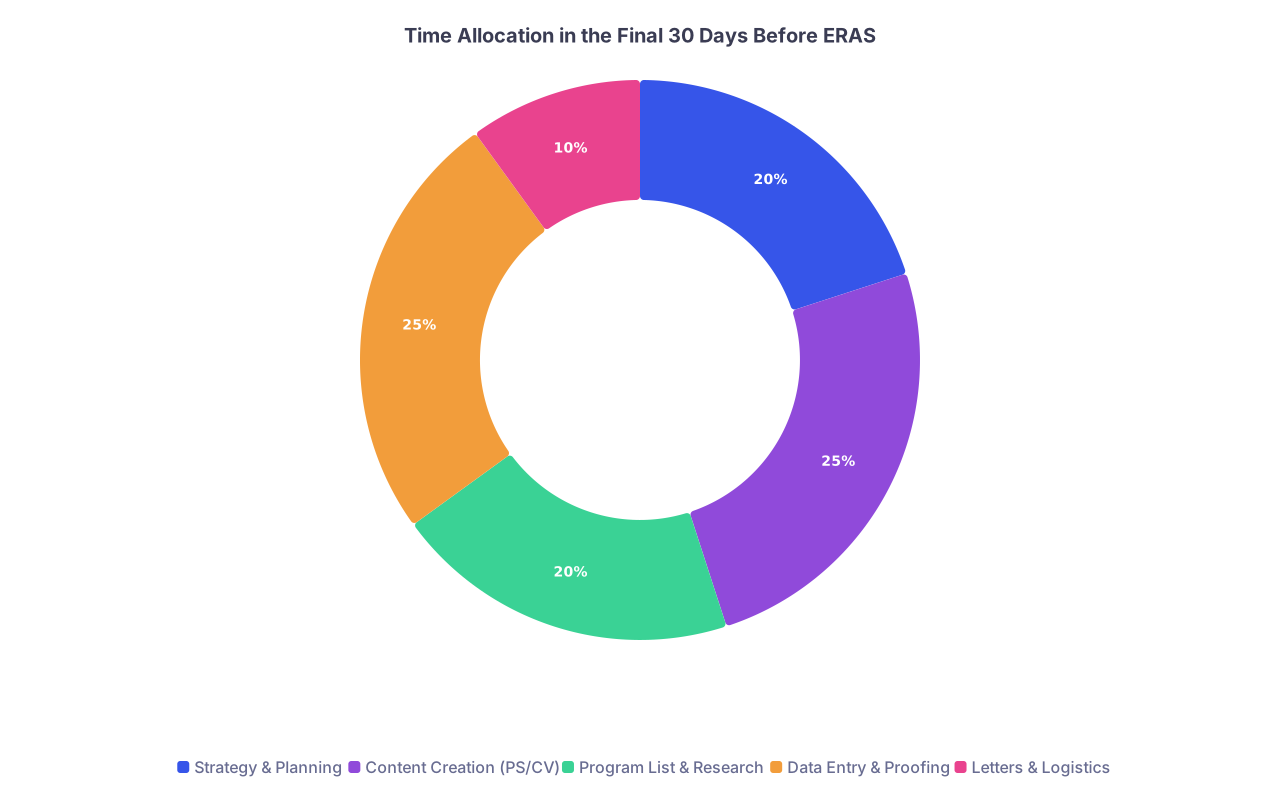
| Category | Value |
|---|---|
| Strategy & Planning | 20 |
| Content Creation (PS/CV) | 25 |
| Program List & Research | 20 |
| Data Entry & Proofing | 25 |
| Letters & Logistics | 10 |
If you are slightly behind this schedule
Reality: some of you will find this with 18 days left, not 30. You can compress.
Priority order if you are behind:
- Lock specialty and program strategy (Days −30 to −25)
- Secure LORs and draft personal statement (Days −24 to −15, condensed)
- Build program list and enter ERAS data (Days −14 to −5)
- Leave at least 2 days for proofreading and tech checks (Days −4 to −2)
Do not sacrifice proofreading and LOR tracking just to obsess over another personal statement edit.


Key takeaways
- By 30 days out, you should have your specialty choice, letter strategy, and broad program tiers decided; the rest of the month is execution, not existential crisis.
- The most efficient use of this final month is front‑loading strategy and content, then using the last week for clean data entry, proofreading, and technical checks.
- Early, clean submission beats last‑minute “perfect” every time; treat your target submission day like a launch date and work backward with discipline.