
The panic over whether to hit “submit” before all your LORs arrive is wildly overblown.
You’re not losing interviews because you certified and submitted your ERAS app on opening day while two letters were still pending. You’re losing interviews—if you lose them at all—because of your scores, your school, your specialty choice, your personal statement, your program list… not because a letter uploaded five days late.
Let’s dismantle this properly.
The Myth: “Never Submit Until Every LOR Is In”
Here’s the script I hear every year from terrified MS4s:
- “My advisor said don’t submit until all letters are uploaded—programs will think my app is incomplete.”
- “Reddit says programs filter out incomplete apps instantly.”
- “If I submit with only 2 letters instead of 3, I’m dead.”
No. That’s not how this actually works in the real world of program coordinators, filters, and busy PDs.
You need to separate three different timelines:
- When ERAS allows you to certify and submit your application.
- When programs can first download applications from ERAS.
- When your specific application is actually reviewed by a human.
Those are not all the same day. And the gap between them is what kills this myth.
How ERAS and LORs Actually Work
Let me walk through the mechanics, because once you see the workflow, the fear mostly disappears.
You can:
- Assign letter writers.
- Submit your ERAS application.
- Have letters arrive later and still get attached to programs you already applied to.
You’re not “locked out” of updating LORs after you hit submit. That’s the key misunderstanding.
The only thing that gets locked when you certify is:
- Your common application form (experiences, personal statement choice for that program, demographics, etc.)
Letters of recommendation are a separate data stream. They can trickle in. They do trickle in. Every year. For almost everybody.
Program coordinators know this. PDs know this. ERAS literally built the system this way because late letters are normal.
The Real Timeline: What Programs See and When
Here’s the pattern at most programs: they do not sit there at 8:00 AM on “download day” and instantly reject every app with only 2 letters attached. They are:
- Sorting by filters (US vs IMG, Step scores, specialty-relevant filters).
- Grouping by school or region.
- Reviewing in batches over days to weeks.
To make this concrete, here’s a simplified timeline that I’ve seen in multiple IM, FM, and peds programs:
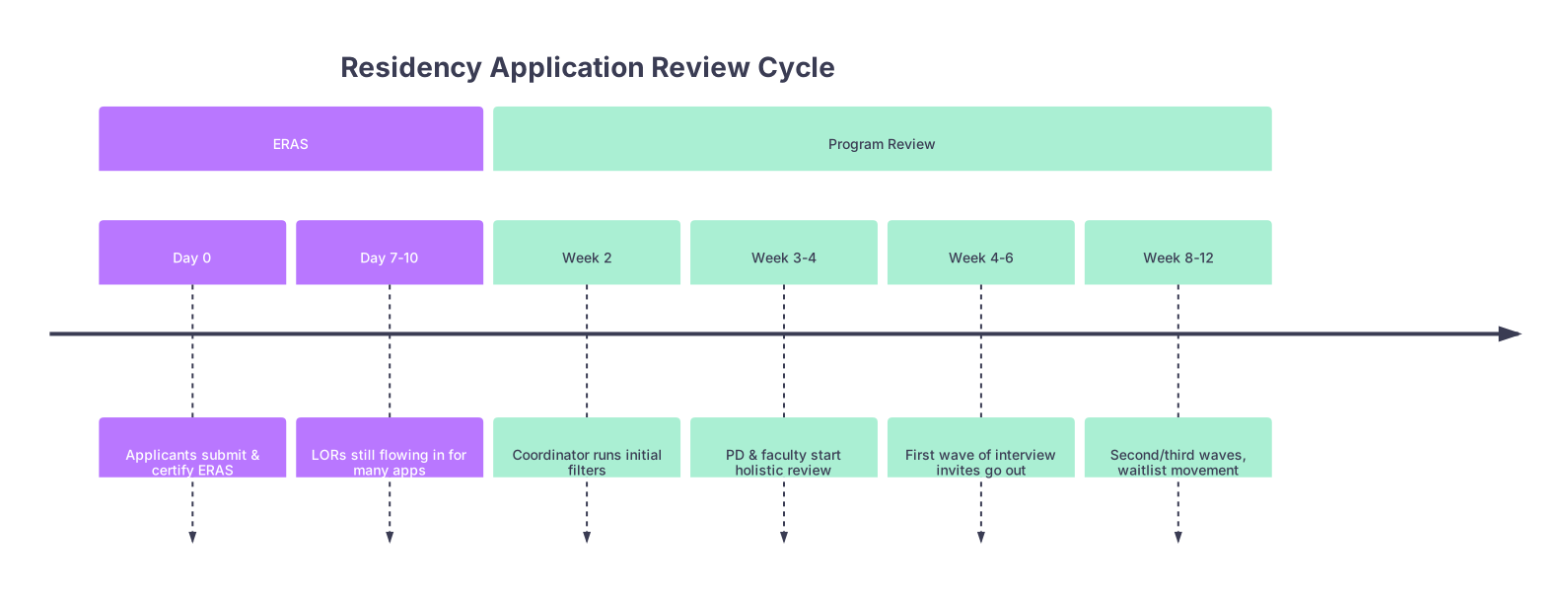
| Period | Event |
|---|---|
| ERAS - Day 0 | Applicants submit & certify ERAS |
| ERAS - Day 7-10 | LORs still flowing in for many apps |
| Program Review - Week 2 | Coordinator runs initial filters |
| Program Review - Week 3-4 | PD & faculty start holistic review |
| Program Review - Week 4-6 | First wave of interview invites go out |
| Program Review - Week 8-12 | Second/third waves, waitlist movement |
Your third letter coming in on Day 3? That’s still well before your application is seriously reviewed at many programs.
Do some ultra-competitive specialties and brand-name programs front-load review? Yes. But even they do not universally require all 3–4 letters to be present on Day 1 to even glance at an application.
What Actually Hurts You (Versus What You’re Afraid Of)
Let me be very clear:
What really hurts you:
- Submitting your ERAS app late in the cycle (weeks after programs first download).
- Having weak letters (generic, lukewarm, or negative undertones).
- Having missing required letters for a long time (e.g., no specialty-specific letter 3–4 weeks into review season).
- Applying too narrowly (15 ortho programs and nothing else, with a 230 Step 2).
What usually does not hurt you:
- Submitting your application early with 2 letters already in and 1–2 more arriving in the next several days.
- Having a known high-quality writer who uploads a bit later but before serious review starts.
- Letters trickling in during the first week or so after ERAS opens for program downloads.
Programs care far more about:
- That you applied early enough for a full, fair review.
- That you eventually meet their letter requirements by the time they’re actively reviewing and sending interview offers.
Not whether the letters were all there at 9:01 AM on opening day.
Let’s Look at the Data (Such As It Is)
No, there’s no randomized controlled trial for “submit with 2 LORs vs. 3 LORs” because nobody is funding that study.
But we do have:
- NRMP Program Director Survey data about what PDs say they care about.
- NRMP Charting Outcomes data about timing and interview odds.
- A lot of real-world experience from coordinators and faculty actually reading apps.
From the NRMP Program Director Survey (e.g., 2021, 2022 editions), factors cited as “highly important” for interview offers usually include:
- USMLE/COMLEX scores (until Step 1 went P/F, now Step 2 is king)
- Grades in required clerkships
- Class ranking/Medical school reputation
- Specialty-specific letters of recommendation
- Personal statement and perceived “fit”
But timing specifics? “LORs present on opening day” is not on that list. “Application completed reasonably early” is, but that’s about weeks, not hours.
Here’s a simplified comparison to reality:
| Applicant Fear | PD/Program Reality |
|---|---|
| Submitting before all LORs arrive | Fine if letters arrive soon after |
| 2 letters instead of 3 on Day 1 | Acceptable short-term, if 3rd is coming |
| Application “auto-rejected” as incomplete | Rare; usually just flagged for later review |
| One letter uploads 5–7 days late | Almost never a dealbreaker |
| Submitting application 3 weeks late | Absolutely can hurt interview chances |
And I’ve heard program coordinators say it bluntly: “We expect letters to trickle in. We don’t toss people out for that in Week 1. What kills people is completing their apps in late October.”
That’s the piece most students ignore while obsessing over whether to click submit on September 4 vs. September 6.
The Key Exception: Specialty-Specific Letters and Hard Minimums
Now, let’s not swing to the opposite naive extreme. There are situations where missing letters matter. A lot.
Three scenarios:
Hard minimums for review.
Some programs literally will not review an application until they see a minimum number of letters (usually 3, sometimes 4 for surg specialties). The coordinator may have a checklist or status flag like “Complete vs Incomplete.”Required specialty letter.
For certain specialties, not having a specialty-specific letter (e.g., EM SLOE, surgery letter from an attending in that field, etc.) will seriously hurt you if missing for long.Late season completion.
If your application is still missing key letters 3–4 weeks into the review period, now it can absolutely hurt. Because programs start filling interview slots. Momentum matters.
But notice the difference: this is about how long you remain incomplete, not whether you hit submit before your letter writer took action.
If your third letter appears on Day 4 and programs don’t start serious review until Week 2, you’re not in the danger zone.
If your EM SLOE still isn’t uploaded in mid-October? Yeah, that’s a problem.
Tradeoff: Early Submission vs Waiting for That “Perfect” Letter
Here’s the real decision you’re facing:
- Option A: Submit early with 2–3 solid letters already in, while knowing 1 more (maybe your “best”) is coming soon.
- Option B: Delay submission for 1–3 weeks waiting for that last letter so your app looks “perfect” on Day 1 at the program side.
In most cases, Option A is better. Early matters more than cosmetically complete.
Why?
- Programs start building their “review pools” from early applicants.
- Your file is in the system; once the new letter arrives, it’s there for them when they open your app.
- A great late letter in Week 1 is still a great letter. It doesn’t magically become weaker because you hit submit earlier.
The only time Option B might make sense is if:
- You are in a hyper-competitive specialty (derm, plastics, ENT, ortho, neurosurgery).
- The missing letter is your only specialty-specific letter from a big-name person.
- You know from your school/program advising that this specific letter is critical for your viability.
Even then, we’re usually talking about holding your app for a few days, not a few weeks.
What Coordinators Actually Do With “Incomplete” Apps
Let me translate what “incomplete” usually means operationally:
- They download all apps once ERAS opens.
- They use filters (school type, score cutoff, visa status, etc.) for a first pass.
- For those that pass filters but are “missing something” (like one letter), the app gets parked—often in a separate queue or just mentally tagged as “check back in a week.”
- Once letters arrive, those apps are re-opened and dropped back into the main pool.
Nobody is manually blacklisting you because a letter came on Day 5 instead of Day 0. They do not have that kind of time, and they are not that petty.
The only time this turns into a death sentence is when programs are already filling 80% of their interview spots and your application finally becomes “complete” in mid-to-late October. That is absolutely too late in many specialties.
So I’ll say it again: your bigger enemy is late application, not slightly staggered letters.
Strategy: How To Play This Smart (Not Paranoid)
Let’s make this actionable. Here’s how a rational applicant should handle LOR timing.
Aim to submit early with at least 2–3 strong letters already in.
If your school’s advising says “3 letters minimum, one specialty-specific,” then have those ready or within days.Have explicit, calendar-based deadlines for letter writers.
When you ask: “Could you have this submitted by [specific date two weeks before you plan to submit ERAS]?” Not “sometime in September.”Track letters like a hawk—but do not delay weeks just for cosmetic completeness.
If you’re missing 1 letter from a reliable writer and everything else is set, submit. Let the letter catch up.Know your specialty norms.
EM SLOEs, surgical letters, certain fields do care more about specific types of letters. Early specialty-specific letters help you; they don’t require absolute simultaneity with your ERAS submission.Communicate (once) with chronic late letter writers.
If someone is known to be slow, send one polite reminder: “Programs start reviewing applications around [X date]; it would help me a lot if it’s uploaded by then.” Then stop spamming them. If they’re that slow, you should already have other letters.If a crucial letter is delayed into October, adjust.
Do not just sit and wait. Add backup letters, broaden your program list, consider prelim or less competitive programs, talk to your dean’s office. But don’t just keep your app frozen.
A Quick Visual: What Actually Matters For Interview Odds
Here’s a rough, reality-based weighting of factors that influence interview offers for most core specialties (IM, FM, peds, psych, etc.):
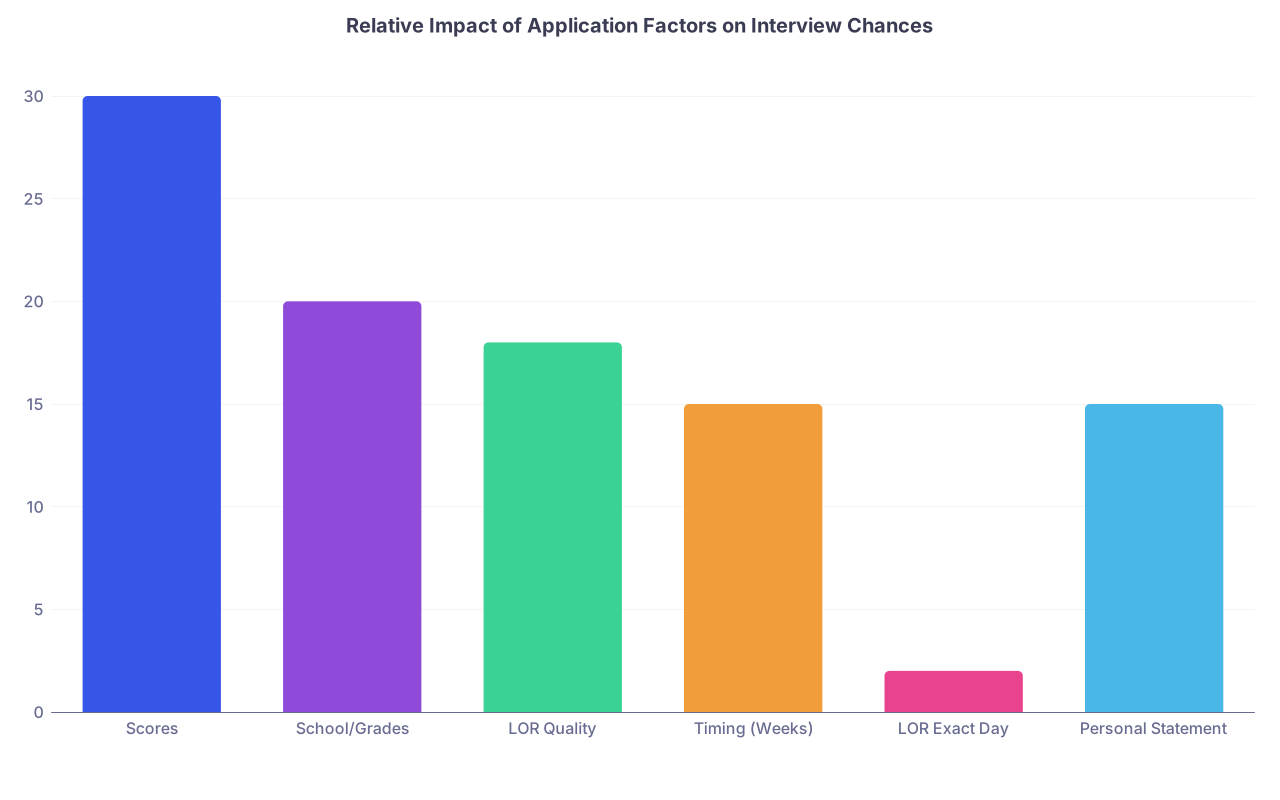
| Category | Value |
|---|---|
| Scores | 30 |
| School/Grades | 20 |
| LOR Quality | 18 |
| Timing (Weeks) | 15 |
| LOR Exact Day | 2 |
| Personal Statement | 15 |
That tiny 2%? That’s the “exact day the last LOR arrives” effect. Everything else dwarfs it.
Yes, this is a conceptual illustration, not a randomized trial. But it matches what PDs, coordinators, and advisors consistently report.
The One Thing You Should Actually Be Afraid Of
If you want something to legitimately worry about, it is this:
Submitting your ERAS application weeks after most of your peers in a competitive specialty, with letters still missing into October while programs are already sending out their first 2–3 waves of invitations.
That’s how people quietly destroy their cycle. Not with a September 6 submission that had a letter show up on September 10.
Years from now, you won’t remember which day your last letter uploaded or how many hours you debated the submit button. You’ll remember whether you acted on solid strategy or let anxiety drive the car.