
The obsession with submitting ERAS the second it opens is wildly overblown—and the data backs that up.
If you’re panicking because your application will go in “a week late,” you’re burning stress on the wrong problem. That week is not what makes or breaks your Match. Your scores, grades, letters, and how you rank programs? Those matter. Whether you clicked “submit” at 9:01 a.m. on opening day or five days later? Not nearly as much as people claim.
Let’s dismantle this myth properly.
The Origin of the “Submit on Day 1 or Die” Myth
Here’s the script I hear every single cycle:
“If you’re not in the first upload batch you’re done.”
“Programs review applications in the order they’re received.”
“Early birds get all the interview spots.”
That advice spreads on Reddit, group chats, and from that one classmate who “knows someone in admissions.” The problem: it confuses logistics with selection. Programs do not hand out interviews to the first 50 people who submit and ignore the rest.
Here’s what actually happens in most programs I’ve seen or talked to:
- ERAS opens for submission on a specific date.
- Programs don’t even get your file until a separate date when ERAS releases applications to programs in one big dump.
- Programs are flooded with hundreds to thousands of applications at once.
- They run filters (Step scores, geographic ties, visa status, etc.) and sort piles based on content, not timestamp.
A program director isn’t sitting there thinking, “Well, this applicant has a 265 and three first-author pubs, but the other one submitted 9 hours earlier, so… tough luck.”
The myth persists because timing feels like something you can control. It’s much easier to fixate on the calendar than on a mediocre personal statement or a missing strong letter.
How ERAS Timing Actually Works (Not the Reddit Version)
Let’s separate three different “timing” concepts that get blended together into one panic.
- The date ERAS opens for editing and uploading.
- The first day you can submit your application.
- The date programs receive and can view your application.
For most specialties and years, all applications submitted before the “program release date” are effectively bundled together. They show up as one big wave. Submitting 4 days “early” inside that window doesn’t teleport your file to the top of the stack.
Does being months late hurt? Yes. Does being days late inside the same release window matter? Almost never in any meaningful way.
To make this clearer:
| Scenario | Effect on Competitiveness |
|---|---|
| Submitted before program release date | Treated as part of main initial pool |
| Submitted 1–7 days after release date | Minimal to no impact at most programs |
| Submitted 2–4 weeks after release date | Some loss of early interview opportunities |
| Submitted >1 month late | Noticeable disadvantage, especially in competitive fields |
| Submitted after many interview invites sent | Significant disadvantage |
Notice what’s not there: “Submitted at 9:00 vs 9:07 vs next morning.”
The obsession with the exact hour is noise.
What the Data and Behavior of Programs Tell You
You won’t find a neat randomized trial of “submit September 6 vs September 13” because nobody’s funding that study. But you can look at patterns: NRMP data, program behavior, and what PDs actually say when they’re not posturing on social media.
1. NRMP Match Data: The Big Signals Matter More
NRMP’s Charting Outcomes in the Match and Program Director Surveys are pretty consistent:
- Step scores (or pass + Step 2 score range)
- Clerkship grades
- Specialty-specific letters of recommendation
- Number of contiguous ranks
- Failing Step attempts, red flags, etc.
These factors strongly correlate with match outcomes. Timing is occasionally mentioned by PDs—but usually as “very late applications are less likely to be reviewed,” not “if you missed the first upload batch by 48 hours you’re doomed.”
The Match is driven by the quality of your application and your rank list. Timing within days is a rounding error by comparison.
2. Program Capacity and Reality
Programs receive insane volumes: 1500+ applications for 6–12 categorical spots in some fields. They don’t read them chronologically, one by one, until slots fill. They filter and sort:
- By Step 2 CK cutoff (explicit or soft)
- By med school type (US MD, DO, IMG)
- By geographic preference
- By research or degree (MD/PhD vs MD)
I’ve watched programs do this. They literally export CSVs from ERAS, run filters, and only then do they start more detailed reviews. Timestamp is not the variable they’re sorting on.
3. Multiple Invite Waves
Programs don’t send all their interview invites in one burst and then shut the doors forever. They:
- Send a first wave
- See how many people accept / decline
- Adjust and send more
- Reserve some slots for home students, special cases, or late found strong candidates
This alone destroys the idea that if you weren’t there the first morning, you’re invisible.
The Real Difference Between “Early,” “On Time,” and “Late”
Now let’s draw the line where timing actually does matter—because I’m not telling you to submit in November.
Think about timing like this:
- Optimal: Submitted by the time programs first receive apps or within a few days.
- Acceptable: Within 1–2 weeks of that date.
- Not great: 2–4 weeks late.
- Objectively bad: More than a month late, or after many programs have already started interviewing.
That “week” you’re terrified about? Often still inside “optimal” or “acceptable.”
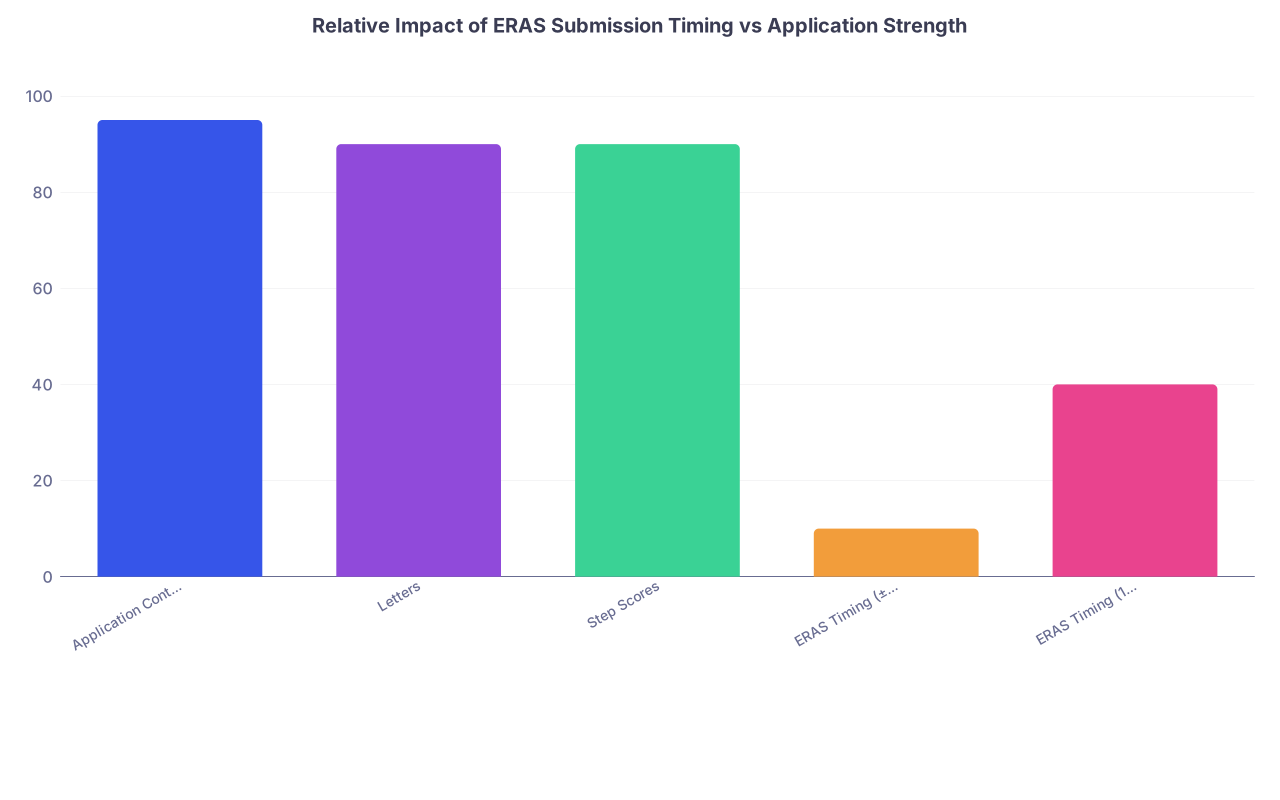
To visualize the impact:
| Category | Value |
|---|---|
| Application Content | 95 |
| Letters | 90 |
| Step Scores | 90 |
| ERAS Timing (±1 week) | 10 |
| ERAS Timing (1+ month late) | 40 |
Is the scale arbitrary? Yes. But it reflects what PDs actually care about. Being a month late hurts. Being a few days off the “ideal” date barely registers.
Where a Week Can Matter—and Where It Absolutely Doesn’t
Let me be specific so you know whether your situation is actually a problem.
Situations Where a 3–7 Day Delay Almost Never Matters
- You’re still before or just after the program release date.
- You’re in a moderately competitive specialty (IM, Peds, FM, Psych) and applying broadly.
- Your stats and application are not borderline. You’re comfortably in range.
- Your letters are all in, and you’re just polishing experiences or personal statement.
In these cases, taking an extra 3–7 days to:
- Fix a weak personal statement
- Correct obvious typos
- Update a meaningful research acceptance or poster
- Get one more strong letter uploaded
…is almost always a better trade-off than hitting “submit” half-baked.
Situations Where Timing Matters More
- Ultra-competitive specialties (Derm, Ortho, Plastics, ENT, Uro, etc.) where:
- Interview spots are limited.
- Programs over-invite early and then slow down.
- Borderline applicants who need every possible marginal advantage.
- Very late submissions (weeks after programs started heavy review and sending invites).
- Situations where your med school or dean’s office is notoriously slow, and programs know it.
Even then, we’re usually talking about weeks, not whether you were there on the first or third day of submissions.
The Bigger Risk: Rushing a Bad Application
You know what I have seen tank people’s cycles? Sloppy, rushed applications submitted “on time” to satisfy fake urgency.
Examples I’ve personally seen:
- A personal statement with the wrong specialty named. Sent to 40+ programs. Because the student was determined to submit the first morning and didn’t do a final read.
- Incomplete experience descriptions—bullet points that literally said “fill this later.”
- A missing LOR from the only attending in the specialty they’re applying into, because they wouldn’t wait 4–5 more days for it to come in.
- Not updating ERAS after a Step 2 CK score that would have rescued a mediocre Step 1.
You don’t get bonus points for being first if what you submitted looks careless.
If an extra week means:
- Catching red-flag mistakes
- Tightening your narrative
- Getting a key letter in
- Syncing Step 2 CK score reporting properly
Then that week is not a liability; it’s a strategic choice.
The One Timing Detail People Constantly Misplay: Step 2 CK
Step 2 CK timing is where things actually get intertwined with ERAS submission, and people mess this up out of panic.
Programs care a lot more about:
- Whether you have a Step 2 score available by the time they seriously review apps
- Whether that score helps or hurts your story
than they care about whether your ERAS was in on Wednesday vs Monday.
If your Step 1 is weak or pass-only, a strong Step 2 CK score is leverage. Submitting ERAS five days earlier without that score is usually worse than waiting a bit and having a 250+ on display.
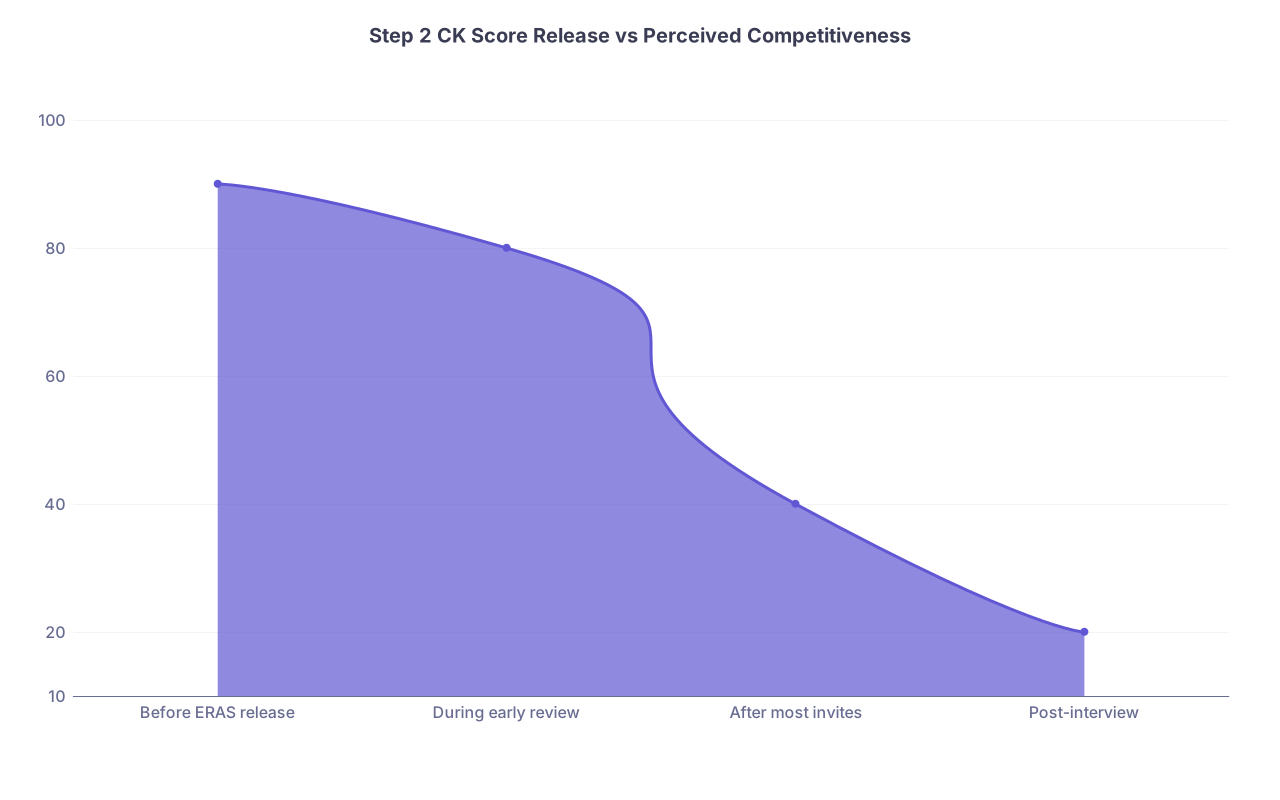
There’s even a strategic timing angle here:
| Category | Value |
|---|---|
| Before ERAS release | 90 |
| During early review | 80 |
| After most invites | 40 |
| Post-interview | 20 |
Again, the “submit on the first hour” obsession distracts from the much more important question: Will my Step 2 be uploaded when programs actually start evaluating me?
How Programs Really Manage the First Weeks of ERAS
Forget the fantasy of 50 faculty members lined up to read every application in timestamp order. The real workflow in a busy program looks more like this:

| Step | Description |
|---|---|
| Step 1 | Applications Released |
| Step 2 | Coordinator Downloads Batch |
| Step 3 | Filters by Basic Criteria |
| Step 4 | Generates Initial Shortlist |
| Step 5 | Faculty/PD Review Subset |
| Step 6 | Send First Wave of Invites |
| Step 7 | Monitor Accept/Decline |
| Step 8 | Second Wave / Backup Invites |
See where “application timestamp” appears? Exactly nowhere.
When to Stop Tweaking and Just Submit
Now, here’s where some of you go off the rails in the other direction and use “timing doesn’t matter” as an excuse to procrastinate. That’s not what I’m saying.
Reasonable rule of thumb:
- If you’re more than ~1 week past when programs can first see apps and you’re just “editing sentences for vibes,” hit submit.
- If you’re delaying solely because you’re anxious, not because anything substantial will change (letters, scores, major experiences), submit.
- If your dean’s office or advisor has already reviewed and said it looks good, believe them.
A week to add a major publication, fix embarrassing errors, or get a strong letter? Worth it.
A week to rename 10 experiences from “Led a team of…” to “Collaborated with…”? Not worth it.
The Bottom Line: What a Week Really Means
Strip away the message board hysteria and here’s where we land:
A few days to a week difference in ERAS submission timing, near the start of the cycle, does not make or break your Match. Your application content, scores, letters, and rank list are what matter.
Major delays (weeks to a month+) are a different story. That’s when you start missing early review and invite waves, especially in hyper-competitive specialties.
Rushing a weak or error-filled application to meet an artificial “first day” deadline is worse than taking a few days to strengthen it. Use time strategically, not anxiously.
If you’re agonizing over a 5–7 day delay but haven’t re-read your personal statement, triple-checked your experiences, or thought seriously about your letter strategy, your priorities are backward.
Fix the substance. Then submit. The calendar will not save—or sink—you on its own.