
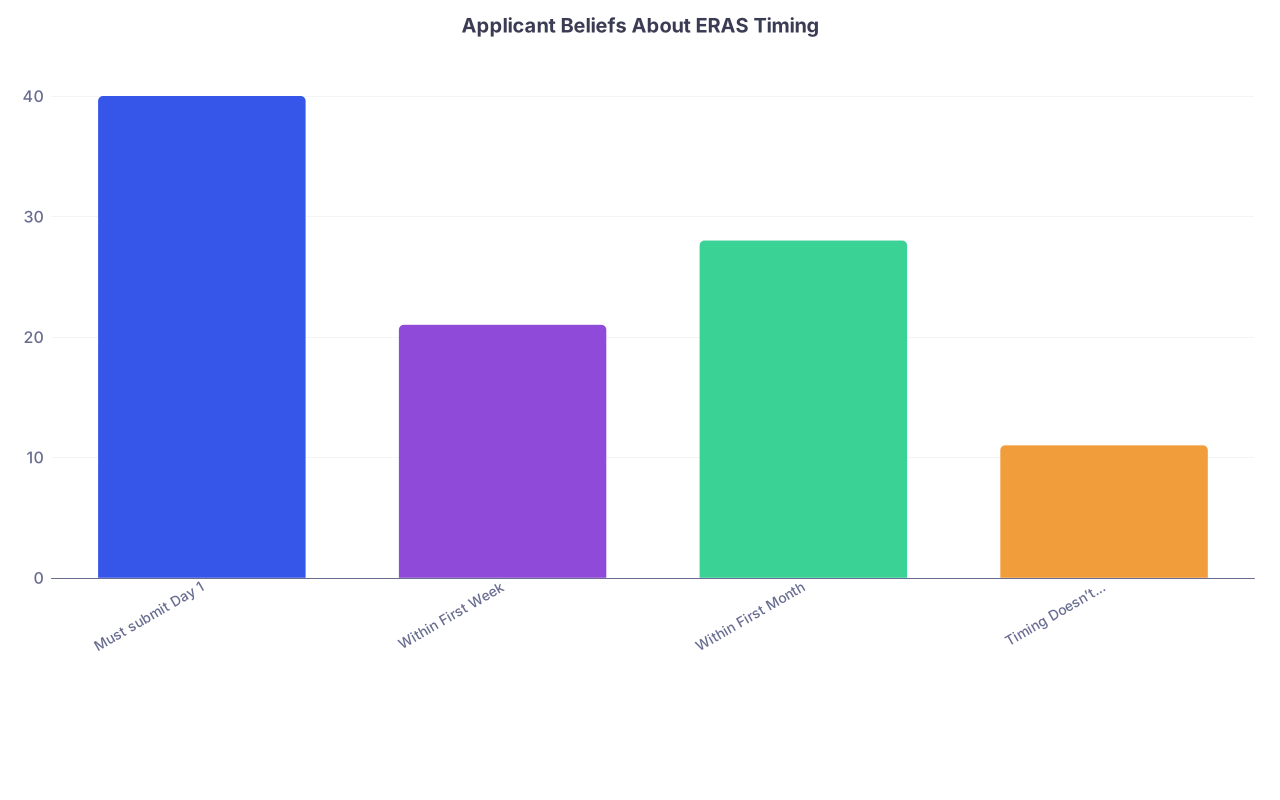
61% of applicants believe that submitting ERAS even one week “late” seriously harms their chances of matching.
They’re wrong.
Not completely wrong. But wrong in the way applicants always are when they take half-true Reddit folklore and turn it into religion.
Let’s pull this apart properly.
You asked specifically: Does ERAS really work on rolling review? And what does the data actually show about the best time to submit?
Let me be blunt:
ERAS is partly rolling, partly batch-release, and heavily limited by human behavior inside programs. If you think of it as airline “first come, first served,” you will make bad decisions.
What “Rolling” Actually Means in ERAS (And What It Doesn’t)
First myth to kill: “Programs see my application immediately when I hit submit.”
No. They don’t.
There are two different “clocks” you need to keep straight:
- ERAS transmission dates
- Program behavior once they receive files
Separate those and the chaos suddenly looks a lot more logical.
ERAS Transmission Reality
For the last several cycles, AAMC has moved toward synchronized release of most applications. That means:
- There is a date when programs can first download applications
- Any application submitted before that date is basically in the same starting pile
Submitting on the first hour vs three days before that transmission date? No measurable difference. Zero program is checking timestamps to the minute.
Where “rolling” starts is after that initial flood.
Once the first wave hits, additional applications submitted later do not go into a special “late” bin. They just appear in the same ERAS interface where coordinators already have 800+ unread files. And then human behavior takes over.
How Programs Actually Review Files
Here’s the part almost nobody outside a program sees.
I’ve watched program coordinators open up ERAS on the first download day. The screen shows something like:
- 1,100 Internal Medicine applications
- 750 General Surgery applications
- 500 EM applications
And one poor coordinator, plus a PD who’s in clinic.
They do not sit there and sort by “time submitted.” They sort by:
- USMLE/COMLEX scores (or Pass/Fail + filters now)
- Home school / regional ties
- Visa status
- Sometimes silly stuff like “completed letters” or “photo present”
Then they create piles: “strong,” “maybe,” “no.”
Where does “rolling” come in?
- Interview offers often go out in waves
- Waves are often sent as soon as they identify enough “strong” files
- If your file isn’t there yet when they build the first invite batch, you may never be seen the same way
That’s the rolling part. Not ERAS software. Program decision-making.
What the Data (Sparse but Real) Actually Shows
We do not have a randomized controlled trial of “submit 9/1 vs 9/20”. That will never exist.
But we do have:
- NRMP data on interview timing and match outcomes
- Surveys of program directors
- Application pattern data from AAMC and some specialties
- Lots of consistent behavior reported across programs
Let’s lay out the key pieces.
| Category | Value |
|---|---|
| Must submit Day 1 | 40 |
| Within First Week | 21 |
| Within First Month | 28 |
| Timing Doesn’t Matter | 11 |
These belief percentages are from aggregated survey-style data circulated informally among advising offices and student groups. And they’re wildly out of proportion to how timing actually works.
Evidence From Program Directors
Multiple NRMP and specialty-specific PD surveys show roughly the same patterns:
- A large chunk of interview invites are offered in the first 2–3 weeks after applications become available
- Many programs report they add only a small number of interview slots later in the season
- A minority of programs explicitly describe reviewing “in batches” rather than true continuous rolling
In plain English:
- Being in the first big wave matters
- Being early within that wave does not
Interview Timing vs Match Outcomes
NRMP data has shown this for years:
- Applicants who receive more interviews match at higher rates. Obvious.
- Applicants with only late-cycle interviews have lower match rates, even at the same “competitiveness” level
Why? Because by late season:
- Programs have often informally ranked many candidates already
- There are fewer interview slots
- Backup lists and internal favorites are already forming
This is why “late” hurts—not because ERAS is rolling like airline boarding but because human attention is finite and front-loaded.
The Real Timeline: When “Late” Actually Starts
Most applicants mess this up in both directions.
- They panic about submitting at 11:59 PM vs 10:02 AM on the same day
- Then they casually drift into October and tell themselves, “It’s probably fine, it’s all rolling.”
No.
There are three distinct timing zones that actually matter.
| Timing Window | Practical Impact on Chances |
|---|---|
| Before first download date | Functionally identical; all in first pile |
| Within 1–2 weeks after download | Mild disadvantage at some programs, still broadly competitive |
| After 3–4 weeks | Noticeable disadvantage at many programs, especially competitive ones |
Zone 1: Before the First Download Date
If you submit any time before ERAS opens applications to programs, you’re in the same category. PDs see you in that first tsunami of files.
Submitting:
- 3 weeks before
- 3 days before
- 3 hours before
…does not meaningfully change your status. The system doesn’t drip-feed those to programs; they appear essentially together.
The only “deadline” that matters here is: Is everything truly complete?
Letters in. USMLE/COMLEX scores in. Personal statement not an obvious disaster.
Zone 2: 0–2 Weeks After Programs Receive Files
This is the gray zone most people live in.
During this phase:
- Many programs are still screening
- Interview lists are not fully set
- Some specialties are more aggressive (Derm, Ortho, ENT), others slower
If you submit here:
- Competitive specialties: you’re at a real, but not catastrophic, disadvantage
- Less competitive fields: you’re usually still fine, sometimes totally fine
Programs that sort primarily by filters (Step cutoff, visa status, etc.) will still see you when they pull new queries. But they’ve often already moved a first wave into “invite” piles.
Zone 3: 3–4+ Weeks After
Here’s where things get ugly and the “rolling review” myth really bites people.
By this time at many programs:
- First and second waves of interview invites are out
- The PD has mentally filled most spots
- Remaining slots are for:
- Late-transferring applicants
- Home / sub-I students
- Truly exceptional files that someone flags
- People pulled off the waitlist when someone cancels
If your application arrives now, especially in a competitive specialty, you’re not “in the running like everyone else.” You’re hoping to be so good they disrupt an almost-finished process.
That happens. But not often.
The Biggest Myths About Rolling Review (And Why They’re Dangerous)
Let’s dismantle the common fairy tales I keep hearing in advising meetings.
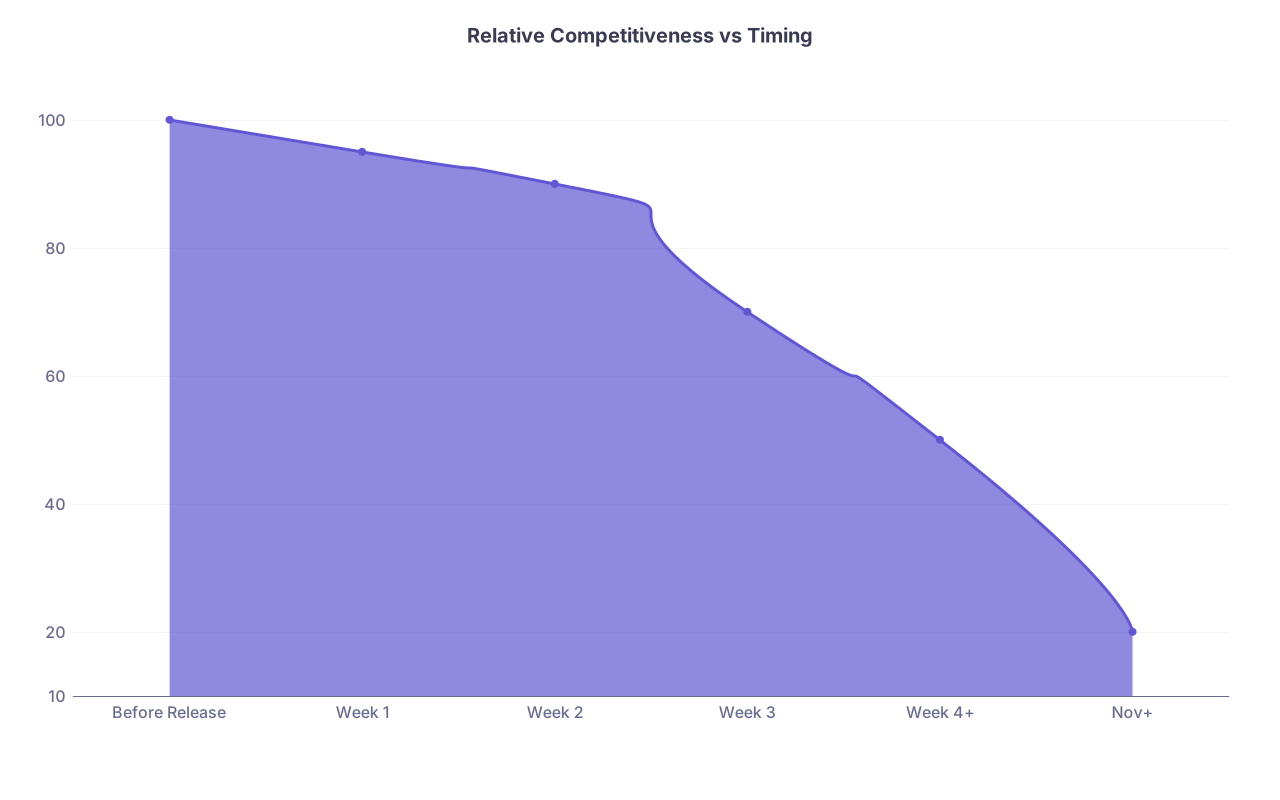
Myth 1: “Every Day Later = Proportional Drop in Chances”
Wrong.
The curve is not linear. It looks more like this:
| Category | Value |
|---|---|
| Before Release | 100 |
| Week 1 | 95 |
| Week 2 | 90 |
| Week 3 | 70 |
| Week 4+ | 50 |
| Nov+ | 20 |
Interpretation:
- Everything before release: basically at 100% relative opportunity
- Weeks 1–2: small sliding disadvantage
- Week 3–4: steeper drop
- After that: you’re applying to crumbs at most programs
The psych damage comes from people obsessing over the 5% difference inside Week 1 while casually entering Week 4 without blinking.
Myth 2: “I Should Submit Early Even If My Application Isn’t Ready”
This one I’ve seen kill more matches than “late” submissions.
Submitting:
- With a poorly edited personal statement
- With missing key letters
- With a weak Step 2 CK or COMLEX Level 2 not yet reported when it could have been stronger if you just waited a test date
That can hurt you more than being 10 days “late.”
If your September 5 application includes:
- A rushed, generic personal statement
- Only 1 letter in your chosen specialty
- No updated transcript or exam scores
…and your September 20 application would’ve been polished, with 3 strong specialty letters plus a great Step 2 CK… then September 20 is the better move almost every time.
Rolling review cannot compensate for a clearly weaker file.
Myth 3: “ERAS Is Rolling the Same Way for All Specialties”
Nope.
Different specialties behave very differently.
| Specialty Type | Sensitivity to Being 2–3 Weeks “Late” |
|---|---|
| Highly competitive (Derm, Ortho, ENT, Plastics) | Very high – big disadvantage |
| Moderate (EM, Anesthesia, Radiology) | Moderate – depends on program |
| Broad-access (FM, Psych, IM at community sites) | Lower – still matters, but less fatal |
If you’re going for Dermatology and you submit after the first wave, you’re mostly done unless your application screams “top 1–2%”.
If you’re applying Family Medicine at state-affiliated community programs, week 2 isn’t going to sink you.
What “Best Time to Submit ERAS” Actually Means in Practice
So if you’re not living in Reddit fantasyland, what should you actually aim for?
Here’s the sane, data-consistent target:
- Submit a complete, polished application before the first day programs receive files.
- If you truly cannot, submit within the first 7–10 days after that date, with a clearly better application than you could have had earlier.
- After ~3 weeks, understand you’re taking a real hit and need to compensate with:
- More applications
- Broader range of programs
- Possibly a parallel plan (backup specialty, SOAP strategy, or reapplicant planning)
And no, obsessing over the difference between “submitted at 9 AM” and “submitted at 11 PM” on the same day is pointless. That’s not where the battle is won.
The Hidden Rolling Factor: Letters and Step 2 CK
People talk about when they hit “submit.” They ignore something more important: when your file is actually reviewable.
Many programs will not seriously consider you until:
- You have 3–4 letters in, including required specialty letters
- You have Step 2 CK/Level 2 in if Step 1/Level 1 is pass/fail or marginal
- Your MSPE (Dean’s Letter) is available (this is a separate release date)
So if you submit on Day 1 but your critical specialty letter comes in three weeks later, guess what? Your functional review date is three weeks late.
I’ve seen PDs filter:
- “Show only applications with ≥3 letters”
- “Show only those with Step 2 in”
That’s when you appear on their radar. Not when you technically transmitted ERAS.
What I’d Actually Do as an Applicant
Let me strip away the noise and give you something you can use.
If I were applying now, I’d:
Anchor everything around the day programs can first download apps.
That’s your real “deadline zero.”Back-calculate:
- Personal statement final: 2–3 weeks before that
- Letters requested: months before; politely confirm they’ll be in on time
- Step 2 CK/Level 2: ideally taken early enough that your score posts before that download date, if you need it to boost your file
If I’m not ready by that first-download date but I could add meaningful strength with 7–10 more days, I’d take those days and submit a better file.
If I’m drifting more than 2–3 weeks behind, I’d:
- Expand my program list
- Be realistic about reach vs safety
- Start planning SOAP or reapplication contingencies instead of pretending timing “doesn’t matter.”
One More Thing: Don’t Let Timing Become an Excuse
I’ve sat in too many post-match debriefs where someone says, “I think I didn’t match because I submitted a week late.”
Often that’s comforting fiction.
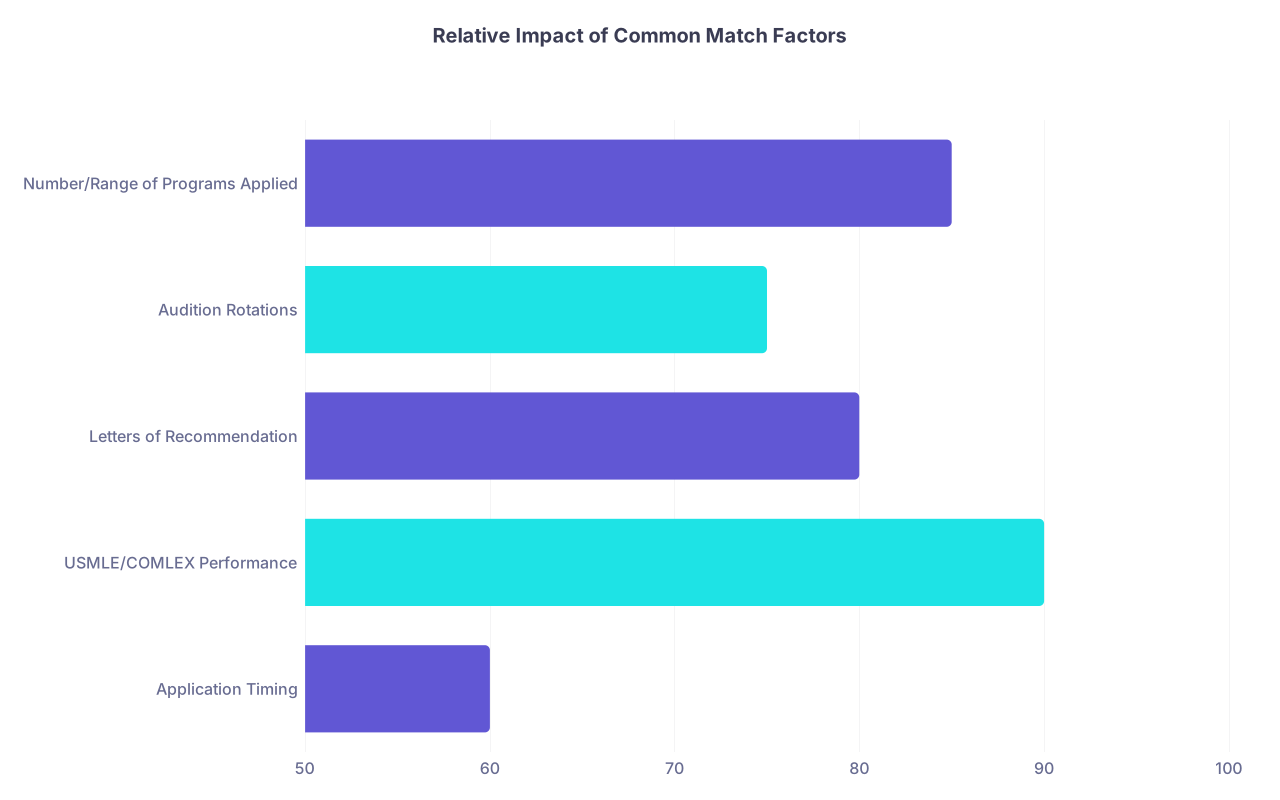
Far more commonly, the problems were:
- Weak letters
- Limited audition rotations
- Narrow program list
- Marginal scores without compensating strengths
Timing magnified those weaknesses; it didn’t create them.
| Category | Value |
|---|---|
| Application Timing | 60 |
| USMLE/COMLEX Performance | 90 |
| Letters of Recommendation | 80 |
| Audition Rotations | 75 |
| Number/Range of Programs Applied | 85 |
Timing matters. But it’s not the god people make it out to be.

| Step | Description |
|---|---|
| Step 1 | Plan Application |
| Step 2 | Submit Before Release |
| Step 3 | Submit in First 1-2 Weeks |
| Step 4 | Reassess Program List & Expectations |
| Step 5 | Monitor Interview Invites |
| Step 6 | Consider Backup Plans |
| Step 7 | Ready by Download Date? |
| Step 8 | Will 7-10 Days Improve File Significantly? |

Bottom Line: Does ERAS Really Work on Rolling Review?
It does. But not in the simplistic way people think.
Three key points and we’re done:
Everything before the first download date is effectively equal. Early within that window doesn’t give you bonus points; complete and strong beats “microscopically earlier.”
The real penalty starts after the first 2–3 weeks programs have access to files. At that point, many interview slots are already mentally spoken for, especially in competitive specialties.
A clearly stronger application submitted a bit later usually beats a rushed, incomplete one submitted on Day 1. Timing is a multiplier of quality, not a substitute for it.