
What actually happens to your ERAS application if you submit it 10 days "late" but much stronger than your classmates’ rushed versions?
Let me ruin the comforting myth up front: there is a timing effect in ERAS, but it’s not the Instagram version of “submit at 9:00 AM on opening day or you’re dead.” The truth is messier, specialty‑dependent, and very unforgiving to people who obsess over the calendar while ignoring the content.
You’re not in a race to click “submit.” You’re in a competition to look like someone worth interviewing the entire time programs are reading files.
Let’s dismantle the folklore.
What ERAS Timing Actually Does (And Does Not) Do
The widely repeated belief: “If you don’t submit ERAS the first hour it opens, your chance of getting interviews tanks.”
Reality is more like: “Submitting in the first main batch helps. After that, quality dwarfs timing.”
Here’s how the mechanics actually work in most years (details change slightly, but the pattern holds):
- ERAS opens for applicants to start filling out.
- Then there’s a first date when you can submit.
- Then there’s a separate date when programs can download applications. On that date, every application submitted before that point is released in one big batch to programs.
- Anything you submit after that first release shows up later, often in a smaller trickle.
That creates three groups:
| Group | Submission Timeframe | How Programs See You |
|---|---|---|
| Group 1 | Before first program download date | In the initial big batch |
| Group 2 | Within ~1–2 weeks after | In early rolling review |
| Group 3 | Several weeks or months later | Late, after many interview slots filled |
So yes, there is a difference between submitting before the first release versus, say, 6 weeks later. But no, there’s zero evidence that 9:01 AM vs 4:00 PM on the same day changes your fate.
The timing leverage is coarse, not minute‑by‑minute.
How Programs Actually Review Applications (Not the Fantasy Version)
Programs are not a single monolith, but the “we’ve started reviewing and we’re already full” fear is only half true.
I’ve watched this up close in several departments:
Someone (often a chief resident, APD, or coordinator) runs filters:
- US MD vs DO vs IMG
- Step/COMLEX cutoffs
- Graduation year
- Visa needs
They generate priority piles:
- “Auto‑review” group (meets all filters, maybe home students first)
- “Maybe” group (borderline scores, older grads, mixed signals)
- “No-go” group (way below thresholds, incomplete, red flags)
Faculty or selection committee starts reviewing in batches.
Invitations go out in waves over weeks, not minutes.
Yes, early files are more likely to land in that first big review pile when there’s maximum interview space. But you know what pushes people from “maybe” to “invite”? Not their timestamp. Their letters, Step 2 score, narrative, and obvious fit.
Programs have more applicants than time, but they’re not crazy. They will absolutely invite a stellar “later” applicant over a mediocre “early” one.
What the Data, Not Reddit, Suggests
Do we have randomized, perfect, prospective data on “submit day vs interview count”? Of course not. NRMP and AAMC don’t release granular per‑day ERAS timing curves.
What we do have:
NRMP Program Director Surveys
PDs consistently rank timing as far less important than USMLE/COMLEX scores, clerkship performance, letters, MSPE, and personal statement. Many mention “early application” as a minor plus, not a fundamental criterion.Program comments at meetings and webinars
Variants of: “Please apply early, but we will review strong applications later as well.” Translation: we don’t want to be flooded last minute, and yes, most of our slots are allocated from early batches. But we still look at later applicants, especially from our own school or people who clearly fit our niche.Observed behavior across specialties
- Hyper‑competitive fields (Derm, Ortho, ENT, Plastics, some surgical subspecialties) tend to send the majority of invites early, within the first 2–4 weeks.
- Internal Medicine, Peds, FM, Psych, Neurology, EM, etc., spread invites over a longer window and routinely send second and third waves.
- Even in competitive specialties, “late but exceptional” applicants get attention. I’ve seen an ENT PD email, “We have to look at this person” a month into application season.
No credible data shows a cliff where your odds drop to zero if you submit 72 hours after opening. There is a slope, not a cliff.
Early vs Sloppy: The Real Trade‑Off
Here’s the brutal part that most people ignore: rushing ERAS destroys more applications than a 5–10 day delay.
Examples I’ve actually seen:
- Personal statement with the wrong specialty: “I look forward to a career in Emergency Medicine” … in an Internal Medicine app.
- LOR tagged as “Dermatology” uploaded to Anesthesiology.
- Major research publication omitted because the student “didn’t want to delay submission another day to get the PubMed ID.”
- Step 2 score pending, then released a week later as a huge improvement over Step 1—but the applicant had already been auto‑screened out at several places.
Programs notice errors and half‑baked narratives. They notice cookie‑cutter PS paragraphs reused across barely related specialties. They notice when your experiences are skeletal and non‑specific because you were racing the clock.
And those things hurt you more than submitting, say, 5 days after the first release date.
Let me be specific:
If the choice is:
- Submit in the first batch with a generic, typo‑ridden PS, missing one key LOR, and poorly described experiences
vs - Submit 5–7 days later with a polished, specific PS, complete LOR set, and well‑curated experiences
I will pick the second option every single time. And so will most program directors who aren’t asleep.
The One Timing Window That Really Matters
There is, however, one timing window you can’t hand‑wave away: don’t be significantly late to the party.
Where “significantly late” changes by specialty.
For most core specialties:
- If you submit before the first program download date or within the first week or two after that, you’re effectively “early enough,” assuming your file is complete or nearly complete.
- Submitting 3–6 weeks later starts to hurt. More auto‑screens have already happened. Some programs are already at or near their desired interview volume.
- Submitting months later is basically a Hail Mary unless you’re an internal candidate, have strong connections, or are aiming at less competitive programs desperate to fill.
For extremely competitive specialties (Derm, Ortho, ENT, Plastic, some Surgical subs):
- You really should aim to be in the initial release batch with a complete, polished application. Those programs often fill 70–90% of their invitation slots early.
- But even there, a 1–3 day delay to finish a major improvement (final Step 2 score, strong LOR, completed away rotation evaluation) can still be worth it.
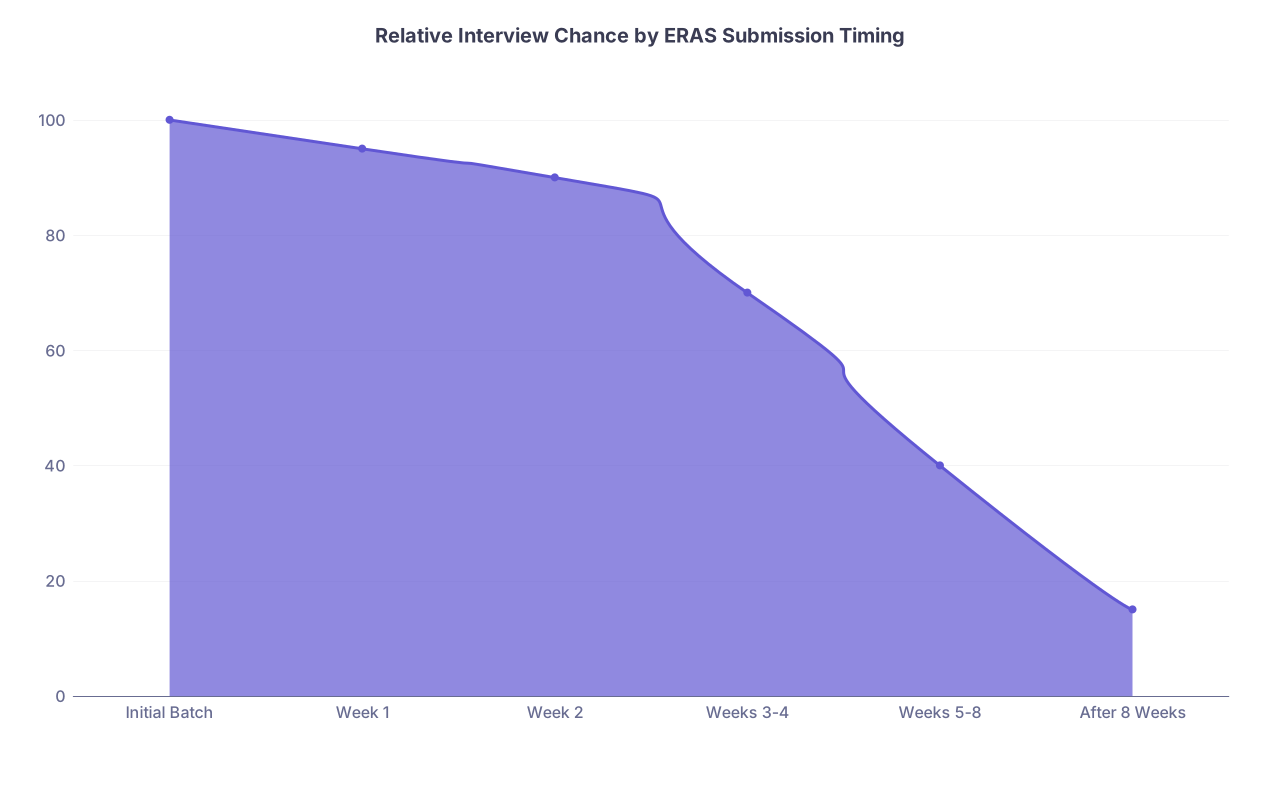
To visualize the rough pattern:
| Category | Value |
|---|---|
| Initial Batch | 100 |
| Week 1 | 95 |
| Week 2 | 90 |
| Weeks 3-4 | 70 |
| Weeks 5-8 | 40 |
| After 8 Weeks | 15 |
Is this exact? No. But it’s much closer to reality than “submit at 9:00:01 AM or you’re invisible.”
Specialty Differences: Not All Timelines Are Equal
This is where blanket advice becomes garbage. Timing impact varies a lot.
| Specialty Type | Timing Sensitivity | Comment |
|---|---|---|
| Dermatology, Ortho, ENT, Plastics | Very High | Aim for first batch, polished and complete |
| EM, Anesthesiology, General Surgery | Moderate–High | Early helps, rolling invites |
| Internal Medicine, Pediatrics, Psych | Moderate | Early preferred, multiple waves |
| Family Medicine, Neurology, PM&R | Low–Moderate | Early still better, but more flexible |
If you’re going for Derm and debating whether to wait an extra 4 weeks to do a last‑minute away: bad idea. If you’re going for FM and can submit 3–4 days later to massively improve the clarity of your application narrative: that’s usually a smart trade.
Myths That Need To Die
Let’s kill a few specific myths one by one.
Myth 1: “First‑day submission guarantees more interviews.”
No. It guarantees absolutely nothing. It just puts you in the first large review pile.
Weak app in the first batch = weak results.
Strong app a week later = usually better results.
Myth 2: “If you’re not first‑day, you’re late.”
Programs do not log timestamps and punish people for applying 4 days into the season. They care that your file is on their radar while they still have flexibility in sending invites.
Again: the window is measured in weeks, not hours.
Myth 3: “Programs stop looking after the first wave of invites.”
Flatly untrue. Many programs:
- Save spots for internal candidates or late Step 2 scores.
- Run second and third review passes.
- Replace declined or canceled interviews with new invites.
Does priority shrink over time? Yes. Do they completely stop reading after October 3rd? No.
Myth 4: “You should submit even if your app is incomplete—just get in the pool.”
This one is especially harmful.
Submitting with a missing Step 2 that would rescue a mediocre Step 1, or without a key LOR from an away rotation, often gets you permanently sorted into the ‘no’ pile before your best data arrives.
Some programs do commit to re‑review after updates. Many do not. You rarely know which is which.
How to Use Timing Intelligently, Not Anxiously
Here’s the adult version of ERAS timing strategy:
Aim to submit in or very close to the first program release batch for your specialty. That part is real.
Do not, under any circumstances, sacrifice:
- Coherent, specialty‑specific personal statement
- Completed core letters (especially from aways or key rotations)
- Accurate, thoughtful description of experiences
- A Step 2 score that meaningfully improves your profile
If you are choosing between:
- A rough, incomplete first‑batch application
- A complete, polished application 5–10 days later
You submit the second one.
If you are considering:
- Delaying 3–6 weeks for minor tweaks
That’s where you’re just procrastinating and burning real opportunity.
- Delaying 3–6 weeks for minor tweaks
One more thing: updates after submission (new scores, publications, awards) help, but they rarely fully compensate for a train‑wreck first impression. Programs have selective attention. You want to look good the first time they pull your file.
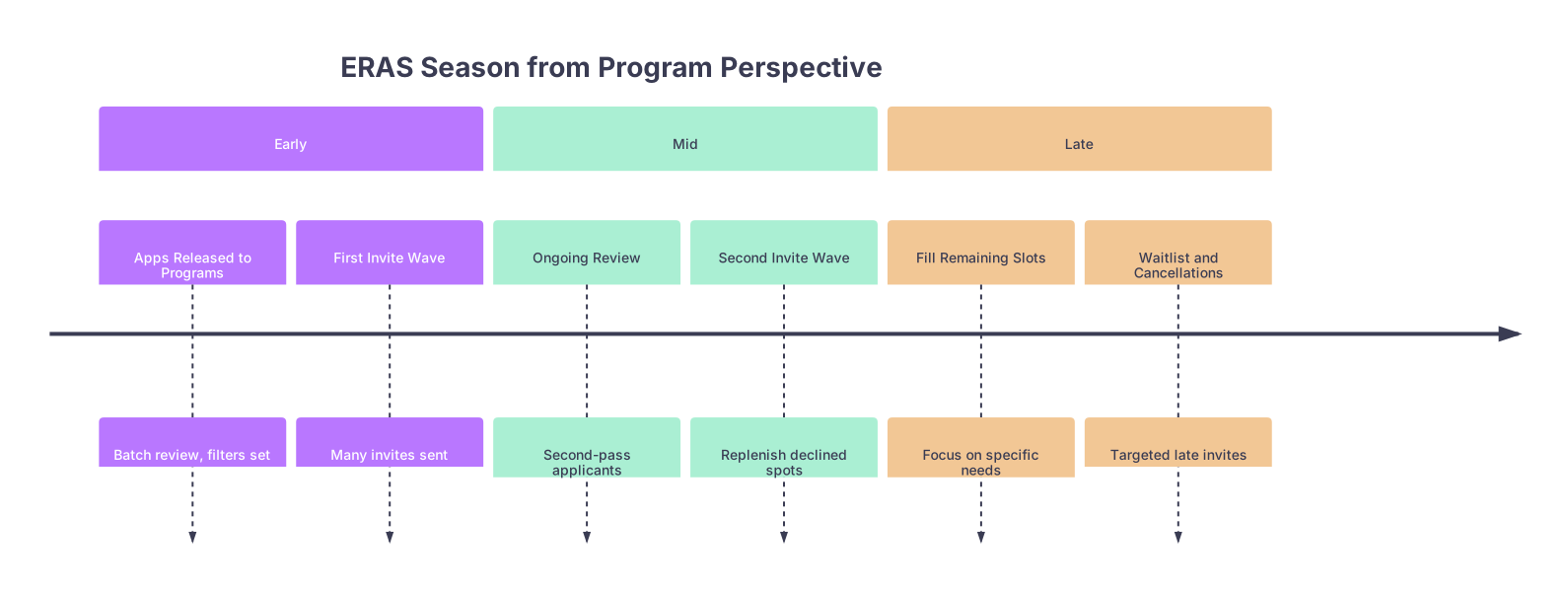
Visualizing the Process: When Programs Actually Move
| Period | Event |
|---|---|
| Early - Apps Released to Programs | Batch review, filters set |
| Early - First Invite Wave | Many invites sent |
| Mid - Ongoing Review | Second-pass applicants |
| Mid - Second Invite Wave | Replenish declined spots |
| Late - Fill Remaining Slots | Focus on specific needs |
| Late - Waitlist and Cancellations | Targeted late invites |
If your application shows up mid‑timeline but clearly screams “we should have invited this person earlier,” you can still get pulled into that second invite wave. If you show up late with a generic file that looks just like the first 800 they saw? You get ignored.
The Real Guarantee
The only thing ERAS timing guarantees is this: if your application is weak, no amount of “early” will save it, and if your application is strong, being months late will absolutely hurt you.
Your goal isn’t “earliest.”
Your goal is “early enough and undeniably strong.”
FAQ (Exactly 4 Questions)
1. Is submitting ERAS on the first possible day always better than waiting a week?
Not if “first day” means submitting an incomplete or sloppy application. Being in the initial release batch is helpful, but a 5–7 day delay that allows you to add a strong letter, a markedly better Step 2 score, or a coherent personal statement is usually worth it. Programs care far more about a strong file than a perfect timestamp within that early window.
2. How late is “too late” to submit ERAS and still expect a normal number of interviews?
For most core specialties, once you’re 3–6 weeks past the first download date, you start losing serious ground, and by a few months out you’re in long‑shot territory unless you have special connections or are applying to less competitive programs. Hyper‑competitive specialties are less forgiving and expect you to be in the first batch.
3. If I improve my application after submitting (new Step 2 score, publication), will programs re‑review my file?
Some will, many will not. A few programs explicitly say they re‑review updates; others quietly never circle back. You cannot rely on “I’ll update them later” as the primary strategy. Make your file as strong as possible before their first major review pass whenever you can.
4. I have to choose: apply early with Step 1 = 215 and pending Step 2, or wait for Step 2 which I’m confident is >240. What should I do?
In most cases, you wait for the stronger Step 2, especially in fields where Step 2 is increasingly emphasized. A 215 with no Step 2 often gets auto‑screened out. A 215 paired with a 240+ can move you into a different review category entirely. Sacrificing that rescue score just to be first‑day is usually a bad trade.
Key takeaways:
Early helps, but it doesn’t rescue a mediocre file. Submit early enough with a complete, polished application; don’t sabotage yourself chasing a timestamp.