
Submitting ERAS after MSPE release is not the death sentence people keep telling you it is. The panic is louder than the data.
Let me be blunt: submitting September 27 vs October 3 is not the difference between matching and going SOAP. But submitting November 10 because you “wanted it to be perfect”? That can absolutely hurt you.
The problem is not “after MSPE.” The problem is how late, in which specialty, with what kind of application, and what programs you’re targeting. Nuance that gets totally lost in the Reddit echo chamber and your class GroupMe hysteria.
Let’s dismantle the myth properly.
What “On Time” Actually Means in ERAS
Every year I watch the same ritual: people melting down because they aren’t ready to smash “Submit” at 9:00:01 a.m. on the ERAS opening day.
Here’s the reality nobody on social media explains clearly:
- Programs cannot see your application until the ERAS transmission date.
- MSPEs (Dean’s Letters) are not visible to programs until October 1.
- For most core specialties, interview invites do not go out all on Day 1. There’s a spread over weeks.
Programs batch review. Some start early, some late, some rolling. The idea that there is a single magical moment where everyone gets reviewed and if you’re not in that first batch you’re doomed? Fiction.
What actually matters is whether your application is available when they’re reviewing their first serious chunk of applicants. That window is weeks, not hours.
Where Timing Actually Matters (And Where It Doesn’t)
Let’s get concrete. Different specialties behave differently.
| Specialty | Timing Sensitivity | Comments |
|---|---|---|
| Dermatology | Very High | Super-competitive, early |
| Plastic Surgery | Very High | Small N, early screening |
| Orthopedics | High | Early invites common |
| ENT / Urology | High | Small programs, early |
| Internal Med | Moderate-Low | Many programs, rolling |
| Family Med | Low | Wide window, less rush |
If you’re shooting for dermatology or plastics at powerhouse academic programs, being in the first big pile does help you. These programs may effectively “front-load” their interview list. Being 3–4 weeks late there is dumb.
But for internal medicine, family medicine, peds, psych, prelim medicine, and even a lot of general surgery programs, a submission in the first 2–3 weeks after ERAS opens is functionally “on time.”
This is where the MSPE panic comes in.
The MSPE Release Date Is Overhyped
You’ll hear this constantly: “If you submit ERAS after MSPE release you’re too late. Programs will have filled all their interview spots.”
Reality check: the MSPE does not even unlock until October 1. If you submit September 30 vs October 2, your MSPE becomes visible to programs the same day: October 1 (for everyone). There is no advantage there.
The actual concern isn’t “after MSPE release.” It’s “how far into October (or beyond) are you going?”
Here’s what tends to be true in practice:
- Submitting a few days after MSPE release (say October 2–5): usually fine for most specialties and most programs, especially mid-tier and community programs.
- Submitting mid- to late October: now you’re realistically late for the most competitive specialties and some top-tier programs.
- Submitting November or later: now you’re eating into interview season. Programs have fewer interview spots and less patience.
The MSPE release date is a psychological cliff, not a data-based one. It’s just the day everyone has on the calendar, so people latch onto it like it’s some magic cutoff.
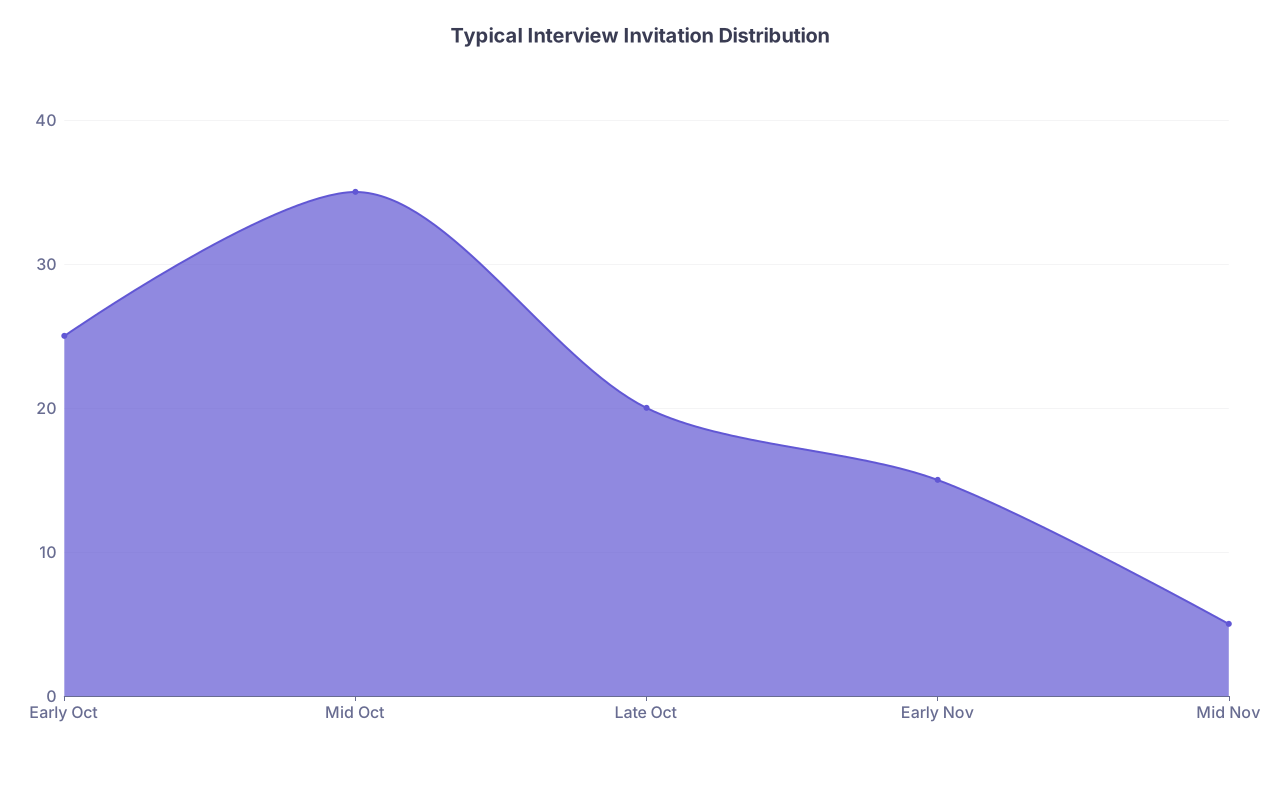
| Category | Value |
|---|---|
| Early Oct | 25 |
| Mid Oct | 35 |
| Late Oct | 20 |
| Early Nov | 15 |
| Mid Nov | 5 |
Do some programs send a chunk of invites in the first week of October? Yes. Do they send all of them that week? No. There’s a long tail.
What the Data and Program Behavior Actually Suggest
Let’s talk about what we actually see, from NRMP data and the way programs behave year after year.
NRMP Program Director Survey after Program Director Survey shows the same core truth: the decision to interview you is based on a small set of things:
- USMLE/COMLEX scores (or pass and school reputation now that Step 1 is P/F)
- Clerkship grades / class rank
- Specialty-specific letters of recommendation
- Perceived fit (from personal statement, experiences, school, geography)
Timing isn’t in the top few factors. It influences when your app is seen, not how good it looks when it gets there.
Here’s how timing interacts with reality:
- Competitive applicants: You have a margin of error. A 260+ Step 2, strong letters from known faculty, solid research, and a reasonable geographic strategy means that submitting a week or so after MSPE release is highly unlikely to “kill your chances.”
- Borderline applicants: You have less slack. You will probably be applying broadly, to more mid- and lower-tier programs, including community sites that review later. Here, a slightly later submission might matter less than you think, because many of those programs are still digging through the pile in late October/early November.
- Hyper-competitive specialties: Here, you really do want to be in that first big wave. You should be aiming to submit essentially as soon as MSPE hits (or even a bit before, with the understanding that MSPE will populate automatically).
The people who get burned by timing are usually not the “submitted October 3 instead of September 27” crowd.
It’s the “I didn’t submit until November 8 because I kept tweaking my personal statement” crowd.
The Real Trade-Off: Fast vs Polished
This is the part students hate to hear: obsessing about micro-timing is often a way to avoid the more uncomfortable truth—that your content matters far more than the exact date.
I’ve reviewed applications where someone rushed to submit on Day 1 and:
- Uploaded an outdated or wrong personal statement.
- Left a major experience half-finished or barely described.
- Had obviously weak or generic letters because they asked late.
Submitting early with those issues is not “strategic.” It is self-sabotage disguised as hustle.
On the flip side, waiting three weeks to submit so you can wordsmith your personal statement from “90% good” to “92% good” while your letters are already in and your CV is done? That’s pointless perfectionism.
Here’s the saner rule:
Submit as early as you can once the application is complete and coherent, not perfect. For most people, that’s within about 1–2 weeks of ERAS opening or MSPE release.
Waiting an extra 3–5 days after MSPE to fix a legitimately weak personal statement or clean up a messy experiences section is a good trade. Waiting 3–4 weeks is not.
Programs Do Not All Hit “Sort by Submission Time”
There’s a persistent fantasy that programs sit down on October 1, hit “Sort by Submission Time,” take the first 100 apps, and send all their invites that week. That’s not how this works.
Some patterns I’ve seen and heard directly from faculty and coordinators:
- Some programs pre-screen by Step 2 score or class rank and never even look at many low-filter apps, regardless of timing.
- Some programs do true rolling review, but the committee meets weekly or biweekly. Apps are batched by meeting date, not by hour of submission.
- Community programs often start serious review later than the big-name academic shops. That actually reduces the penalty for a modestly late submission if you’re applying there.

So yes, earlier is generally better than later. But this isn’t concert tickets. You’re not in a queue for the last two floor seats.
What kills people isn’t being days behind. It’s being months behind. Or being early with a weak, inconsistent, or obviously half-baked application.
Concrete Scenarios: Are You Actually “Too Late”?
Let’s walk through some real-world scenarios I’ve actually seen:
Scenario 1: Medicine Applicant, Submits October 4
US MD, internal medicine, Step 2 in the low 230s, solid but not insane CV. Letters are in. Application finished September 29, but student waits to see MSPE before final submit and hits it October 4.
Did this destroy their chances? No. They matched at a solid university program after ~14 interviews, many of which were sent out late October and November.
For IM, this is “on time.”
Scenario 2: Derm Applicant, Submits October 15
Strongish Step 2, decent research, but submits October 15 because they were “still finessing their research description” and procrastinated asking for a final letter.
This does hurt. Dermatology programs are small, many front-load interviews, and some are already nearly done choosing their list by late October. This applicant ended up with very few interviews and matched only because of a backup prelim and a later reapplication.
Here, yes, being well after MSPE—and into mid-October—actually mattered.
Scenario 3: FM Applicant, Submits November 1
DO student, going for family medicine, mixed grades, Step 2 just above passing. Submitted November 1 after failing to organize earlier. Applied broadly to community programs.
Did they suffer for the date? Somewhat. A few programs had already filled interview spots. But family medicine has a lot of capacity, and many community sites were still looking to fill their calendar. They still ended up with enough interviews and matched.
Would October 5 have been better? Sure. Did November 1 “kill their chances”? No.
The Hidden Variable: Program Tier and Geography
Timing hurts you most when combined with two things:
- You are aiming at highly competitive, name-brand programs that get flooded with applicants.
- You are geographically constrained and applying to a small number of regions.
Top-tier academic programs are spoiled for choice. They can fill interview slots early and move on. If you apply to 25 programs, 20 of which are top-20-name institutions, and submit late October, you’ve boxed yourself in twice: timing and selectivity.
Mid-tier and community programs, especially outside the coasts and big metro hubs, are more forgiving. They need to fill their interview schedules and will continue to look at later apps.
If your list is mostly:
- Big-name academic, coastal, urban, and
- Hyper-competitive specialty
then yes, you play by stricter timing rules. If not, the penalty for “a bit after MSPE” is often smaller than your peers think.
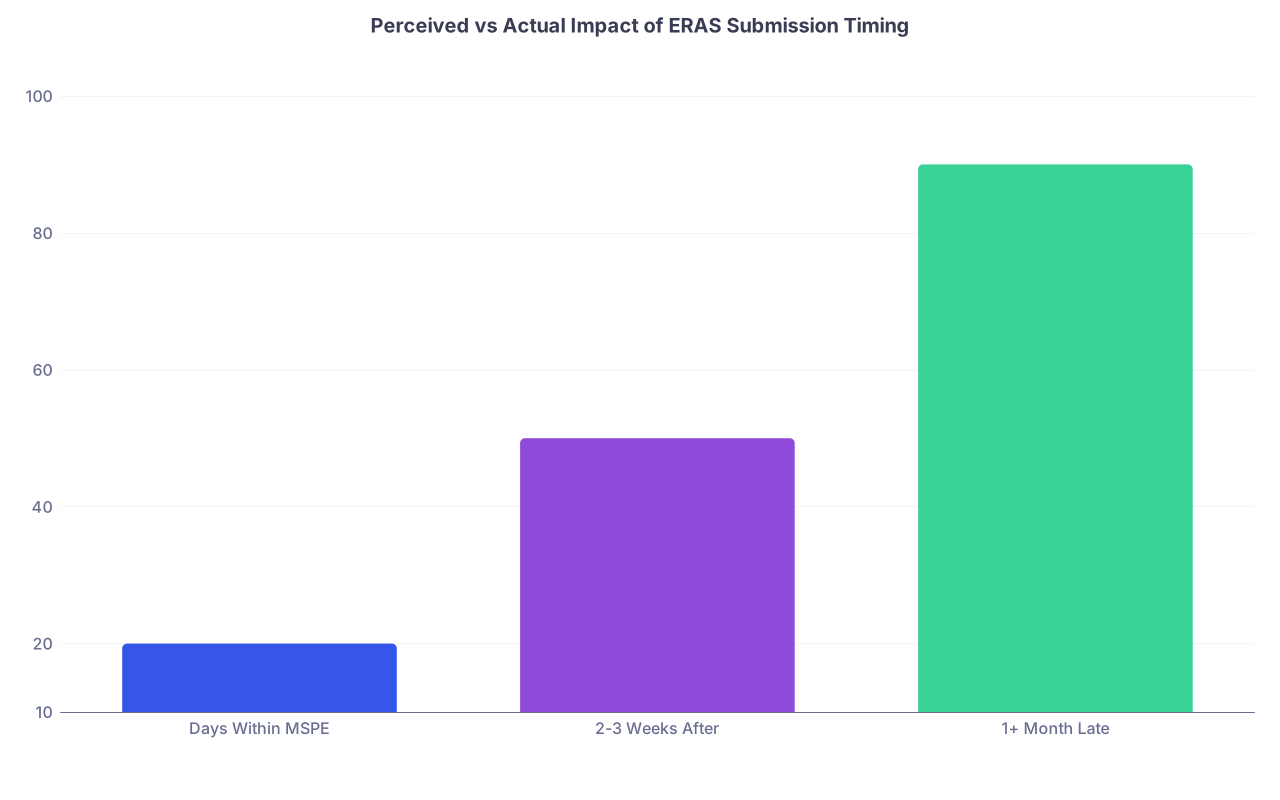
| Category | Value |
|---|---|
| Days Within MSPE | 20 |
| 2-3 Weeks After | 50 |
| 1+ Month Late | 90 |
Interpretation: students perceive massive impact even for small delays. Actual impact is minor for short delays, more meaningful beyond a month.
What You Should Actually Do
If you’re late-ish right now and trying to figure out if you’re doomed, here’s the no-BS path:
- Be honest about your specialty and competitiveness. If you’re not applying derm/plastics/ENT/ortho/neurosurg, your tolerance for modest delay is higher.
- Stop chasing 100% perfection. Fix glaring weaknesses, then submit. An extra week to correct real problems is fine. An extra month for word choice is not.
- Make sure letters, scores, and MSPE are all in. An “on time” submission with missing key pieces is not on time at all.
- Consider broadening your list. If you’re submitting closer to mid-October or later, counteract the timing risk by expanding applications to more mid-tier and community programs and more regions.

| Step | Description |
|---|---|
| Step 1 | Is app complete? |
| Step 2 | Fix major gaps |
| Step 3 | Submit ASAP, expand list |
| Step 4 | Submit now, stop tweaking |
| Step 5 | Submit + apply broadly |
| Step 6 | Specialty very competitive? |
| Step 7 | > 3 weeks past MSPE? |
If you’re 3–10 days after MSPE release and your app is ready? Submit. You’re fine.
If you’re mid- to late October? You’re not dead, but you’ve lost some ground, especially in the competitive fields and elite programs. Compensate with volume and realism.
If you’re in November? Now timing actually is a real liability. You need a broader list and honest backup planning.
FAQ: ERAS Timing and MSPE Myths
1. Is submitting ERAS a few days after MSPE release too late?
No. For most core specialties (IM, FM, peds, psych, many gen surg programs), submitting within a week or two of MSPE release is still effectively “on time.” Hyper-competitive fields have less slack, but even there, a few days is not catastrophic.
2. Do programs see my application before the MSPE is released?
They can see your ERAS application and scores as soon as ERAS transmits to programs, but MSPEs all unlock together on October 1. Submitting right before or right after that date doesn’t change when your MSPE becomes visible.
3. Do programs really fill all interview spots in the first week of October?
Some highly competitive programs front-load invites, but most programs send them in waves across several weeks. Many community and mid-tier programs are still offering interviews in late October and November.
4. Is it better to submit a “perfect” application later or a “good enough” application earlier?
Earlier with “good enough but complete” beats later with “perfect but delayed” in almost all situations. Fix serious issues—typos, missing experiences, disorganized personal statement—but do not spend weeks polishing minor details at the cost of timing.
5. I’m already in late October/November—should I still submit?
Usually yes, but adjust expectations. You’re late, especially for top programs and competitive specialties. Apply more broadly, include community and less competitive programs, and have an honest backup plan. Late is worse than early, but it does not automatically equal “no match.”
Two key points to walk away with.
First, “after MSPE release” is a fake cliff. The real issue is how late overall you are and what field and tier you’re aiming for. A modest delay is noise; a month-plus delay is signal.
Second, content beats micro-timing. A coherent, complete, reasonably early application will outperform a rushed mess or a perfectionist’s November masterpiece. Submit as soon as it’s solid—and stop letting Reddit scare you into thinking a three-day delay destroyed your career.