
The hysteria about ERAS timing is wildly overblown. “If you don’t submit at 9:00:01 AM on opening day, you’re done” is not advice. It’s how anxious people talk to each other on Reddit.
Let me be blunt: timing matters, but not the way you’ve been told. There is a real difference between “early,” “on time,” and “late.” But the cutoff is measured in weeks, not minutes.
You’re not competing to hit “submit” first. You’re competing to be fully ready by the time programs actually start reading.
Let’s separate myth from data.
What ERAS Timing Actually Controls (And What It Doesn’t)
Here’s the core misunderstanding: students think ERAS is a race to submit as soon as the system opens. Programs don’t see your application the moment you submit. There are hard dates that matter way more than the minute you pressed the button.
The typical ERAS timeline (for most specialties):
- Early June: ERAS opens for applicants to start working
- Early September: You can submit applications to programs
- Late September: Programs can start downloading and reviewing applications
- October–January: Interviews sent and conducted
- February: Rank lists due
The big inflection point is when programs access applications, not when you first click submit.
So the reality:
- Submitting on the first possible day vs 3–7 days later? Functionally the same for most programs.
- Submitting before programs can download (i.e., by that “program access” date)? That’s “on time.”
- Submitting after that date? Now you’re playing catch-up, but there’s still a window.
- Submitting in November? That’s where “too late” actually starts to be true for most people, with rare exceptions.
Let’s map this more concretely.
| Timing (relative to program access date) | Category | Competitiveness Impact |
|---|---|---|
| ≥ 2 weeks before | Early/Ideal | Best shot, no penalty |
| 0–7 days before | On Time | Essentially no impact |
| 0–2 weeks after | Mildly Late | Small hit, specialty-dependent |
| 2–6 weeks after | Late | Noticeable penalty; some doors closed |
| > 6 weeks after | Very Late | Heavily disadvantaged; niche exceptions |
Again: we’re talking weeks. Not hours.
Why the “Submit at 9:00 AM or You’re Dead” Myth Persists
I’ve heard this exact line from MS4s in advising offices: “My friend said if I don’t submit in the first minute, I’ll be filtered out.”
Here’s what’s really going on:
People confuse correlation with causation. Strong, organized applicants tend to submit early. They also tend to have better scores, letters, and experience. They match better. Timing gets the credit when it’s really the overall package.
Online forums amplify extremes. The people who submit late and match fine don’t write dramatic posts. The panicked ones do. You hear the horror stories, not the boring successes.
Advisors sometimes oversimplify. Instead of saying “Don’t wait until November,” they say “Submit on the first day.” It’s shorter and scares you into not procrastinating. But it’s not precise.
Programs vary wildly. Some competitive specialties do fill almost all interview spots early. Others keep a rolling review and send invites in waves. Students mash all of that into one oversimplified rule.
There’s a kernel of truth: earlier is safer. But there is no magical 9:00 AM cliff.
What Programs Actually Do With Your Application
Let’s talk mechanics. Because once you see how programs handle their pile, the panic starts looking silly.
Most programs:
- Download a massive batch of applications around the program access date.
- Apply filters: US vs IMG, Step scores/pass, YOG, visa needs, etc.
- Use faculty/residents/PDs or a committee to review subsets.
- Send interview invitations in waves over weeks to months.
They are not saying, “We will only consider the first 1,000 applications sorted by timestamp.”
In fact, many program coordinators will tell you:
- They keep downloading new applications for weeks.
- They add late applicants when spots cancel or they need specific profiles (home students, couples match adjustments, applicants with certain interests or languages).
- They absolutely do look again at the pool when people cancel interviews or no-show.
Is being in that first big batch of downloaded applications good? Yes. Because:
- You get reviewed when there are maximum interview spots available.
- You avoid being the “extra” app they have to squeeze into a nearly full schedule.
- You look prepared and serious about the specialty.
But whether you were downloaded on Day 1 or Day 3? Not the difference between matching and SOAPing.
Specialty Differences: When Timing Actually Starts to Hurt
Now the part nobody wants to hear: specialty matters. Step scores matter. How risky your application is matters.
Broad strokes:
- Super competitive: Derm, Ortho, Plastics, ENT, Neurosurgery, Urology.
- Moderately competitive: EM (variable), Anesthesia, General Surgery, OB/GYN, Radiology.
- Relatively less competitive (for US MDs especially): IM (non-elite), Peds, FM, Psych, Path, PM&R, Neuro.
In competitive fields, programs often:
- Have more qualified applicants than interview spots within days.
- Fill a big chunk of interviews in the first 2–4 weeks after applications open.
- Read more aggressively early, then get pickier.
In less competitive fields, programs often:
- Review in waves and keep sending invites for months.
- Have unfilled interview slots and welcome later applicants.
- Are more forgiving about timeline, especially for solid US grads.
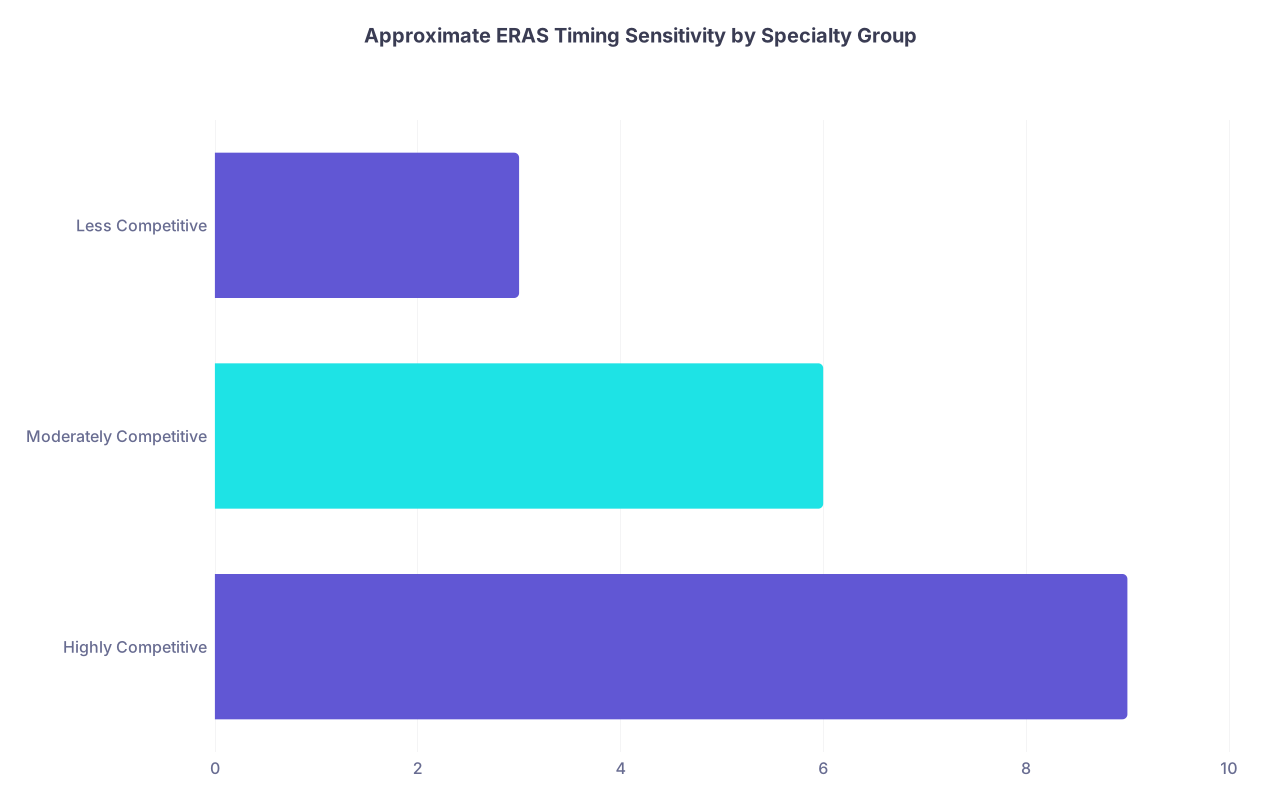
So “How late is too late?” is not the same for Derm vs Family Medicine.
| Category | Value |
|---|---|
| Highly Competitive | 9 |
| Moderately Competitive | 6 |
| Less Competitive | 3 |
(Scale: 1 = timing barely matters, 10 = timing is critical. This isn’t official data; it reflects how strongly timing influences your odds based on observed interview patterns.)
Very rough cutoffs for “starting to hurt you” if you’re otherwise a typical applicant:
- Highly competitive specialties: Submitting >1 week after program access = you’re swimming upstream. >2–3 weeks late = real damage.
- Moderately competitive: >2–3 weeks late hurts; >4–6 weeks late is a big handicap.
- Less competitive: >4 weeks late starts to matter more, but you can still get interviews later, especially from community programs.
Again: this is not yes/no. It’s probability.
Concrete Scenarios: Who’s Actually in Trouble?
Let’s walk through some real-world-style cases I’ve seen.
Scenario 1: The September 28 Submitter (Internal Medicine)
US MD, 232 Step 2 CK, no Step 1 score (P/F era), applying to categorical Internal Medicine. Submits apps 3 days after program access date because a letter was delayed.
Reality:
- Zero meaningful impact for mid-tier or community IM programs.
- Maybe a tiny disadvantage at the super-elite places (MGH, UCSF, Hopkins) that are drowning in applications and have lots of polished, early applicants.
- For 90% of their list, “September 25 vs 28” is noise.
This applicant does not need to panic. At all.
Scenario 2: The October 15 Submitter (OB/GYN)
US DO, solid but not stunning scores, applying OB/GYN. Program access was late September. They submit mid-October, about 2–3 weeks after programs started reviewing.
Now we’re in “not ideal” territory:
- Many programs have already sent their first wave of invites.
- Some will keep reading apps and sending invites through November.
- They’ll likely get fewer invites than if they were complete on Day 1, but they’re not automatically doomed.
This is the “mildly to moderately late” group. You don’t burn your application. You adjust expectations and apply broadly.
Scenario 3: The November 20 Submitter (EM)
US MD, average-ish app, Emergency Medicine. Submitting nearly two months after programs started.
Here’s where the myth aligns more closely with reality:
- Many EM programs have already sent out the bulk of their invites.
- Some still send out late invites as people cancel or fail to respond.
- But you’ve missed the prime window. You’re now hoping for cancellations, under-filled programs, or places that intentionally keep late spots.
This is where “too late” starts to have teeth for most average candidates in EM, Surgery, OB, etc.
Scenario 4: IMG Applying to Internal Medicine in December
Non-US IMG, applying IM, submitting in December.
No sugarcoating: this is late. Most community programs have already filled interviews. Some university programs may be full.
But here’s the non-panic version:
- Some community hospitals and less popular locations still have interview capacity later.
- Programs that lost candidates to other offers sometimes dip back into the pool.
- The match rate plummets with this timing, but it’s not literally zero.
Is this good strategy? No. Is it automatically pointless? Also no—especially if you have strong scores, solid US clinical experience, or specific geographic/regional advantages.
How Much Should You Delay for a Better Application?
This is the real tradeoff almost nobody explains properly: Is it better to submit earlier with a weaker app, or later with a stronger one?
I’ll be blunt: it depends what “better” means.
Delaying is usually worth it if:
- You’re waiting for a clearly strong letter from a well-known faculty member in your specialty.
- Your personal statement is genuinely rough and not yet coherent.
- You have a failed attempt / marginal Step situation and need an advisor to help you frame it properly.
- You’re about to get your only meaningful specialty-specific experience documented (e.g., your only EM SLOE, your only Derm letter).
Delaying is usually NOT worth it if:
- You’re tweaking wording and commas.
- You’re rewriting your personal statement for the 12th time because your friend’s cousin didn’t like a sentence.
- You’re waiting for “maybe” a better letter from someone who barely knows you.
- You’re obsessively ranking programs rather than just adding them and finalizing.
A messy, incomplete application? That hurts more than a 5–7 day delay. But a 3–4 week delay for “vibes” is just self-sabotage.
Realistic “Too Late” Lines by Category
Let me put some rough boundaries down, since that’s what people actually want.
Assuming you’re a typical applicant (not a star, not a disaster), and ignoring very niche exceptions:
- “Basically fine” window: Submit from the first day up to about 7 days after program access. Almost no downside.
- “Noticeable but survivable” delay: ~1–3 weeks after program access. Some lost opportunities, especially in competitive fields, but still absolutely viable.
- “You’re hurting yourself” territory: ~3–6 weeks after program access. Competitive specialties feel this a lot. Less competitive fields may still be okay with broad applications.
- “Functionally too late for many, but not all”: >6 weeks after. You’re relying heavily on under-filled programs, cancellations, unusual circumstances, or being an exceptionally strong candidate.
| Category | Value |
|---|---|
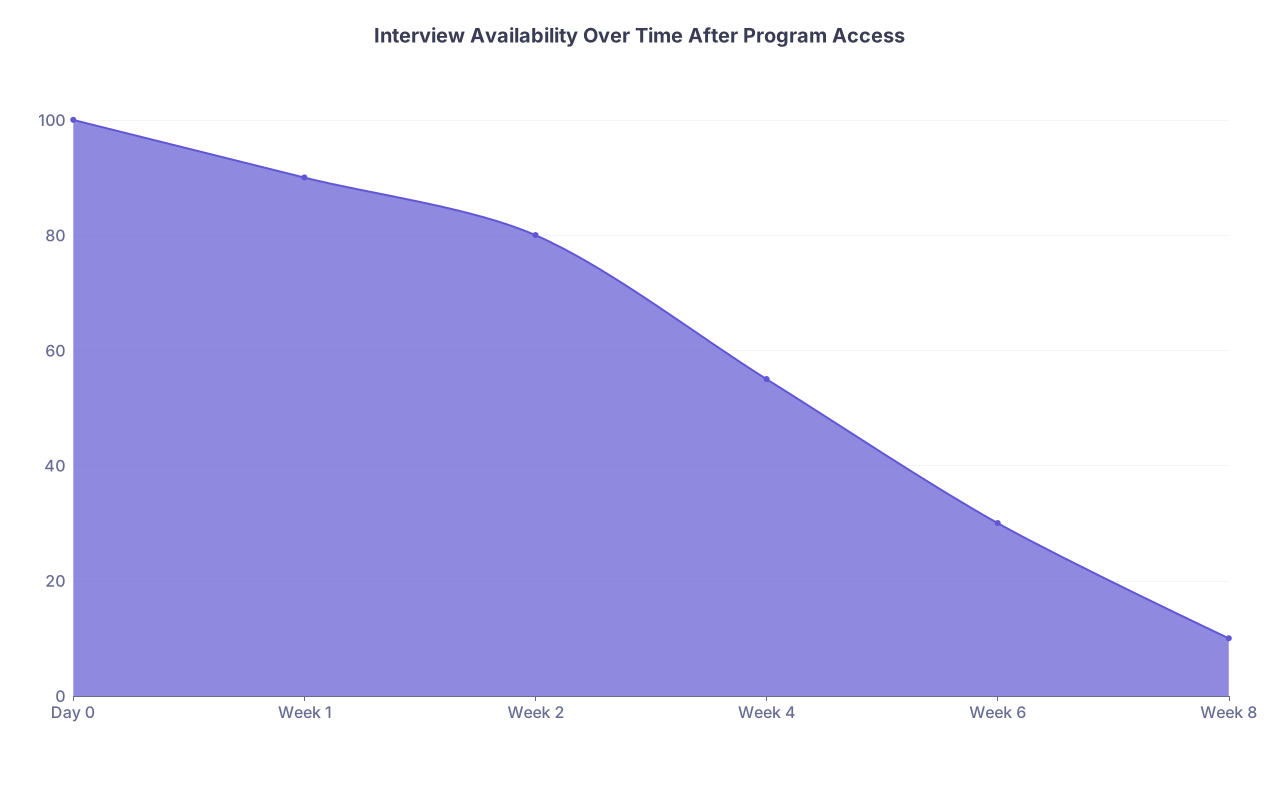
| Day 0 | 100 |
| Week 1 | 90 |
| Week 2 | 80 |
| Week 4 | 55 |
| Week 6 | 30 |
| Week 8 | 10 |
This isn’t a real ERAS dataset; it reflects what program directors consistently report: a big chunk of interviews go out early, then taper.
Practical Rules: What You Should Actually Do
Cut through all the noise and here’s the sane version:
Aim to be complete and submitted by the program access date or within that first week. That’s the target. You do not get extra points for “9:00:00 AM.”
If you’re slipping past that first week, prioritize substance over perfection. Strong letters, coherent personal statement, accurate experiences.
Talk to a real human advisor if you’re going to be >2 weeks late relative to program access, especially in competitive specialties. You’re now in strategy territory, not just timing.
If you’re already late in October or November, do not decide it’s pointless and give up. Decide whether:
- You’ll apply this year, understanding it’s a longer shot, or
- You’ll regroup, strengthen your CV meaningfully, and apply early the next cycle.
The dumbest move is missing this cycle by a week or two because someone told you if you weren’t ready at 9 AM on Day 1, you might as well wait a year. That is fantasy.
The Bottom Line
Three things you should walk away with:
- ERAS isn’t a 9:00 AM sprint; it’s a “be ready by the time programs start reading” game. That window is measured in days to weeks, not seconds.
- “Too late” is specialty- and risk-dependent, but for most people it starts to really bite a few weeks after programs can download, not a few minutes after you can click submit.
- It’s almost always smarter to submit a strong, coherent application a few days “late” than a sloppy or incomplete one “on time”—but waiting months and calling it strategy is delusion, not planning.