
Submitting ERAS in the first week is not a magic ticket to interviews—and the panic around “day-one or bust” is wildly overblown.
Programs are not handing out interview slots like concert tickets where the first 100 get in and everyone else is doomed. That’s the myth applicants keep repeating to each other every August. And it’s not how most programs actually work.
Let me lay this out clearly: timing matters some, but not the way Reddit and your most anxious classmates say it does. What matters more is how early you are relative to when programs start reviewing and whether your application is actually complete (LORs, MSPE, scores, etc.), not whether you clicked submit at 9:01 AM on opening day.
Let’s separate data from dogma.
How Programs Really Review ERAS (Not the Story You Hear)
Every year I hear the same line: “If you’re not in by the first 24–48 hours, your chances drop off a cliff.”
No. Here’s the reality I’ve heard from PDs, coordinators, and faculty who actually sit in those committee rooms.
Most programs:
- Batch download applications after the ERAS release date, not when you personally hit submit.
- Review over weeks, often months, especially in less competitive specialties.
- Use filters first (Step scores, geographic ties, IMG/US grad, etc.) before they care about timestamps.
- Have far more applicants than interview slots, so they’re looking for reasons to prioritize or screen, not just “who clicked submit fastest.”
A lot of the panic comes from misunderstanding the difference between:
- The day you can submit your application to ERAS
- The day programs actually get access to applications (ERAS release)
- The day each program starts seriously reviewing
Those are not the same.
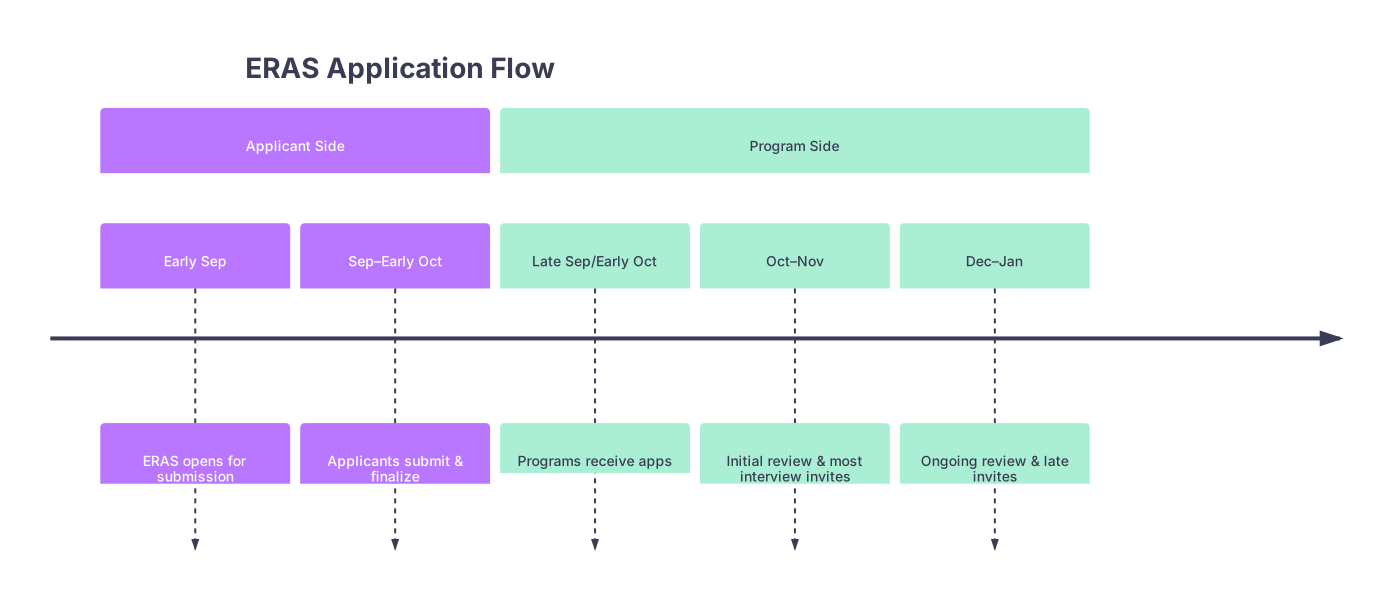
The Real ERAS Timeline (Typical Year)
| Period | Event |
|---|---|
| Applicant Side - Early Sep | ERAS opens for submission |
| Applicant Side - Sep–Early Oct | Applicants submit & finalize |
| Program Side - Late Sep/Early Oct | Programs receive apps |
| Program Side - Oct–Nov | Initial review & most interview invites |
| Program Side - Dec–Jan | Ongoing review & late invites |
If you submit in the first week ERAS allows submission, but weeks before programs can even see your file, your “advantage” is mostly psychological. Yes, being ready on the release date is helpful. No, clicking the button on Day 1 vs. Day 5 of your submission window does not meaningfully change anything by itself.
What the Data and Patterns Actually Show
We do not have a perfect randomized trial of “submit week 1 vs. week 3” with interview outcomes. But we do have patterns from NRMP, AAMC, and what programs report publicly.
Here’s the key pattern: early vs. very late matters; first-week vs. second-week typically does not (for most specialties).
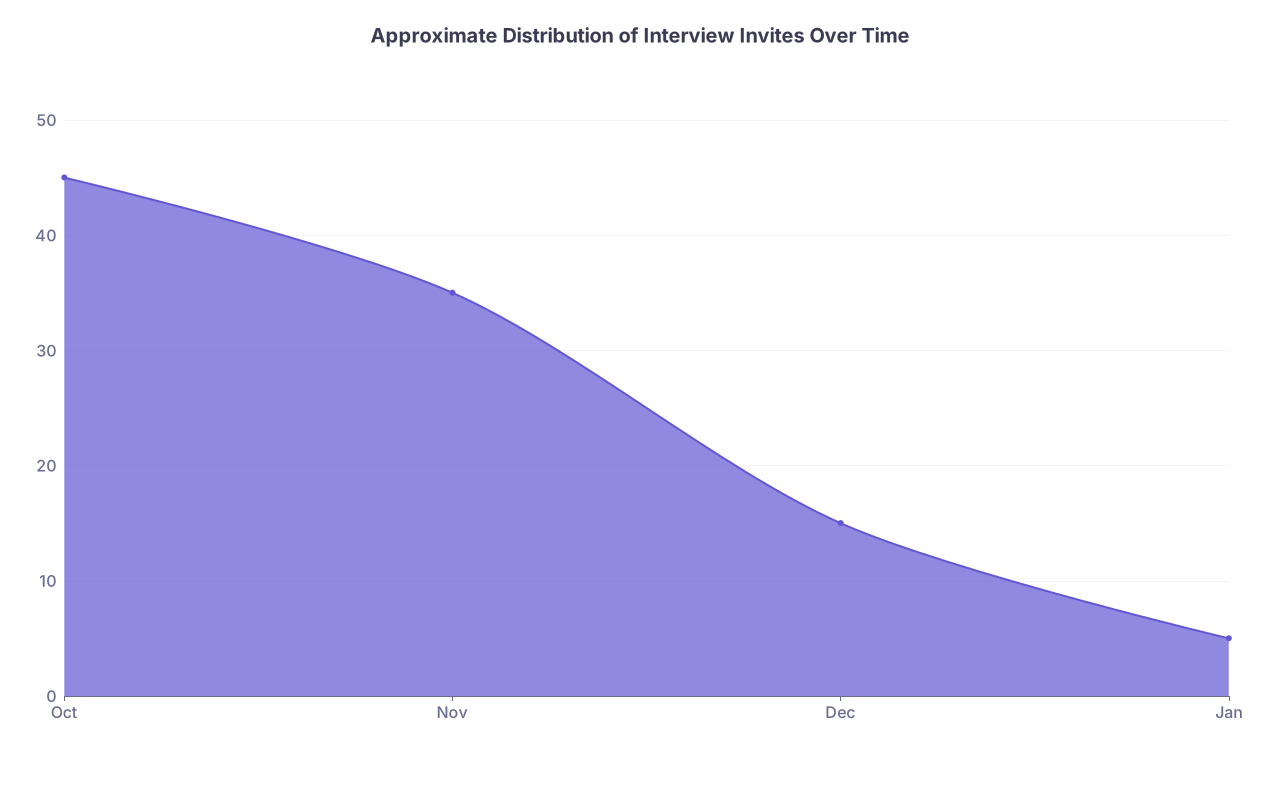
Look at how interview offers usually cluster:
| Category | Value |
|---|---|
| Oct | 45 |
| Nov | 35 |
| Dec | 15 |
| Jan | 5 |
Roughly:
- Biggest chunk of interview invitations goes out in October and early November
- There’s a second wave (cancellations, added slots, reassessment) later
- Programs do not fill all interviews in the first 24–72 hours of having applications
Now pair that with:
- Programs are flooded on day one of download.
- Many PDs explicitly say they do not review strictly first-come-first-served:
- They filter.
- They sort.
- They sometimes prioritize home students, away rotators, or specific Step cutoffs.
So where does that leave you?
You want to be ready by the time programs start reviewing, ideally right around when ERAS releases to them. After that, there's a soft decay, not a cliff. Early October is not the same as mid-December. But September 16 vs. September 22? Usually a rounding error.
Early, But Not Neurotic: What “Good Timing” Actually Looks Like
Let’s define terms, because people love saying “early” like it’s a religion.
| Timing (relative to program access date) | Category | Typical Impact on Chances |
|---|---|---|
| 0–3 days before or on release | Ideal/Early | Maximal benefit; you’re in the first full review batch |
| 1–2 weeks after release | Acceptable | Nearly equivalent to “early” at most programs |
| 3–6 weeks after release | Late | Noticeable disadvantage, some spots already filled |
| >6 weeks after release | Very late | Often only waitlist/cancellation spots left |
Focus on that middle band: 1–2 weeks after release. That’s where most of you who are panicking actually are.
If you hit ERAS submit in that window, you are not “late.” You’re in the main flow. The dogma that “if you aren’t ready on day one, it’s over” is just anxiety with a megaphone.
Where you get punished is:
- Submitting after many programs have already sent out 60–80% of their invites
- Submitting incomplete (no Step 2, missing key LORs) while others are complete
- Being in a hyper-competitive specialty where PDs really do start skimming aggressively the moment apps drop
When Early Submission Actually Matters More (And When It Doesn’t)
Timing is not equally important for every specialty or profile.
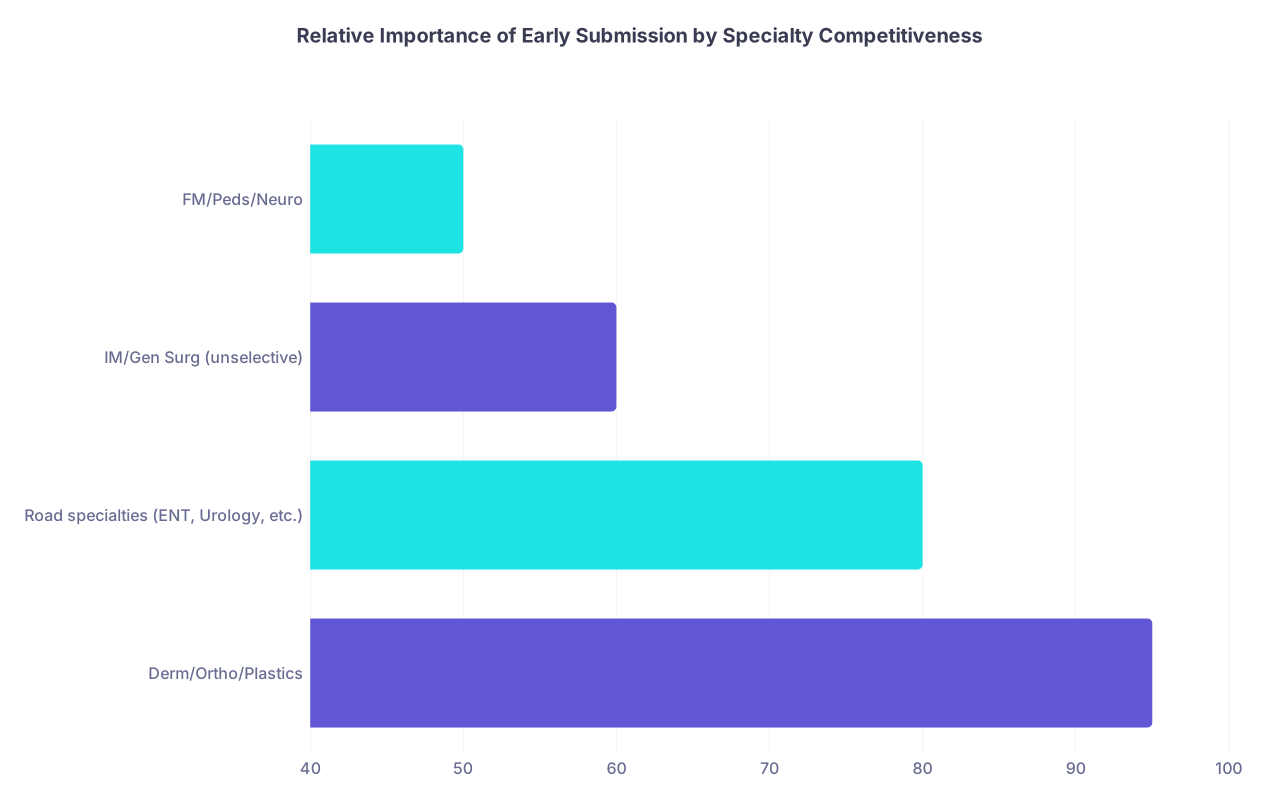
Here’s how it tends to break down.
| Category | Value |
|---|---|
| Derm/Ortho/Plastics | 95 |
| Road specialties (ENT, Urology, etc.) | 80 |
| IM/Gen Surg (unselective) | 60 |
| FM/Peds/Neuro | 50 |
(Dummy “importance scores” out of 100—but this matches what PDs informally report.)
High-competitiveness specialties (Derm, Ortho, Plastics, ENT, etc.)
Here, early does matter more. Why?
- Programs are flooded with hyper-qualified applicants.
- Many have strict filters (Step cutoffs or class rank).
- They often invite a large portion of their perceived top pile quickly.
If derm programs download their apps on Day 1 and you submit two weeks after that, you may fall into the “second pass” pile. Not ideal.
But again: we’re talking about your position relative to program access day, not whether you hit submit literally the first day ERAS lets you.
Core specialties (IM, General Surgery, EM, etc.)
Wide range here. At big-name academic programs, you still want to be in that early batch. Community programs often:
- Review applications for months
- Continue sending invites into December or later
- Are more flexible with timing as long as your file is complete
For a standard IM applicant targeting a mix of academic and community programs, submitting within the first 1–2 weeks of program access is more than fine.
Less competitive / workforce-needy specialties (FM, Peds, Psych, some Neuro)
These programs:
- Tend to review for longer
- Often keep slots open for late or reapplicant candidates
- Care more about fit, geography, and completeness than the exact submission day
Early is still better. Mandatory? No. A September 30 vs. October 10 submission is rarely going to make or break you in these fields by itself.
The Bigger Trap: Submitting “Early” but Incomplete or Weak
Here’s the quiet part no one says out loud: an incomplete or sloppy application submitted “early” is worse than a strong, coherent application submitted a week later.
I’ve watched this play out:
- Student A: Submits on the literal first minute ERAS opens. Two letters in. Step 2 score pending. Personal statement generic and clearly rushed.
- Student B: Submits 7 days later. Three strong letters (including from an away rotation), polished personal statement tied to their experiences, updated CV.
Who wins more interviews? B. Easily.
Because programs don’t see “time submitted” in a big red banner. They see:
- Scores
- Letters
- MSPE
- Clinical grades
- Narrative consistency
Many PDs have said directly: they’d rather see your complete file slightly later than your half-baked file slightly earlier.
So if your choice is:
- Submit on Day 1 with a missing crucial letter or weak statement
vs. - Submit on Day 7 with everything solid
You submit on Day 7.
Data vs. Panic: IMG, DO, and “At-Risk” Applicants
This is where the myth spreads fastest. IMGs, DOs, and candidates with red flags are told they must submit on the earliest possible date “or you’re done.”
Reality’s more nuanced.
Yes, for:
- IMGs
- DOs applying heavily to MD-heavy programs
- Applicants with:
- a failed exam attempt
- low Step scores
- significant gaps
You absolutely want every scalable edge you can get: more applications, good geographic spread, targeted programs, and yes, being early.
But “edge” is not the same as “binary life-or-death.” Being in the early pool versus the late pool matters for you. Being Day 1 vs. Day 5 of submission doesn’t move the needle nearly as much.
Where you lose as an at-risk applicant is:
- Applying in November for a field where main invites went out in October
- Under-applying (e.g., 20 IM programs as an IMG)
- Ignoring program filter patterns (e.g., repeatedly applying to programs that haven’t taken IMGs in years)
Early is strategy. First-week-or-bust is superstition.
What You Actually Should Do About ERAS Timing
Strip out the noise. Here’s the practical, data-aligned play.
Anchor on the program access date, not the applicant submission date.
Plan to be fully submitted and complete by the time programs can first see applications—or within about a week of that.Do not sacrifice quality for a symbolic “Day 1” badge.
If waiting 4–7 days means:- A key letter gets uploaded
- Your personal statement improves dramatically
- Your experiences section is actually coherent
Then you wait those days.
Avoid real lateness, not imaginary lateness.
Real lateness = weeks after most programs started sending invites.
Imaginary lateness = “I submitted 6 days after my classmate.”Use your anxiety productively.
Be the person whose:- Letters are requested early
- CV is stable by midsummer
- Personal statement is drafted and revised before the ERAS window even opens
Then “early” happens naturally without you staying up at 2 AM to beat a fictional deadline by 6 hours.
Quick Reality Checks That Kill the Myth
Let me drive a few stakes into the “first week mandatory” idea.
- If first-week submission were truly mandatory, people who submitted in week two wouldn’t match at normal rates. They do. Every year.
- PDs regularly complain about application inflation, not about “we ran out of strong candidates in week one.”
- Community programs in many regions are still sending out interview invitations in December and January. You think all of those candidates submitted in the first 72 hours? Of course not.
- NRMP data on unmatched applicants almost never cites “submission timing” as a primary risk factor. They list:
- Exam failures
- Low test scores
- Few programs applied to
- Lack of parallel planning
Timing? Mentioned occasionally, but in the late-October or later sense, not “I clicked submit 5 days too late.”
Bottom Line: What Actually Matters
You do not win this game by being the first person in the ERAS line. You win it by being:
- Early enough that your app is in the main review wave
- Complete and coherent when programs look at you
- Strategic about your specialty choices, program list, and letters
If you want it distilled:
- Submitting by the time programs start reviewing, or within ~1 week after, is functionally “on time” for most applicants and most specialties.
- Being weeks late hurts you. Being days “late” within the first couple of weeks almost never does—unless you’re flirting with when invites are already flying.
- A stronger, complete application submitted a few days later is more powerful than a rushed, incomplete application submitted on Day 1.
That’s the data-aligned reality. The rest is premed trauma rebranded as residency wisdom.