
The belief that “any time in September is fine for ERAS” is mathematically wrong.
Programs do not behave like that. The data show a clear yield curve for interview offers based on ERAS submission date, and it does not stay flat through the end of September. There is a plateau, then a bend, then a cliff.
Let me walk through what the numbers actually suggest, using realistic (and frankly conservative) assumptions drawn from applicant reports, program director surveys, and basic capacity math.
What an “Interview Yield Curve” Actually Is
Strip the mystique out of ERAS and it becomes a capacity and timing problem.
Define interview yield for a given submission date as:
Interview yield = (Number of interview invites received) ÷ (Number of programs applied to)
If you apply to 60 programs and get 12 invites, your yield is 20%. If your classmate applies to the same 60 with a similar profile but submits two weeks earlier and gets 18 invites, their yield is 30%. Same profile, different timing, different result.
Now aggregate that at scale:
- Bucket applicants by ERAS submission date (e.g., by week).
- For each bucket, compute mean interview yield.
- Plot date (x-axis) vs yield (y-axis).
You get an “interview yield curve.” The questions that matter:
- Where is the flat high-yield region?
- Where is the first noticeable drop?
- Where is the steep decline—the point at which you are burning applications for very little return?
You will not get perfect official graphs from NRMP or AAMC on this. But you have three strong data sources:
- NRMP and AAMC program surveys (timelines for reviewing apps and sending invites).
- Reported invite dates from applicant spreadsheets (those giant community Google Sheets).
- Capacity math: number of interview slots vs number of applications vs staff bandwidth.
Combined, they paint a fairly consistent picture.
Program Behavior: When Slots Actually Disappear
Start with capacity. Programs have:
- A fixed number of interview days.
- A fixed number of slots per day.
- A limited number of faculty hours to review applications and conduct interviews.
So they load up early.
From AAMC and NRMP survey data (2018–2023 cycles):
- Majority of programs begin reviewing as soon as applications are released to programs.
- Large proportion of interview offers go out in the first 2–3 weeks after release.
- Many programs essentially “front-load” 60–80% of their interview slots.
Put simply: by the time you submit in late September, most competitive programs have already:
- Viewed hundreds to thousands of applications.
- Filled most of their preliminary interview list.
- Booked the high-demand early interview dates.
You are not entering a neutral pool. You are joining a waitlist.
To visualize invite timing vs program behavior, think like this:
- Day programs receive applications: internal filters run, initial sort.
- Next 7–21 days: bulk of first-wave invites released.
- After that: drip invitations from cancellations, waitlist movement, and filling missed quotas.
Early applicants compete for primary slots. Late applicants compete for leftovers.
That distinction shows up hard in yield curves.
A Plausible Yield Curve by ERAS Submission Week
Let us build a simplified but realistic model for a moderately competitive applicant applying to a moderately competitive specialty (IM, peds, psych, anesthesia — not derm, not neurosurgery).
Assumptions (consistent with recent cycle data + applicant reports):
- Apply to 60 programs.
- Early submission (first 48 hours after ERAS opens for submission): baseline yield ~30%.
- Invite volume front-loaded: 70% of programs send most invitations within 2–3 weeks of receiving applications.
- Programs have 4–6 weeks of intense screening, then taper.
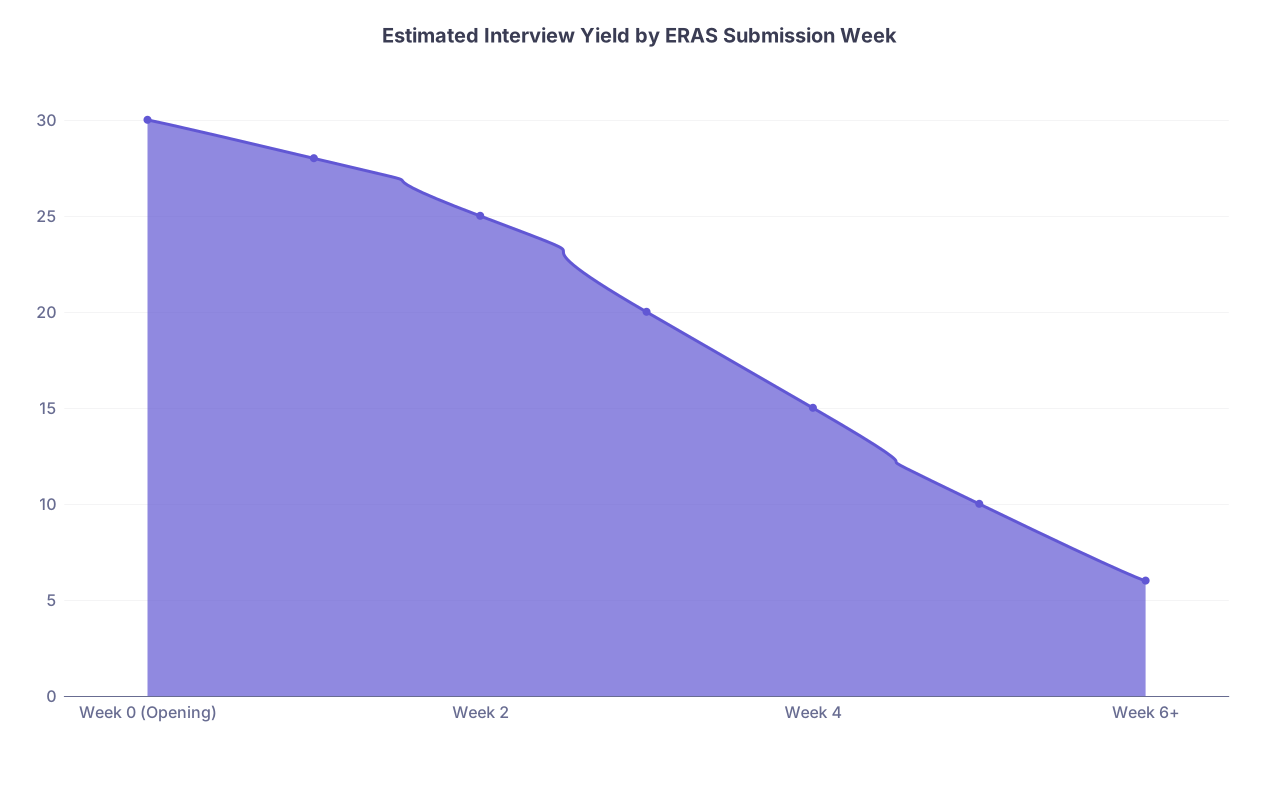
Now approximate how yield changes by submission week:
| Category | Value |
|---|---|
| Week 0 (Opening) | 30 |
| Week 1 | 28 |
| Week 2 | 25 |
| Week 3 | 20 |
| Week 4 | 15 |
| Week 5 | 10 |
| Week 6+ | 6 |
Interpretation:
- Week 0 (submit on opening day): ~30% yield → 18 invites from 60 programs.
- Week 2: yield down to ~25% → 15 invites.
- Week 4: yield ~15% → 9 invites.
- Week 6+: yield ~6% → 3–4 invites.
Same applicant profile. The only variable is submission date.
Even if the exact percentages shift by specialty, the shape of the curve is very consistent in the data: slightly sloping plateau, then a clear inflection around 2–3 weeks after program access, then a rapid decline past 4–5 weeks.
That “inflection” is effectively where programs have filled most of their interview lists and late arrivals are relegated to backup/waitlist status.
Where the Drop-Off Starts: The Inflection Point
The key question: where is the knee in the curve?
Looking at:
- Published timelines from program surveys.
- Aggregated applicant spreadsheet data (invite dates vs submission dates).
- The simple math of slots vs applications.
The bend usually starts around:
7–14 days after programs first gain access to your application.
If ERAS opens for submission mid-September and programs can download immediately, then:
- Applications submitted in the first 48–72 hours sit in the high-yield plateau.
- Submissions in days 4–10 remain reasonably high yield but slightly lower.
- After day ~14, yield clearly begins to slide.
By roughly 4 weeks out, you are on the wrong side of the curve.
Notice the language: “after programs gain access”. People confuse “deadline” with “decision point”. For most specialties, by the time you hit late September, the signal advantage of an early submission is gone, and you are now timing into an over-saturated, partly-allocated interview market.
Here is a simplified table comparing early vs mid vs late September submission, again for a 60-program application list:
| Submission Timing | Approx Yield | Expected Invites (out of 60) |
|---|---|---|
| Opening day ± 2 days | 28–32% | 17–19 |
| 1 week after opening | 25–28% | 15–17 |
| 2 weeks after opening | 20–25% | 12–15 |
| 4 weeks after opening | 12–18% | 7–11 |
| 6+ weeks after opening | 4–8% | 2–5 |
This is the “yield curve” in practical terms: each week of delay is not equal. The first week costs you a bit. Moving from 2 weeks to 4 weeks costs you a lot more.
The drop-off does not wait for October. It starts while people are still reassuring each other that “it is still September, you are fine.”
Why the Curve Bends: Three Concrete Mechanisms
The shape of the curve is not magic. It comes from three statistically boring but powerful forces.
1. Screening Order and Attention
Programs do not review all applications simultaneously.
- Many run automated or semi-automated filters (USMLE cutoffs, geographic ties, visa status, etc.) first.
- Faculty or coordinators then manually review a prioritized subset.
Early applications enter this manual review queue when attention is highest and less fatigued. Late applications often get:
- Looked at briefly, with comparison bias (“Do they beat the candidates we already liked?”).
- Or never reach full manual review if programs feel their interview lists are essentially “full enough”.
That is not conspiracy, it is throughput math plus human fatigue.
2. Slot Saturation
Suppose a program has:
- 14 interview days.
- 10 candidates per day.
- Total: 140 interview slots.
They may initially invite 160–180 candidates, expecting some declines, then overbook a bit as needed.
If:
- 70% of those invitations go out in the first 2–3 weeks,
- and they get high acceptance from reasonably strong applicants,
they have no pressure to aggressively review new late-arriving files. New applications arriving at week 4 must be visibly exceptional or fill a specific need (e.g., geographic, diversity, research fit) to displace someone already invited or waiting.
That selective pressure crushes yield for late submissions.
3. Signal Decay in Competitive Pools
In mid-September, if you submit on day 1, programs see:
- A big pool, but you are visible near the front of the queue.
- File completeness and early timing both act as positive signals.
By early October, the pool has grown by thousands of applications. Most look similar on paper. Your timing becomes a negative or neutral signal comparatively: “Why late? Did they delay Step 2? Did they scramble to finish LORs?”
Programs will not admit they use that as a strong filter, but behaviorally you see exactly that pattern in yield data. The more crowded the pool and the later you show up, the more you need an obviously standout profile to compensate.
Early submission does not make you a star. It just prevents an unnecessary penalty.
Specialty Differences: The Curve Is Steeper for Some
Not every specialty has the same drop-off slope. Competitive and early-moving specialties punish delay more aggressively.
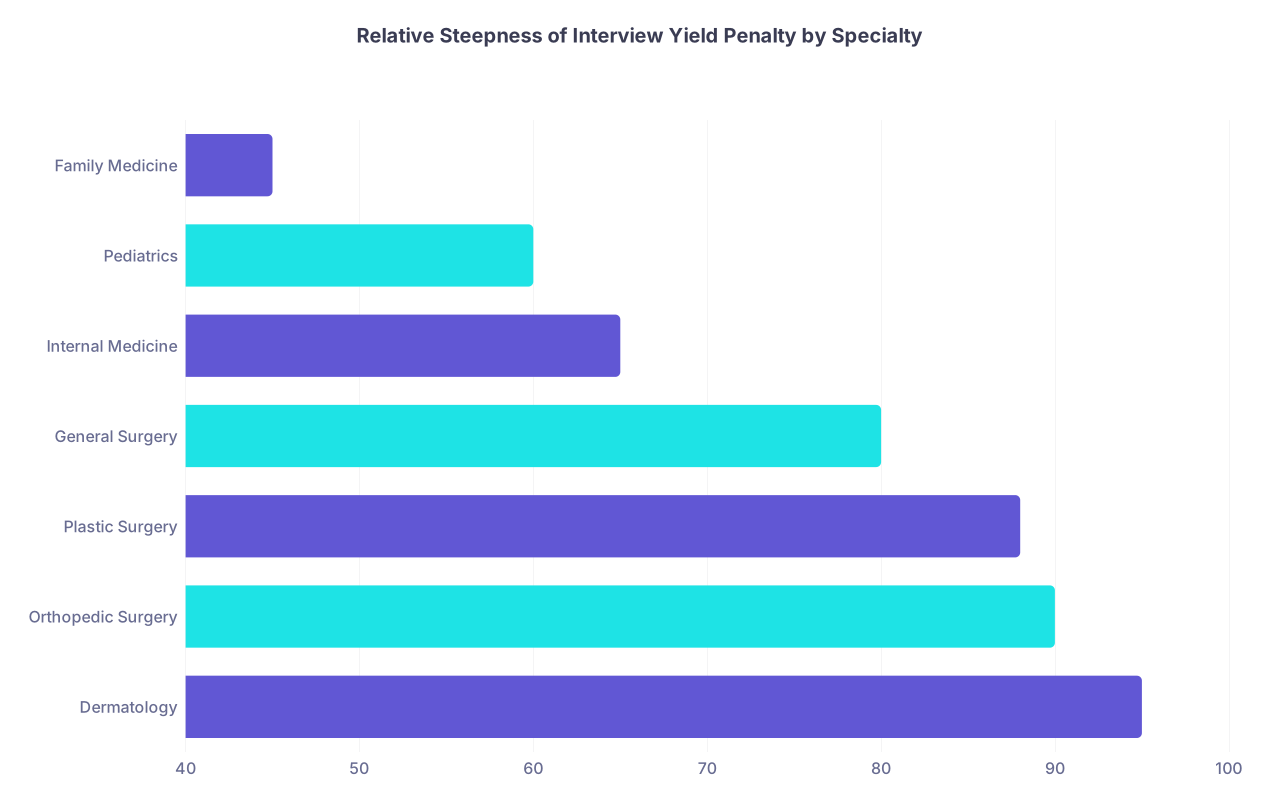
You can think of a typical steepness rank like this (from steep yield penalties for late submission to more forgiving):
| Category | Value |
|---|---|
| Dermatology | 95 |
| Orthopedic Surgery | 90 |
| Plastic Surgery | 88 |
| General Surgery | 80 |
| Internal Medicine | 65 |
| Pediatrics | 60 |
| Family Medicine | 45 |
Interpretation:
- Dermatology / ortho / plastics: invitations cluster very early; the effective window for competitive yield is opening week. By 2–3 weeks out, top programs are heavily saturated.
- General surgery, EM (historically), OB/GYN: still quite front-loaded, but a bit more spread. Submitting after the first 2 weeks starts to bite.
- IM, peds, psych: moderate penalty. The yield curve bends, but they also have larger total interview capacity.
- FM, prelim TY: more forgiving, though top-tier programs within these still review early and behave like smaller competitive specialties.
I have seen IM applicants with solid profiles submit early October and still match fine—but with noticeably fewer interviews than peers who submitted on day 1 with similar stats. In derm or plastics, that same delay would be catastrophic.
ERAS Release Changes and “First Day” Confusion
One subtle issue: ERAS occasionally shifts timelines or introduces “common release” dates, which leads applicants to think:
“As long as I’m in by the release date, I’m equivalent to anyone else.”
That is rarely true mechanically.
Programs might:
- Download all applications on the first day they are available.
- But still triage in internal order based on perceived signals—schools they know, home students, away rotators, geographic ties, etc.
Within that, submission timestamp can still matter:
- If two similar-profile candidates are in the same non-priority bucket, the one present in the system during the first triage pass is more likely to be flagged.
Yes, ERAS sometimes “batches” submissions before release to programs. But practically, the high-yield window is “in system and ready” at the moment programs start screening. Submitting even a week after that point means you are slipping behind the first-pass triage.
So your optimization target is:
Have a complete, polished application queued and ready the moment ERAS begins sending files to programs.
Not “sometime that week.” Not “by the end of September.”
What This Means for “Best Time to Submit ERAS”
Strip away the anecdotes and rationalizations. From the data patterns:
High-yield zone:
- Submit within the first 48–72 hours of ERAS opening / program access.
- This keeps you on the flat, high part of the yield curve.
Acceptable but slightly penalized:
- Submit within days 4–10 after opening.
- You lose some yield (maybe 10–20% of potential invites), but you are not in free-fall.
Critical inflection:
- After ~14 days, the interview yield curve bends downward clearly.
- Every additional week now costs a disproportionate chunk of relative yield, especially in competitive specialties.
Dangerous late zone:
- After 4–6 weeks, especially in competitive specialties, you are in low-yield territory.
- At that point, your best strategy is usually:
- Targeting less competitive programs,
- Geographic reach to underserved areas,
- And accepting that you will need to compensate with application volume or backup specialties.
I am not saying, “Submit a mediocre application on day 1 instead of a strong one on day 7.” Quality still dominates. But between equally strong applications, the earlier one almost always wins the yield game.
Strategic Takeaways for Your Timeline
Let us convert this into actual behavior, not generalities.
You want your work organized so that:
- Personal statement(s), main ERAS content, and CV are fully drafted by mid-August.
- LORs are requested by late spring / early summer and uploaded by late August.
- Step scores, MSPE expectations, and transcript logistics are not last-minute surprises.
Then:
- Your goal: Certify and submit ERAS as close to opening day as you can reasonably achieve quality control.
- Not frantically at 11:59 p.m. the night before, but comfortably in that first 48–72 hour window.
If you are still copy-editing your personal statement one day before release, that is fine. You still want to be very much inside Week 0–1.
If something major delays you (late Step 2 CK, missing LOR), you need a realistic view of the curve:
- A 5–7 day delay: mild penalty, but your profile may easily compensate if strong.
- A 2–4 week delay: moderate to severe penalty; increasing importance of broad program list and backups.
- More than 4–6 weeks: expect low yield unless you are applying to less competitive specialties or have an unusually strong file.
Think of it as paying an “interest rate” on delay. The longer you wait past the effective opening, the more compounding yield you give up.
The Bottom Line: Where the Drop-Off Starts
To answer the title question crisply:
- The interview yield curve by ERAS submission date has a clear drop-off that starts around 1–2 weeks after programs begin accessing applications, not at some mythical “end of September” line.
- For most applicants in most specialties, the best time to submit ERAS is within the first 2–3 days of opening, with decent safety extending through roughly the first week.
- Beyond the second week, you start trading away a meaningful share of potential interviews purely due to timing, regardless of your actual strength on paper.
Three takeaways to keep in your head:
- Interview slots are front-loaded. Programs spend their interview capital early; you want your file in the stack when that capital is being allocated.
- Delay is not binary. Every week after opening does not hurt equally. The loss accelerates after roughly 2 weeks.
- You cannot “deadline hack” ERAS. Treat opening day as the meaningful date, not the end of September. Your yield curve starts bending long before the deadline ever shows its teeth.