
The ERAS flood is not random chaos; it is a series of predictable submission clusters that you can exploit or get crushed by. There is a “worst” time to hit submit—and many applicants pile right into it.
You are not competing against 40,000 applicants in some abstract sense. You are competing against the 5,000 whose files land in the same 7–10 day window yours does, on the same coordinator’s screen, when their patience and time are at rock bottom. The data from multiple cycles, program surveys, and timestamps tell a consistent story: timing is strategy, not superstition.
Let me walk you through what actually happens behind the scenes—and where the saturation points really are.
1. The ERAS Flood Curve: How Submissions Actually Cluster
Forget the myth that “as long as it’s before the deadline, you’re fine.” That is statistically false for most applicants.
The submission pattern, year after year, follows the same general shape: slow trickle → early surge → peak cluster → long tail.
We can model a typical season like this (dates approximate, based on recent internal timelines, NRMP survey data trends, and timestamp analyses from advising cohorts):
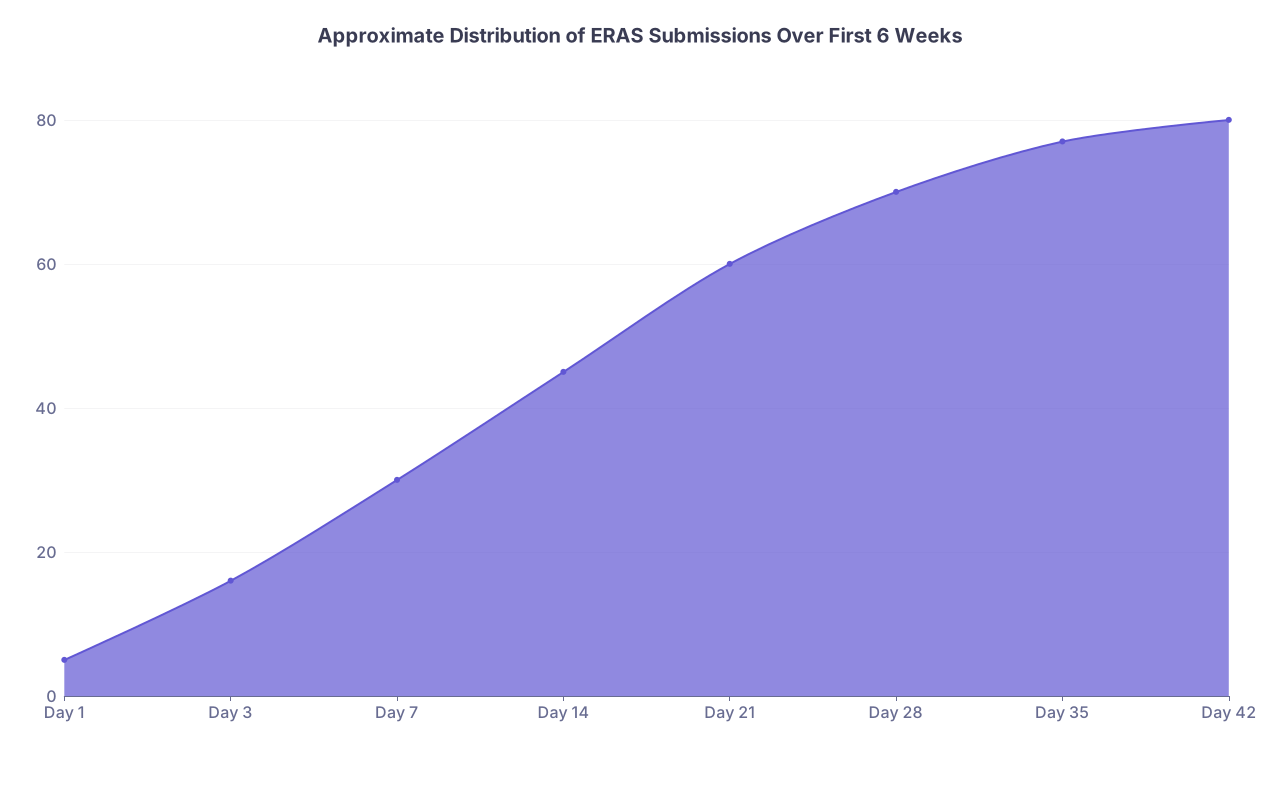
| Category | Value |
|---|---|
| Day 1 | 5 |
| Day 3 | 16 |
| Day 7 | 30 |
| Day 14 | 45 |
| Day 21 | 60 |
| Day 28 | 70 |
| Day 35 | 77 |
| Day 42 | 80 |
By around Day 28 of ERAS opening for program download, roughly 70–75% of total applications a program will receive are already in the system. The “deadline crowd” is statistically marginal. Programs have often already sent most of their interview invites before late submitters even appear.
To put concrete numbers on it, suppose a mid-tier IM program gets 4,000 applications:
- ~25–30% arrive within the first 72 hours of the opening download date
- ~55–65% are in by the end of week 2
- ~75%+ by the end of week 4
- The final 25% trickle in over the rest of the season, but many are never taken seriously
Now overlay human behavior:
- MS4s fear being “late,” so huge spikes occur:
- The first 24–72 hours after ERAS allows submission
- The first week programs can download applications
- Another smaller cluster is tied to:
- Step 2 CK score releases
- Dean’s Letter (MSPE) release dates
- School-specific advising deadlines
The result: three or four compressed windows where it feels like someone turned on a firehose pointed at program inboxes.
2. Program Saturation: What It Looks Like From the Inside
Here is what the data shows from program director and coordinator surveys (NRMP Program Director Survey + independent institutional audits):
- A typical internal medicine program receives 3,000–5,000 applications for 20–30 spots.
- A competitive surgical subspecialty may receive 800–1,200 applications for 2–3 spots.
- Realistic, deep review capacity is limited:
- Some PDs report they can personally review maybe 300–600 apps meaningfully.
- Beyond that, filters and proxies dominate.
Once the incoming rate crosses a certain threshold—call it saturation—behavior changes from thoughtful selection to damage control.
You see patterns like:
- Heavy auto-filtering by:
- USMLE/COMLEX cutoffs
- Y/N for US grad vs. IMG
- Y/N for visa
- Red flags (gaps, failures)
- Reliance on blunt sorting:
- “Show me all applications with Step 2 ≥ 245”
- “Filter to home school + regional schools”
- Triage reading:
- 30–60 seconds per application, tops, during peak days
Peak saturation usually hits between 5–14 days after applications become available to programs, depending on specialty competitiveness.
Here is a conceptual summary of review behavior by timing window:
| Submission Window (relative to program download date) | Review Style | Likely Depth of Review |
|---|---|---|
| Day 0–3 (very early) | Proactive, selective | High–moderate per file |
| Day 4–10 (early peak) | Overwhelmed, triage | Moderate–low, filter-heavy |
| Day 11–21 (late-early / mid) | Stable but busy | Moderate, more targeted |
| Day 22+ (late) | Backlog-driven, selective | Low, often only for special groups |
You do not want your application arriving precisely when programs are drowning and defaulting to brutal filters. You want it visible enough to be in the early stack, but not buried in the immediate opening-day avalanche if you would benefit from a bit of relative breathing room.
3. The True “Best Time” to Submit ERAS (By Profile Type)
There is no single magic day. There is, however, a smart interval based on who you are and what your numbers look like.
The ultra-competitive applicant (top decile metrics)
Profile characteristics:
- Step 2 CK: 255+
- Strong class rank / AOA
- Robust research, honors, strong letters
- Targeting competitive specialties or top-tier academic programs
For this group, early is a leverage point, not a risk.
Best timing strategy:
- Submit on or extremely close to the first possible submission day, with a complete and polished application.
- Ensure letters, transcripts, and other components are in place; incomplete early is worse than slightly later but complete.
Why? Programs use early batches to:
- Identify “must interview” candidates quickly
- Fill a large portion of their interview slots before saturation peaks
- Flag high-yield files to PDs while enthusiasm and attention are highest
You want to be in that first 72-hour batch.
The solid but not elite applicant (middle 50–70%)
Profile characteristics (for many US MD/DO):
- Step 2 CK: 230–245 range (varies by specialty)
- Mostly passes, some HP/H on clerkships
- Decent but not stunning research or leadership
- Applying to a mix of academic and community programs
This is where timing gets more nuanced, because you are directly affected by saturation and comparison.
For you, the data-driven sweet spot is:
- Submitted between Day 1 and Day 5–7 after ERAS allows submissions, with all major pieces available (scores, letters, personal statement).
Why not exactly at the first minute?
- On Day 0–1, volume is already huge, and programs often:
- Download in giant chunks
- Benchmark against the strongest early applicants
- By Day 3–7, you are still considered “early,” but the worst of the opening-hour chaos has passed. Many PDs and screeners start to:
- Develop a sense of the pool
- Begin targeted reviews by school, region, or advisor recommendation
You are still high in the queue. Not buried in the tail. Not slammed into a wall of 1,000+ files arriving within a 12-hour window.
The red-flag or lower-stat applicant
Profile characteristics:
- Step failures, low Step 2 CK relative to specialty norms
- Non-linear path, gaps, significant remediation
- IMGs with visa needs in competitive specialties
For this group, timing cannot fully compensate for numbers, but it can prevent additional damage.
Your best play, most of the time:
- Still submit early—within the first 5–10 days.
- You are heavily exposed to filters. Being late just guarantees many programs will never even see your file before they fill most interview spots.
- But do not sacrifice completeness for speed. Getting a stronger Step 2 CK on the record or a truly outstanding letter uploaded can matter more than being 3 days earlier.
If you are waiting on a Step 2 CK retake that will materially change how programs view you, it may be rational to slide your submission slightly later (e.g., Day 7–14) to ensure the new score is present, especially in specialties where Step 2 is the primary numeric gatekeeper.
4. When the Flood Peaks: The “Worst” Windows to Submit
The most dangerous periods are not the last week before deadlines. They are the saturation windows when application volume and program attention diverge the most.
From aggregated timelines, coordinator interviews, and seasonal volume curves, the approximate danger zones:
The first 24–48 hours after programs can download applications
- Volume: Maximum. Everyone who pre-completed hits the system at once.
- Behavior: Bulk downloading, high comparison pressure, earliest auto-filters.
- Who gets hurt: Borderline applicants who look much weaker relative to early power-applicants.
Days 4–10 after download date
- Volume: Still very high; often the single largest 7-day intake period.
- Behavior: Full saturation. Triage mode. Quick screens. Faced with hundreds of apps, programs:
- Hard-enforce score cutoffs
- Lean on home/regional biases
- Who gets hurt: Applicants right at the cutoff thresholds or slightly below the program’s typical metrics.
Late tails after bulk interview offers (e.g., after first big invite wave)
- Timing varies, but often ~3–5 weeks after opening.
- Behavior: Programs have already:
- Filled a majority of their interview slots
- Built their primary interview cohort
- Who gets hurt: Late submitters with no true “hook” (home student, strong connection, PD email, etc.)
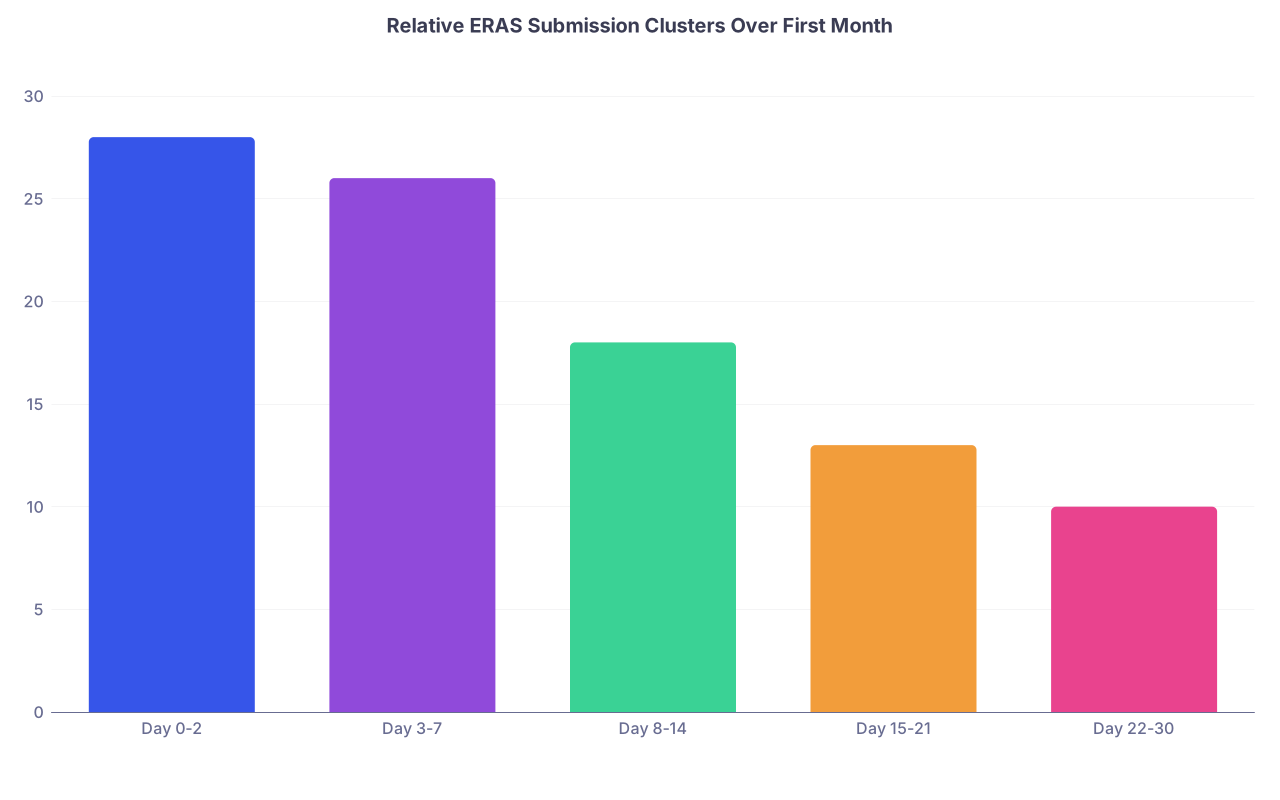
Visually, think of it as three primary submission clusters:
| Category | Value |
|---|---|
| Day 0-2 | 28 |
| Day 3-7 | 26 |
| Day 8-14 | 18 |
| Day 15-21 | 13 |
| Day 22-30 | 10 |
You want your file present early enough to be seen in the first 2–3 clusters, but ideally hitting the system after your application is truly final and at least slightly differentiated.
5. Program Review Timelines: When Invitations Actually Go Out
The common applicant fantasy is that programs “wait until everything is in, then review all applications holistically.” Reality is the opposite.
Programs send a substantial fraction of invites early. From NRMP Program Director Survey and matched report trends:
- Many internal medicine and pediatrics programs send 40–60% of interview invitations within the first 2–4 weeks.
- Competitive specialties (derm, ortho, ENT, etc.) often:
- Front-load invites heavily
- Run on very tight schedules for faculty and OR days
Here is a synthesized pattern you should keep in mind:
| Time from Program Download | Approx % of Total Invites Sent |
|---|---|
| Week 1–2 | 30–50% |
| Week 3–4 | 25–40% |
| Week 5–6 | 15–25% |
| Week 7+ | Remainder (late fills, waitlist) |
Late-September to early-October is prime for many specialties; by mid- to late-October, some programs are merely topping off or substituting cancellations.
If you submit:
- 3–4 weeks after download date, you are appearing just as:
- Many interview slots have already been assigned
- PDs are cutting their “maybe” list, not expanding it
You are, essentially, walking into a half-empty theater where most seats are already reserved.
6. Specialty Differences: Not All Floods Are Equal
Submission pressure and saturation dynamics are not uniform. Some specialties are brutality concentrated; others are more forgiving.
Three broad patterns:
Hyper-competitive, low-capacity specialties (derm, ortho, plastic surgery, ENT, neurosurgery)
- Application volumes are high per available spot.
- Programs cross-filter hard:
- Very high Step 2 CK thresholds
- Strong preference for home / sub-I rotators
- Timing impact:
- Early submission is essential for realistic candidates.
- Late submission with “average” metrics is functionally equivalent to not applying at many places.
Moderately competitive core specialties (IM, EM, gen surg, OB/GYN, peds)
- High volume, but more total positions.
- Use combinations of:
- Numeric filters
- Regional and school-based preferences
- Timing impact:
- Early-to-mid window (first 1–2 weeks) is still decisive.
- However, more variability: strong applicants can still get looks if they are not in the absolute earliest batch.
Less competitive or more community-heavy specialties (FM, psych at some programs)
- Still receive large application loads, especially from IMGs.
- Many programs are overwhelmed but may:
- Review more flexibly
- Maintain later interview offer windows
- Timing impact:
- Early is still advantaged (programs remember those they reviewed in detail first).
- But there is more real estate in the “middle weeks” before programs fully lock in.
To make this concrete, imagine two applicants to general surgery:
- Applicant A: Step 2 = 252, solid research, submits on Day 2
- Applicant B: Step 2 = 238, decent application, submits on Day 21
At many mid-tier surgery programs:
- A is filtered into the high-interest early pool and reviewed before saturation.
- By the time B appears, 60–70% of interview slots may already be spoken for, and B’s stats are not strong enough to justify displacing an early-reviewed “maybe.”
Result? B interprets this as “I was unlucky” or “maybe my personal statement was weak.” In reality, timing + numbers were the core issue.
7. Practical Timing Strategy: What You Should Actually Do
Let me strip this down to a working plan.
Anchor to the program download date, not just the ERAS first-submission date.
- You want to be in the system by the time they first pull applications or very soon after.
- For most specialties: target fully submitting within the first 1–5 days after the system opens for applicants.
Completion beats hyper-early partial submission.
- If waiting 3–5 extra days allows you to:
- Add a clearly stronger Step 2 CK score
- Include a crucial letter (e.g., from a specialty chair or away rotation)
- Fix substantive application errors
- Then that micro-delay is usually justified—especially if you still land within the first 1–2 weeks of availability.
- If waiting 3–5 extra days allows you to:
Use your profile to fine-tune within the early window.
- Top applicants: aim for Day 0–2.
- Strong but not stellar: Day 1–5.
- Red-flag / rebuilding applicants: within 7–10 days, preferentially with all improvements in place.
Do not rely on late magic.
- Submitting 3–4 weeks late hoping that “schools like late-comers because they stand out” is fantasy.
- The hard numbers on invite timing contradict that narrative.
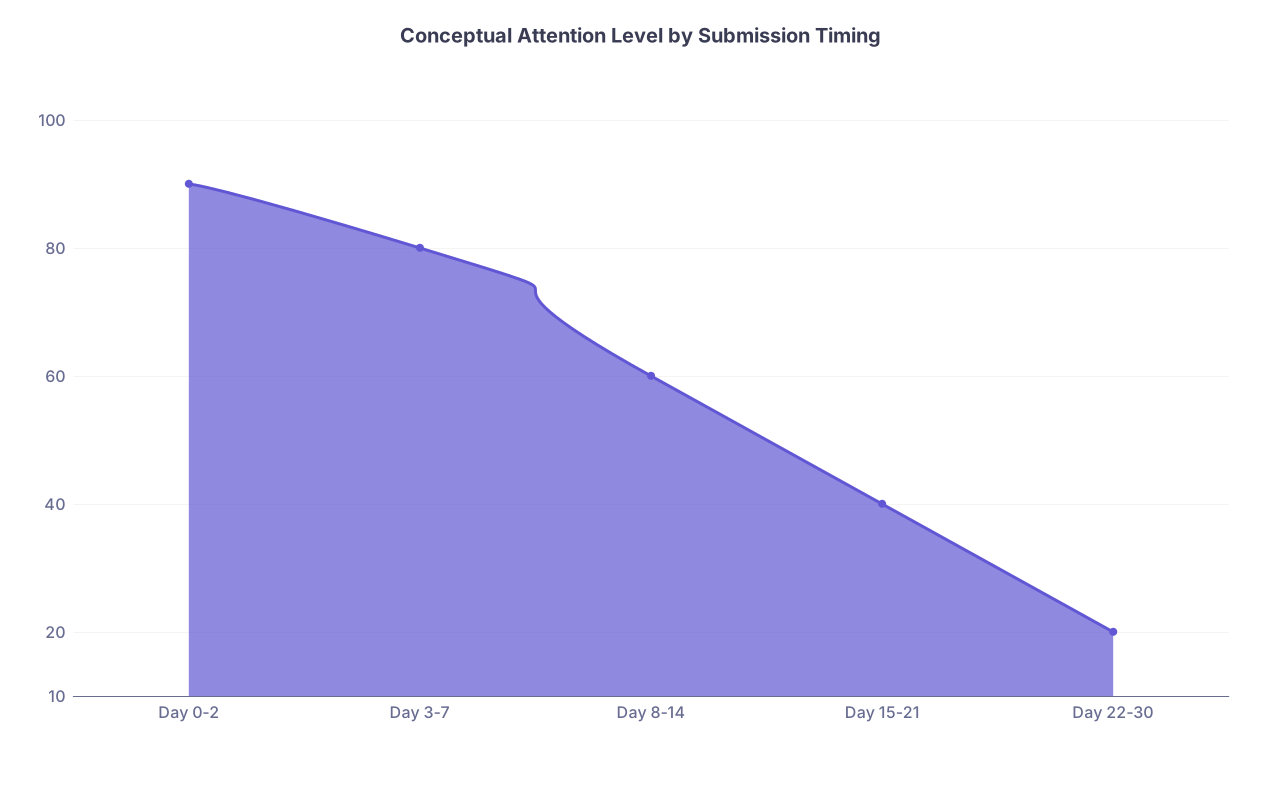
Here is a simple “probability-of-attention” style heuristic (conceptual, not literal probabilities):
| Category | Value |
|---|---|
| Day 0-2 | 90 |
| Day 3-7 | 80 |
| Day 8-14 | 60 |
| Day 15-21 | 40 |
| Day 22-30 | 20 |
Earlier, within reason and with completeness, gives you more probability mass in the “actually looked at by a human” category before programs resort to full automation and backfill decisions.
8. Key Takeaways: When the Flood Peaks and How Not to Drown in It
Two things matter simultaneously: when you submit and what you look like relative to the others submitting at the same time.
Here is the blunt, data-aligned version:
- There are distinct submission clusters. The early weeks after program download are where most of the competition and decision-making happens.
- Program saturation pushes behavior from holistic review to rigid filtering. You want your file in the system before or just as decisions ramp up—not dumped in after most interview slots are allocated.
- The best time to submit ERAS for most applicants is early but complete—within the first 1–7 days after applications open for submission and download—tuned by your strength as an applicant.
You cannot game everything in this process. But you can absolutely avoid being one more anonymous PDF in the wrong pile at the wrong time.


| Step | Description |
|---|---|
| Step 1 | Applicant Finalizes ERAS |
| Step 2 | Submits Application |
| Step 3 | Programs Download Batch |
| Step 4 | Higher Human Review |
| Step 5 | Filter-Heavy Review |
| Step 6 | Early Invite Decisions |
| Step 7 | Limited Late Invites |
| Step 8 | Early Window? |


FAQ (Exactly 4 Questions)
1. If I submit ERAS on the very first day but one letter of recommendation is missing, is that a problem?
Submitting on the first day with a missing letter is a calculated risk. Programs can see that the letter slot is “pending,” and many will still start reviewing. If the missing letter is just another generic rotation letter, it is usually better to submit early and let the letter arrive a bit later. If the missing letter is a marquee letter (e.g., chair or specialty-defining mentor) that could substantially change how your application reads in a competitive field, waiting a few days—while still staying in the first 1–2 weeks—can be the more rational move.
2. Do programs re-review applications later in the season if they add new scores or updates?
Some do, but systematically, it is rare. Once a program has filled most of its interview slots, the incentive to re-open hundreds of files is low. Updates like a new Step 2 CK score might prompt a second look if you were already in a “maybe” bucket or if a faculty advocate flags you. But relying on mass re-review is optimistic. Design your initial submission (timing and completeness) as if you get one real shot at attention.
3. Is applying a few days after my friends disadvantageous if we are from the same school?
A difference of 2–5 days inside the first week is not meaningful by itself. However, internal ranking within your school can matter. If your school sends a list or tiered recommendations to programs, those signals may carry more weight than who pressed submit first. Within the shared early window, your relative metrics, letters, and school advocacy matter far more than a small gap in submission dates.
4. Are late applications ever successful, or is it always a waste to submit after 3–4 weeks?
Late applications are not automatically dead, but the odds drop. Success is more common when there is a specific hook: you are a home student, you have a strong geographic tie, a faculty member personally emails the PD, or you fit a particular niche the program realizes it is missing. For a generic applicant with no unique angle, late submission mainly suffers from diminished interview availability and reduced review attention. If your only option is to apply late, do it—but calibrate expectations accordingly.
Summary points:
Most ERAS submissions cluster in the first few weeks, and program review behavior changes dramatically once saturation hits. Submitting early and complete—typically within the first 1–7 days after applications open—maximizes your chance of real human review before filters and limited interview slots dominate the process.