
The panic about “submit on ERAS opening day or you are doomed” is wildly overstated. The data shows a far more nuanced story.
You are not in the same risk category if you submit on September 7 vs September 28. You are in a different risk category if you are still “polishing” in October while everyone else’s files are already being screened.
Most applicants ask this question too late, and most advisors answer it with hand‑waving: “Earlier is better.” That is not helpful. You need to understand how program review actually works, what dates matter, and where the real inflection points are for your Match odds.
Let’s walk through this like we would any other high‑stakes system: by breaking down timelines, constraints, and actual behavior patterns of residency programs.
1. What the Calendar Actually Looks Like (Not the Myth)
ERAS and NRMP do not care that you are “almost done.” Programs care about what is in their inbox when they begin serious screening.
A typical timeline for a recent cycle (dates shift slightly year to year, but the pattern holds):
- Early June: ERAS opens for applicants to start working on applications.
- Early September: ERAS submission opens to applicants.
- Mid-September: ERAS transmits applications to residency programs on a specific release date.
- Late September–October: Programs begin formal reviewing and sending out most interview invitations.
- November–January: Majority of interviews.
- February: Rank list certification deadline.
- March: Match Week.
The key insight: Programs all receive your application on the same release date if it is certified and submitted by that ERAS program transmission date. Submitting on the first day vs. five days before the transmission date puts you in the same initial batch for most specialties.
The real cut is not “September 5 vs September 15.” It is:
- “Before programs start serious review”
- Versus “After initial interview invitations are already going out”
That is where timing begins to show up in your odds.
2. How Programs Actually Process Applications
Programs do not sit there on Day 1 reading every file front to back. They use filters, batching, triage, and—frankly—shortcuts.
From faculty and coordinator comments and the pattern of interview invite timing, here is the default workflow I keep seeing:
Initial filter pass (automated or semi‑automated)
- USMLE/COMLEX thresholds
- Visa status
- Grad year cutoffs
- Sometimes school region / affiliation
Early review window (first 2–4 weeks after receipt)
- PDs and selection committees review a subset of files more closely.
- 40–70% of interview invitations go out in this phase, depending on specialty.
Rolling invitations and waitlist management (rest of season)
- Canceled interviews open slots.
- Late but strong applicants are slotted in selectively.
In that context, timing matters for one specific reason: being in the early review batch keeps you in contention before most interview spots are allocated.
So the relevant question is not “Early vs. mid‑September submission.” It is “Am I in the group they are looking at when they still have most of their interview slots available?”
3. What Limited Data We Have on Timing and Match Odds
Nobody has published a perfect, randomized dataset on ERAS submission dates and Match outcomes. But we do have:
- NRMP Charting Outcomes (US MD, DO, IMGs)
- Program director surveys
- Observed timelines for invitations by specialty
- Aggregated anecdotes from coordinators and PDs across multiple cycles
If you synthesize all of that, three patterns emerge:
- Submitting before ERAS transmits to programs vs. after transmission day is a real divide.
- Within the “on-time” window, differences of a few days rarely matter. Weeks can.
- The weaker your application, the more time advantage matters. The strongest applicants get more slack.
To make this concrete, let’s quantify the idea of “effective access” to interview slots.
A simple capacity model
Assume a categorical IM program:
- 2,500 applications received
- 120 interview slots
- 80% of interview invites sent in the first 4 weeks after transmission
- 20% reserved for late, canceled, or exceptional candidates
If you apply:
- In the initial transmission batch: you compete for 120 slots.
- Three weeks after that: you are effectively competing for closer to 20–30 “fresh” slots plus any that open from cancellations.
- Two months late: you are almost entirely dependent on cancellations or unusual circumstances.
In other words: by the time you are a late applicant, the program has already committed the majority of its interview “budget.”
Now map that back:
- Submitted and certified before ERAS transmits to programs = “on time”
- Submitted during late September / early October = “borderline but viable”
- Submitted mid‑October or later = “late; odds significantly worse at most programs”
The question in your title—“Early vs. Mid‑September ERAS Submissions”—is essentially about the on‑time region. That is where myth and reality diverge the most.
4. Early vs. Mid‑September: Does It Matter Within the On‑Time Window?
Short answer: For most applicants and most specialties, early‑September vs mid‑September is a marginal difference at best if both are before program download and early screening.
Let’s set up a rough scenario based on observed invite timing in moderately competitive specialties (IM, Peds, FM, Psych, OB/Gyn, Anesthesia):
- 70–85% of applications arrive on or before the program transmission date.
- Programs begin serious review on or shortly after that transmission date.
- By 3–4 weeks after transmission, 50–70% of interviews are already sent.
Now, compare three applicant groups:
- Group A: “Opening day” early submitters
- Group B: Submitted 7–10 days later but before program transmission
- Group C: Submitted 2–4 weeks after program transmission
For Groups A and B, programs effectively see both at the same time, in the same flood. Your file is sitting in the same queue on Day 1 of their screening.
Where it gets slightly more complicated:
- Some programs or coordinators start pre‑sorting or running filters in the days leading up to transmission, using internal tracking after you certify/submit.
- Others do nothing until the official release, then flip the switch.
So is there any rational reason to care about opening‑day vs one week later if both are fully ready by the time programs start? Only in edge conditions:
- If a handful of highly organized programs truly do “first‑in, first‑reviewed” internally before release (they exist, but they are not the norm).
- If letters of recommendation or MSPE drafts are being circulated and informally previewed by affiliated programs early.
For the vast majority of applicants across the majority of programs:
- Early‑September vs mid‑September does not materially change your Match odds if both result in a complete, polished application ready to be reviewed in the first waves.
The data that does exist on drastic timing differences—such as applicants whose applications were complete several weeks after the bulk—shows meaningful declines in interview volume, especially for non‑top decile applicants.
But between “September 7” and “September 18”? You are arguing over small fractions in a system dominated by:
- Step scores / COMLEX scores
- Clerkship performance
- Letters
- Specialty‑specific red flags
5. Where Timing Starts to Bite: “On‑Time” vs “Late”
Now we get into the part that actually matters for your Match odds.
Look at how interview invites are distributed. For most non‑extreme specialties:
- 50–70% of invites go out in the first 3–4 weeks after programs receive applications.
- Another 20–30% over the next month.
- The last 10–20% are drips, waitlist movement, and filling cancellations.
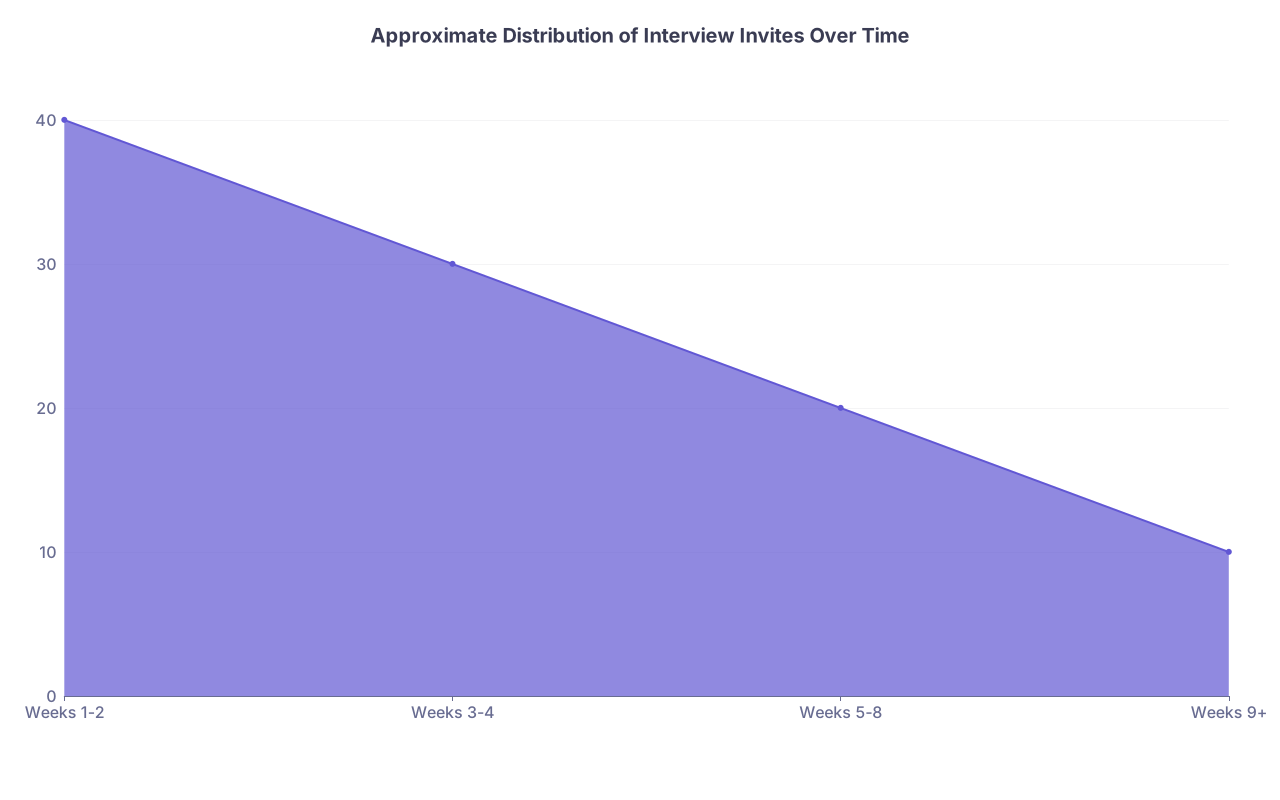
| Category | Value |
|---|---|
| Weeks 1-2 | 40 |
| Weeks 3-4 | 30 |
| Weeks 5-8 | 20 |
| Weeks 9+ | 10 |
Now, tie your submission date to these windows.
If you:
Submit and are complete by program transmission:
You are in the Week 1–2 and Week 3–4 pools. Full access.Submit 2–3 weeks after transmission:
Programs may already have extended ~50–70% of their interviews. You are in a narrower slice of opportunity, fighting for remaining and substitute spots.Submit in mid‑October or later:
You are functionally applying for the bottom 10–20% of slots and for cancellations, unless you are truly exceptional or applying to less competitive programs.
In other words, there is an exponential decay in opportunity once you are past the early review wave, not a linear decline day by day across September.
So timing strategy in rational terms:
- Target: Complete and submitted before program transmission
- Acceptable: Within 1–2 weeks after, if there is a compelling reason (e.g., waiting on a big Step 2 CK improvement)
- Dangerous: 3+ weeks after, unless you are over‑applying or aimed at less competitive programs
The distinction you proposed (early vs mid‑September) mostly lives in that first bucket.
6. Does Timing Matter More for Certain Applicant Types?
Yes. Timing interacts with applicant strength. Think of timing as leverage, not a cure.
Strong applicants (high scores, strong clinicals, solid letters)
These people can submit somewhat later and still do well because programs will make exceptions for clearly desirable files.
A US MD with:
- Step 2 CK 255
- Honors in core rotations
- Strong home program letter
who submits in late September might still get a wide and healthy slate of interviews in IM or Psych.
Programs will dig into the pile for them.
Borderline or at‑risk applicants
This is where timing becomes a non‑trivial multiplier.
Examples:
- US MD with 220 Step 2 CK applying Anesthesia
- US DO with average COMLEX and minimal research applying IM in a competitive region
- Non‑US IMG with 235–240 Step and no strong US clinical experience
These applicants depend heavily on:
- Broad application lists
- Being seen before filters and thresholds are “tightened” late in the season
- Catching programs when they still have flexibility and not just a few spare interview slots
For this group, being on‑time vs 3–4 weeks late can be the difference between:
- 8–12 interviews (reasonable Match probability)
- 3–4 interviews (high risk of going unmatched)
Again, not “September 7 vs September 13.” It is “September 15 vs October 15.”
7. When You Should Delay on Purpose
One of the rare smart arguments for a mid‑September (or even later) submission is waiting for a substantially better Step 2 CK score or a key letter.
Scenario:
- You are sitting on a mediocre Step 1 or you are an applicant where Step 2 is heavily weighted.
- You take Step 2 CK in late August.
- You receive your score mid‑ to late September.
If your Step 2 CK is:
- 10–15+ points higher than your previous performance would predict,
- and the specialty heavily emphasizes Step 2 (e.g., after Step 1 went pass/fail),
then waiting to submit until that score is in can be a net positive, even if you drift into slightly later territory.
The crude trade‑off:
- Submit early with weak or missing score → More early visibility, worse academic signal.
- Submit a bit later with a strong score in hand → Less early visibility, stronger file.
For many borderline candidates, the second option is better. Not always, but often enough that I have seen it salvage otherwise weak cycles.
Similarly, if you are waiting on a crucial letter—like a home program PD letter for a specialty like Surgery or Ortho—submitting a week or two later to include that letter can be rational if it moves you from “generic” to “backed by someone we know and trust.”
Just do not conflate a smart, targeted delay for a specific, meaningful upgrade with endless perfectionism that leads to October submission.

| Step | Description |
|---|---|
| Step 1 | Draft Ready by Early Sept |
| Step 2 | Wait for Score, Submit Late Sept |
| Step 3 | Submit Before Program Transmission |
| Step 4 | Reconsider Delay |
| Step 5 | Accept Slightly Later Timing |
| Step 6 | Major Upgrade Pending? |
| Step 7 | Will Submission Slip > 2-3 Weeks After Transmission? |
8. Program Types Where Timing Sensitivity Is Higher
Not all programs behave the same way. Timing tends to matter more for:
- Very competitive community programs that receive huge volumes but have small faculties for screening
- Lifestyle specialties (Derm, Radiology, PM&R) and prestige programs that are flooded with strong applicants early
- Programs with strict filters that then review small batches more thoroughly in the first days
In those environments:
- Being in the first wave can slightly increase the odds your file is reviewed by a human rather than lost in a sea of near‑duplicates.
- Coordinators sometimes batch the first 500–1000 apps and hand them off to faculty committees. If you appear after that, you may be “round 2” once most invites are already tentatively allocated.
Compare this to less timing‑sensitive programs:
- Smaller, more regional community hospitals
- Programs that historically send invites on a rolling, less compressed timeline
- Certain primary care heavy programs
Here, submitting a few days or even a week after everyone else does not dramatically change your trajectory if you are still early in their review process.
So yes, if you are targeting high‑volume, high‑prestige programs, bias slightly toward the earlier side of the on‑time window. But do not sacrifice clear, avoidable weaknesses in your application just to click “submit” 72 hours earlier.
9. Putting It Together: What the Data‑Driven Strategy Looks Like
Strip the noise away and view this as a capacity and queueing problem.
You can think of your ERAS timing decision as a trade‑off between:
- Queue position: Earlier = more likely to be in the first major review batch.
- Signal strength: Later but with stronger metrics/letters = more likely to clear filters and attract interview offers.
Here is a simplified comparison table based on realistic patterns:
| Submission Timing | Access to Interview Slots | Relative Risk of Fewer Interviews | When It May Be Optimal |
|---|---|---|---|
| Early Sept (pre-transmission) | ~100% of slots | Lowest | If application is already strong and complete |
| Mid-Sept (still pre-transmission) | ~100% of slots | Essentially same as early | If waiting briefly on non-critical polishing |
| Late Sept–Early Oct (0–2 weeks post-transmission) | ~60–80% of slots | Moderate | If delayed for a clearly better Step 2 or key letter |
| Mid–Late Oct (3–6 weeks post-transmission) | ~30–50% of slots | High | Only justifiable with major application upgrade |
| November or later | ~10–20% of slots | Very high | Usually a serious disadvantage |
Then layer applicant strength:
- Top‑quartile applicants: Can tolerate small timing delays; focus slightly more on completeness and signal.
- Middle‑quartile applicants: Should prioritize being in the initial program review batch, unless delay causes a major improvement (e.g., Step 2 jump).
- Bottom‑quartile / red‑flag applicants: Need both early access and maximum possible signal improvements; they have less slack overall.
One more visual, this time linking approximate interview odds to timing for an “average” applicant in a moderately competitive field:
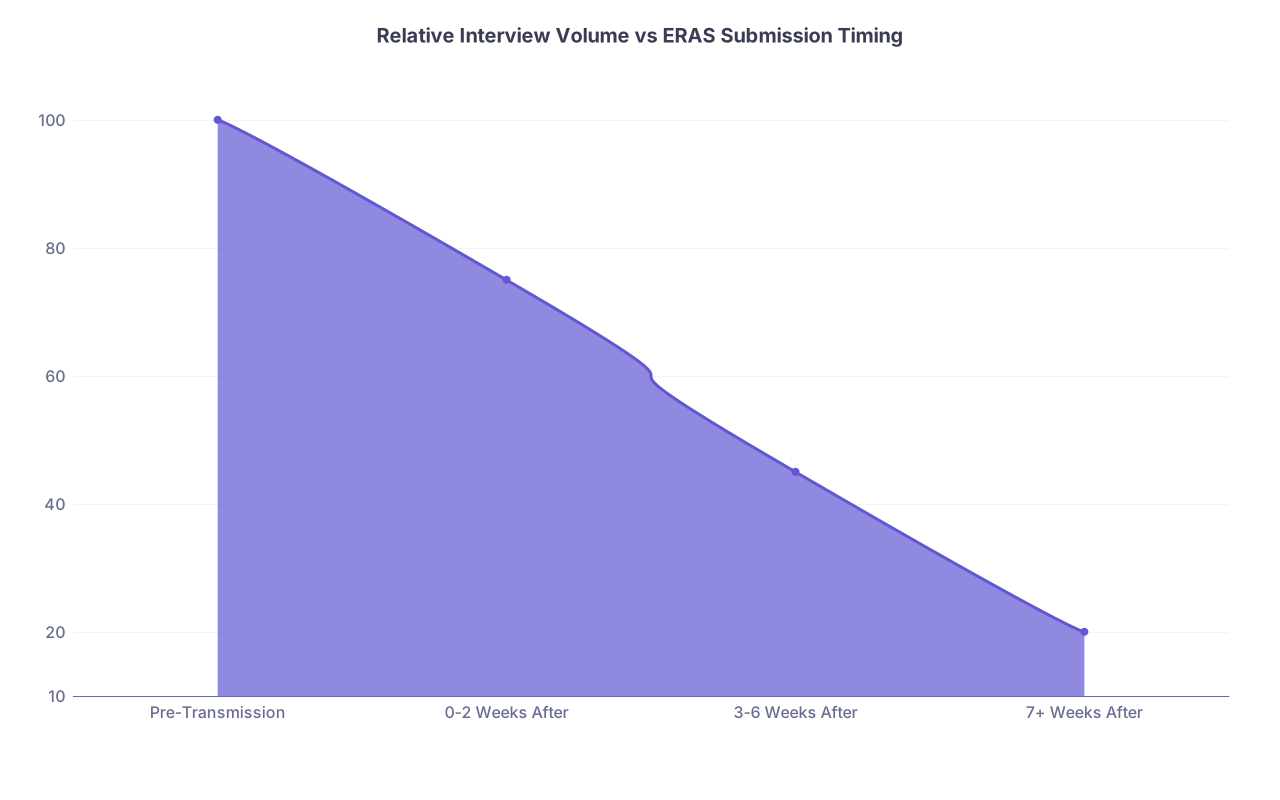
| Category | Value |
|---|---|
| Pre-Transmission | 100 |
| 0-2 Weeks After | 75 |
| 3-6 Weeks After | 45 |
| 7+ Weeks After | 20 |
This is not exact, but it captures the pattern I keep seeing in real cycles: ** a gentle slope inside the on‑time window, then a steep drop once you are late.**
10. So, Does Early vs. Mid‑September Change Match Odds?
If you force me to give a binary answer for the specific comparison you posed—early vs. mid‑September ERAS submissions—here it is:
- If both submissions result in a complete application before programs begin serious review and before or right at transmission, the difference in Match odds is negligible for most applicants.
Submitting five days earlier will not rescue a weak application. Submitting five days later will not sink a strong one.
Where you should absolutely care about timing:
- Do not drift into the “programs are already sending 50–70% of their invites” phase before your file is complete.
- If you are not a top‑tier applicant, assume that 3–4+ weeks after program transmission is a materially worse position.
- If you must delay, do it in exchange for something measurably valuable (a clear score bump, a crucial letter), not for cosmetic tweaks to wording in your personal statement.
Final Takeaways
- Early‑September vs mid‑September, within the pre‑transmission window, does not meaningfully change Match odds for most applicants; “on time vs late” is the real divide.
- Interview opportunity decays sharply weeks after programs start reviewing, not days within the on‑time window.
- Use timing strategically: submit early enough to be in the first major review batch, but delay briefly only when it buys you a significant, numeric upgrade in your application signal.