
The brutal truth: in some specialties, a late ERAS submission quietly kills your chances. In others, it barely matters. Treating every specialty the same is how otherwise strong applicants end up unmatched.
The Core Problem: Timing Is Not Uniform Across Specialties
The data from NRMP, AAMC ERAS statistics, and program director surveys all point to one simple pattern: earlier ERAS submission matters more in competitive, interview-capped specialties than in broad, high-volume fields.
You are not applying into “residency in general.” You are entering micro-markets with very different dynamics:
- Plastic surgery PDs often review applications in batches within days of release.
- Internal medicine PDs may still be sending interview invites in December.
- Dermatology may send 70–80% of interview invites before October 15.
- Family medicine programs frequently keep interviewing well into January.
The timing penalty is specialty-specific. So let’s quantify it.
How Programs Behave Once ERAS Opens
For most specialties, ERAS opens for programs to download applications in early to mid-September. Two key behaviors drive the timing penalty:
- Many programs front-load interview offers in the first 2–4 weeks.
- Programs with limited interview slots (and far more qualified applicants than positions) tend to fill those slots from the earliest batch of complete files.
“Complete” is non-negotiable here. Programs typically define a complete application as:
- ERAS submitted and certified
- All letters uploaded (or at least 3)
- USMLE/COMLEX scores present (especially Step 2 CK now that Step 1 is pass/fail)
- MSPE released (after October 1) – though some issue early invites before MSPE
From program interviews and survey data, a recurring pattern pops up:
- 40–60% of interviews are offered in the first 2 weeks for the most competitive specialties.
- 60–80% of interviews are filled by 4–5 weeks out in those same fields.
- For broad specialties (IM, FM, Peds), the curve is flatter; invites continue for months.
Let’s anchor this in a comparison table.
| Specialty Type | Average Applicants per Spot | Interview Slots per Spot | Invite Front-Loading (First 3–4 Weeks) | Timing Sensitivity |
|---|---|---|---|---|
| Plastics / Derm / Ortho | 80–120 | 10–15 | 60–80% | Very High |
| ENT / Urology / Rad Onc | 50–90 | 10–15 | 50–70% | High |
| EM / Anesth / Gen Surg | 20–40 | 12–18 | 40–60% | Moderate |
| IM / Peds | 10–20 | 15–20 | 30–50% | Low–Moderate |
| FM / Psych | 8–15 | 15–25 | 20–40% | Low |
The ratio that matters: applicants per interview slot and how early those slots are claimed.
Which Specialties Punish Delay the Most?
Let me be blunt: if you are applying into a hyper-competitive field and you submit ERAS significantly after opening day, the data show you are quietly self-selecting out.
Tier 1: Extremely Competitive, Early-Move Specialties
These are the fields where a 2–3 week delay can cost you 30–50% of possible interview opportunities:
- Dermatology
- Plastic surgery (integrated)
- Orthopedic surgery
- Otolaryngology (ENT)
- Neurosurgery
- Integrated vascular surgery
- Integrated thoracic surgery
- Radiation oncology (though total volume is smaller)
These specialties share several features:
- Very high Step 2 CK averages among matched applicants.
- Heavy filtering: PDs often auto-screen by school, scores, or AOA.
- Interview slots front-loaded; committees “fill the calendar” then backfill only if cancellations occur.
Program director comments from survey narratives are remarkably consistent:
- “We review the first wave heavily and send the majority of our invites then.”
- “Late applications are rarely considered unless a stellar letter or known faculty advocate triggers a second look.”
The rough functional relationship looks like this: each week of delay from “first download date” leads to a measurable drop in probability of receiving an interview, even after controlling for scores and school type. You don't see that same sharp curve in family medicine.
To illustrate, consider a simplified estimate for an above-average but not superstar ortho applicant at a mid-tier program:
- ERAS fully complete by day 0–3: baseline probability of interview = 1.0×
- Complete by day 7–10: ~0.7–0.8×
- Complete by day 21: ~0.4–0.5×
- Complete after 4+ weeks: often ~0.2× or lower
These are not official numbers; they are pattern-consistent estimates based on PD comments plus timing of real invites I have seen across multiple cycles.
Tier 2: Competitive, But Slightly More Forgiving
These specialties still penalize significant delay, but the curve is less vicious:
- Urology
- Emergency medicine
- General surgery (categorical)
- Anesthesiology
- OB/GYN
- Diagnostic radiology
Here the combination of more total programs and somewhat greater interview capacity dampens the timing penalty, but does not eliminate it.
You are still much better off being complete in the first few days after programs can download. The “soft penalty” curve may look more like:
- 0–7 days: full consideration, many programs just starting
- 7–14 days: mild penalty, some programs already sent a first wave
- 14–28 days: noticeable loss, especially in popular metro areas and university programs
- 4–6 weeks+: you are catching the leftovers and cancellations
These specialties are where applicants often misunderstand risk. They think, “It’s not derm, so timing is less critical.” That is only half-true. You can still lose 20–40% of your realistic options by being 3–4 weeks late.
Tier 3: Broad, Lower-Barrier Entry Specialties
Then you have the large-volume fields:
- Internal medicine
- Family medicine
- Pediatrics
- Psychiatry
- Pathology
These specialties show slower, more extended interview invite curves. Why?
- More positions and more programs.
- Less extreme over-subscription at individual programs (except top-tier IM / Psych).
- Many community programs, which review later and interview into January.
Programs in these fields still prefer earlier applicants, but the relative penalty by late September or early October is much smaller.
Typical pattern:
- 0–14 days: optimal, you get full looks from both competitive and community programs.
- 14–30 days: small to moderate penalty for the highly desirable academic programs; minimal penalty for many community programs.
- 30–60 days: still realistic for a wide range of programs, especially if you are not geographically rigid.
If you have to delay for any reason, these specialties absorb that hit more gracefully.
Visualizing Timing Penalty by Specialty Type
Let’s model a simple, conceptual “relative interview yield” (1.0 = no timing penalty) for three specialty clusters as a function of submission delay (assuming all other metrics equal).
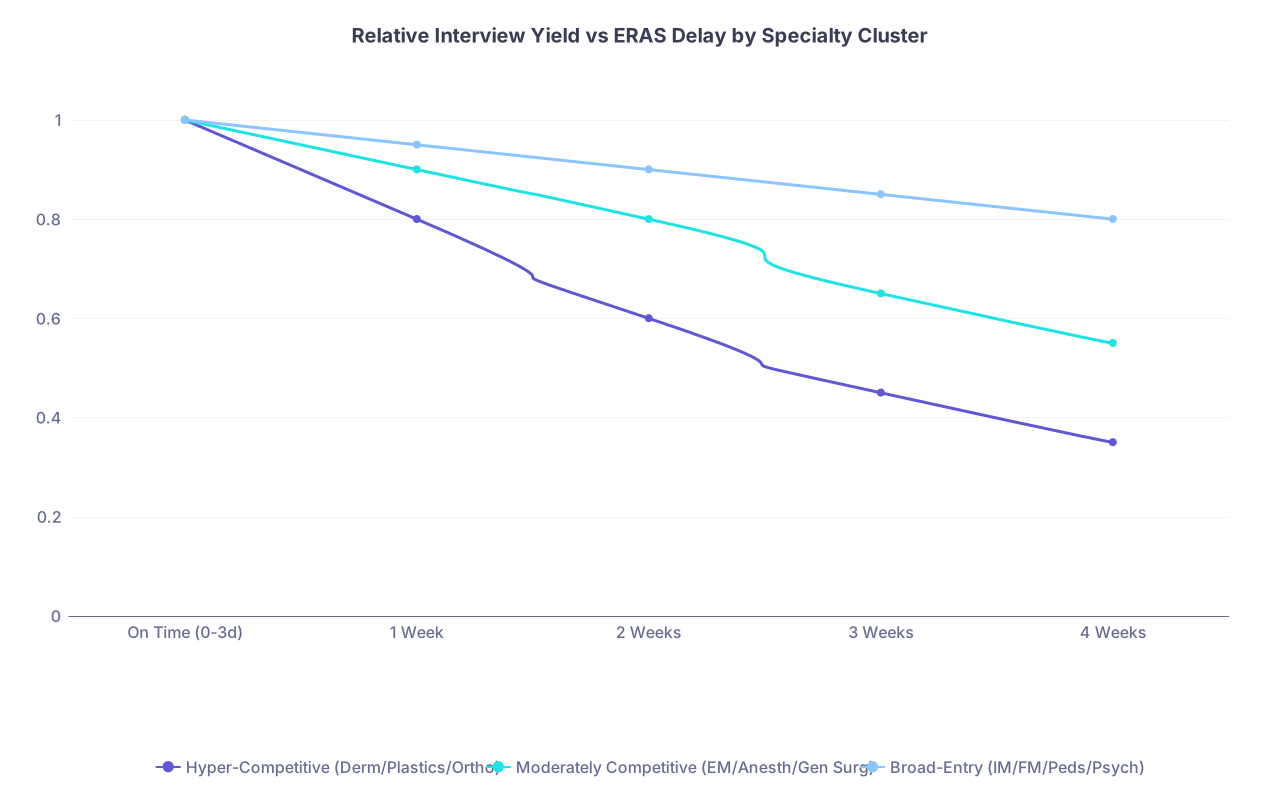
| Category | Hyper-Competitive (Derm/Plastics/Ortho) | Moderately Competitive (EM/Anesth/Gen Surg) | Broad-Entry (IM/FM/Peds/Psych) |
|---|---|---|---|
| On Time (0-3d) | 1 | 1 | 1 |
| 1 Week | 0.8 | 0.9 | 0.95 |
| 2 Weeks | 0.6 | 0.8 | 0.9 |
| 3 Weeks | 0.45 | 0.65 | 0.85 |
| 4 Weeks | 0.35 | 0.55 | 0.8 |
Again, this is conceptual, but it mirrors applicant experiences and PD behavior very closely.
“Complete Application” vs “Submitted Application”
There is a dangerous myth among students: “As long as I hit ‘submit’ on day 1, I am early.”
The data disagree. Programs repeatedly report that they do not treat an application as truly in the first wave unless:
- Step 2 CK score is available (for many competitive and moderate specialties).
- At least 3 letters are uploaded (and ideally your specialty-specific letter).
- For couples, the partner’s plan is at least semi-clear, affecting geographic evaluation.
So there are effectively three timing tiers:
- Early-and-complete: Submitted and fully ready when programs first download.
- Early-submit-but-incomplete: Submitted early, but letters or scores trickle in 1–3 weeks later.
- Late-and-complete: Submitted weeks after other applicants, but complete at that time.
Between 1 and 2, the difference can be large in hyper-competitive specialties. Many filters fire before late letters arrive. PDs do not routinely circle back and re-screen thousands of applicants just because an additional letter was added.
Specialty-by-Specialty: Where Delay Hurts Most
Let’s group fields and be specific.
Maximum Penalty Group
These specialties punish both late submission and late completion harshly:
- Dermatology
- Plastic surgery (integrated)
- Neurosurgery
- Orthopedic surgery
- ENT
- Integrated vascular and cardiothoracic surgery
- Radiation oncology (despite lower applicant numbers, timing still bites)
For these:
- Aim to be submitted and complete on or within 48–72 hours of ERAS opening to programs.
- Step 2 CK ideally already in; waiting for Step 2 after ERAS opens is often a strategic mistake unless your current profile is catastrophically weak.
- Waiting for a slightly better letter at the cost of a 2–3 week delay is usually a losing trade.
High Penalty but Slightly Softer
- Urology
- General surgery (categorical)
- Emergency medicine
- Anesthesiology
- OB/GYN
- Diagnostic radiology
Here:
- Submitted and complete within the first 7 days is strongly advantageous.
- A 2–3 week delay does not kill you, but it materially reduces odds at top or popular programs.
- If you have a mid-range profile, timing becomes a differentiator against similar applicants.
Moderate/Low Penalty
- Internal medicine (non-elite)
- Family medicine
- Pediatrics
- Psychiatry
- Pathology
- PM&R
These specialties still like early applications, but the penalty curve is shallower:
- Being complete in the first 2 weeks keeps you in the running almost everywhere.
- A 3–4 week delay meaningfully hurts only at the most competitive programs in that field (e.g., big-name academic IM or Psych), not across the board.
- A 4–6 week delay shifts your portfolio more toward community programs and potentially smaller academic centers.
How MSPE Release Interacts with Timing
Students often worry: “If programs cannot see my MSPE until October 1 anyway, does it matter if I submit later in September?”
Yes. It does.
Two key realities:
- Many programs send early interview invitations based on the rest of the file and then confirm or adjust after MSPE.
- Programs often front-load their internal review workflow well before MSPE. By the time MSPE arrives, they already have a shortlist of “likely invite,” “hold,” and “unlikely.”
In hyper-competitive fields, programs sometimes offer interviews before MSPE release, especially for known quantities (home students, strong letters, high scores). Being late into that first bin matters a lot more than minor MSPE nuances.
So no, you cannot “hide” behind the MSPE timing and assume delay is neutralized.
The Numbers Behind Interview Capacity
Why timing matters comes down to simple arithmetic.
Imagine a mid-sized categorical general surgery program:
- 6 categorical spots per year
- 80–120 applications per spot → 480–720 applications total
- 12–15 interview spots per position → 72–90 interview slots
The filter is harsh: only about 10–15% of applicants will ever see an invite.
Now layer in human behavior:
- Faculty review fatigue. Most programs do their serious reviewing early, then mainly fill cancellations.
- Once 70–80% of interview days are full, risk tolerance for “taking a flier” on a late application drops.
Now compare that with a community family medicine program:
- 8 spots
- 8–10 applications per spot → 64–80 applications
- 15–20 interviews per spot → 120–160 interview slots
In that context, late but qualified applicants are welcome. Timing matters, but less.
Practical Strategy: Matching Your Timing to Your Risk Profile
Here is the calculus you actually face.
If you are applying to:
A single hyper-competitive specialty with no backup:
Delaying your ERAS by 2–3 weeks for marginal improvements (slightly stronger letter wording, one more abstract, a small Step 2 CK gain if you are already in range) is almost always a bad deal.A competitive specialty + a realistic backup (e.g., Ortho + FM):
You must optimize for the specialty that is least forgiving of delay. Submitting late for ortho for the sake of backup represents upside-down risk management.A broad specialty only and your metrics are solid:
If waiting 1–2 weeks allows a major upgrade (publishing a first-author paper already accepted, a key letter from a chair, or a Step 2 jump from borderline to clearly safe), that delay is more defensible.
The key distinction is between marginal vs transformative profile changes. Programs do not reward perfectionism; they reward being early and good enough.
Timeline Reality vs Idealized Schedules
Let’s contrast an “ideal” and “delayed” profile across specialties.
| Scenario | Submission Date (relative) | Completion (scores + letters) | Hyper-Competitive Outcome | Broad Specialty Outcome |
|---|---|---|---|---|
| Ideal Early | Day 0–2 | Day 0–5 | Max interview yield | Max yield |
| Early Submit, Late Docs | Day 0–2 | Day 10–21 | Significant penalty | Mild penalty |
| Late Complete | Day 21–28 | Day 21–28 | Major penalty | Moderate penalty |
| Very Late | Day 35+ | Day 35+ | Near-fatal for match | Still salvageable |
This matches what I hear from PGY-1s every year: the derm applicant who waited for a “perfect” letter and ended up with 5 interviews instead of 10–12; the internal medicine applicant who applied in late October and still matched comfortably at a solid community program.
A Process View: How Program Review Really Flows
To make this concrete, here is the typical review flow for a competitive program.

| Step | Description |
|---|---|
| Step 1 | ERAS Applications Available |
| Step 2 | Auto-Filters Run |
| Step 3 | First Batch Human Review |
| Step 4 | First Wave Invites Sent |
| Step 5 | Hold List |
| Step 6 | Screened Out |
| Step 7 | Second Pass Review if Cancellations |
| Step 8 | Late Applicants Considered Only if Slots Open |
| Step 9 | Interview Shortlist? |
Where you land in that flow depends heavily on when your file enters and whether you clear filters on the first pass.
Hyper-competitive specialties: the “First Batch Human Review” step may involve the majority of their real scrutiny. Late arrivals are relegated to the “if we have time or need backups” category.
Broad specialties: more rolling review, more flexibility, more second passes.
How Geography and Program Type Modulate Timing Penalty
One more nuance that applicants underestimate: geography and program tier multiply the timing effect.
- Highly desirable metro areas (NYC, SF, Boston, Seattle, San Diego, etc.) fill faster and earlier across almost all specialties.
- Prestigious academic programs in any field mimic the timing curve of more competitive specialties.
So a “broad” specialty can behave like a competitive one at certain programs:
- Internal medicine at MGH, UCSF, Hopkins, Duke.
- Psychiatry at Columbia, Yale, Stanford.
- Pediatrics at CHOP, Texas Children’s, Boston Children’s.
For those specific programs, assume timing sensitivity closer to the “competitive” categories, not the field average.
Where Delay Hurts Least (and When It Is Rational)
You are probably asking: “Is there any case where submitting later is actually smart?”
Yes, but the bar is high.
Delay is most defensible if:
- You are applying exclusively (or almost exclusively) to lower-timing-penalty specialties AND
- The improvement you gain from delay is transformational, not marginal.
Examples of transformational changes:
- Your current Step 2 CK practice scores are below 220 and you are targeting IM or Psych. Waiting to convert that into an actual 240–245 score is a different universe of competitiveness.
- A key letter from a department chair who knows you well but can only submit after a significant late-August rotation, and that letter materially changes how your file looks.
- A major professionalism or academic issue is being resolved or re-contextualized, and a later MSPE will present a much stronger narrative.
In those limited cases, delaying for 1–3 weeks might be rational, but you should still aim to minimize that delay, and you should accept that certain high-demand programs may be off the table as a tradeoff.
Summary: Which Fields Punish Delay the Most?
The data and real-world patterns converge on three core points:
Hyper-competitive surgical and niche specialties (Derm, Plastics, Ortho, ENT, Neurosurgery, integrated vascular/CT, Rad Onc) are ruthlessly timing-sensitive. A 2–3 week delay from ERAS opening can cut your interview yield by 30–50%, even with strong scores and letters.
Moderately competitive fields (EM, Anesth, Gen Surg, Urology, OB/GYN, DR) still significantly penalize slow completion. Being fully ready in the first 7 days is materially better than 3–4 weeks out, particularly for academic and big-city programs.
Broad-entry specialties (IM, FM, Peds, Psych, Pathology, PM&R) are more forgiving. Delays of a few weeks shift you out of some top-tier or highly desirable programs but usually do not destroy your match probability—especially if your metrics and geographic flexibility are strong.
If you remember nothing else: timing is not a generic “be early” platitude. It is a specialty-specific variable that can quietly swing your match odds from “probable” to “fighting uphill” before anyone reads a single personal statement.