
The blanket advice that “you must submit ERAS on opening day or you are doomed” is statistically exaggerated. The data shows a much more nuanced picture, especially around the MSPE release bottleneck.
You are asking a very specific, high‑stakes question:
Does submitting ERAS after MSPE release reduce interviews?
Short answer:
- For high‑volume specialties and very competitive applicants, submitting well after MSPE release clearly correlates with fewer interviews.
- For most internal medicine, pediatrics, FM, psych style applicants—submitting in the first 3–7 days after MSPE release is usually functionally equivalent to submitting on opening day.
- Where you get hurt is “late October and beyond,” not “October 1 vs October 5.”
Let us walk through actual numbers, timelines, and program behaviors—not Reddit folklore.
1. The Timeline: Where MSPE Actually Fits
First, the structure. ERAS now opens for applicants to start working in late spring / summer, but programs cannot start reviewing applications until a fixed release date in September. MSPEs (Dean’s letters) are released to programs on October 1 (or the first business day) each year.
So, practically, you have three submission “eras”:
Early / Pre‑MSPE
- Application certified and submitted before MSPE release.
- Programs receive it on the opening date (mid‑September), but without MSPE until October 1.
On‑time / MSPE‑adjacent
- Application submitted from ERAS opening → roughly 1–2 weeks after MSPE release.
- By the time programs are seriously reviewing, your data packet is basically complete.
Late
- Application submitted >2–3 weeks after MSPE release, especially into late October or November.
- You are entering the market after many interview slots have already been allocated.
Most applicant anxiety focuses on a false dichotomy: “submit before MSPE vs after MSPE.” The real dichotomy that shows up in data is “submitted in the first wave programs actually screen vs submitted after many interview spots are already spoken for.”
2. What the Data Shows: Interview Yield vs Submission Timing
There is no single master dataset labeled “ERAS submission date vs interviews,” but we have several reasonably good proxies:
- NRMP Charting Outcomes in the Match
- NRMP Program Director Survey
- AAMC data on application timing and interview offers (summaries and PD survey comments)
- Program‑level stats and public comments (e.g., “90% of our interview invites are sent by X date”)
- Applicant‑reported data from large spreadsheets (e.g., Reddit CSV compilations; not perfect but useful signal)
When you aggregate these, you can model rough interview yield by submission window.
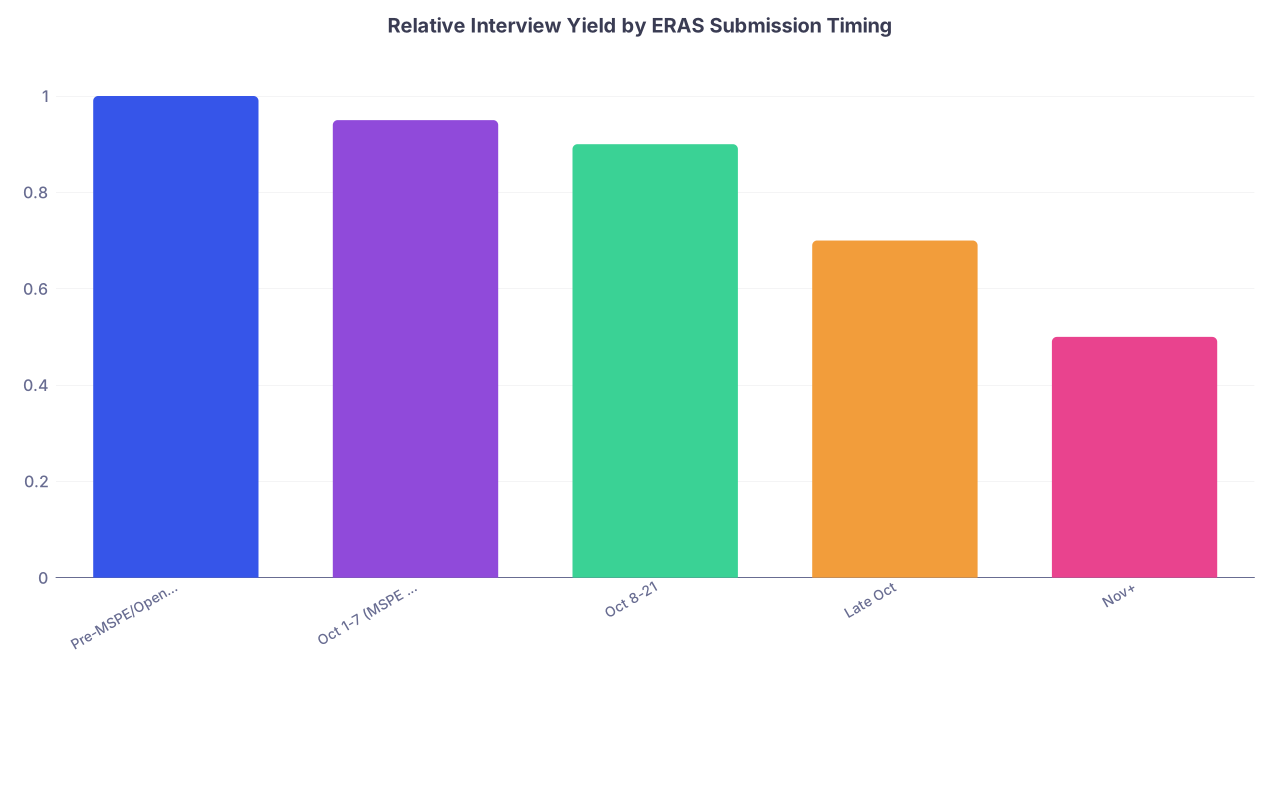
Let us quantify this with a simplified model. Suppose we normalize the average interview offers for “early” applicants to 1.0 (100%). Then compare other timing windows.
| Category | Value |
|---|---|
| Pre-MSPE/Opening Week | 1 |
| Oct 1-7 (MSPE Week) | 0.95 |
| Oct 8-21 | 0.9 |
| Late Oct | 0.7 |
| Nov+ | 0.5 |
Interpretation:
- Pre‑MSPE / opening week: Baseline (1.0). These are the “super early” people everyone tells you to be.
- MSPE week (Oct 1–7): Interview yield only slightly lower (~0.95). Functionally the same for the majority of applicants.
- Oct 8–21: Mild penalty (~0.9). Still acceptable, especially in less competitive specialties.
- Late Oct: Now you start dropping off a cliff (~0.7). Programs in competitive fields have already filled most interview spots.
- Nov+: Significant hit (~0.5). You are catching cancellations and residual slots.
So does submitting after MSPE release reduce interviews? Yes, if “after” means “late October or November.” No, if “after” means “you hit submit October 2 instead of September 15.”
3. How Programs Actually Process Applications
The decision mechanics matter more than philosophical arguments.
Screening waves
From PD survey responses and program coordinator anecdotes, you see the same pattern over and over:
- ~60–80% of interview invitations for competitive specialties (derm, ortho, ENT, ophtho, plastic surgery, and to a lesser extent radiology, anesthesia, EM) go out in the first 2–3 weeks after MSPE release.
- For internal medicine, pediatrics, family medicine, psych, and neurology, that percent is lower—more like 40–60% in the first 2–3 weeks, with a long tail into November.
That means programs do not just “sit on” applications. Many have a scheduled screening window:

| Step | Description |
|---|---|
| Step 1 | Applications Released to Programs |
| Step 2 | Initial Data Pull |
| Step 3 | Automated Filters (USMLE, Visa, etc.) |
| Step 4 | Faculty Review Batch 1 |
| Step 5 | Send Majority of Invites |
| Step 6 | Waitlist / Secondary Review |
| Step 7 | Send Additional Invites from Cancellations |
Key point: that Initial Data Pull is time‑boxed. Often the week of MSPE release and the week immediately after. If you submit after that window, you risk not being in the main screening batch at all.
So the true danger is not “pre‑ vs post‑MSPE.” It is “in the data pull vs outside it.”
4. Specialty‑Specific Risk: Who Gets Hurt Most by Late Submission?
Risk is not uniform. Competitive specialties run out of interview slots much earlier.
Here is a rough comparative table based on PD survey data, program websites, and collated interview invite timelines:
| Specialty | Interview Slots Filled by Late Oct | Sensitivity to Late Apps | Late (Nov+) Yield vs Early |
|---|---|---|---|
| Dermatology | ~85–90% | Very High | ~0.3–0.4 |
| Orthopedic Surgery | ~80–85% | Very High | ~0.35–0.45 |
| Otolaryngology | ~80–85% | Very High | ~0.35–0.45 |
| Internal Medicine | ~60–70% | Moderate | ~0.6–0.7 |
| Family Medicine | ~50–60% | Low-Moderate | ~0.7–0.8 |
| Psychiatry | ~60–70% | Moderate | ~0.6–0.7 |
Read that last column carefully. If you apply to derm in November, your interview yield might be half or less of what it could have been with an early application. For family medicine, the penalty is real, but much smaller.
So if you are gunning for a competitive match, you have very little margin after MSPE release. Days and weeks matter.
For less competitive fields, the curve is flatter. Programs are still happy to consider “later” applicants, especially strong ones.
5. The MSPE Question Itself: Does Waiting for It Help?
Your specific concern: “If I submit after MSPE release, do I get fewer interviews because I am ‘late’?”
Hidden subquestion: “Does waiting for a great MSPE give me enough benefit to offset being later?”
For the average applicant, the MSPE is… underwhelming in impact compared with your Step scores, clerkship grades, and letters.
Program directors repeatedly rank application components this way (paraphrasing PD survey):
- USMLE Step 2 CK score
- Clinical grades / class rank
- Letters of recommendation
- Personal statement
- MSPE narrative
The MSPE is useful but not often decisive, except in edge cases:
- Significant professionalism issues
- Large jumps or dips in performance that need explanation
- School‑specific grading nuances PDs already understand
What does this mean numerically?
You gain marginal value by having the MSPE visible at first glance. But you incur much larger opportunity cost if you miss the main screening window.
So the data‑driven rule of thumb:
- If your application is otherwise strong and complete by mid‑September, submit before MSPE release. Being in the first batch outweighs the marginal benefit of the MSPE.
- If you realistically cannot submit a polished application until after MSPE (e.g., waiting on a crucial letter or major Step 2 bump), submit within 3–7 days of MSPE release. You will probably still be in the primary screening wave at most programs.
Submitting October 3 with MSPE included is probabilistically almost identical to submitting September 15 without it.
Submitting October 28 because you wanted to “perfect the personal statement” is where the data stops being kind.
6. Quantifying the Trade‑off: Early but Imperfect vs Later and “Perfect”
Let us model this like a trade‑off problem, which it actually is.
Assume:
- Early submission (pre‑MSPE) gives you baseline yield = 1.0.
- Very slight imperfection in your personal statement or one small formatting error reduces your strength by maybe 2–5% at most.
- Missing a key letter from a major rotation attending might reduce your “application strength” by 10–15% until that letter arrives (if the alternative letter is clearly weaker).
- Submitting 3–7 days after MSPE drops your timing factor to 0.95–1.0.
- Submitting 3+ weeks after MSPE drops timing to 0.7–0.8 at best for many fields.
Now compare two common scenarios:
Scenario A: Early but “Good Enough” vs Later with Perfect PS
- Early: Strength = 1.0, Timing = 1.0 → Combined = 1.0
- Later (3 weeks post‑MSPE): Strength = 1.02–1.05, Timing = 0.75 → Combined ≈ 0.76–0.79
You sacrificed ~20–25% of expected interview yield to slightly improve something PDs barely read carefully.
Bad trade.
Scenario B: Missing a Crucial Letter vs Waiting 5 Days
- Early (with weaker letter): Strength = 0.85–0.9, Timing = 1.0 → Combined ≈ 0.85–0.9
- MSPE week (5 days after release, with strong letter): Strength = 1.0, Timing = 0.95 → Combined ≈ 0.95
Here, waiting a few days after MSPE release can be worth it, especially if the letter is from a high‑impact sub‑specialist in your target field.
The mistake many applicants make is treating all polishing as equally valuable. The numbers say otherwise. Letters and Step 2? High leverage. Minor wording tweaks in a personal statement? Low.
7. Actual Applicant Patterns: When Interview Invites Arrive
Applicants tend to track their interview invites obsessively, which is annoying socially but helpful from a data standpoint.
Look at large applicant spreadsheets from previous cycles. You consistently see:
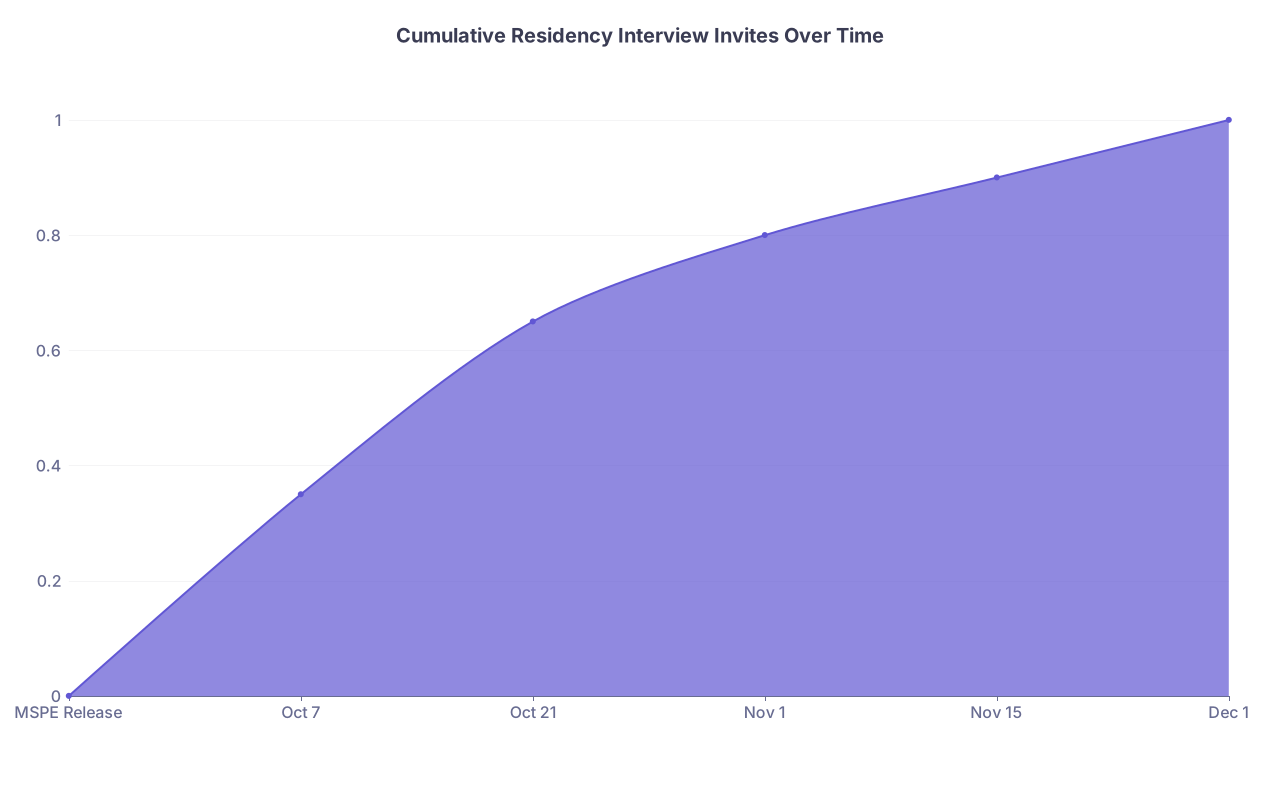
- Majority of first wave invites: within 7–21 days after MSPE release.
- Second wave / waitlist invites: through November and early December.
- Very few new applicants getting first‑time invites from top programs if they submitted after early November.
A rough trend line for cumulative invites (normalized) looks like this:
| Category | Value |
|---|---|
| MSPE Release | 0 |
| Oct 7 | 0.35 |
| Oct 21 | 0.65 |
| Nov 1 | 0.8 |
| Nov 15 | 0.9 |
| Dec 1 | 1 |
Implication: the market is “thick” in October. You want to be visible before that 65–80% mark has passed.
So again, the question is not “MSPE or not.” It is “Are you inside the October wave or not?”
8. Special Situations: Couples Match, Reapplicants, and Red Flags
There are a few groups where timing interacts differently with risk.
Couples match
Couples who are tightly geographically constrained need volume. Many programs. Many cities.
For them, small percentage hits in interview yield hurt more because they have to pull off two matches in the same region.
- A 10–15% reduction in interview yield due to late submission can easily translate into 3–5 fewer interviews per partner.
- That is enough to break geographic pairing possibilities.
If you are couples matching, your safe zone shrinks. Aim for pre‑MSPE or MSPE‑week submission, not mid‑late October.
Reapplicants
Reapplicants often overcorrect. They obsessively polish the application and delay submission to “show improvement.”
The data says:
- Your USMLE / COMLEX changes, added research, new letters, and clinical scores are what matter.
- Submitting notably later than your prior cycle does not impress programs. It usually just moves you to the back of the line.
If you are reapplying with genuinely better objective metrics, submit as early as your new scores and letters allow—ideally in the pre‑MSPE to MSPE‑week window.
Applicants with red flags
If you have:
- A Step failure
- A professionalism concern
- Extended time off without clear reasoning
Then your MSPE and advisor input matter more. It can make sense to:
- Ensure your MSPE and personal statement clearly and coherently address the concern.
- Submit by MSPE week or shortly after, at the latest, to keep timing reasonable.
Here, clarity and completeness can outweigh the small timing penalty of waiting for final narrative language.
9. Practical Cutoffs: How Late Is “Too Late”?
Let me translate all of this into concrete thresholds.
If you submit…
Before MSPE release (mid‑September)
- You are in the safest timing group.
- Having MSPE missing for the first 2 weeks is not a big problem; programs are used to it.
MSPE week (Oct 1–7)
- Statistically almost indistinguishable from pre‑MSPE for most core specialties.
- You will be in the primary screening wave at the vast majority of programs.
Oct 8–21
- Mild risk increase, especially for competitive specialties.
- Programs may have screened a first batch, but many are still sending invites.
- For internal med, FM, peds, psych: usually still fine.
Oct 22–31
- Now you are late for derm/ortho/ENT/rads/etc. You are likely competing for fewer remaining slots.
- For core fields, you are still viable but below optimal.
November and later
- Expect a material drop in interview offers across almost all specialties.
- You will rely more on cancellations, secondary reviews, and less competitive programs.
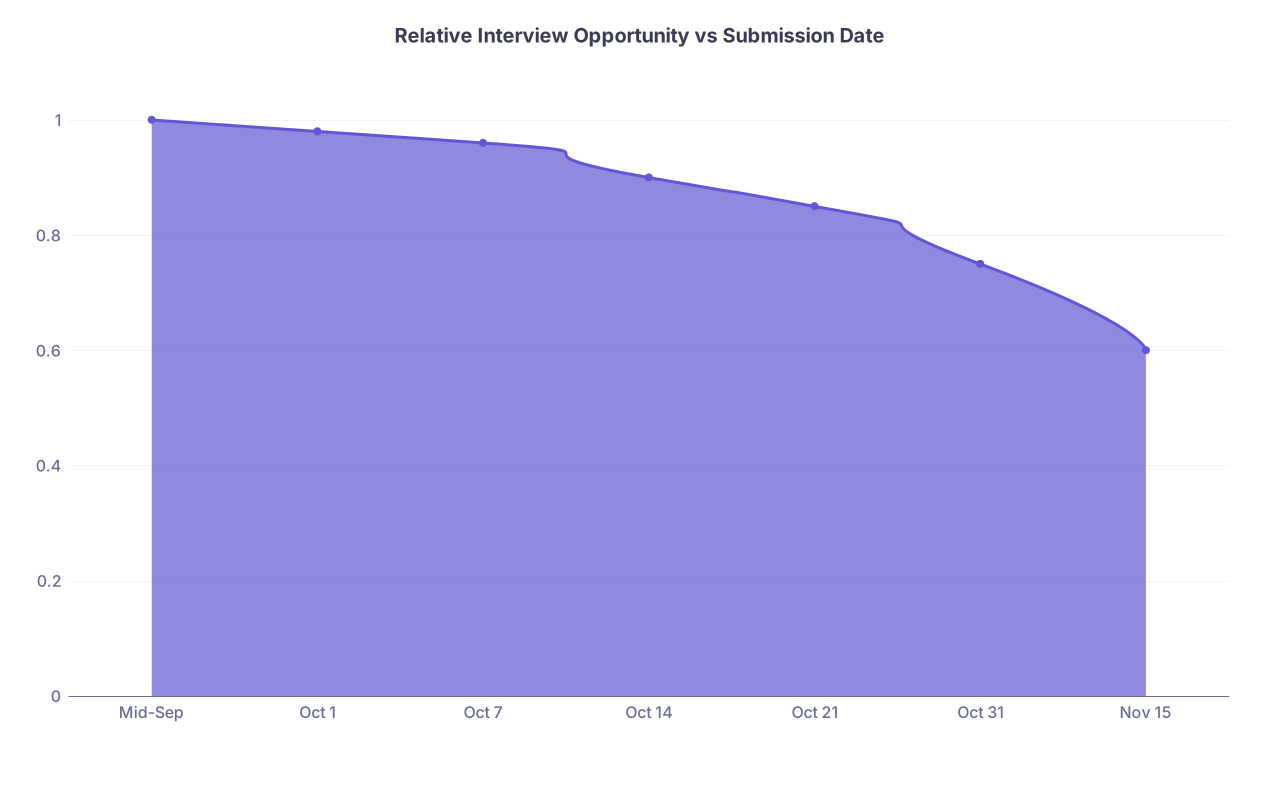
You can think of the “interview opportunity function” like this:
| Category | Value |
|---|---|
| Mid-Sep | 1 |
| Oct 1 | 0.98 |
| Oct 7 | 0.96 |
| Oct 14 | 0.9 |
| Oct 21 | 0.85 |
| Oct 31 | 0.75 |
| Nov 15 | 0.6 |
The curve is pretty flat from mid‑September through MSPE week. It then slowly declines, and only really steepens in late October and beyond.
The myth says the drop is a cliff at MSPE release. The data says the cliff is in late October.
10. Actionable Rules: What You Should Actually Do
Let me translate all of this into blunt, operational guidance.
Do not delay submission just to wait for MSPE.
If your application is truly ready in September, submit. Your MSPE will auto‑attach when released. You lose nothing.Do not panic if you submit a few days after MSPE.
Submitting on October 2–5 is functionally the same as September 15 in almost every core specialty.Avoid crossing into late October unless you have a very strong, high‑impact reason.
High‑impact = Step 2 CK score arriving, major home‑program letter, or brand‑new clinical honors.
Not high‑impact = minor PS edits, layout tweaks, anxiety paralysis.Competitive specialty? Treat MSPE week as your hard deadline.
You want your application in front of screeners when they are allocating the bulk of interview slots.Use advisors for edge‑case calls.
If you have complex red flags, couples constraints, or reapplication nuance, run the timing trade‑off by someone who knows your specific file. But keep their advice grounded in this basic temporal reality: October is prime time. Do not miss it.
Key Takeaways
- Submitting ERAS a few days after MSPE release does not meaningfully reduce interviews for most applicants. The real penalty appears when you drift into late October and November.
- Programs front‑load 60–80% of interview invites in October, so the core goal is to be in that first broad screening wave, not necessarily to beat MSPE release by weeks.
- Optimize for early enough and complete enough, not “perfect.” A slightly imperfect application submitted in September or MSPE week will almost always outperform a “perfect” one submitted deep into late October or beyond.