
Waiting on class rank to submit ERAS is how people quietly wreck their application timing.
You are not going to game this system by waiting for a slightly nicer quartile line on your transcript while everyone else hits submit. Programs do not care that you waited. They care that they saw your file early, could screen it, and could invite you before their calendar filled.
Let me walk you through how to manage this without shooting yourself in the foot.
1. The Hard Truth About ERAS Timing vs Class Rank
Here is the basic problem:
- Class rank / quartile often updates late (August, September, even October).
- ERAS has an opening date (you can start and certify) and a release date (when programs actually receive files).
- Programs front‑load interview invites in the first 2–4 weeks after ERAS files drop.
- Many schools drag their feet on updating MSPE and transcripts.
So you end up thinking:
“Should I wait until my new rank is posted before I certify and submit?”
In almost every case: No. You should not wait.
You submit on time and update later.
The only real question is how to do that without creating a messy, inconsistent application or annoying your dean’s office.
Here is the correct way to think about it:
- Timing beats tiny improvements.
A move from 3rd to 2nd quartile is not worth losing early review. - ERAS is built to accept updates.
Programs expect updated transcripts and MSPEs; they are used to it. - Your job is to lock in everything you control early and then layer updates on top as they arrive.
We will set this up step by step.
2. The ERAS Timeline You Should Actually Be Using
You cannot manage class rank updates if you do not understand the real ERAS calendar.
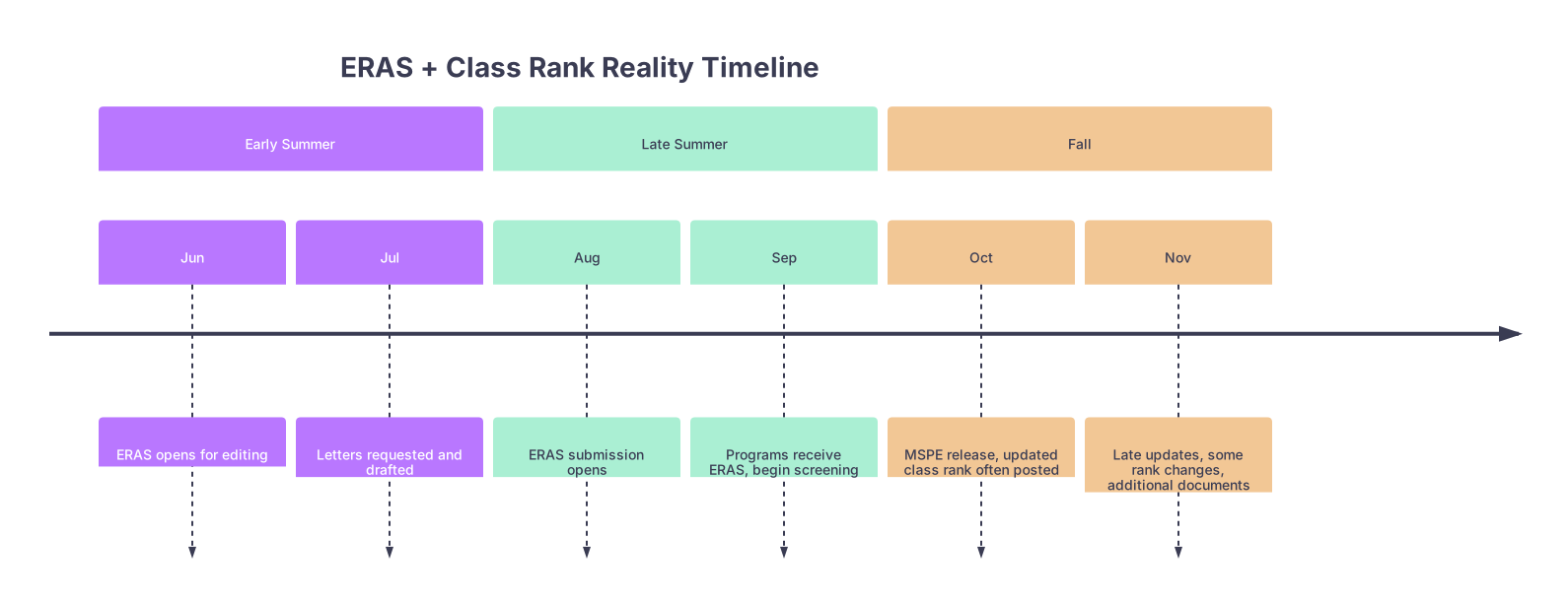
| Period | Event |
|---|---|
| Early Summer - Jun | ERAS opens for editing |
| Early Summer - Jul | Letters requested and drafted |
| Late Summer - Aug | ERAS submission opens |
| Late Summer - Sep | Programs receive ERAS, begin screening |
| Fall - Oct | MSPE release, updated class rank often posted |
| Fall - Nov | Late updates, some rank changes, additional documents |
Now map this to what matters:
June–July
- Build your ERAS core (experiences, personal statement, program list draft).
- Request letters of recommendation.
- Confirm with your school:
- When will the transcript be updated?
- When will class rank / quartile be finalized?
- When is the MSPE lock date?
August (submission window opens)
- Goal: have ERAS certified and submitted near the opening date, even if your class rank is not updated yet.
- Your LORs can still be incoming. That is normal.
September (programs get applications)
- This is prime screening time.
- You want your application already in the queue.
October (MSPE release)
- This is when many programs take a second, deeper look.
- Updated MSPE = updated rank usually shows up here.
- You can still send additional updates if rank changes again (rare but happens).
If your school tells you: “We will not have updated rank until late October,” then you stop trying to time your ERAS to that data. You plan to submit without it and then rely on MSPE + optional update emails to reflect any changes.
3. Decision Framework: Submit Now or Wait?
Here is the blunt framework I use when advising students.

Step 1: Pin down the actual rank update date
Email or call your dean’s office. Do not guess.
Ask specifically:
- “When will my official class rank/quartile be updated on the transcript?”
- “Will that same rank be reflected in the MSPE that goes to programs on October 1?”
- “If rank updates after the MSPE is finalized, do you issue an addendum or updated letter?”
Write down those answers. They drive everything.
Step 2: Compare that to ERAS milestones
Now line that up with ERAS:
| Scenario | Rank Update Timing | Recommended ERAS Strategy |
|---|---|---|
| A | Before ERAS submission window | Wait for updated transcript, then submit early in window |
| B | Between ERAS submission and MSPE release | Submit ERAS on time, update transcript when available |
| C | At or after MSPE release (Oct+) | Submit ERAS on time, rely on MSPE + separate update |
| D | Unclear / “We don’t know” | Plan for worst (late), submit ERAS on time, update later |
Step 3: Decide based on your competitiveness
This is where people overthink.
You should consider delaying submission only if all three are true:
- You are right on a cutoff threshold (e.g., borderline top 25% or AOA).
- Your school can give you the exact date before programs receive ERAS.
- Waiting would delay you by only a few days, not weeks.
Examples where delaying a few days might make sense:
- Your dean’s office says:
“New quartiles will post on August 28. ERAS applications release on September 5.”
You can reasonably wait for the updated transcript and then submit on Aug 28–29 and still be early. - You are currently 3rd quartile but have confirmed strong upward trajectory, and your school historically bumps many students into 2nd quartile with final grades, and they have given you a firm early update date.
Everyone else?
You submit early and accept that your class rank in the initial transcript may lag.
I have watched far too many students “wait for the new transcript” and end up submitting 2–3 weeks after their peers. That is not subtle. Programs notice.
4. How to Submit ERAS Early and Still Use New Class Rank
The smart play is simple: chop this into phases.
Phase 1: Submit a complete-enough ERAS on time
Your ERAS should be application-ready even without the final rank:
- All experiences and descriptions polished.
- Personal statement final.
- Program list at least 80–90% set.
- At least 2–3 letters assigned for core specialties (more for competitive fields).
- Transcript uploaded, even if it has old rank.
Then you certify and submit as soon as the window opens (or within a few days).
Your application status for programs: “ready to review.”
This is what matters for screening.
Phase 2: Update as new information posts
You use three levers:
Updated Transcript
- Once the new transcript with updated rank is available, you:
- Ask the dean’s office to upload the new version to ERAS.
- Programs automatically see the new file in the ERAS Documents section.
- You do not need to re-submit ERAS; it updates passively.
- Once the new transcript with updated rank is available, you:
MSPE (released Oct 1)
- Confirm your MSPE draft reflects updated rank.
- If it does, that is your “official” rank in most program directors’ eyes.
- Programs generally read MSPE after initial screening, especially for borderline or waitlist decisions.
Targeted Update Email (use sparingly)
- If your rank improved substantially (for example, 3rd → 1st quartile, or you became AOA), you can send a brief, professional update to a limited set of programs.
- This matters more for:
- Highly competitive specialties (Derm, Ortho, ENT, etc.)
- Reach programs where every point of differentiation helps.
You do not spam 60 programs with “FYI my rank bumped slightly.”
Use judgment.
5. How Much Does Small Movement in Class Rank Actually Matter?
Let me be blunt: people massively overestimate the impact of small rank shifts.
Here is roughly how programs react to different scenarios.
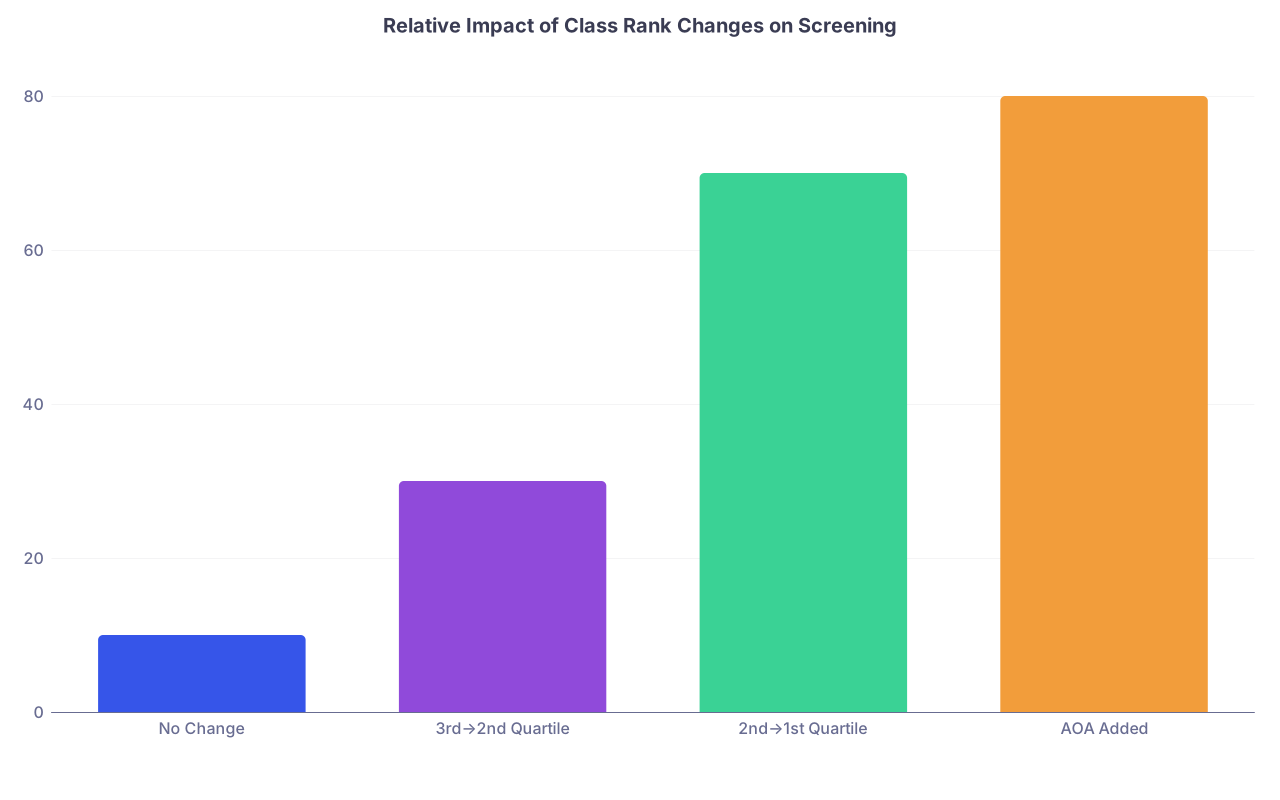
| Category | Value |
|---|---|
| No Change | 10 |
| 3rd→2nd Quartile | 30 |
| 2nd→1st Quartile | 70 |
| AOA Added | 80 |
(Think of these numbers as relative influence, not percent chances.)
More detail:
No change / minor shift within quartile
- Programs do not care.
- They are not scanning for “moved from 68th to 62nd percentile.”
3rd → 2nd quartile
- Mild improvement.
- Helps some students at some programs, but rarely flips an application from “no” to “yes” by itself.
- Nice, but not worth missing early review.
2nd → 1st quartile
- This can help in academic / competitive programs.
- Add this as an update, especially if your Step scores and clinical grades are strong.
AOA / Special Honors added
- This is worth pushing out as an update for most specialties.
- It is a binary checkbox in many PDs’ minds.
The key point: time of submission is a global factor; rank tweaks are marginal factors.
You do not sacrifice global for marginal.
6. Concrete Protocols for Different Applicant Types
Let us talk scenarios. These are real patterns I see every year.
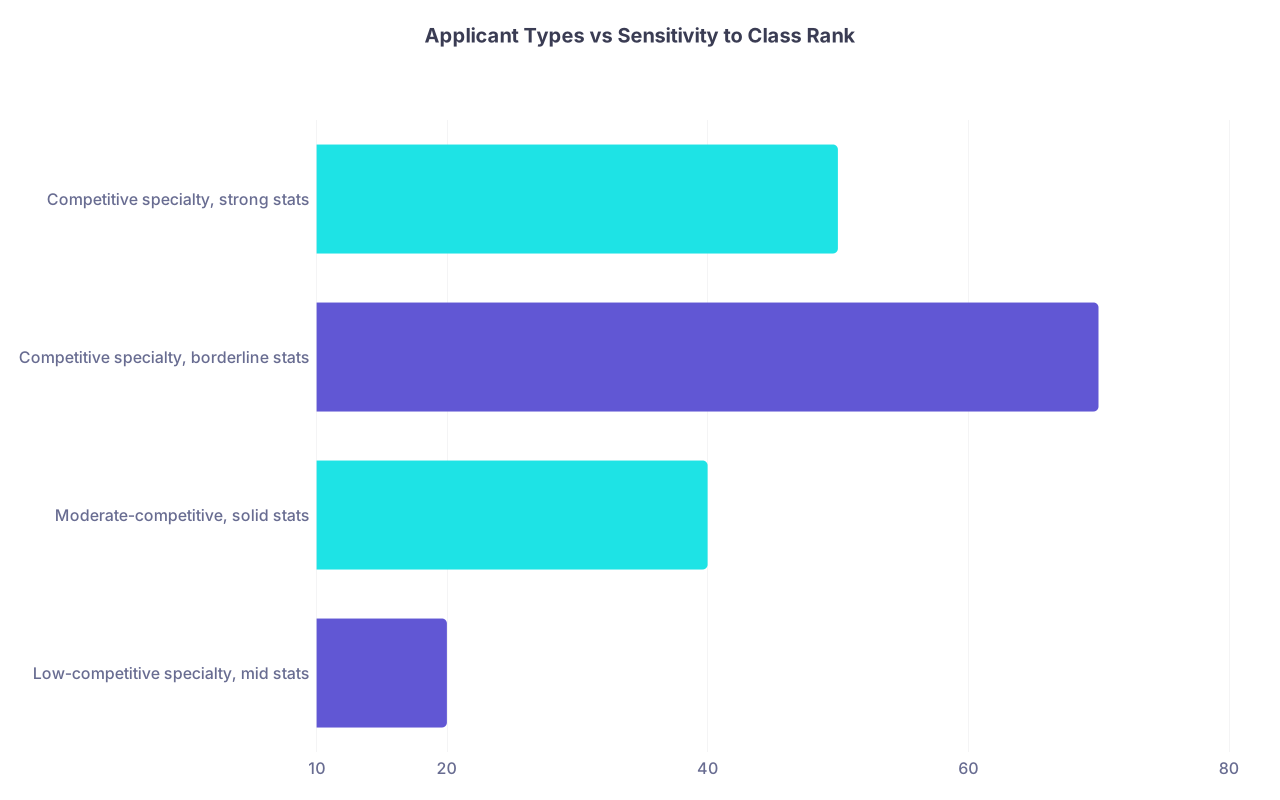
| Category | Value |
|---|---|
| Low-competitive specialty, mid stats | 20 |
| Moderate-competitive, solid stats | 40 |
| Competitive specialty, borderline stats | 70 |
| Competitive specialty, strong stats | 50 |
Scenario 1: Primary care / less competitive specialty, average stats
Example: FM, IM (community), Peds, Psych, Pathology, PM&R.
- You are in 2nd or 3rd quartile currently.
- You expect maybe a small bump, but nothing dramatic.
Protocol:
- Submit ERAS as early as possible in the window.
- Do not wait for rank changes.
- When transcript updates, let the school upload it.
- Skip update emails unless there is a huge shift or a major honor.
Your energy is better spent:
- Tailoring program signals / preference signals correctly.
- Improving personal statements.
- Practicing interviews.
Scenario 2: Mid‑competitive specialty, solid stats
Example: IM (academic), Anesthesia, EM (varies by year), OB/GYN, Radiology.
- You are currently in 2nd quartile, strong clinical grades, decent Step scores.
- Your school says rank will update late August.
Protocol:
- If the rank update is before applications release to programs:
- Wait for updated transcript by a few days.
- Submit immediately after it posts (still early).
- If it is after release:
- Submit ERAS early anyway.
- Let transcript update when available.
- Confirm MSPE uses updated rank.
- Do not send mass update emails.
Consider 5–10 targeted updates if you jump to 1st quartile.
Scenario 3: Highly competitive specialty, borderline stats
Example: Derm, Ortho, ENT, Plastic, Urology, Neurosurgery.
- You are sitting at 3rd quartile with strong Step but weaker preclinical.
- Your dean warns that rank may or may not move up.
Protocol:
- Assume worst‑case: rank will not change in your favor.
- Submit ERAS on time; do not delay more than a couple days.
- Work with your dean to:
- Maximize MSPE narrative (strong rotations, strong sub‑Is).
- Highlight trend: “Improved significantly in clinical years…”
- If your rank actually jumps significantly:
- Ask for:
- Updated transcript.
- MSPE addendum if MSPE was already locked (some schools will).
- Send very carefully chosen update emails to top 5–10 programs only.
- Ask for:
Here, timing and letters are usually more important than rank movements. Programs in these fields read faculty comments and sub‑I performance obsessively.
Scenario 4: Highly competitive specialty, already strong stats
- You are in 1st quartile already or clearly will be.
- You are AOA or very likely to be.
- You are tempted to wait until all honors are officially printed.
Protocol:
- Submit ERAS as early as possible.
- When AOA / new rank is final:
- Get updated transcript + MSPE with AOA noted.
- Send short updates to your true reach programs:
- Example: “Writing with a brief update: I was recently elected to AOA…”
That is it. 3–4 sentences max.
- Example: “Writing with a brief update: I was recently elected to AOA…”
Do not strategically delay to have “perfect” documents. Your application is already strong. You gain more from being in the first review waves.
7. Exactly What to Say and Do When Rank Updates Late
Here is the script and workflow when your rank updates after you already submitted.

Step-by-step workflow
Confirm the change is visible on an official document.
- Updated transcript or MSPE.
- Do not send updates based on rumor, hallway conversations, or “I think I’m top 25% now.”
Ask your dean’s office:
- “Has the updated transcript been uploaded to ERAS?”
- “Does my MSPE reflect my final rank / honors?”
- “Do you recommend I send any separate updates to programs, or will the MSPE + transcript be sufficient?”
Decide if an email is justified.
Email update is justified if:- Rank change is big: 3rd → 1st quartile, or newly AOA.
- You are applying to competitive programs that truly care about tiny academic differences.
- You have not already spammed programs with low‑value updates.
Draft a 3–5 sentence email like this:
Subject: Application Update – [Your Name], [Specialty]
Dear Dr. [Program Director Last Name] and the [Program Name] Selection Committee,
I am writing with a brief update to my ERAS application. Following the release of our final third-year grades, my medical school has updated my class rank to the [top X% / first quartile], which is now reflected on my official transcript and MSPE.
I remain very interested in [Program Name] and would be honored to be considered for an interview.
Sincerely,
[Your Name], [Med School], AAMC ID: [XXXXX]
No fluff. No “I hope this email finds you well” paragraphs. They do not have time.
- Send only to a curated list.
- Top-choice academic programs.
- Places you have geographic or personal ties.
- Not every single program.
8. Common Mistakes to Avoid
I see the same self‑inflicted wounds every year.

Mistake 1: Delaying certification by weeks “to wait for the new transcript”
You gain very little and lose first‑wave review. Programs will not re‑sort their list because your rank nudged up.
Mistake 2: Over‑updating programs
If you send:
- One email for Step 2 score.
- Another for class rank.
- Another for AOA election.
- Another for a poster abstract.
You look disorganized and high-maintenance. Bundle updates when possible.
Mistake 3: Inconsistent documents
You do not want this situation:
- Transcript says “3rd quartile.”
- MSPE says “2nd quartile.”
- Personal statement mentions being “in the top 25%.”
Fix this:
- Once final rank is known, standardize all references.
- If older documents conflict, address it briefly in an update or have your dean clarify in MSPE.
Mistake 4: Hoping rank will rescue a weak application
If your Step, clinical grades, and letters are mediocre, jumping from 3rd → 2nd quartile by itself will not transform your chances. You should focus on:
- Realistic program list breadth.
- Strong, specialty‑specific letters.
- Solid Step 2 score (if not yet reported).
Rank is one line item, not the headline.
9. Quick, Practical Checklist
You want something you can literally run down on a Sunday and know you are on track.
| Step | Task | Timing |
|---|---|---|
| 1 | Confirm rank update + MSPE dates with school | Early summer |
| 2 | Finalize ERAS core (experiences, PS, program list) | By late July |
| 3 | Submit ERAS near opening of submission window | August |
| 4 | Ensure transcript uploaded, even if rank old | At submission |
| 5 | When rank updates, upload new transcript via school | As soon as available |
| 6 | Verify MSPE reflects final rank | Before Oct 1 |
| 7 | Decide on targeted program updates (if major change) | Oct–Nov |
Tape that to your wall if you have to.
FAQ (Exactly 4 Questions)
1. If my rank updates after I submit ERAS but before programs download applications, should I un-certify and re-certify?
No. There is no practical benefit. Once you certify and submit, you do not un‑do it. Your school can upload the updated transcript, and programs will see the new document in ERAS. The key is that your application itself is in the system early; documents can and do update behind it.
2. My school does not publish numeric class rank, only quartiles. Should I mention my percentile in my personal statement anyway?
Do not invent a more precise rank than your school officially uses. If they say “second quartile,” use that language only. Do not claim “top 30%” unless that phrase appears in an official document such as your MSPE. Programs get suspicious when the application text and school documents do not match.
3. What if my rank goes down after a final update? Do I need to tell programs?
If your transcript and/or MSPE already show the new, lower rank, you do not need a separate “confession” email. Programs will see it. Do not draw extra attention to it. Your energy is far better spent preparing strong interviews and ensuring your letters and Step 2 score help balance the narrative.
4. For couples matching, should both partners wait on rank updates so we can submit together?
No. Couples should prioritize both applications being in early, not synchronized to the same hour or day. Submit each application when it is individually ready and early in the window. Rank updates can be handled independently via transcripts and MSPEs. Matching as a couple is driven far more by program lists and interview overlap than by the exact date you hit “submit” together.
Key takeaways:
- Early ERAS submission almost always beats waiting for a slightly better class rank.
- Use ERAS the way it was designed: submit on time, then let transcripts, MSPE, and selective updates carry later rank changes.
- Reserve emails and “updates” for genuinely meaningful shifts (big quartile jump, AOA), and keep them short, specific, and professional.