
The worst ERAS mistake for dual applicants is not “being late.” It is being on time for the wrong specialty.
Let me break this down specifically. The calendar is not neutral when you are applying to a competitive primary specialty and a “backup” field. The timing that optimizes your shot at dermatology, ortho, plastics, ENT, neurosurgery—pick your poison—can quietly sabotage your chances in internal medicine, prelim surgery, psych or FM if you get it wrong. Or vice versa.
This is not about vibes. It is about how different specialties actually review, filter, and schedule interviews across September–January, and how your file looks on their screen when you are clearly hedging.
I am going to treat you like a serious applicant who already knows the basics of ERAS and NRMP. You want to know: When do I submit? Which programs see what? When do I send signals? How do I protect my primary specialty while having a real, not fantasy, backup plan?
1. The Ground Rules of ERAS Timing That Dual Applicants Ignore
First, anchor the non-negotiables. These are the things you do not get to “strategy” your way around.
ERAS timing fundamentals
Every cycle, the exact dates shift a bit, but the structure is stable:
- ERAS opens for applicants: mid–late June
- You can start working on it, upload documents, ask for letters, etc.
- Program access to applications: usually sometime in September (programs receive all submitted apps at once on the “release” date)
- MSPE release: October 1
- Rank list deadline: late February
- Match Day: mid-March
From a timing perspective for dual applications, the key fact is this:
Programs see the timestamp of when your application was submitted to their program, and they see it relative to their own internal filters and interview scheduling window. They do not care when you "started" ERAS.
The second key fact: many competitive specialties front-load their review and invites into the first 1–2 weeks after ERAS release. Backup specialties spread invites out longer, but their earliest invite waves heavily favor applicants who were in the first batch they saw.
So “I will apply to my backup in October if my primary looks weak” is usually magical thinking.
Single vs dual submission timing
Three basic patterns I see:
- Primary and backup both submitted on ERAS release day.
- Primary submitted on release day, backup filed 1–3 weeks later.
- Primary submitted on release day, backup delayed until October or later “if needed.”
Pattern 3 is usually a trap. By the time you “know” your primary is not working out (first or second week of October), a large portion of early interview spots in your backup field are already spoken for at desirable programs, and your file arrives flagged as late and possibly unfocused.
You need to decide your dual-application strategy before ERAS opens to programs, not reactively after you get disappointed by the first invite wave.
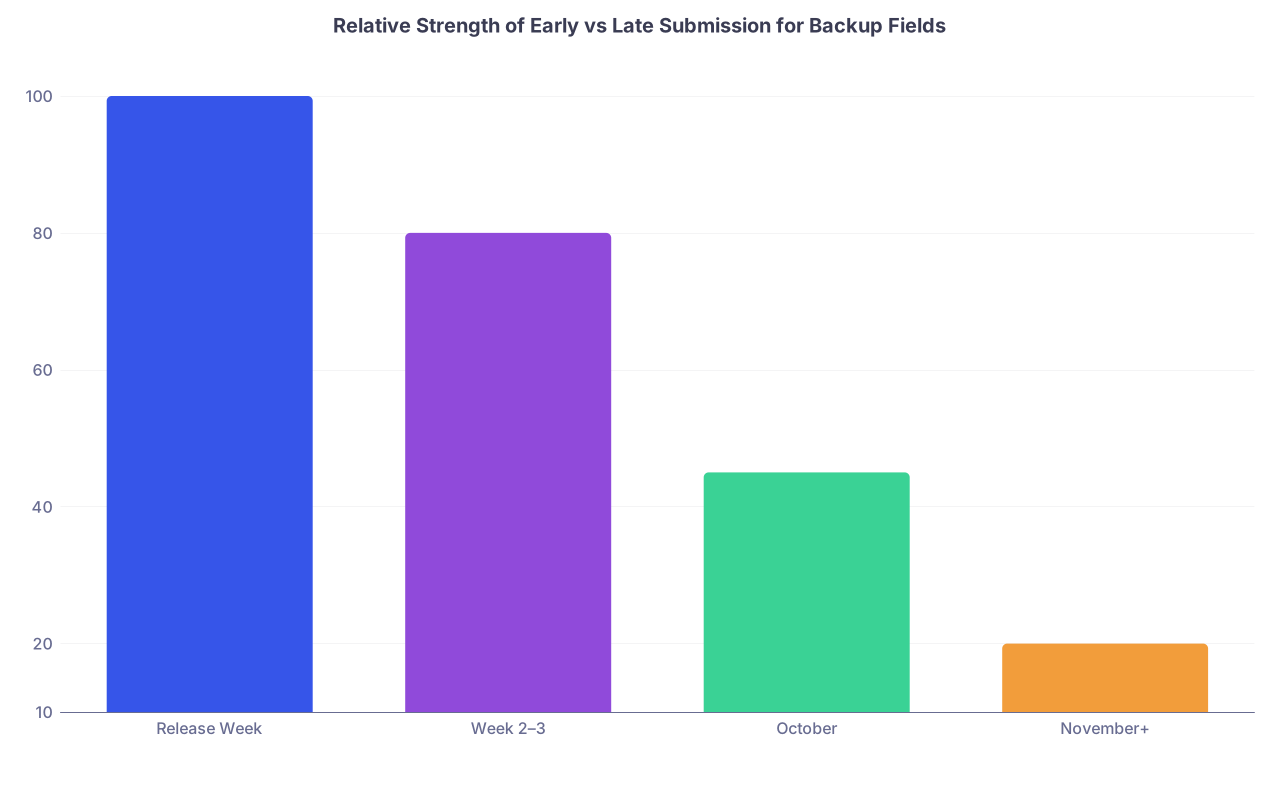
| Category | Value |
|---|---|
| Release Week | 100 |
| Week 2–3 | 80 |
| October | 45 |
| November+ | 20 |
The numbers here are not literal percentages, but they reflect how interview yield typically drops off with later submission for backup fields at solid academic or well-regarded community programs.
2. How Different Specialties Actually Behave (So You Can Time Around Them)
You cannot fine-tune timing without understanding the culture and mechanics of the fields you are dealing with.
Competitive “early-move” specialties
Think: Dermatology, Orthopedic Surgery, Plastic Surgery, Otolaryngology, Neurosurgery, Integrated Vascular, some Radiology spots, etc.
Common patterns:
- Heavy filter use (Step 1/2 CK, clerkship grades, AOA, home-rotations, research)
- Many invites released in the first 7–10 days after ERAS opens to programs.
- Strong weight on signals (when applicable), home/away letters, and evidence of genuine specialty commitment.
- They expect your ERAS to scream: “This is my primary identity.”
If you are dual-applying from any of these, you have to accept one hard truth:
Your ERAS and your life have to look like you are fully committed to the competitive specialty, while quietly preserving an escape hatch.
Trying to look “balanced” on ERAS to reassure your backup field will usually just weaken you in the competitive field. And they are the ones with no mercy.
Backup fields and how they read dual applicants
Common backup fields:
- Internal Medicine (categorical and prelim)
- Transitional Year
- Psychiatry
- Family Medicine
- Pediatrics
- Anesthesia (for some surgical applicants)
- Neurology (occasionally)
These programs differ in how paranoid they are about being your Plan B.
Internal medicine at a university hospital with multiple fellowship pipelines? They know a lot of people using them as a backup for derm, cards pathways, etc. They care, but they tolerate some dual-application behavior if your metrics are strong and your story is coherent.
Family medicine community program? They often want lifers. If your file screams, “I was at an ortho research year until yesterday,” it can be a problem.
Psychiatry right now is in an awkward middle: competitive enough that they do not want to be blatantly used as a garbage bin for burned-out surgical applicants, but not so overrun that they can ignore late or dual apps entirely.
You have to calibrate your messaging accordingly.

3. Primary-First, Backup-Ready: The Core Timing Strategy
Now the part you actually care about: how to time things so you give your primary specialty every possible advantage without tanking your backup.
Step 1: Lock your primary specialty strategy by July
By July, you should know:
- Primary specialty
- Whether it uses signals, early commitments, or supplements (e.g., PD letters, specialty-specific forms)
- How competitive you are realistically (not based on your friends’ opinions, but on actual data and specialty charts)
Then decide: are you a “dual applicant from Day 1” or a “primary-only unless evidence forces me”?
My bias: if you are in a high-risk zone for your primary (borderline scores, light research in derm/rads, no home program in your chosen surgical field, or mid/low-tier school with no strong departmental support), you dual-apply from the start, but you do it cleverly.
| Profile Feature | Primary-Only Reasonable | Immediate Dual-Apply Wise |
|---|---|---|
| Step 2 CK | ≥ 250 primary competitive, strong letters | < 240 for derm/rads/ortho/ENT/plastics |
| Research | Multiple first-author specialty pubs | Minimal or no specialty research |
| Home Program | Strong home program with advocates | No home program in that specialty |
| School Tier | Top 40 with strong match history | Lower-tier or new school |
| Clinical Honors | Mostly Honors in core clerkships | Mixed HP/P, questionable narratives |
If you are on the right half of this table for 2+ rows, you should not wait until October to discover you “need” a backup.
Step 2: Submit primary and backup ERAS applications at or extremely near release
You do not delay the backup to October. You time it more tightly.
The cleanest play in most cases:
- Aim to submit ERAS to both your primary and backup programs within 24–48 hours of ERAS opening to programs.
- Have all letters, personal statements, and specialty-specific components ready before that date.
This does not mean you send generic slop to your backup. It means you do the work early so you are not improvising when the clock is ticking.
Why not wait to see if you get early interviews in the primary field?
Because real feedback about your competitiveness takes weeks, not days. One early invite or one early silence is not predictive. By the time the pattern is obvious, backup fields have started triaging.
Step 3: Use signals and short lists to protect your primary bet
In specialties with preference signaling (ENT, derm, some others), this is non-negotiable: your signals must be focused on your primary specialty. Do not waste a single derm signal trying to hedge on some borderline derm program “just in case” you go for a backup later. That is nonsense.
Your timing strategy around signaling:
- Rank your signals before you select backup programs.
- Once signals are in, you can intentionally favor backup programs in geographic areas that are underrepresented in your signal list (so your dual status is less obvious to any one local PD clique).
Step 4: Make your backup application quiet, but not late
Here’s what I typically recommend for dual applicants:
- Same submission week for primary and backup, yes.
- Personal statement for backup that is brief, direct, not overcompensating, but genuinely explains your interest.
- Letters of recommendation:
- 2 strong specialty letters for your primary (plus a third if custom).
- 1–2 tailored letters for backup if possible, plus 1 general or medicine letter.
Do not send 3 ortho letters to an internal medicine program. They will see exactly what that is.
Many backup programs accept a mix: 1 field-specific letter, 1 medicine/primary care letter, and 1 “general strong clinical” letter. Structure that ahead of time so timing is clean for both.
4. ERAS Timing by Common Dual-Application Pairings
Let’s get more concrete. The questions I hear tend to cluster around a few repeat pairings.
Ortho / General Surgery / Neurosurgery → Internal Medicine or Prelim / TY
Pattern: Surgical applicant with good but not stellar metrics, unsure if they will land enough interviews.
Timing strategy:
- Submit all surgical applications on ERAS release date.
- If you are clearly high risk (borderline scores, no home program, no big-name letters), you also submit a targeted set of IM and/or prelim/TY applications on release date or within 48 hours.
You do not wait to see what ortho or neurosurg does with you.
For backup in this lane:
- TY and prelim surgery spots fill rapidly and earlier; applying late here is deadly.
- IM categorical has slightly more flexibility but is still front-loaded at strong programs.
How to avoid looking like a pure backup tourist in IM:
- Have at least one genuine IM-oriented letter (from wards, sub-I, or an IM research mentor).
- Personal statement that acknowledges your strong procedural interest, but frames IM honestly: interest in critical care, cardiology, or hospitalist work, not “I am applying here because derm is hard.”
- Programs in regions with fewer surgical programs (e.g., some Midwest community IM programs) are less hypersensitive to you being “really a surgeon.”
Derm / Radiology / Anesthesia → Internal Medicine / Transitional Year
Derm and diagnostic radiology especially are unforgiving on timing. They filter quickly and heavily.
Dual applicants here should:
- Submit both sets of applications on release date. Period.
- Prioritize having at least one medicine or general clinical letter ready by early September, not “I’ll ask in October if derm looks bad.”
Transitional Year timing:
- TY programs often send invites slightly later than categorical IM or FM, but many still start serious review in the first 2–3 weeks after release.
- The best TYs associated with big-name hospitals or strong advanced programs absolutely care about early submission.
A lethal mistake: applying to advanced rads/derm on time, then slapping together a TY list in late October after realizing you need PGY-1 spots. By then, good TY interview slots are half gone.
ENT / Plastics / Neurosurgery → Neurology / IM
Some highly procedural competitive applicants choose Neurology or IM as backup.
Neurology timing historically has been a bit more forgiving, but that is changing with rising interest.
Strategy:
- Same rule: submit primary and backup close to release.
- Make neurology look at least somewhat deliberate:
- Neuro elective or sub-I completed and written up in your experiences.
- One letter from a neurologist or neuro ICU attending.
- If you apply to IM as well, stagger your backup slightly within the same window:
- ENT/Plastics: ERAS release + 0 days.
- Neurology: +1–3 days.
- IM: +3–5 days.
This does not change your actual competitiveness much, but keeps your file from looking like it was sprayed everywhere at 12:01 AM.
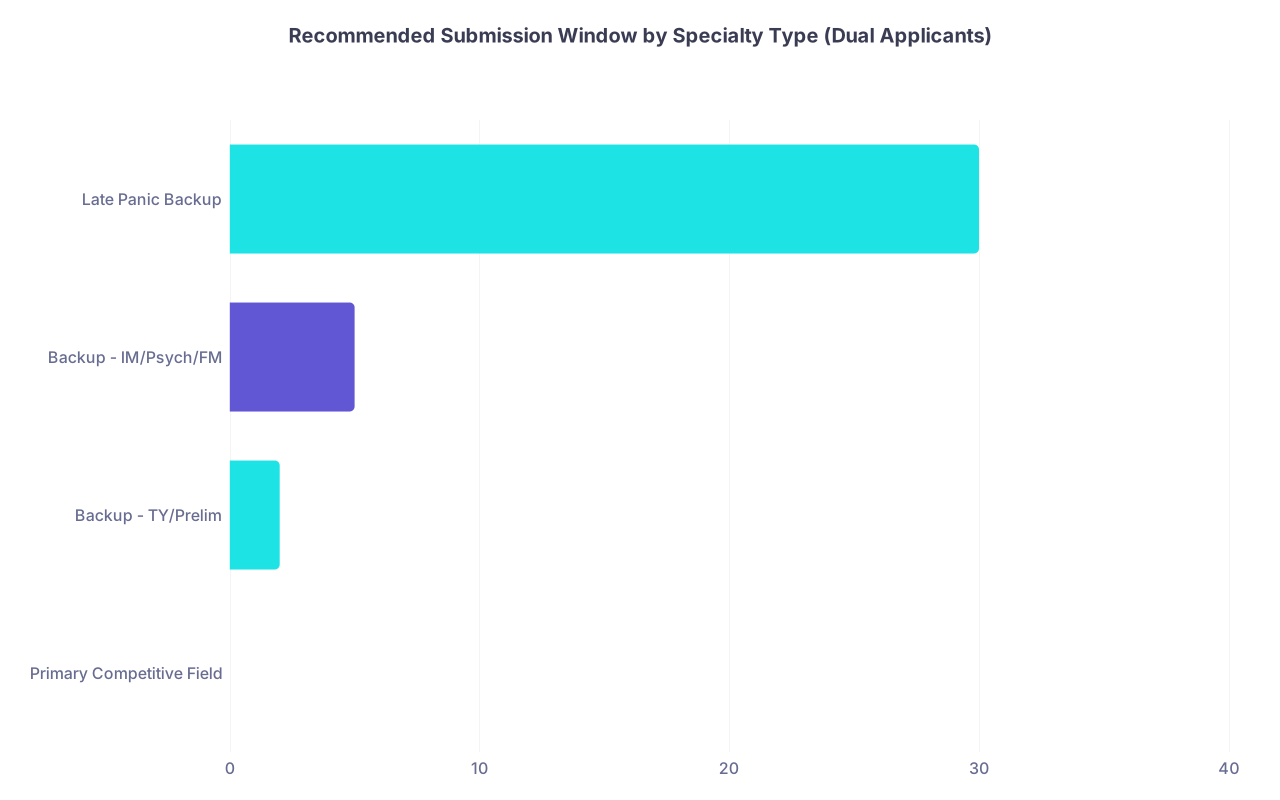
| Category | Value |
|---|---|
| Primary Competitive Field | 0 |
| Backup - TY/Prelim | 2 |
| Backup - IM/Psych/FM | 5 |
| Late Panic Backup | 30 |
Interpretation: Aim for 0–5 days difference from ERAS release for primary and sensible backups. “Panic backup” submissions at 30+ days are handicapped.
Psych / FM / Peds as backup for a competitive field
These fields vary regionally, but timing rules:
- Strong academic psych and some FM programs: early to mid submissions preferred, but they will still consider applicants into October if the rest of the file is good.
- However, if your backup is your only realistic path to a match (e.g., you are a marginal applicant even for that field), you cannot afford to be in the late group.
Dual applicants from ortho → psych, or neurosurg → FM, etc. need to be realistic about fit:
- Submit to these backup programs within the first week of ERAS release.
- Personal statement must not read like a surgical personality trying to cosplay as a community psychiatrist. They will smell it.
5. Letters, Personal Statements, and What Programs Actually See
You cannot talk timing without documents. A “timely” application with obvious placeholder letters or a generic personal statement reads worse than a slightly later but fully mature application.
Letters: order of operations
You want your letters in before ERAS opens to programs, not trickling in during October while PDs are reviewing.
Timing plan:
- By early July: identify all potential letter writers for both primary and backup.
- By early August: request letters from all of them, specifying which specialty(ies) each letter will be used for.
- By early September: follow up to confirm upload status.
For dual applicants:
- Primary specialty: 2–3 strong field-specific letters.
- Backup: at least 1 letter explicitly speaking to that field or to your general clinical performance.
You do not need 6 different letters. You need 4–5 total, tagged and assigned intelligently to programs in each field.
Personal statements: avoid the timestamp trap
ERAS doesn’t show programs when you edited the personal statement, but the content itself can betray panic if you rush a backup PS in October.
Write both:
- Primary specialty PS: polished, detailed, clearly niche.
- Backup PS: clear, mature, not over-emotional, written before the season starts.
Do not:
- Write a backup PS that over-explains your dual application in a dramatic narrative.
- Lie about “always wanting” that backup specialty. PDs talk; they see where else you matched or applied.
A reasonable tone for backup PS timing-wise:
- Explicitly describe early influences that made the backup field intellectually or practically appealing.
- Acknowledge multi-factor interests without sounding like you just got rejected by derm last night.
- Keep it under control—shorter, more focused, less flowery is better.

6. Monitoring Season Progress Without Destroying Your Timing
Dual-application timing is not set-and-forget. You do need to adjust if your primary or backup trajectory looks very different from what you expected.
But your initial timing still has to be aggressive.
The “ERAS release to October 15” reality
Here is how the first month typically unfolds:
- Week 0–1:
- Competitive programs send out first major interview wave.
- Backup fields start acknowledging receipt, sending a few early invites.
- Week 2–3:
- Many mid-tier and community programs review their first pass.
- Declines from early invites open up a second, smaller wave.
- Week 4+ (early October):
- Late reviews, waiting list pulls, some programs realize they under-invited and scramble.
If you submit your backup in mid–October, you are reliant almost entirely on that last group.
Better approach:
- September: you watch patterns—but you do not add a new backup field this late, you simply expand within the same backup field if necessary.
- Early October: if your primary interviews are catastrophically low (e.g., derm with 0 interviews by Oct 10), you increase the number of backup programs and send a brief, professional update email to some where you are particularly interested.
Reasonable vs panicked expansions
Reasonable expansion (timing OK):
- You applied to 40 IM programs on release, got 2 interviews by end of September.
- You expand to 20–30 more IM programs in early October, focusing on slightly lower-tier or more community-leaning places.
Panicked expansion (timing hurts you):
- You applied only to derm until mid-October, got 0 interviews.
- You now apply to 80 psych and 50 FM programs on October 20 with no field-specific letters, generic PS, and your entire ERAS screaming derm.
The second scenario is where timing really kills you. Psych and FM may still fill you, but the cost is enormous: many interviews declined or not offered that would have materialized with a September file.
7. Red Flags PDs See in Dual Applicants—and How Timing Makes Them Worse
Program directors are not naïve. They see dual applications all the time. They tolerate them selectively.
The problem is when your timing amplifies the red flags.
Common red flags:
- Extremely late submission date relative to the specialty norm.
- Letter set entirely misaligned with the specialty (e.g., 3 derm letters for FM).
- Personal statement that feels rushed, generic, or clearly copy-pasted with field names changed.
- ERAS experience section with zero evidence of longstanding interest in the backup field.
Timing intersects with these in two ways:
- Late submission + misaligned docs = “desperation file”
- Early submission + incomplete backup docs = “lazy file”
The sweet spot is:
- Early submission (within first week of release)
- Complete and coherent doc set for both specialties
- Minor asymmetries are acceptable (backup field will understand you did not spend 4 years doing psych research if you were all-in on neurosurg), but the base story must line up.

| Step | Description |
|---|---|
| Step 1 | Decide to Dual Apply |
| Step 2 | Prepare both applications by Aug |
| Step 3 | Primary-only with contingency |
| Step 4 | Submit both within 0-5 days of release |
| Step 5 | Monitor early invites |
| Step 6 | Stay primary-focused |
| Step 7 | Activate pre-planned backup apps |
| Step 8 | Submit backup expansion early Oct |
| Step 9 | High-risk primary? |
| Step 10 | Primary interviews adequate by Oct 1? |
Notice what is missing from this diagram: “Decide to dual apply in late October and hope.” That is not a strategy.
8. The “Fine-Tuning” Moves That Actually Matter
If you want nuance, here is where you put it. Not in delaying submission.
Fine-tuning is about distribution, document assignment, and communication, more than about whether you hit submit on September 6 or September 9.
Specific levers:
Target density:
- Apply more heavily to your primary specialty in regions with multiple programs and a history of taking your school’s graduates.
- Apply more heavily to your backup specialty in regions where your primary specialty is sparse or hyper-competitive, to avoid looking blatantly dual in one small city.
Letter assignment:
- For IM/psych/FM backup: mix 1–2 primary specialty letters that highlight your work ethic and clinical strength, with at least 1 field-appropriate or medicine letter. Time them all to be available before release.
Communication timing:
- If you are very serious about certain backup programs, send brief, thoughtful emails in late September or early October, once your application is complete and before they have exhausted interview slots.
- That is far stronger than rushing in with a brand-new late application.
Interview spreading:
- As invites come, accept broadly early, then later in the season cull your primary/backup mix based on evolving probabilities.
- Your initial early timing gives you options; your interview scheduling choices refine your final path.
Key Takeaways
For dual applicants, the real timing optimization is not “primary now, backup later.” It is submitting both primary and backup within the first week of ERAS release, with documents and letters ready for each.
Competitive specialties front-load their interview offers; backup fields are more forgiving but still disproportionately favor early, coherent applications. Waiting until October to “activate” a backup usually hands away interview seats that would have been yours.
Fine-tuning is about where you apply, how you assign letters, and how you explain your interests—not about delaying backup submission. Early, deliberate, and internally consistent beats late, reactive, and obviously desperate every single time.