
The way most applicants use the ERAS timeline wastes signaling tokens and dilutes their strongest applications.
You are not “submitting early.” You are either aligning with how programs actually review applications—or you are pushing your file into a pile that will not matter. Let me walk through how to use the ERAS calendar, signaling tokens, and application batches like a surgeon uses a scalpel: intentionally, not emotionally.
1. The ERAS Timeline: What Actually Matters (Not What Gets Repeated on Reddit)
First, anchor yourself in the real choke points of the ERAS season. Not the folklore.
Here is the simplified structure for a typical residency cycle (dates shift slightly each year, but the pattern is the same):
- ERAS opens for applicants: mid–June
- Programs become visible to applicants: late June / early July
- ERAS submission opens: early September
- Application transmission to programs (the “batch release”): mid–September
- Program download and initial review: mid–September to late October
- Peak interview invitation wave: October–November
- Second wave / waitlist invites: late November–December
The single most important point for your strategy:
Programs see your application for the first time on the transmission date.
Submissions before that date are all “on-time.” Submissions after that date are late. There is no “super early” advantage within that pre-release window.
So when we talk about “best time to submit ERAS,” we are really talking about:
- Being complete (application + MSPE placeholder + key letters + Step 2 if relevant) by the transmission date.
- Batch-structuring which programs see your file in the first wave versus later waves.
- Aligning signaling token use with that first wave when eyes are fresh and interview slots are wide open.
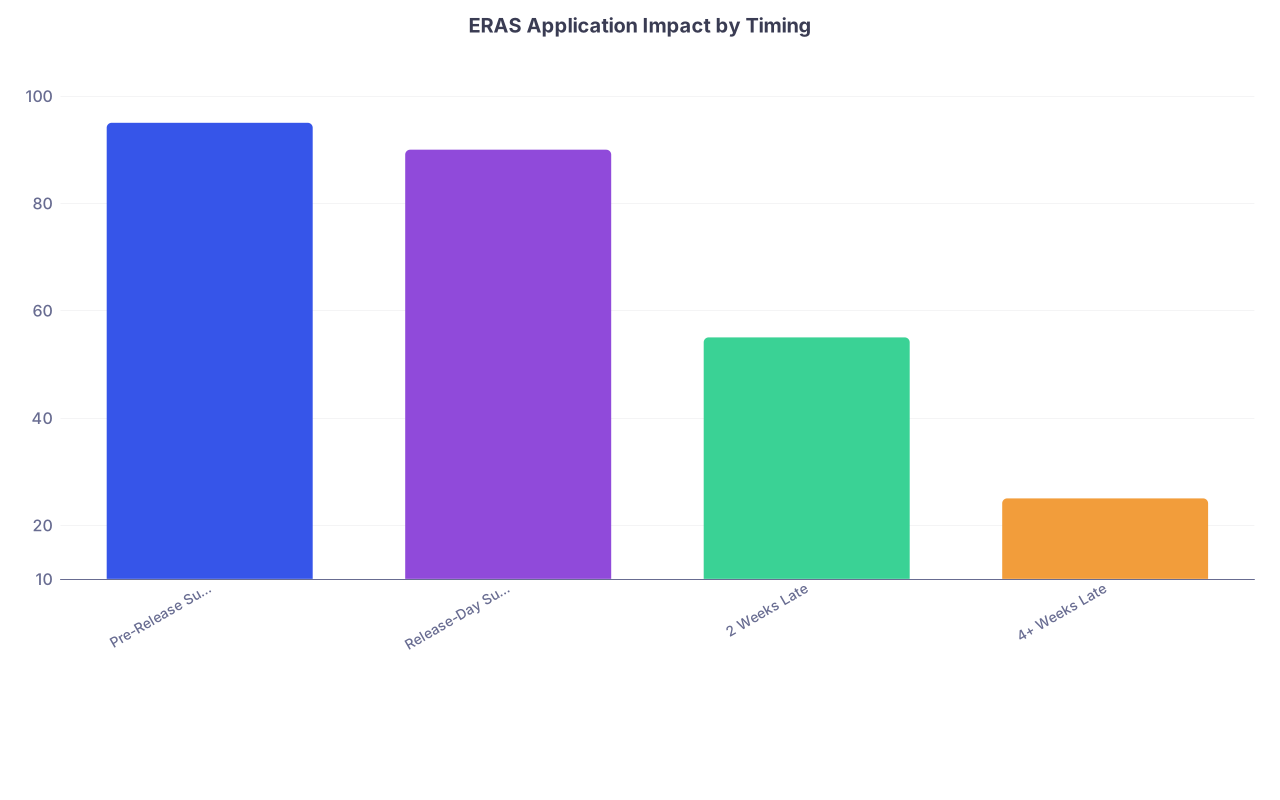
| Category | Value |
|---|---|
| Pre-Release Submitted | 95 |
| Release-Day Submitted | 90 |
| 2 Weeks Late | 55 |
| 4+ Weeks Late | 25 |
Think of those numbers as “relative interview probability,” not absolutes. You want to live in the left two bars.
2. What Signaling Tokens Actually Do (And What They Definitely Do Not)
Signaling tokens are not golden tickets. They are tie-breakers and attention-directors in an environment where programs are drowning in applications.
At most medium to highly competitive programs, the internal conversation sounds like this:
“We have 1,200 ERAS downloads. Our interview cap is 120. Who clearly wants to be here? Start with the signals and our home rotators. Then we will back-fill with strong unsignaled applications.”
So, functionally, program signaling does 3 very specific things:
- It pulls you into the first-pass review queue at that program.
- It gives you a sympathy buffer if one part of your application is borderline for that program (slightly below-average Step 2, fewer publications, etc.).
- It can serve as a positive discriminator among otherwise similar applicants when building the interview list.
What it does not do:
- It does not override hard screens (e.g., “No Step 2 CK score, no review,” or “IMGs only from our affiliate schools”).
- It does not compensate for a catastrophically weak application (multiple Step failures, pervasive professionalism issues).
- It does not guarantee an interview even if you are perfectly qualified.
That means your signaling tokens are most effective when:
- Your base application would probably be reviewed anyway, but you want to move from “maybe” to “likely.”
- You are aiming up a tier—one notch above your “comfortable” range—not wildly out of range.
- You are synchronized with the first program review wave. Signals sent to programs that have already filled 80% of their interviews are heavily devalued.
3. Mapping Timeline to Strategy: When Your File Must Be Ready
The ERAS timeline is fixed. Your readiness is not. That mismatch is where people lose interviews.
Let me spell out the key tension:
Step 2 CK timing, letters of recommendation, and personal statement refinement have to collide with the ERAS transmission date in a controlled way. Otherwise your signaling tokens land on a half-finished file.
Here is how you should think about “application readiness” versus the calendar.
A. By Late July: Skeleton Application and Program List Draft
By the time everyone else is still bragging about finishing their away rotation, you should have:
- Core ERAS entries (education, experiences, honors, publications) drafted.
- Personal statement at solid second-draft level.
- A long list of programs, grouped into:
- “Reach but plausible”
- “Target”
- “Safety / backstop”
- A map of which specialties you are applying to if you are dual applying (IM + Neuro, etc.).
Because the timeline interacts differently with single vs dual applicants, your early planning matters more than people admit.
B. August: Convert Draft into a Weapon
August is where serious applicants separate from “I’ll just see what happens” applicants.
Your August goals:
- Finalize your experiences and descriptions.
- Lock in at least 2 specialty-specific letters, with a realistic plan for a 3rd.
- Decide where signals are going in broad strokes (you can refine specific names later).
- Confirm your Step 2 CK plan:
- If you scored well on Step 1 (when it still had a score) and are in a less competitive field, you can get away with a later Step 2 CK as long as it posts near or before transmission.
- If you need Step 2 CK to “rescue” a marginal Step 1 or you are targeting competitive fields, that score must be in by transmission or very shortly after.
If you are still debating your program list on September 10, you are already on your back foot.
C. Early September to Transmission: Finalization Phase
This window is deceptively dangerous. You will hear people say “Submit the second the system opens!” That is fear talking.
Here is the reality: any submission before the official release date is effectively the same. Programs will not see “who clicked first.”
Your job in that pre-release period is:
- Clean the last typos.
- Confirm letters are uploaded; gently chase any that are not.
- Sanity-check your program list count and distribution.
- Tighten your signaling choices against your final list.
- Batch-structure your submission if you are using waves (we will get to how, specifically).
You are not rewarded for impatience. You are punished for sloppiness.
4. Using Batches: How to Structure First-Wave vs Second-Wave Applications
Here is where people get cute and then burn themselves. Yes, batching can work. No, you should not hold back your best programs “for a separate wave” after the initial release.
The only question that matters: Which programs see my complete application at the first program download?
Every program that you even remotely care about should be in that first-release batch. Period.
Batching is for you, not for gaming program behavior.
Correct reasons to batch:
- To spread out secondary survey responses or supplemental essays (some specialties).
- To control interview scheduling chaos if you apply to a very broad range geographically.
- To sequence your “safety” programs slightly later so you can see early signal from targets and reaches.
Bad reasons to batch:
- Hoping programs in later waves will see you “later in the season when they have more context.”
- Saving signals for a second wave (major mistake in competitive specialties).
- Holding back on programs you are ambivalent about and then panicking when invites are slow.
A simple, functional batch structure:
- Batch 1 (at or before transmission date):
- Every program you signaled.
- Every program you would be genuinely happy to interview with.
- Enough programs to reasonably fill your interview dance card if everything else goes average.
- Batch 2 (1–2 weeks after transmission):
- Extra geographic backups.
- Programs that are lower on your preference list but still acceptable.
- Batch 3 (if needed, 3–4 weeks after transmission):
- Emergency backstop. Community programs, less desirable locations, or prelim-only spots.
Do not create Batch 4, 5, 6. That is just denial converted into Excel.
| Batch | Timing vs Transmission | Program Type Focus |
|---|---|---|
| 1 | On or before release | Signaled + top priorities |
| 2 | +1–2 weeks | Mid-tier / geographic flex |
| 3 | +3–4 weeks | Backups / prelim / safety |
5. Where to Spend Signaling Tokens: Matching Timing to Program Tier
Now the real question you actually care about: How do you combine the timing with token placement so you are not lighting them on fire?
Different specialties have different token counts and structures, but the logic is consistent. Assume something like:
- A small number of “gold” or “program” signals for your main specialty.
- Often a smaller count for a secondary or less-competitive specialty.
Step 1: Define Your Personal Program Tiers (Not Just Doximity Rank)
You are not applying to “top 10” versus “the rest.” You are applying across realistic categories:
- Tier 1: “Reach but real” – your Step 2, research, and letters are slightly below their median, but not absurdly off.
- Tier 2: “On par” – your profile fits the median of their current residents.
- Tier 3: “Comfortable” – you are clearly above the program’s median metrics, or bring something distinctive.
Signals are most valuable into Tier 1 and high Tier 2. Signaling deep Tier 3 places is usually wasteful unless there is a powerful geographic or personal reason.
Step 2: Overlay Timing
Programs differ in how early they send interview invites, but the first wave heavily clusters within the first 2–3 weeks after they download ERAS.
If you send your signal to a program after they have already conducted their main screen, that token is functionally devalued.
So your rule is simple:
All signaled programs must be in your first submission batch, finalized before transmission.
No exceptions. You do not “add a signaled program in October” and expect full utility.
Step 3: Allocate Signals Across Tiers Intentionally
For a typical IM applicant with, say, 18 tokens (example numbers):
- 8–10 signals to Tier 1 “stretch but plausible” programs.
- 6–8 signals to Tier 2 “ideal fit” programs—especially in highly desired locations.
- 0–2 signals to Tier 3 programs where you have a very specific reason (partner’s job, family care, etc.).
For a more competitive specialty with fewer tokens (e.g., 7 signals):
- 4–5 signals to Tier 1.
- 2–3 signals to Tier 2.
- None to Tier 3 unless it is literally your dream program for non-academic reasons.
The subtlety nobody explains: Do not cluster all signals at the same prestige/competitiveness level.
You want a staggered ladder:
- Some very aspirational.
- Some realistic but still strong.
- A couple that are likely to love the attention and convert that into an invite.
That distribution stabilizes your outcomes.
6. Dual Applicants: Timing and Signaling Without Sabotaging Yourself
If you are dual applying (say Neurology + IM, or EM + IM), everything becomes more timing-sensitive.
Typical mistakes I see:
- Submitting the primary specialty on time, delaying the secondary one “to see how things go.”
- Hoarding signals for one field and then panic-applying to the other late, with no signals left.
- Splitting attention so much that neither application is perfected by transmission.
You cannot afford that.
A better framework:
- Decide your priority specialty by July. Not in October after seeing interview numbers.
- Allocate signals so that:
- Priority specialty gets the majority and all are in Batch 1.
- Secondary specialty gets its own designated signals, again in Batch 1 for that specialty.
- Submission timing:
- Both specialties’ applications should be complete and submitted on or before the first transmission date for that season.
- Do not wait to see how priority interviews go before sending the second application. By the time you “realize” you need them, you are a late applicant.

| Step | Description |
|---|---|
| Step 1 | Decide Priority Specialty by July |
| Step 2 | Draft Both Specialty Applications |
| Step 3 | Allocate Signals to Both Fields |
| Step 4 | Complete Letters and PS by Late August |
| Step 5 | Submit Both Before ERAS Release |
| Step 6 | Monitor Interview Flow |
| Step 7 | If Weak in Priority, Lean on Secondary Interviews |
This is emotionally uncomfortable because it feels like you are “planning to fail” in the priority field. In practice, you are buying insurance at the only time the market is open.
7. Aligning Letters, Step Scores, and Timeline With Signal Power
Tokens on a half-baked application are like premium gas in a car with three flat tires.
If you want signals to hit maximum effect on release day, three pieces must be in place:
A. Letters of Recommendation
Programs do not always wait for every single letter to be in before sending interviews, but having at least 2 strong, on-specialty letters uploaded by transmission increases the credibility of your file.
Practical sequence:
- Ask for letters late spring / early summer.
- Give faculty a hard deadline: “I am aiming to submit ERAS by [date before transmission].”
- Track letters in ERAS every week from August onward.
- If a critical letter is not in by one week before transmission, politely escalate (in person, email from coordinator, or choose a backup writer).
Do not hold your entire application hostage for a single “big name” letter that might never arrive. A good, on-time letter beats a famous, missing one.
B. Step 2 CK Timing
This is where the ERAS timeline can hurt you.
If you know you need Step 2 CK to rehabilitate or define your competitiveness, you must schedule it so the score:
- Posts at least 1 week before transmission for maximum safety, or
- At worst, posts within 2–3 weeks after transmission if your Step 1 or prior performance is solid.
If your Step 2 CK will post late October:
- Some programs will screen you out automatically for “incomplete file.”
- Others will put you into a “hold for score” pile, and many early interview spots will be gone by the time that pile is re-reviewed.
Signals attached to an application missing a crucial Step 2 CK when that test is central to their filter? Diminished value.
Be realistic:
- If your Step 2 schedule is unavoidably late, adjust your program list and endurance expectations. Apply slightly broader. Accept that some programs will not seriously look at your file until November.
8. Putting It All Together: A Concrete Month-by-Month Playbook
Let me outline a realistic, aggressive timeline that leverages signaling and batching instead of stumbling into it.
June
- ERAS opens. Register, link MyERAS and relevant services.
- Start filling in education, experiences, and publications in a rough draft form.
- Draft your initial program spreadsheet (location, type, competitiveness, vibe).
- Identify potential letter writers and schedule meetings.
July
- Tighten your personal statement draft to near-final form.
- Meet with letter writers; confirm deadlines.
- Start building a preliminary tiered program list:
- Tier 1 / 2 / 3, as I described earlier.
- Identify signal-worthy programs tentatively, flagged in your spreadsheet.
- Check specialty-specific signaling rules (some fields have centralized systems with different caps).
August
- Lock personal statement and experiences by mid-August.
- Confirm at least 2 core letters submitted or strongly promised.
- Do a serious audit of your program list:
- Is it numerically sufficient?
- Is there a healthy mix of tiers?
- Are there enough geographic or institutional backstops?
- Finalize the set of programs that will receive signals, even if you are still debating 1–2 among them.
- Decide on batching structure:
- Exactly which programs are in Batch 1 (almost all).
- Which lower-tier programs might be shifted to Batch 2 or 3 as insurance.

Early September (Before Release)
- Enter final program selections into ERAS.
- Assign signals to your priority programs.
- Triple-check every field that will be transmitted:
- Personal statement linked correctly.
- Correct letters assigned to each program.
- No obvious omissions (e.g., a major publication left out).
- Submit your application no later than a few days before the official program download date. Not because earlier is “better,” but because any technical issue or late change then still has buffer.
Transmission Week
- Confirm your application shows as “transmitted” to all intended programs.
- Freeze. Do not start tinkering with major changes unless there is a glaring error.
- Watch for any communication about supplemental applications from specific programs or specialties and complete them quickly.
Late September – Early October
- Monitor interview invitations, but do not catastrophize after 5 quiet days.
- If by 2–3 weeks after transmission you are seeing much weaker-than-expected traction:
- Deploy Batch 2 programs (if you held any back).
- Consider whether to modestly increase your program count in slightly safer tiers.
- Do not waste tokens at this point; those ships have sailed. Focus on application breadth, not more signaling.
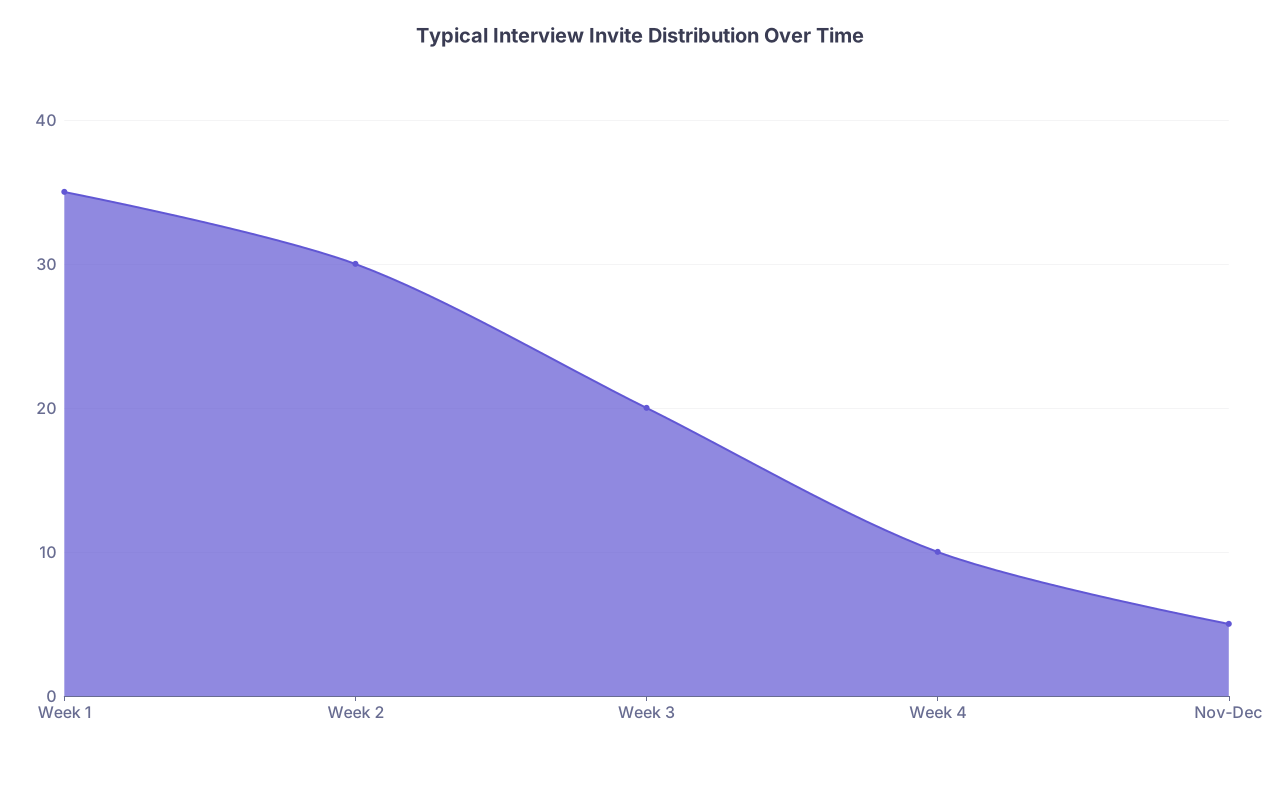
| Category | Value |
|---|---|
| Week 1 | 35 |
| Week 2 | 30 |
| Week 3 | 20 |
| Week 4 | 10 |
| Nov-Dec | 5 |
November – December
- Respond quickly to any second-wave invites.
- If numbers remain low:
- Use Batch 3 (true backups), especially if you under-applied initially.
- Explore prelim-only options or SOAP-minded contingency planning.
At this stage, signaling is done. The game is about maximizing total interviews, not optimizing prestige.
9. Common Myths That Ruin Timing and Token Strategy
Let me call out a few bad ideas I see repeated every cycle.
Myth 1: “I’ll wait to submit until my last letter posts; then my application will be stronger.”
Reality: A complete-but-late file is worse than a slightly incomplete-but-timely file. Programs will still add new letters you assign later. Do not delay transmission waiting for perfection.
Myth 2: “I will save some signals for later once I see who shows interest.”
Reality: Signals exert maximal impact at the first-pass sort. A “late signal” in October is usually behind the primary screen. You are signaling into a nearly locked interview schedule.
Myth 3: “I should submit my top programs in a separate ‘VIP batch.’”
Reality: If they are top programs, they must be in your first wave. Artificially delaying them for “special treatment” means they see your file later than your peers.
Myth 4: “If I submit on the very first hour ERAS opens, programs will be impressed.”
Reality: All applications transmitted by the release date are effectively tied. You gain nothing by racing to be first, and you risk sloppy errors.
Myth 5: “I can fix a weak signaling strategy with just applying to more programs later.”
Reality: Volume cannot fully compensate for poor allocation of early attention. Late-add programs are less likely to yield high-quality interviews, especially at competitive institutions.

10. Final Synthesis: How to Think About This Like a Program Director
If you take nothing else from this, internalize how the calendar looks from the other side of ERAS.
A program director or selection committee member sees:
- A single intimidating download of hundreds to thousands of applications on the release date.
- Limited bandwidth to seriously review a subset.
- A set of crude filters: scores, school, letters, research, geography, signaling.
- A strong need to quickly differentiate “likely good fits” from “probably not worth deeper review.”
Your job is to design your timeline, signaling, and batches so that:
- Your application is present in that first major review wave at every program where you used a signal or have genuine interest.
- Your strongest credentials (Step 2, letters, coherent personal statement) are already visible at that moment.
- Your signals are concentrated in programs where you have a realistic but not guaranteed chance, across a spread of tiers.
- Your later batches exist solely as reinforcement and safety, not as delayed main moves.
That is how you turn the ERAS timeline from a source of anxiety into an asset.
You are not just “submitting early.” You are building a timed release of a curated portfolio into a chaotic selection system. Done right, the timeline works for you. Done reactively, it buries you.
With a clear plan for timing, tokens, and batches, you are ready to move on to the next battlefield: turning those invitations into confident, controlled interview days. But that is a strategy for another round.