
Here's the trap. Your Qbank numbers look good, maybe even great, and that starts to feel like proof. Proof that you're on track. Proof that your study plan is working. Proof that you're "basically ready."
That's how people walk into boards with fake confidence.
I've seen this happen too many times: a resident is sitting on a shiny 78-85% in an old question bank, redoing familiar topics, feeling reassured by upward trends, then gets punched in the mouth by a board-style benchmark. Not because they're lazy. Not because they're incapable. Because they built their plan around the wrong metric.
That mistake has a name: blueprint drift.
Blueprint drift is what happens when your prep tool and the current exam stop testing the same thing in the same way. The topics may sound similar on paper. But the emphasis changes. The vignette structure changes. The "next best step" logic changes. The test starts rewarding updated reasoning while you're still harvesting points from older patterns.
Red flags you're drifting:
- You rely heavily on last year's Qbank trends.
- Your percent correct is rising, but board-style assessments stay flat.
- You're doing lots of familiar questions and very few current benchmark exams.
- You're overweighting Qbank percentages and underweighting calibration.
- Your misses cluster in newer management themes, guideline shifts, or unfamiliar vignette framing.
Don't make this mistake: boards do not reward archived Qbank stats. They reward current competence, flexible reasoning, and execution under test-day conditions. Old percentages can be comforting. Comfort is not readiness.
Define the Two Metrics: "Qbank Good" vs "Board Ready"
These are not the same metric. Treating them like they are is sloppy, and it costs people points.
"Qbank good" usually means things like:
- high percent correct
- solid performance in timed blocks
- improved accuracy over repeated exposure
- visible completion streaks and topic coverage
Useful? Yes. Final answer on readiness? No.
"Board ready" means something different:
- you can handle new item sampling
- you can reason through unfamiliar vignettes
- you perform under real timing pressure
- your knowledge matches the current blueprint
- your results hold up on external, board-style assessments
A Qbank can tell me a few things. It can show whether you're studying consistently. It can suggest baseline competence. It can expose obvious content gaps. It can help train retrieval.
What it cannot do, by itself, is guarantee:
- alignment with the newest exam emphasis
- protection against format shifts
- accurate prediction when item writers change style
- real-world transfer to unfamiliar question wrappers
That's where calibration comes in.
Calibration is the question most people avoid because they're afraid of the answer: Do your good Qbank scores actually translate into strong board-style performance?
If the answer is no, your Qbank score is not a badge of readiness. It's just a study metric.
That distinction matters. A lot.
I've seen residents defend a strong bank percentage like it's courtroom evidence. Then you look at their benchmark and it's mediocre, or worse, falling. That's not bad luck. That's miscalibration. And the worst move after that is doubling down on the same bank trying to "get confidence back."
No. Confidence built on a misaligned metric is dangerous confidence.
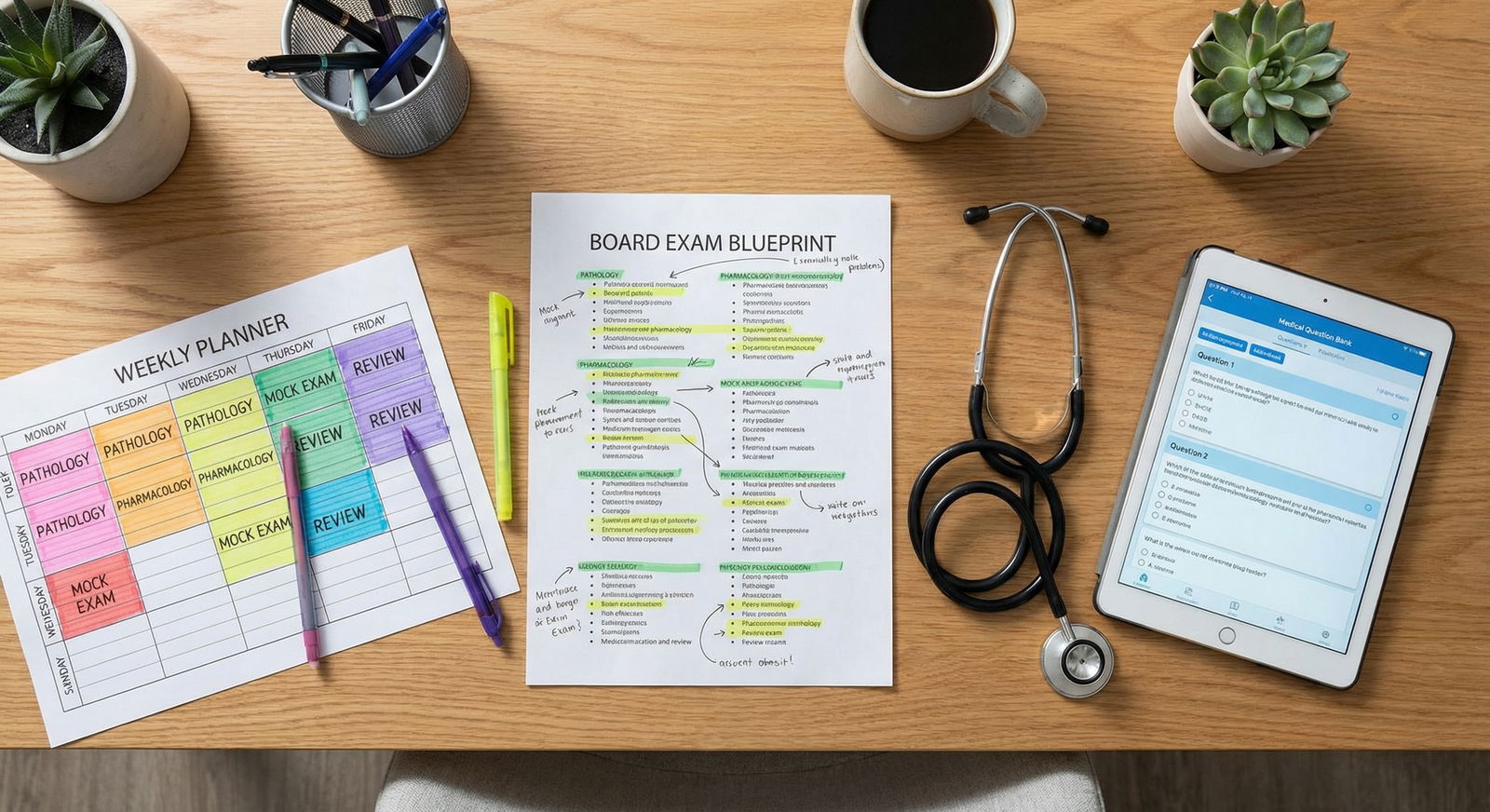
Blueprint Drift: How Content, Emphasis, and Formats Change
Blueprint drift sounds technical, but the idea is simple: the exam moves, and your prep doesn't.
You may be using the same workflow that worked six months ago. Same bank. Same review habits. Same percentages. Meanwhile, the board's content mix and question emphasis have shifted just enough to make your "good performance" less meaningful.
That drift comes from several places:
- Guideline updates. Management pathways change. Screening thresholds change. treatment sequencing changes.
- Item-writing emphasis. The exam may move from diagnosis recognition to management prioritization, or from fact recall to risk stratification.
- Psychometrics and sampling. Boards don't test a fixed packet of favorite topics. They sample constructs differently over time.
- Training-program mismatch. What your institution emphasizes and what the board emphasizes are often not identical.
This is where people get fooled. They say, "But I know the topic." Maybe. But do you know the version of that topic the board currently cares about?
Examples:
- Internal medicine: You memorized the disease and classic findings. Great. But the board wants the management sequence under uncertainty, what to do now, what to do after stabilization, when not to overtest, when escalation is indicated.
- Surgery: You reviewed broad operative facts, but the questions are really about peri-op judgment, contraindications, complications, and next-step decision points.
- Pediatrics: You know the diagnosis list, but the board asks through developmental context, red-flag presentations, dosing safety logic, and parent counseling traps.
That's drift. Same neighborhood. Different target.
Watch for these warning signs:
- Your explanations sound smart, but your accuracy remains weirdly uneven.
- You keep missing questions from recently emphasized clinical themes.
- Your practice set feels familiar, but your benchmark performance says otherwise.
- You're getting better at recognizing old distractors rather than solving new problems.
Here's the ugly truth: a stale Qbank can train you to feel competent without forcing transfer. That is one of the most dangerous forms of studying because it rewards the illusion of mastery.
Why High Qbank Scores Can Still Be Dangerous
High percentages are seductive. They make you feel safe. That's exactly why they're risky.
A high Qbank score may reflect:
- memorized distractors
- repeated exposure to familiar stem patterns
- recognition-based answering
- improvement inside one testing ecosystem only
None of that guarantees transfer.
Boards punish shallow fluency. They ask you to work through uncertainty, not just spot a recycled clue cluster. If your brain is saying, "I've seen this one before," you may be training recall of bank patterns rather than real clinical reasoning.
And don't ignore timing and endurance. Another common mistake.
You do well in 10- or 20-question sets, maybe even untimed, then assume that performance will scale to a full board day. It often doesn't. Stamina matters. Attention drift matters. Decision fatigue matters. The sixth block version of you is not the first block version of you.
Protect yourself with one hard rule: require transfer.
Ask:
- Can I answer a new vignette testing the same concept in a different wrapper?
- Can I explain why the correct answer wins, not just why I recognized it?
- Can I execute under full-length timing pressure?
If not, your high percentage is incomplete evidence. Maybe useful. Definitely not enough.
Board-Aligned Strategy: What to Use Instead of Old Qbank Data
You need a better hierarchy. Here it is:
1. Build a benchmark ladder
Use resources in this order:
- Recent board-aligned assessments
- Targeted practice based on benchmark misses
- Maintenance Qbank practice for reinforcement
That order matters. Don't flip it. The benchmark should tell you what matters now. The Qbank should help you fix it.
2. Use Qbanks for diagnosis, not ego
A Qbank is a tool. Not an oracle.
Use it to answer:
- What topics am I missing?
- Are these misses content, reasoning, timing, or carelessness?
- Can I improve transfer after review?
Do not use it mainly to chase a prettier percentage line.
3. Define alignment clearly
A practice resource is aligned when it reasonably matches:
- topic coverage
- vignette style
- difficulty spread
- current management emphasis
- performance trends seen on external benchmarks
If your bank score improves but those other markers don't, you're optimizing the wrong thing.
4. Use decision rules, not vibes
Here's the protective version:
- If Qbank rises and benchmark rises: keep going.
- If Qbank rises and benchmark stays flat: suspect miscalibration.
- If Qbank rises and benchmark drops: stop. Reassess blueprint alignment immediately.
- If benchmark identifies narrow weak domains: pivot targeted review there before doing random volume.
I'm blunt about this because I've seen the alternative. Residents panic after a disappointing benchmark, then retreat into the comfort of old bank blocks they know they can score well on. That is emotional studying. It feels productive and wastes precious time.
Decision-Making Framework: The 4 Questions to Ask Before You Change Anything
Before you overhaul your study plan, ask these four questions. In order.
1. Is the data recent enough to match the current exam?
If you're anchoring on last-year performance, old blocks, or stale percentages, you're already exposed. Recency matters. A lot.
Ask yourself:
- When was this performance generated?
- Does it reflect the current blueprint or an older one?
- Am I treating outdated data like current evidence?
Old data can inform. It should not dominate.
2. Does my Qbank performance calibrate to board-style benchmarks?
Not "is it high?" Does it correlate?
If you're scoring 80% in the bank but producing mediocre benchmark results, the raw percentage is not your friend. It's noise wrapped in reassurance.
Look for:
- similar domain strengths and weaknesses across tools
- parallel improvement trends
- less divergence over time, not more
3. What is my error taxonomy?
This is where disciplined people separate from tourists.
Sort misses into:
- content gaps, you didn't know it
- reasoning errors, you knew pieces but chose badly
- timing failures, you ran out of space to think
- careless mistakes, misread, clicked fast, skipped qualifiers
If you don't know your error type, your review will be vague and mostly useless.
4. Am I correcting causes or repeating symptoms?
This is the big one.
Bad pattern:
- miss question
- read explanation
- nod
- redo similar question
- feel better
- make same mistake later
Good pattern:
- identify the exact error mechanism
- write the governing principle
- practice a small set of new questions on the same construct
- verify changed performance
Don't just revisit your symptoms. Fix the machinery.
Specialty-Specific Pitfalls: Residency Applicant Patterns That Produce Blueprint Drift
Different fields drift in different ways, but the mistake is the same: confusing topic exposure with testable mastery.
Internal Medicine
Common error: over-focusing on isolated disease facts.
Boards love:
- management sequences
- escalation thresholds
- competing diagnoses under uncertainty
- risk/benefit decisions in medically messy patients
If you only know "what disease this is," you're underprepared.
Surgery
Common error: mistaking breadth for readiness.
You reviewed lots of procedures, anatomy, and trauma facts. Fine. But board questions often lean on:
- peri-operative judgment
- contraindications
- complications
- next best step after something goes wrong
If your prep ignores those pivots, you're studying the surface.
Pediatrics
Common error: memorization without context.
Boards reward:
- developmental framing
- safety logic
- dosing judgment
- recognition of red-flag presentations
If you're memorizing lists but missing why a presentation is dangerous in this age group right now, you're drifting.
Protective fix across specialties: shift from topic coverage volume to construct mastery.
Focus on:
- diagnostic logic
- next-best-step reasoning
- risk stratification
- management sequencing
That's what travels across question wrappers.
What a Healthy Trend Looks Like, and What Doesn't
A healthy trend is not just a higher percentage. That's amateur thinking.
A healthy trend looks like:
- Qbank accuracy improving
- benchmark performance improving too
- repeated error categories shrinking
- less volatility in the same blueprint domains
- better endurance and timing under realistic conditions
Sometimes progress feels worse before it looks better. You may feel slower while learning real reasoning instead of speed-pattern guessing. That's fine, if benchmarks confirm you're improving.
Red flags that should make you intervene:
- Qbank % stays high while recent benchmark scores stagnate
- missed items keep clustering in the same domains
- your review is passive reading rather than corrective repetition
- you're relying more heavily on old bank data because newer assessments make you uncomfortable
That last one is a classic self-protective mistake. Don't hide in familiar data.
When drift is suspected, change cadence:
- reduce dependence on older question-bank trends
- increase recent board-style exposure
- shorten passive review
- intensify targeted corrective practice
That is how you stop feeding the illusion.
Summary
Don't make this common, very fixable mistake: treating old Qbank success like board readiness.
Good bank scores are useful, but they are not sacred. If they stop matching current board-style benchmarks, trust the mismatch. Don't explain it away. Don't protect your feelings with more familiar questions. Don't chase stale percentages because they look pretty.
Your North Star is alignment:
- current blueprint
- current reasoning demands
- current benchmark calibration
And the moment your Qbank performance and benchmark performance split apart, assume blueprint drift or miscalibration until proven otherwise. Then adjust fast. Smarter, not just harder.