
It’s 11:47 p.m. You told yourself you’d do 40 questions today. You did… 12. Half-distracted. Got most of them wrong. Now you’re scrolling through your co-residents’ GroupMe where someone just posted their “hit 2,000 questions!” screenshot like it’s a casual thing and not a full-on panic trigger.
You’re thinking: I’m behind. Again. Everyone else is studying more. I’m going to be the only one who fails.
Let’s talk about that. Because I’ve watched this same exact spiral play out every single year with smart people who end up passing just fine—and also with people who actually were at risk and waited too long to take it seriously.
You’re not crazy for worrying. But your brain is lying to you a little.
First: No, They’re Not All Studying More Than You
Your brain does this annoying thing: it only compares you to the loudest people.
The people who are quietly doing 20–40 questions a day and not posting screenshots? Your brain ignores them. The person bragging about 120 questions after a “chill” day on nights? That one your brain treats as the norm.
Here’s the ugly truth I’ve seen:
- Some people massively exaggerate how much they study.
- Some people do a ton of bad studying (scrolling through explanations half-asleep doesn’t count).
- Some people are doing things that would absolutely break you if you tried to copy them. Because their life, support, and baseline are different.
And then there’s you, sitting there thinking, “If I’m not doing 100+ questions a day, I’m doomed.”
You’re not doomed. But you do need to be honest: are you behind in reality, or just behind compared to the imaginary version of your co-residents in your head?
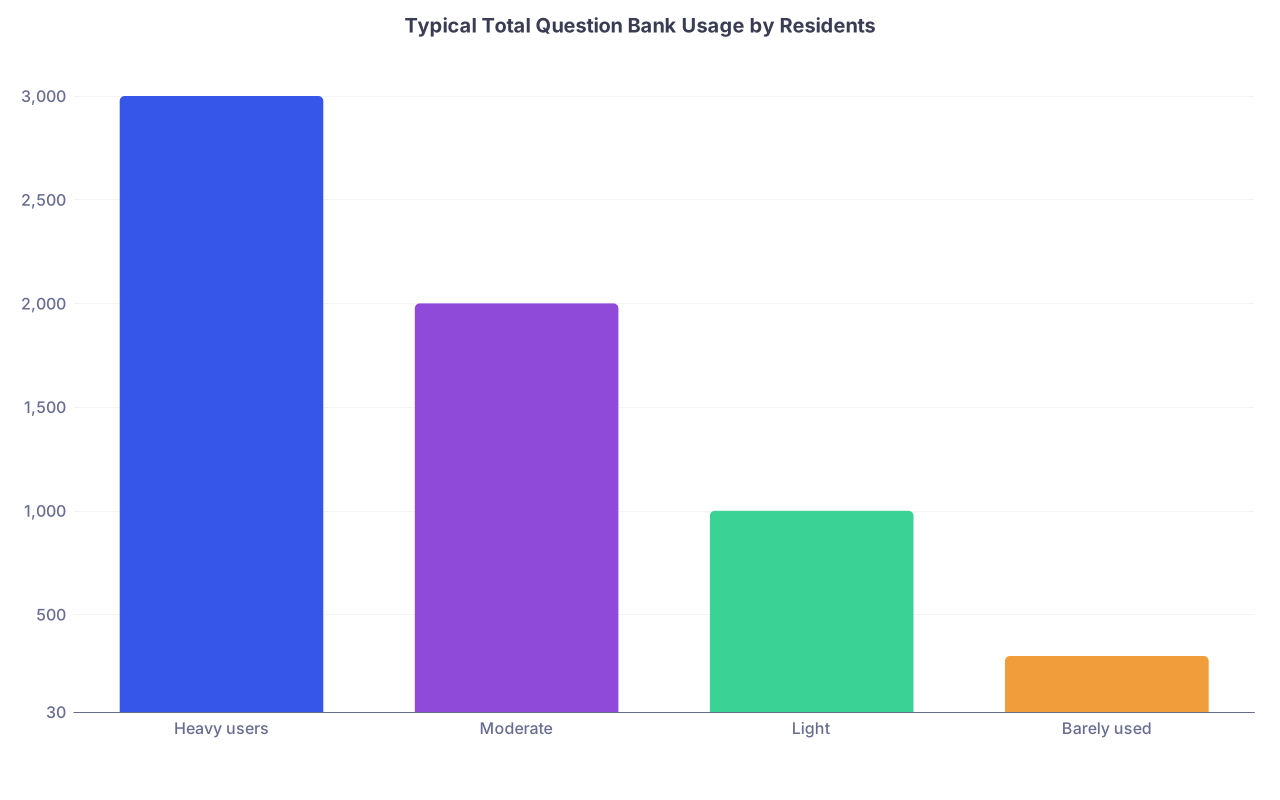
Let me put some actual numbers in front of you, because vague anxiety is way more terrifying than concrete reality.
| Category | Value |
|---|---|
| Heavy users | 3000 |
| Moderate | 2000 |
| Light | 1000 |
| Barely used | 300 |
From what I’ve seen across multiple programs:
- Heavy people: 2,500–3,500+ questions
- Most people: ~1,500–2,000
- A non-trivial number: 800–1,000
- And yes, some absolute chaos goblins: <500 and cram last minute
Plenty of people in the “moderate” and even some in the “light” group pass just fine because their studying is focused, not flashy.
So when you tell yourself “Everyone is doing more than me,” what you really mean is “I saw two screenshots from gunner types and my brain generalized it to the entire universe.”
It feels real. It’s not accurate.
Are You Actually Behind? Here’s the Harsh but Helpful Check
Let’s pretend we’re brutally honest for a minute. No sugarcoating. Just data.

Ask yourself these:
- When is your exam date?
- How many questions do you realistically want to get through?
- How many questions per week are you actually averaging right now? Not aspirational. Actual.
Now do the math:
- Weeks left × average questions per week = total likely questions
Example:
Exam in 10 weeks. You’re currently averaging ~120 questions/week (say 20 per day, 6 days a week).
10 weeks × 120 = 1,200 questions.
If your goal was 2,500, yeah, you’re behind for that goal. But here’s the catch: the 2,500 number is arbitrary. You can pass—and score decently—well below that if you stop sabotaging yourself with perfectionism.
If, on the other hand, you’re doing like 40 questions/week and your exam is in 6 weeks and you’ve only done 300 total?
Yeah. That’s not “I feel behind.” That’s “I’m actually behind.”
The point isn’t to panic. The point is to be specific. Vague dread is paralyzing. Concrete numbers can be fixed.
The Real Problem: You’re Studying in Anxiety Mode, Not Learning Mode
Here’s the ugly cycle I’ve watched (and lived):
- You feel behind.
- You panic and set an insane goal. “OK, 80 questions a day starting tomorrow. Non-negotiable.”
- You’re post-call, exhausted, your brain is mush. You get through 25, hate every second, retain nothing.
- You feel like a failure. You say, “What’s the point?” You doom-scroll. You skip the next day entirely.
- Now you’re even more behind.
That’s not a discipline problem. That’s an anxiety problem dressed up as “motivation.”
I’ve seen residents do 1,200 questions really well and outperform people who rushed through 3,000 like a speedrun.
The exams (ABIM, ABFM, whatever specialty) do not care about your question count. They care about your actual understanding.
Which leads to the painful question: how much of what you’re doing right now is performative studying vs. effective studying?
If you’re:
- Doing questions half-asleep
- Never actually reviewing wrongs deeply
- Never circling back to weak topics
…then yeah, you will always feel behind, because nothing is sticking.
You don’t fix that by doubling the question count. You fix it by doing less, better.
What Actually Works When You Feel Perpetually Behind
Let’s say you’re in the thick of residency: long days, random cross-cover nonsense, maybe nights, maybe you have kids, maybe you’re barely functioning. You don’t need a fantasy schedule. You need something that doesn’t collapse the second you’re post-call.
Here’s what I’ve seen work for worried, sleep-deprived residents who still passed:
1. Pick a minimum that feels almost embarrassingly small
Something like:
- 10–15 questions on truly brutal days
- 20–30 on normal days
And then you actually do it, even when the day is trash.
Your anxiety will scream: “That’s not enough! If I don’t do 60–80/day I’ll fail!”
But here’s the reality:
10–20 consistent questions 5–6 days a week > 0 questions 3 days, 80 questions 1 day, guilt the rest.
Sustained, boring, imperfect progress beats heroic spurts followed by burnout.
2. Make review matter more than question count
If you’re short on time, I’d rather you:
- Do 15 questions
- Spend 30–45 minutes reviewing every explanation, building mental frameworks
…than blast through 40 questions with shallow review.
The exam doesn’t ask, “How many UWorld blocks did you complete?” It asks, “Do you understand why the patient with X needs Y and not Z?”
3. Attach studying to something you already do
This sounds stupidly simple, but it helps when you’re tired and your executive function is wrecked:
- First thing when you sit on the bus/train: 5–10 questions
- First 30 minutes after you eat dinner: 1 block
- Right before bed: review explanations from the morning (no new questions)
You want zero decision-making. No “Will I study tonight?” Just “What time is it? Ok, that means I open the QBank.”
But What If I Really Am Far Behind and the Exam Is Soon?
This is where your anxiety is not totally wrong. There is a line where “I’m behind” becomes “I’m at actual risk.”
Let me be blunt: I’ve seen good residents fail because they waited until 4–6 weeks before the exam to start “for real,” while still doing heavy inpatient blocks and assuming future-them would somehow have more energy.
So if this is you:
- Exam in ≤ 8 weeks
- Total questions done so far: < 500
- You feel shaky on core topics in your specialty
You can’t fix this with “just believe in yourself.” You need triage.

| Step | Description |
|---|---|
| Step 1 | Weeks until exam |
| Step 2 | Set slow steady plan |
| Step 3 | Assess risk level |
| Step 4 | Focus on weak areas |
| Step 5 | Talk to PD or mentor |
| Step 6 | Adjust schedule or delay |
| Step 7 | Stick to daily minimums |
| Step 8 | 8 or less |
| Step 9 | <500 questions done? |
Here’s what I’d actually do in that situation:
- Talk to someone who’s not panicking: PD, APD, trusted upper level, or faculty who cares about education and not just “resilience.”
- Be specific: “My exam is in 7 weeks. I’ve done 300 questions. I’m on wards 6 days a week. I’m worried I won’t be ready.”
- Ask directly:
- “Do you think I should consider moving my exam date?”
- “Can we rearrange anything in my schedule?”
- “What’s the minimum effective plan you’ve seen work this close?”
Delaying isn’t always possible. And sometimes it’s not necessary. But pretending everything is fine while your stomach is in knots and you’re doing 0–10 questions a week? That’s how people end up failing.
I’d rather you confront the worst-case scenario now—“I might need to move the test or adjust my block schedule”—than casually drift into it unprepared.
The Silent Part: You’re Exhausted, Not Lazy
You keep calling yourself lazy. “If I actually cared, I’d have finished UWorld months ago.”
I’m going to push back on that.
You’re working 60–80 hours, dealing with sick patients, codes, consults, night float, emotional whiplash from death and bad news and complaints. Then you go home and your brain is like, “Cool, let’s parse renal pathophysiology now.”
You’re not lazy. You’re drained.
And burnout plays this sneaky game where you stop being able to tell the difference between “I don’t care” and “I have nothing left.”

If you had absolutely no drive, you wouldn’t even be reading this. The fact that you’re panicking about being behind means you care.
But caring doesn’t magically create energy. You still have a finite battery. That’s not moral failure. That’s biology.
So instead of asking, “Why can’t I make myself study like everyone else?” try, “What’s the smallest, realistically sustainable amount I can do most days, even when I feel wrecked?”
That’s the version of you that passes boards. Not the imaginary version who wakes up one day and suddenly wants to do 100 questions daily after a 14-hour shift.
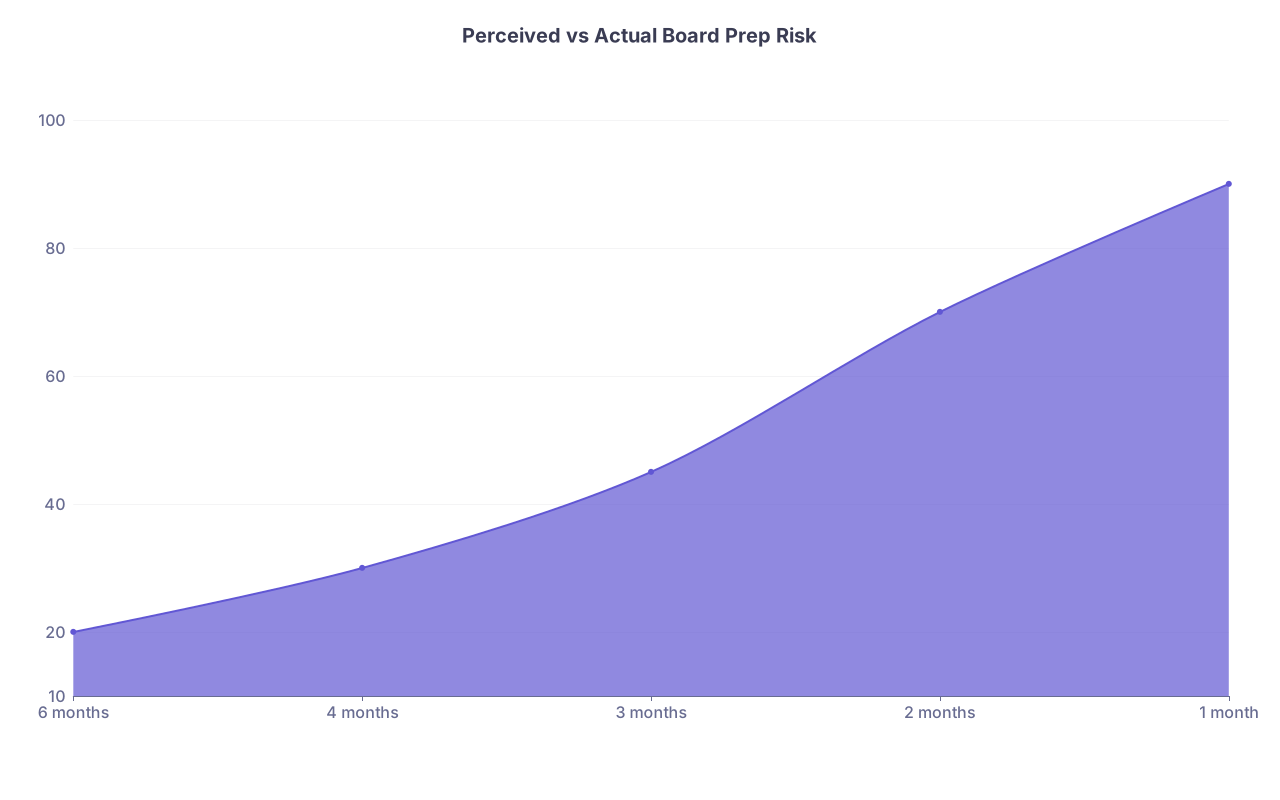
A Rough Sense of “Am I In Disaster Territory?”
You probably want some kind of benchmark to cling to, even if it’s imperfect. Fine. Here’s a crude framework I’ve seen play out in real life for many residents.
| Time Until Exam | Total Qs Done | General Risk Feel |
|---|---|---|
| 6 months | 0–300 | Totally fine if you start now |
| 3 months | 300–700 | Manageable but start being consistent |
| 2 months | <500 | Getting risky, need serious plan |
| 1 month | <800 | High risk, consider big changes |
Is this exact? No. But if you’re 4–6 months out and freaking out because your co-resident started 9 months ago and is on their second pass? Relax. You’re not doomed.
If you’re inside 2 months with almost nothing done? That’s where you stop just “worrying” and start restructuring your actual life temporarily.
| Category | Value |
|---|---|
| 6 months | 20 |
| 4 months | 30 |
| 3 months | 45 |
| 2 months | 70 |
| 1 month | 90 |
What’s wild is this: I’ve seen people at “low/medium” risk panic like they’re at 90, and people at actual 90-risk calmly say, “I’ll ramp up soon” while doing basically nothing. Your anxiety level does not equal your actual risk.
So you need external reality checks like this.
What To Do Tomorrow (Not In Your Perfect Future Life, But Tomorrow)
If you read all this and your brain is still screaming, “OK but I’m BEHIND,” here’s what tomorrow could look like. Not ideal. Not magical. Just possible.
- Pick a tiny baseline for tomorrow. Example: 15 questions + 30 minutes review. That’s it.
- Commit to it before the day starts. Text someone if you need to: “Ask me at 9 p.m. if I did my 15 questions.”
- Accept that the conditions will not be perfect. You might do them tired. You might do them on your phone. Still counts.
- Do not “make up” for lost time by doubling tomorrow’s goal. That’s what keeps blowing you up.
If you can string together 5–7 days of “small but real” effort, your anxiety shifts. Not because the situation is magically fixed, but because you’ve proven to yourself you’re not helpless.
And the gap between “I’m helpless” and “I’m behind but I’m doing something daily” is huge.
FAQ (You’re Not the Only One Thinking These)
1. What if I genuinely fail because I was behind—does that ruin my career?
It’s bad. I won’t sugarcoat it. Failing boards creates a mess with licensing and can delay graduation. But it’s not a career death sentence for most people. I’ve seen residents fail, pick themselves up, get support, schedule protected time, pass on the second try, and still go on to decent jobs. Is it painful and embarrassing? Yeah. But if that’s your worst-case scenario, it’s survivable. The whole point of your anxiety right now should be to nudge you into consistent action, not to paralyze you with “if I fail, it’s over.” It’s not over.
2. Is it even worth starting if I’m this behind? I feel like I can’t catch up.
Yes, it’s worth starting. The all-or-nothing thinking is lying to you. You don’t need a “complete” prep to pass. You need “good enough” in enough areas. Even if you’re very behind, every block you do between now and the exam is buying you points. People talk themselves into doing nothing because they can’t do “everything,” and that’s how they guarantee a bad outcome. Ten meaningful days of work beats thirty days of avoidance plus shame.
3. Do I need to finish the entire QBank to pass?
No. Finishing everything is nice, and it calms the anxious part of your brain, but it’s not mandatory. I’ve seen plenty of residents pass with 60–70% of a bank done, especially if they were thoughtful about covering high-yield topics and actually learning from explanations. If you’re short on time, I’d prioritize: core bread-and-butter topics in your specialty, high-yield weak areas, and one solid pass of a single main QBank over jumping between three resources and finishing none.
4. How do I stop comparing myself to co-residents who seem way ahead?
You probably won’t stop entirely. You’re human. But you can mute the damage. Mute the QBank screenshots in your group chat. Stop asking people their total question count “just out of curiosity” when it actually wrecks your mood. Pick one or two grounded people to talk to about studying—ideally those who aren’t performance-posting everything—and use them as your reality check. And every time your brain says, “They’re all doing more,” force yourself to answer, “Maybe. I’m still responsible for my next 10–20 questions. That’s it.” Pull your focus back to the next small action, not the imaginary leaderboard.
Bottom line, and I’ll keep this short:
You’re not the only resident who feels perpetually behind on boards. A lot of the “everyone is crushing it” narrative is noise, bragging, and selective seeing. Figure out if you’re actually behind or just scared, pick a tiny daily baseline you can actually hit even on terrible days, and let consistent, imperfect effort pile up instead of waiting for the mythical perfect study phase that never comes.