
The thing that terrifies you isn’t the content. It’s your own brain.
You’re not actually asking, “Can I learn this material?” You’re asking, “What if I freeze on test day the way I keep freezing on practice questions? What if my anxiety is the thing that finally sinks me?”
Let me be blunt: I’ve seen people with 260‑level knowledge fail because of anxiety. I’ve also seen absolutely average test-takers pass comfortably once they stopped letting panic run the show. So yes—test anxiety is real, it’s powerful, and it can absolutely wreck your score.
But it is not some mysterious curse you’re stuck with. And “I freeze on practice questions” is not a prophecy of failure.
It’s a warning sign. And you can actually do something about it. Now. Before you walk into your board exam.
What “Freezing” on Questions Really Means (It’s Not Just You Being Dumb)
You sit down to do a block of UWorld or AMBOSS. First question pops up. You read the stem. Your chest gets tight. Your mind does that awful static-noise thing. You stare at the options thinking, “I’ve never seen this in my life,” even though you literally reviewed it three days ago.
You call it “freezing.” But under the hood, it’s this:
Your brain sees: “High-stakes evaluation that determines your future fellowship/job/license.”
Your nervous system hears: “Tiger.”
Fight/flight kicks in. Heart rate up. Adrenaline. Your prefrontal cortex—the part that actually solves questions—gets partially hijacked by your limbic system. You’re not “forgetting everything you studied.” You’re trying to practice differential diagnosis while your brain is screaming: “We’re about to die.”
That’s why:
- You blank on basic things you do know.
- You change right answers to wrong ones because you don’t trust yourself.
- You time out on blocks because you reread every question 5 times in a fog.
None of that means you’re not capable of passing a board exam. It means you’re trying to perform at your mental worst in a context that demands your best.
That’s fixable.
How Much Can Anxiety Actually Hurt Your Board Score?
Let’s talk about the part you’re secretly obsessing over: numbers.
Because there’s a voice in your head going: “Ok but am I going to fail? Like actually fail?”
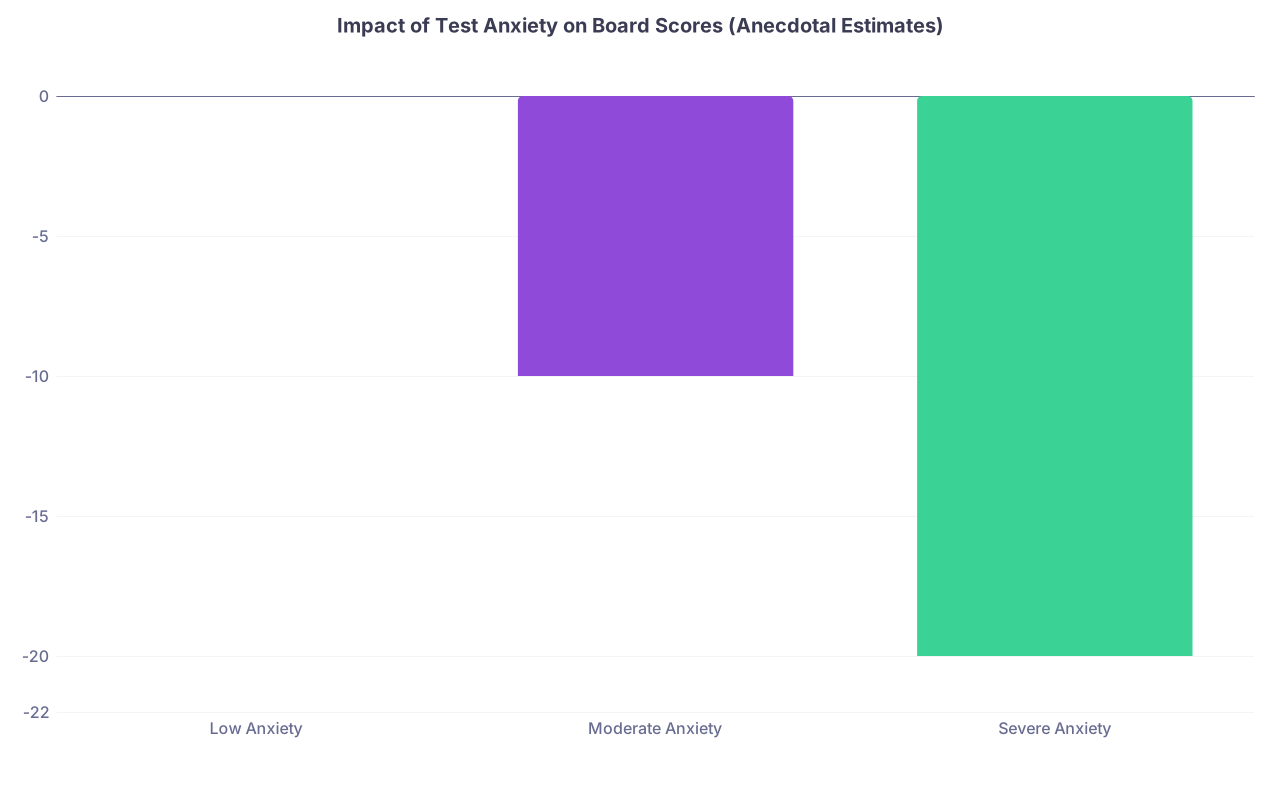
Here’s what I’ve seen over and over with residents:
| Category | Value |
|---|---|
| Low Anxiety | 0 |
| Moderate Anxiety | -10 |
| Severe Anxiety | -20 |
Those numbers aren’t from some major randomized controlled trial. They’re from watching people’s NBME practice scores vs their real exam behavior and post-exam debrief:
- Mild anxiety: small hit, often 0–5 points, sometimes even a boost from focus.
- Moderate anxiety: 5–15 point drop from what their knowledge would justify.
- Severe, unaddressed anxiety: 15–25+ point hit, plus significantly higher fail risk.
Where you get screwed is when your knowledge would’ve passed you, but your state pulled you under the passing line.
Example I still think about:
PGY-2 internal med resident. NBME equivalents around “comfortably pass.” Did fine on practice blocks except when they thought about “This is like the real test,” then their percentage plummeted. Refused meds, refused structured anxiety work (“I’ll be fine on the real thing; adrenaline will help”). Actual boards? Failed by a razor thin margin. Retook with a psychiatrist + coached exposure practice + beta-blocker. Passed with ~20 point jump. Same brain. Very different anxiety plan.
So yeah, in the worst case, anxiety can be the difference between “barely passed” and “barely failed.” That’s the part that keeps you up at night.
But the flipside is just as real: reducing anxiety can reclaim a huge amount of performance without magically learning more facts.
Practice Question Panic vs Actual Exam Day: Are You Doomed?
Here’s the thing nobody tells you when you’re spiraling over your QBank analytics:
Your “I freeze on practice questions” pattern is data, not destiny.
I’ve seen three main patterns:
| Pattern | Real Exam Outcome |
|---|---|
| Freeze in early practice, better with more exposure | Often pass at or above NBME range |
| Fine in practice, panic on real exam | Score drop, sometimes fail |
| Panic in practice, get help, simulate, med support | Scores improve, pass comfortably |
Where you are right now—freezing on practice—can actually be a good position if you treat it as a training signal and not a verdict.
Why?
Because:
- You’ve discovered the problem before the real exam.
- You can engineer practice conditions to beat this thing.
- You can still change your mental habits in the weeks to months before test day.
It’s the people who freeze for the first time on the real exam that have the least room to maneuver.
You, annoying as this is, at least know where the crack is in the foundation.
Concrete Things You Can Do So Anxiety Doesn’t Sink You
You don’t need another generic “mindfulness helps” lecture. You need a plan that you could actually follow as a resident who’s already exhausted.
So here it is: not fluffy wellness. Tactical moves.
1. Stop Treating Every QBank Block Like a Court Verdict
Right now, you’re probably making each practice block feel like a mini-board exam. You sit down thinking, “If I bomb this, it means I’m not ready. If I’m not ready now, I’ll never be ready.”
That is the fastest route to paralysis.
You have to reframe practice as reps, not judgment. The point is not to prove you’re good. The point is to train your brain to function under stress.
Try this: for the next 10 days, deliberately lower the stakes of your practice.
- Tell yourself before each block: “This block is just anxiety practice, not knowledge evaluation.”
- After each block, don’t even look at percentage first. Go straight to: “Where did anxiety show up? Where did I freeze? What was I thinking right then?”
You’re shifting from “Am I good enough?” to “What is my brain doing, and how do I train it?”
It sounds subtle. It’s not. It changes everything.
2. Simulate Test Anxiety on Purpose (So It Stops Owning You)
Right now, anxiety is something that sneak-attacks you. You sit down to do questions, it pounces, you’re hostage.
You need to flip that. Start provoking anxiety on your terms.
Create 100% exam-like sessions: same start time, same length, same break schedule, same food, same scratch paper rituals.

| Step | Description |
|---|---|
| Step 1 | Set exam date |
| Step 2 | Pick weekly sim day |
| Step 3 | Wake up same time as exam |
| Step 4 | Eat test day breakfast |
| Step 5 | Start full block or NBME |
| Step 6 | Timed breaks only |
| Step 7 | Review performance and anxiety notes |
Then here’s the important part: don’t avoid the physical sensations. Notice them.
“I feel my heart racing. My hands are a bit sweaty. My stomach dropped when the timer started.”
And then you continue anyway.
That is literally exposure therapy. You are teaching your brain: “We can feel all this and still read and think.”
Residents who do 4–6 serious simulations like this often report the real exam feels… almost boring. Familiar. Their body is like, “Oh, we do this. This is Tuesday.”
That’s where you want to be.
3. Build a Micro-Script for When You Freeze
Freezing is not a mystical event. It’s a sequence:
Question shows up → fear spike → catastrophic thought → mental blank.
You need a preloaded script for that moment, so you’re not improvising in panic.
Something like:
- Notice: “Okay, I’m blanking.”
- Physically: exhale slowly, long out-breath, shoulders down.
- Say (in your head): “I’ve seen this movie. I can still get partial credit on my brain even at 60%.”
- Force yourself through a 3-step process:
- “What is this question roughly asking? System? Age? Acute vs chronic?”
- “What definitely isn’t right among the answers?”
- “Pick the best remaining. Move on.”
You are not trying to feel confident. You are trying to keep the machine moving.
If you wait until exam day to invent this script, you will default to: “Oh my god oh my god I’m failing.”
Write your script today. Use it every time you freeze on practice questions. Train it until it’s boring.
4. Time-Pressure Training So the Clock Stops Owning You
Anxiety and time are best friends. You see the clock, your stomach drops, and suddenly every question feels like a life-or-death 90-second crisis.
You need to desensitize that.
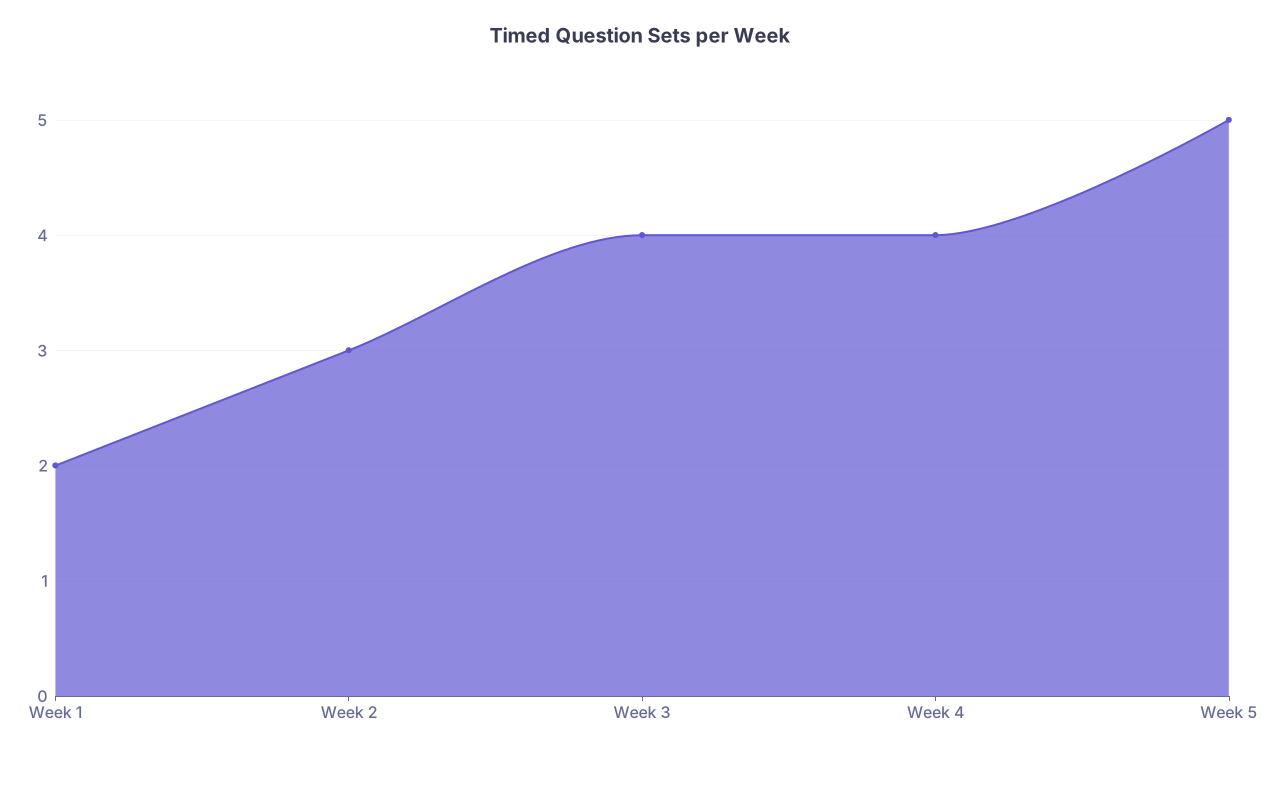
Do this once or twice a week:
| Category | Value |
|---|---|
| Week 1 | 2 |
| Week 2 | 3 |
| Week 3 | 4 |
| Week 4 | 4 |
| Week 5 | 5 |
Start with:
- 10 questions, 20 minutes.
Then gradually tighten to - 10 questions, 15 minutes.
Then 10 questions, 13–14 minutes.
You’re not doing this to be perfect. You’re doing it to feel the rush of “I’m behind”—and prove to yourself that you can function anyway and that a few guessed questions won’t kill your score.
Because that’s reality: you will guess. Everyone does. You’re practicing the skill of “panic, adapt, move on” instead of “panic, stall, drown.”
5. Consider Actual Medical Help (You’re Not Weak. You’re Responsible.)
This is the part people avoid until it’s too late.
If any of these are true:
- You’ve always had major test anxiety (MCAT, Step, in-training)
- You get physical symptoms—nausea, shaking, shortness of breath
- You’ve failed a big exam before because of panic
Then white-knuckling it is risky at best and reckless at worst.
You’re a physician. You treat anxiety in patients. You know this is not a “willpower” issue.
Residents who finally talk to their PCP or a psychiatrist about this are always the same afterward: “Why the hell did I wait so long?”
Common, real-world tools:
- SSRIs or SNRIs if you have broader anxiety. Not a quick fix, but stabilizes the background level.
- Beta-blockers (like propranolol) on test day to blunt the physical surge—if safe for you medically.
- Short-term benzo strategy for sleep before the exam, very carefully and appropriately prescribed.
None of this is shameful. It’s risk management. You’re not trying to be a hero; you’re trying to not tank a career-level exam because you refused treatment for a treatable problem.
6. Your Self-Talk Right Now Is Probably Making This Worse
There’s a difference between “I’m anxious” and “I’m doomed.”
Pay attention to what you’re actually telling yourself lately:
“I freeze on questions. If I do that on the boards, I’ll fail. If I fail, my program will hate me. I’ll never get a good job. I’ll be the resident who couldn’t even pass boards.”
That’s not motivation. That’s a mental strangling.
Try swapping the story—not into cheesy affirmations, but into something realistic:
“I freeze on questions right now because I’ve never properly trained for test anxiety. I can still change that. Plenty of residents have been exactly where I am and passed.”
That’s true. Completely.
You’re not special in your brokenness. This is a common, boring residency problem. I say that on purpose—because “boring” problems are solvable.
What If You Still Feel Terrified? (The Sad but Honest Part)
There’s a chance you do everything right and still feel scared.
That does not automatically mean you’ll fail.
I’ve had people call me after exams saying, “I was anxious the entire time. I felt like I got crushed.”
Then the score report arrives: solid pass. Sometimes even higher than NBMEs. Why? Because they could function at 70% while feeling awful—and 70% was still above the line.
You are overestimating how perfect you have to be. You don’t need Zen monk calm. You don’t need 100% recall. You need to stay just functional enough, consistently enough, to let all the studying you’ve already done actually show up.
So yeah, your anxiety might not disappear. But it does not have to sink your board exam. It just has to be contained.
What You Should Do Today (Not “Someday Before the Exam”)
Don’t leave this as another vague “I should probably work on my anxiety” intention.
Do something small but concrete today:
Open your QBank, set a 10-question timed block for 20 minutes, and deliberately run it as a low-stakes “anxiety practice” session. Before you start, write one sentence on a sticky note: “This block is for training my reaction to panic, not judging my worth.” Stick it next to your screen. Then do the block and, afterwards, write down one moment you froze and exactly what went through your head.
That’s it. One block. One moment. One pattern identified.
That’s how you start turning “I freeze on practice questions” from a death sentence into something you’re actively, deliberately dismantling—before it ever gets a shot at sinking your board exam.