
You scored the highest on your surgery rotation. Your attending told you to apply ortho. Then you spent the next three days in a flare so bad you couldn't grip a pen.
That's the moment the fantasy collides with the reality. And it's more common than anyone admits.
High-demand specialties don't just ask for your time and talent. They demand your body, your nervous system, your immune reserves, and your ability to recover from punishment that would break most people. When you're managing a chronic condition, whether it's rheumatoid arthritis, Crohn's disease, Type 1 diabetes, dysautonomia, or something that doesn't even have a clean name yet, the conversation changes. Not because you're less capable. Because the margin for error disappears.
Here's what nobody tells you in medical school: choosing a specialty isn't just about what excites you intellectually. It's about what your body can sustain for thirty years. The system pushes everyone toward high-acuity, high-prestige fields without accounting for the fact that some of you are running on a different engine, one that needs different maintenance.
This guide will help you think honestly about your condition, your options, and the intersection where your passion meets what's actually sustainable. No sugarcoating. No false hope. Just clear-eyed guidance from someone who's watched trainees thrive and trainees crash because they got this decision right, or wrong.
The Reality Check: Chronic Conditions and Specialty Dreams
Let's get one thing straight: having a chronic condition doesn't make you a lesser physician. It makes you a physician who needs to plan differently.
Medical culture has a toxic relationship with physical limitation. We celebrate the resident who sleeps four hours and runs on caffeine and grit. We treat needing accommodations as weakness. That's garbage. The smartest thing you can do as a trainee is look at your health reality before committing to a path that might break you.
Here's why high-demand specialties deserve a second look when you're managing something chronic: they're designed for bodies that don't have bad days. Surgery means standing in one position for six hours. Critical care means night shifts that wreck your circadian rhythm for years. Emergency medicine means physical chaos and unpredictability baked into every shift. These fields don't pause because your condition flares.
And the attrition numbers tell the story nobody wants to hear. Studies on resident attrition consistently show health reasons as a significant factor, and those are just the cases that get reported. Plenty of trainees white-knuckle through deteriorating health, hiding symptoms, skipping medications, pushing through pain until they either burn out or get forced out.
You don't have to be that person.
(See also: how program directors interpret overapplication for more.)
This guide exists because I've watched too many talented students chase prestige into breakdown. I've also watched students with chronic conditions build extraordinary careers by being strategic, choosing specialties that matched their brilliance and their biology. Both paths are valid. Only one is sustainable.
What we're going to do here is straightforward. We'll break down what different specialties actually demand. We'll give you a framework for honest self-assessment. We'll talk about disclosure, accommodations, and program culture. And we'll map out alternative pathways that don't require abandoning medicine, just reimagining where you practice it.
How Chronic Conditions Intersect with Specialty Demands
Every specialty has a physical and operational profile. Here's what you're actually up against:
Physical demands vary wildly across fields. Surgery and obstetrics mean prolonged standing, often in fixed positions. Orthopedics adds heavy lifting and physical manipulation. Ophthalmology requires sustained fine motor control and awkward neck positioning. Meanwhile, radiology lets you sit, pathology lets you move at your own pace, and outpatient psychiatry is essentially a desk job. Know what your body can handle for eight to twelve hours.
Schedule intensity might be the biggest factor for many conditions. Surgical residencies routinely demand 80-hour weeks with 24-hour calls. Critical care runs on shift work that flips between days and nights. Emergency medicine is shift-based but physically punishing. Compare that to outpatient dermatology (predictable hours, minimal call), radiation oncology (structured schedule), or pathology (minimal urgent add-ons). If your condition is sensitive to sleep disruption, circadian chaos, or stress hormones from chronic time pressure, schedule matters as much as the work itself.
Cognitive load is the hidden tax. High-acuity fields demand rapid decision-making with incomplete information, often while sleep-deprived. That cognitive pressure interacts with conditions in ways people don't anticipate. Brain fog from autoimmune flares. Medication side effects that slow processing speed. Anxiety from managing your condition while managing patients. The mental game isn't separate from the physical game, they compound each other.
Environmental factors round out the picture. Interventional specialties involve radiation exposure (concerning for pregnancy, certain conditions). Surgical fields carry infectious exposure risks. Hospital environments mean constant exposure to pathogens when your immune system might already be compromised. Even seemingly minor factors, fluorescent lighting, temperature control, chemical sensitivities, can matter for specific conditions.
The truth is, most students pick specialties based on what they find interesting, then discover the physical and lifestyle demands later. When you have a chronic condition, you need to reverse the order: start with what your body can sustain, then find the most interesting version of that.
The Self-Assessment Framework: Know Thyself First
Before you fall in love with a specialty, or before you rule one out, you need to get brutally honest about your condition. Not your best-case version. Your real version.
Document your current status. What does your condition look like right now? Not last year when it was better, not in your imagination where it's controlled. Today. What are your symptoms? What's your functional baseline? What does your treating physician say about your trajectory?
Map your triggers and flare patterns. Is your condition predictable or random? Do flares follow stress, sleep disruption, physical exertion, dietary changes, seasonal patterns? The more predictable your flares, the more you can plan around them. Unpredictable flares demand more conservative career choices.
Understand your energy envelope. How many hours of full-function work can you sustain before you need recovery? Be honest. If the answer is six hours, that's critical information. If it's twelve, you have more options. This isn't about weakness, it's about data.
Evaluate medication side effects. What are you taking, and how does it affect your cognition, stamina, and physical capability? Steroids make you wired and then crash. Immunosuppressants increase infection risk. Beta-blockers reduce physical stamina. Your medication profile is part of your career planning.
Build worst-case and best-case scenarios. Best case: your condition stays stable for decades. Worst case: it progresses. What does each scenario look like for different specialty choices? Where do the paths diverge?
Here's the thing: this self-assessment isn't a one-time exercise. Revisit it annually. Your condition changes, your management improves, new treatments emerge. The specialty choice you make at twenty-five doesn't have to be the one you're locked into at forty. But it does need to be viable for the training period, and training is the hardest part.
High-Demand Specialties: The Honest Breakdown
Let's get specific about what high-demand specialties actually require, and where chronic conditions create real barriers.
Surgical subspecialties are the elephant in the room. General surgery, ortho, neurosurgery, ENT, urology, they all demand prolonged standing, often in awkward positions. You need sustained manual dexterity. You need to perform when exhausted. You need to be physically reliable. For conditions affecting joints, stamina, or fine motor control, surgery is genuinely difficult. Not impossible, but difficult. Some surgeons with well-controlled conditions make it work. Many don't. The attrition rate from surgical residencies for health reasons is real, and it's underreported.
Critical care and emergency medicine present different challenges. The work is shift-based, which sounds better, but the shifts are intense, frequently overnight, and physically demanding. ED docs are on their feet constantly, dealing with chaos and confrontation. The cognitive load is enormous. For conditions sensitive to circadian disruption, stress hormones, or infection exposure, these fields can be brutal. Emergency medicine in particular has high burnout rates even among physicians without chronic conditions.

Interventional cardiology, IR, and procedure-heavy fields combine surgical physical demands with medical cognitive demands. Long procedures in heavy lead aprons. Radiation exposure. On-call obligations. These are physically punishing fields that also require sharp decision-making. If your condition affects stamina, cardiac function, or pregnancy planning, think carefully.
Which programs accommodate well? This varies enormously. Some programs have institutional disability services that actually function. Some program directors are allies. Some are nightmares who view accommodations as threats to their training culture. You won't find this information in broass brochures. You find it by talking to current residents, asking pointed questions, and trusting your gut when something feels off.
The attrition statistics are telling. ACGME data on resident attrition shows health reasons account for a meaningful percentage of departures, particularly in surgical fields. But the real number is higher because many residents cite "personal reasons" or "reassessing career goals" when health is actually the driver. The stigma is real. Don't let it silence you.
The Alternative Pathways Worth Considering
Here's where the conversation gets hopeful. Because there are dozens of specialties where you can build an extraordinary career without destroying your body.
Specialties that offer flexibility without sacrificing impact:
- Radiology, sedentary, intellectual, high-impact diagnostic work. Sitting at a workstation, interpreting studies, performing image-guided procedures when desired. Schedule can be structured.
- Pathology, the hidden gem for many. Microscope work, autopsies, molecular diagnostics. Minimal physical demands, predictable hours, intellectually demanding.
- Dermatology, outpatient-focused, procedural but controlled, predictable schedule. Good for conditions requiring routine.
- Psychiatry, especially outpatient. Sedentary, flexible, deeply meaningful work. Minimal physical demands.
- Radiation oncology, structured schedule, high-tech work, meaningful patient relationships.
- Endocrinology, allergy/immunology, rheumatology, subspecialties within internal medicine that tend to be more predictable and outpatient-heavy.
Finding the intersection of your interests and sustainable demands requires creativity. Love surgery but can't stand for hours? Consider ophthalmology, procedures done seated, shorter cases, high precision. Love critical care concepts but can't handle shift chaos? Consider pulmonary outpatient practice. Love the cardiovascular system but can't do 30-hour calls? Consider cardiology in an academic setting with structured schedules and research time.
Academic vs. community practice matters enormously. Academic medicine offers more schedule flexibility, research time that gets you off your feet, and institutional disability infrastructure. Community practice often means more clinical hours and less control. For many physicians with chronic conditions, academic settings provide the scaffolding needed to thrive.
Non-clinical career paths deserve mention too. Medical education, health administration, pharmaceutical medicine, public health, medical writing, consulting. These aren't consolation prizes, they're legitimate careers where your MD creates unique value. Many physicians with chronic conditions find these paths more sustainable and equally fulfilling.
Success stories exist. I know a rheumatologist with lupus who chose the field because she understood her patients from the inside. A radiologist with Crohn's who built a thriving academic career with a flexible schedule. A psychiatrist with chronic fatigue who runs a successful telehealth practice. None of them settled, they found where their gifts met their reality.
Navigating Disclosure, Accommodation, and Program Culture
This is where things get tricky. Disclosure is deeply personal, and the system isn't designed to make it comfortable.
When to disclose: You don't need to disclose during initial applications. ERAS and program directors shouldn't ask about health status pre-match, and legally can't use it against you. Consider disclosure during interviews only if you want to gauge program culture, and even then, frame it carefully. After matching is when formal accommodations happen through institutional disability services.
Legal protections: The ADA applies to residency programs. Programs must provide reasonable accommodations that don't fundamentally alter essential requirements. "Reasonable" is doing a lot of work in that sentence, expect negotiation. Know your rights, document everything, and involve your institution's disability office from the start.
Researching program culture: Ask current residents about wellness culture. Frame questions indirectly: "How does the program handle residents who need flexibility for personal circumstances?" "What's the culture around taking sick days?" "Are there examples of residents who've needed accommodations?" Listen to tone as much as content. Defensiveness is a red flag.
Questions worth asking:
- How does the program support residents with health needs?
- What's the process for requesting schedule modifications?
- How are sick days handled during rotations?
- Is there institutional disability services involvement?
Red flags: Programs that dismiss accommodation questions. Cultures that celebrate "toughing it out." Programs where residents describe fear of taking sick days. Directors who frame health needs as burden. Trust these signals, they're telling you the truth.
Your Action Plan: Making the Decision and Moving Forward
Here's your step-by-step framework:
Complete your self-assessment. Document your condition, triggers, energy envelope, and medication effects. Be honest.
Research specialty demands. Talk to physicians in fields you're considering. Ask about daily reality, not just highlights.
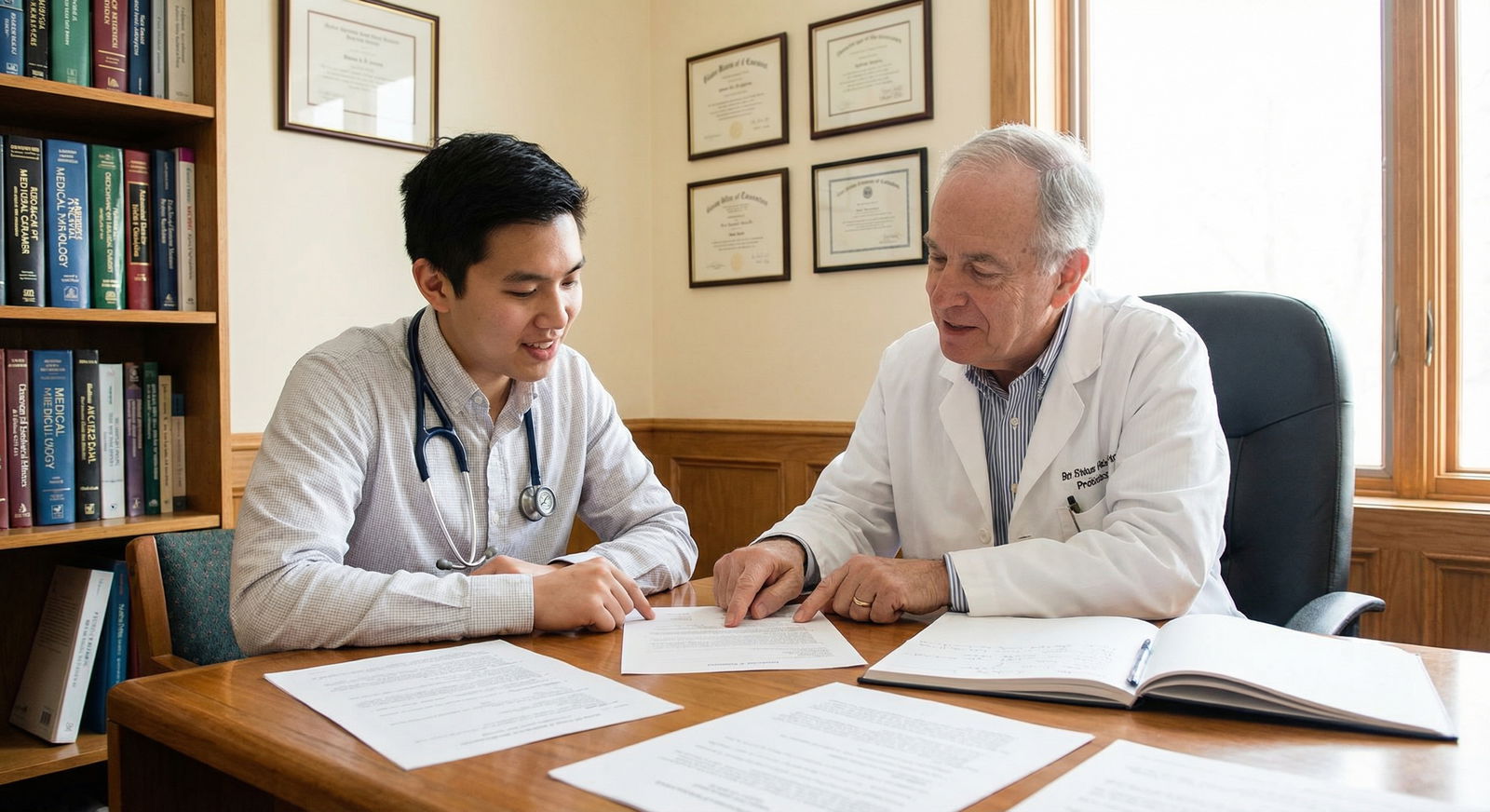
Build your support team. Find a mentor who understands chronic illness in medicine. Connect with your treating physician about career planning. Consider a therapist who specializes in medical professionals.
Create a decision matrix. List your top specialties. Score them on: intellectual interest, physical demands, schedule compatibility, accommodation feasibility, and long-term sustainability.
Do trial runs. Acting internships, away rotations, shadowing experiences. Feel the demands before committing.
Research programs strategically. Look beyond prestige. Find programs with track records of support.
Make backup plans. Identify your second and third choices. Having alternatives reduces desperation.
Resources worth accessing:
- Your institution's disability services office
- ACGME accommodation policies
- The American Medical Association's resources for physicians with disabilities
- Online communities of physicians with chronic conditions
- Your specialty society's wellness resources
Your next step, right now: schedule an appointment with your treating physician. Bring this article. Start the conversation about how your condition maps onto career planning. Don't wait until you're drowning in a rotation that's breaking you.
Key Takeaways
- Your chronic condition doesn't disqualify you, it requires honest self-assessment about what different specialties demand and how that aligns with your health reality.
- High-demand doesn't mean impossible, but it does mean planning: understand your condition's pattern, know your accommodation rights, and research program cultures before committing.
- The right specialty is where your passion meets sustainability, there's no shame in choosing a path that lets you have a long, impactful career rather than a spectacular burnout.