
Attendings are “trying you on” for their specialty long before you ever say, “I’m thinking about going into…” out loud.
They will not admit this in feedback forms. They’ll talk about “learning objectives” and “professional growth.” But behind closed doors, they are doing one thing: deciding whether you’re someone they’d trust as a resident in their field. And they start that evaluation the moment you walk onto their service.
Let me walk you through how that actually works, because nobody explains this to students honestly.
The Hidden Game: You Think It’s a Rotation, They Think It’s an Audition
Students think: “This is my surgery rotation; I’m here to learn, pass the shelf, and not look stupid.”
Attendings think: “If this person told me they were applying surgery, would I want them as my intern?”
That’s the mismatch.
They don’t care nearly as much about your beautifully phrased presentations as you think. They’re watching for specialty-specific behaviors. They’re projecting you 2–3 years into the future: on call, tired, paged every 3 minutes, dealing with angry families, or standing at the head of a crashing patient. They’re asking themselves: Is this someone I’d want next to me when things go sideways?
And here’s the part most students completely miss: they’re test-driving you for their specialty even when you haven’t said a word about what you want to do. Many attendings assume that if you click with their field, there’s at least a 30–50% chance you’ll drift toward it. So they treat every rotation like a scouting trip.
This is why two students on the same team can walk away with totally different comments and opportunities. Same hours. Same patients. Different signal they’re sending about “fit.”
Let me break down what they’re actually looking for, specialty by specialty, and what behaviors quietly move you into the “I’d recruit this person” bucket.
What “Fit” Secretly Means in Different Specialties
No one will say this out loud in orientation. But attendings in each specialty are running the same core mental simulation:
“If this student were an intern here, would I be relieved… or worried?”
| Category | Value |
|---|---|
| IM | 70 |
| Surgery | 85 |
| EM | 80 |
| Psych | 60 |
| Peds | 65 |
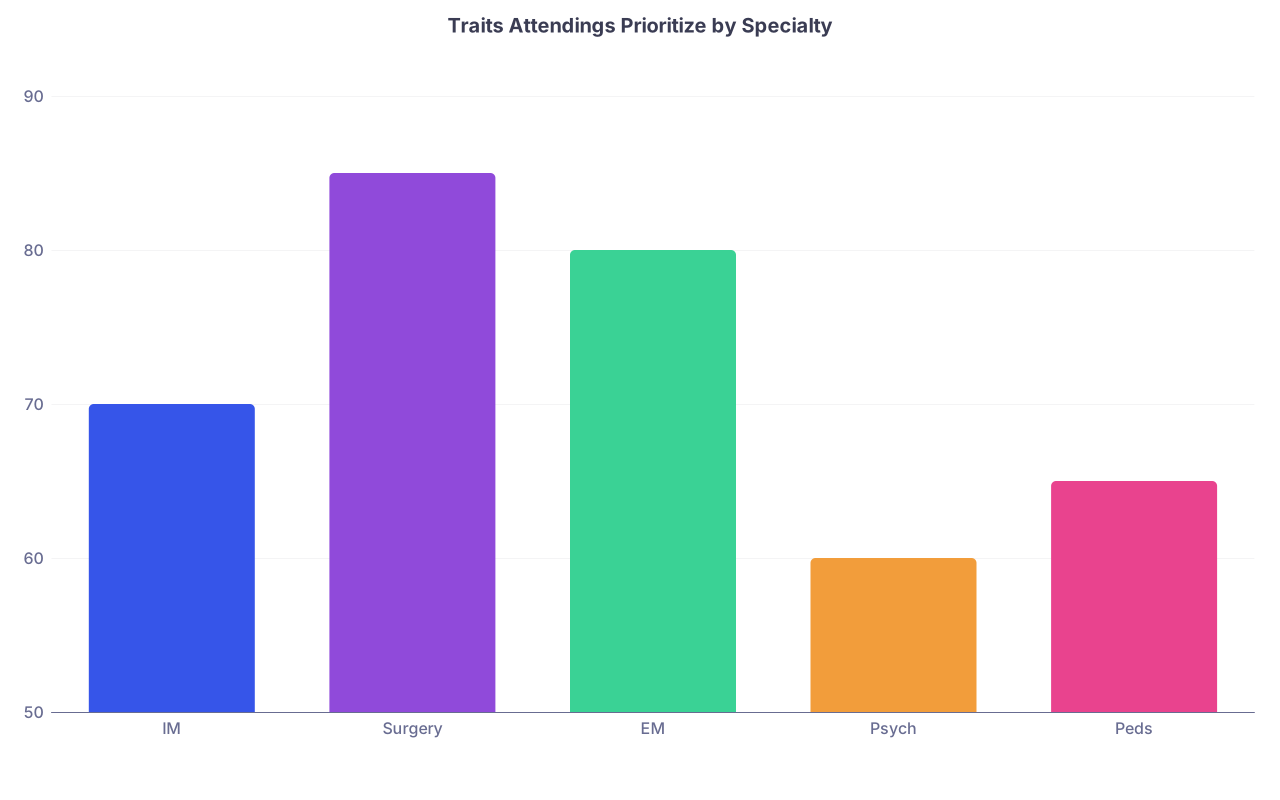
That bar chart? Think of it as “how much weight attendings in that specialty put on specialty-specific ‘fit’ during your rotation,” on a rough 0–100 scale. Surgery and EM are near the top. Internal medicine and peds still care—but you can skate by a bit more if you’re generically competent. Psych is more nuanced and long-game.
Now the real details.
Internal Medicine: Pattern Recognition and Intellectual Honesty
On medicine, attendings test-drive you as a future intern in a specific way. They are not impressed by theatrical presentations; they’re asking:
- Do you close the loop on problems?
- Do you admit when you don’t know something?
- Do you actually understand physiology, or are you parroting UpToDate?
The quiet test-drive moments:
- They’ll see if you notice that the creatinine has nudged up over three days without anyone mentioning it. A good future medicine resident flags that. A mediocre one just reads off the labs.
- They watch when a patient’s story changes. Did you catch that the “mild” chest pain is now exertional and worse? Or did it sail past you?
- They ask you a pointed question they know you don’t know the answer to, just to see how you handle not knowing. Do you bluff? Or say, “I’m not sure, but I’d look it up by…” and then actually follow up?
If you’re thinking about IM, the worst thing you can be is vague and sloppy. The best thing you can be is precise, humble, and relentless about tying loose ends. Rounding notes that say “monitor” without specifying what and how often? That’s how you get mentally tagged as “not medicine material.”
Surgery: Grit, Precision, and Whether You Make Them Nervous
Surgical attendings test-drive you constantly. And their threshold is brutal: “Would I let this person close my anastomosis in 3 years at 2 a.m.?”
They don’t say that to you, but I’ve heard that exact line in conference rooms.
They’re not primarily judging your step score. They’re watching:
- Do you show up early enough to pre-round like a real member of the team, or do you stroll in at 6:15 saying, “I couldn’t find the chart”?
- When you’re scrubbed, do you anticipate and watch or do you stare into space? They notice when you track the field versus when you mentally wander.
- When they let you cut sutures, do you do it cleanly, exactly where they said, or do you fumble and grab the wrong tail? That’s not about cutting—it’s about your hands under pressure.
Here’s the thing: surgery attendings do a very specific stress test. They’ll give you a small responsibility that’s just at your edge—closing skin, handling a simple consult note, updating a family—and then watch for one thing: Do you keep your head when you’re a little overwhelmed?
If you want surgery, you cannot be the student who disappears to “study the anatomy” instead of being in the OR. They’re not looking for someone who knows surgery. They’re looking for someone who lives in the OR willingly.
If you don’t want surgery? They still clock whether you respect the work. Showing that you can be calm, reliable, and uncomplaining on a tough service will quietly help you later when they get called for your residency reference.
Emergency Medicine: Chaos Tolerance and Team Instincts
EM attendings are playing a different game: “If this person is in a resus bay with me, will they help or be a hazard?”
They notice:
- Do you move toward commotion or do you vanish when the trauma comes in?
- When multiple things are happening, can you follow what matters, or do you stand frozen?
- When they give you a time-limited task—“Go get a full set of vitals and come tell me the MAP”—do you return with exactly what they asked, on time, or do you come back with a story and missing data?
They also watch how you behave with nurses. In EM, the nurses will tell the attendings off the record if you’re condescending or useless. If an attending hears, “That student jumped in without being asked and then checked with us before touching anything,” you just got mentally upgraded.
If you say you’re interested in EM but you hate night shifts, complain about overnight volume, or need constant handholding with every patient, they’ll smile to your face and quietly decide you’re not their person.
Pediatrics: Calm Under Chaos + Gentle Steel
In pediatrics, the test-drive is sneakier. You think they’re just watching whether you like kids. They’re actually asking:
- Can you communicate with anxious parents without losing your own center?
- Do you protect the kid’s dignity when the room is full of people?
- Do you advocate appropriately when something feels off?
Attendings will watch you in that moment when a parent is spiraling and the resident is slammed. Do you vanish, pretend to chart, or do you step in—“Would it help if I sat with you and explained what the team is doing right now?”—and then not overstep?
They imagine you as the intern who has to call CPS, talk to frightened parents, or inform a family their child needs an ICU transfer. “Soft” skills here are not soft. They’re the whole job.
Psychiatry: Boundaries, Curiosity, and Your Own Stuff
Psychiatry attendings are running a long psychological test-drive on you whether you realize it or not.
They watch:
- How you react to difficult, manipulative, or emotionally intense patients. Do you get angry? Amused? Detached?
- Whether you can tolerate silence. The student who nervously fills every gap with chatter is not psych-ready yet.
- How you handle your own countertransference. After that borderline patient storms out, are you ranting in the hallway or are you able to reflect with some distance?
If you tell them you’re interested in psych and then you’re late to group sessions, disengaged in interviews, or constantly pushing to leave early, they instantly know you like the idea of psych, not the reality.
Don’t fake being “deep.” What impresses psych attendings is grounded curiosity and clean boundaries. “I don’t know what to say to him yet, but I’m trying to understand what keeps him in this cycle” sounds very different from, “Wow, that guy is just crazy.”
The Micro-Tests Attendings Run Without Warning You
You think your grade comes from the mid-rotation feedback and final eval. That’s maybe 40% of it. The rest is from dozens of micro-tests you probably didn’t recognize as tests.
Here are some of the most common ones I’ve seen (and yes, I’ve heard attendings talk about these behind closed doors).
The “Can I Trust Your Word?” Test
An attending will ask, “Did you check the imaging?” You say, “Yes, it was normal.”
If it turns out you looked at the report but not the images, or worse, you didn’t actually open anything and just trusted the intern—congratulations, you just failed the trust test.
More brutal: once you burn that trust, it sticks. I’ve seen attendings say in a rank meeting, “Strong knowledge base, but I don’t fully trust his data.” That is death for certain specialties.
The “What Do You Do When No One is Watching?” Test
Residents and attendings will notice:
- Do you pick up trash in a room?
- Do you help reposition a patient?
- Do you offer to call a family member back when the resident is buried?
Nobody gives you “points” on paper for those things. But they’re the basis of every private comment like, “She just functions like a resident already” or “He waits to be told what to do.”
On surgery especially, I’ve seen promotions decided on this: the student who stayed late to check on a post-op fever—without being asked—versus the one who left at 4:59 p.m. every day because “my duties were done.”
The “How Do You Respond to Being Challenged?” Test
An attending will intentionally push you with a harder question or critique. Not to humiliate you. To see your default reaction.
- Do you get defensive?
- Do you shut down?
- Or do you lean in, ask a follow-up, and actually improve?
Students who argue with feedback or hide when challenged get mentally removed from “my future resident” consideration, no matter how high their test scores.

| Step | Description |
|---|---|
| Step 1 | First Impression |
| Step 2 | Micro-tests on Trust |
| Step 3 | Response to Stress/Feedback |
| Step 4 | Extra Teaching & Opportunities |
| Step 5 | Basic Teaching Only |
| Step 6 | Strong Written Eval & Advocacy |
| Step 7 | Generic Eval, No Push |
| Step 8 | Specialty Fit? |
How Different Rotations “Try You On” for Residency
Let’s be more explicit. The same behavior is interpreted very differently depending on the specialty context.
| Student Behavior | Medicine Attending Thinks | Surgery Attending Thinks | EM Attending Thinks |
|---|---|---|---|
| Stays late to follow up a lab | Responsible, good intern material | Gritty, maybe one of us | Understands continuity |
| Asks many “why” questions on rounds | Curious, good for IM subspecialty | Slowing us down, depends on tone | Fine, as long as not during codes |
| Avoids traumas or hard family meetings | Might struggle with residency | Not our person | Absolutely not EM material |
| Admits “I don’t know” and follows up next day | Honest and teachable | Teachable, could be molded | Reliable under pressure |
The attending’s mental file on you is not: “Good student.” It’s: “Would or would not want as a resident in our specialty.” That file gets used when you ask for letters, when you come back for sub-I’s, and when rank lists are made.
How to Use This Knowledge Without Turning Into a Performer
If you read all this and think, “So I just have to act like the ideal stereotype of each specialty,” you’ve already missed the point.
The trick isn’t to fake being surgical, or EM, or medicine-y. They see through that. They see 100+ students a year. The act never survives week 3.
The real move is:
- Know what each specialty actually values in a future resident.
- Decide whether those values line up with how you want to practice medicine.
- Then lean hard into the overlap, consistently and authentically.
If you like longitudinal thinking, data, and puzzle-solving, show that on medicine. If you genuinely enjoy acute management and fast decisions, stop hiding in the corner on EM. If your best self comes out in the OR, you should not be pretending to be lukewarm about surgery to “keep options open.”
Attendings are not stupid. They can tell who lights up and who is counting the minutes.
And if you don’t want their specialty? You still benefit. Being the student who acts like a future professional in any field earns you global respect. That respect follows you in emails, phone calls, and “off the record” comments to PDs later.
How This Affects Letters, Rankings, and Your Future Options
Here’s the part that blindsides students every year: by the time you’re officially “deciding” on a specialty, many attendings have already made up their mind about you for or against that field.
When program directors sit around a table to build a rank list, you hear things like:
- “She rotated with us as an M3—solid, would absolutely trust her as an intern.”
- “He’s bright, but he wilted on nights. I don’t see him surviving our call.”
- “She’s fine, but nothing about her made me think, ‘We need her here.’”
That last one is the real killer. Not bad. Just forgettable. You do not want to be that file.
And those comments? They’re not built from your lofty personal statement. They’re built from your test-drive as a student—your sub-I, your visiting rotation, the months you thought you were “just there to learn.”
| Category | Value |
|---|---|
| Clinical behavior on rotation | 35 |
| Letters of recommendation | 25 |
| Scores | 20 |
| Research | 10 |
| Personal statement | 10 |
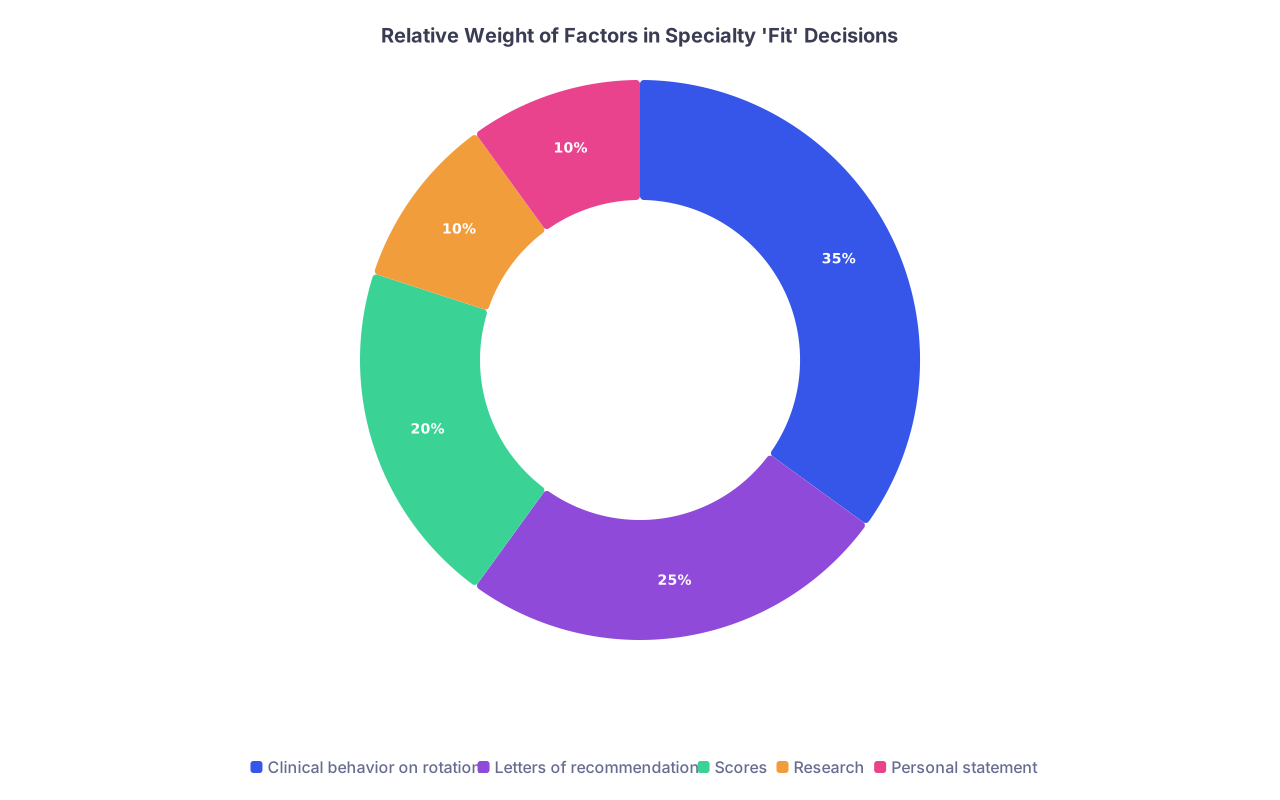
That breakdown is roughly how attendings behave, not how they talk in public. Clinical behavior and letters (which are mostly based on that behavior) dominate. Scores and research are filters, not final deciders among people already in the running.
So no, you cannot “make up for” being unreliable on rotation with a nice Step 2 score. That’s not how human memory works.
How to Actually Apply This Starting Tomorrow
I’ll give you a concrete way to operate on your next rotation without trying to game everything.
Pick 2–3 rotations that line up with specialties you might want. Treat those as active test-drives on both sides. Watch your own energy closely: when are you drained vs. satisfied-tired?
On those rotations, ask one attending a direct, gutsy question:
“If I were your intern in this specialty, what would be the top 2–3 things you’d want to see from me as a student that tell you I’d be a good fit?”
Then actually live that out. Residents talk. Attendings notice when you implement feedback.On every rotation, regardless of interest, behave like your specialty will someday ask that attending what you were like. Because they might. Network is smaller than you think.
Notice how you behave when nobody is watching. The version of you in those moments is what attendings pick up on faster than any polished performance.