
It is 10:30 p.m. You just finished your first clinical rotation that felt amazing. The team loved you. The attending told you, “You’d make a great [insert specialty].” A patient thanked you by name. You walk out of the hospital thinking, “That’s it. I found it. I’m going to be a ____.”
Stop right there.
This is exactly the moment when a lot of students make one of the worst career mistakes in medical school: locking in a specialty after a single “perfect” rotation and then bending the rest of their training (and life) around that decision.
I have watched students do this with surgery, EM, psych, OB/GYN, peds, derm, you name it. The specialty is not the danger. The premature commitment is.
Let me walk you through the traps.
Mistake #1: Confusing a Great Team with the Right Specialty
One “great” rotation is usually code for one thing: a great team.
You had:
- An attending who actually taught and gave feedback.
- Residents who did not humiliate you.
- A schedule that did not completely destroy your sleep.
- A patient population that was grateful and interesting.
All of that matters. It does not, by itself, define a career.
The classic pattern I have seen:
You do Internal Medicine first. You get the unicorn team: chill residents, smart but kind attending, no malignant personalities, good teaching. You think, “IM is incredible. I love this.” Then you do Surgery. Your first week is on a service with a burned-out fellow who hates students, and you are the human retractor. Now you say, “I could never do surgery.”
What did you actually learn?
You learned what it feels like to work with a functional vs dysfunctional team. You did not fully learn what day-to-day internist vs surgeon life looks like over decades.
Locking in here is dangerous because you:
- Over-attribute your happiness to the specialty label.
- Underestimate the impact of one specific micro-environment.
- Miss the chance to see that another field might be even better with the right team.
You need a minimum of:
- One good rotation in a specialty that you think you do not like.
- One bad or mediocre rotation in the specialty you think you love.
Until you have both, you are extrapolating from biased data.

Mistake #2: Ignoring the “Boring Days” Data
A single “great” rotation often has highlight bias. You remember:
- The high-acuity trauma you saw in ED.
- The incredibly satisfying psych patient who actually got better.
- The delivery you assisted in at 3 a.m.
- The first central line you watched in awe.
You do not remember Tuesday afternoon when nothing happened and you were on Epic for 6 hours straight.
Here is the real question you are avoiding: “Can I tolerate the boring, annoying, routine parts of this specialty for 20–30 years?”
You cannot answer that from one high-yield month.
Every specialty has:
- Glamour cases.
- Soul-sucking paperwork.
- Patterns that repeat. Over and over.
The mistake is falling in love with the peaks and ignoring the baseline.
If you come off a rotation saying “I loved that month,” ask yourself:
- Did I like the average day, or just the big moments?
- How many days felt like drudgery, and did that feel acceptable?
- Did I only enjoy it because it was all new and I was a spectator, not responsible?
As a student, you are buffered from the worst parts: billing, RVU pressure, clinic template overload, call responsibility, litigation stress. You see maybe 50% of what actually defines the job.
If your conclusion is “I must do this” after one high-peak month, you are ignoring the boring-days data you have not even collected yet.
Mistake #3: Underestimating How Much Autonomy Changes Everything
Another trap: you like a specialty as a student or sub-I because you do not have real responsibility.
Classic example: emergency medicine.
As a student you:
- See interesting cases.
- Present. Disappear to read. Come back with a plan.
- Go home when your shift ends. No phone calls overnight. No follow-up.
As an attending you:
- Own sick patients.
- Own every miss.
- Get the 3 a.m. lawsuits and QA reviews if something goes wrong.
This applies across the board:
Surgery as student = “cool cases, I closed some skin, I got to scrub.”
Surgery as attending = complications are yours, every consent is yours, every 2 a.m. re-op is yours.Psych as student = long conversations, psychopharm puzzles.
Psych as attending = constant prior auth, risk assessments, pressured systems and sometimes unsafe environments.IM as student = teaching rounds, long differential discussions.
IM as attending = clinic templates, chronic disease management, poor follow-up, documentation demands.
Locking in before you have even seen what senior residents deal with—let alone attendings—is how you end up in year 3 of residency saying, “I did not sign up for this.” But you did. You just did it based on student-level exposure.
You must at least:
- Watch closely what PGY-2 and PGY-3 residents’ days look like.
- Ask explicitly, “What parts of your job do you hate?”
- Notice what tasks actually fall on the attending vs being shielded from your view.
If you avoid those questions because you already “know” this is your specialty, that is not confidence. That is denial.
Mistake #4: Letting Early Identity Solidify Too Fast
Once you tell enough people “I am going into ortho” or “I am definitely doing derm,” something subtle but powerful happens: sunk-cost identity.
You start:
- Selecting rotations, research, mentors that reinforce the choice.
- Minimizing experiences that conflict with it.
- Feeling embarrassed to admit you are unsure.
I have heard this exact sentence more times than I like: “I realized halfway through fourth year that I liked another specialty more, but I had already invested so much into X. It was too late.”
The timeline is unforgiving. Look at it:
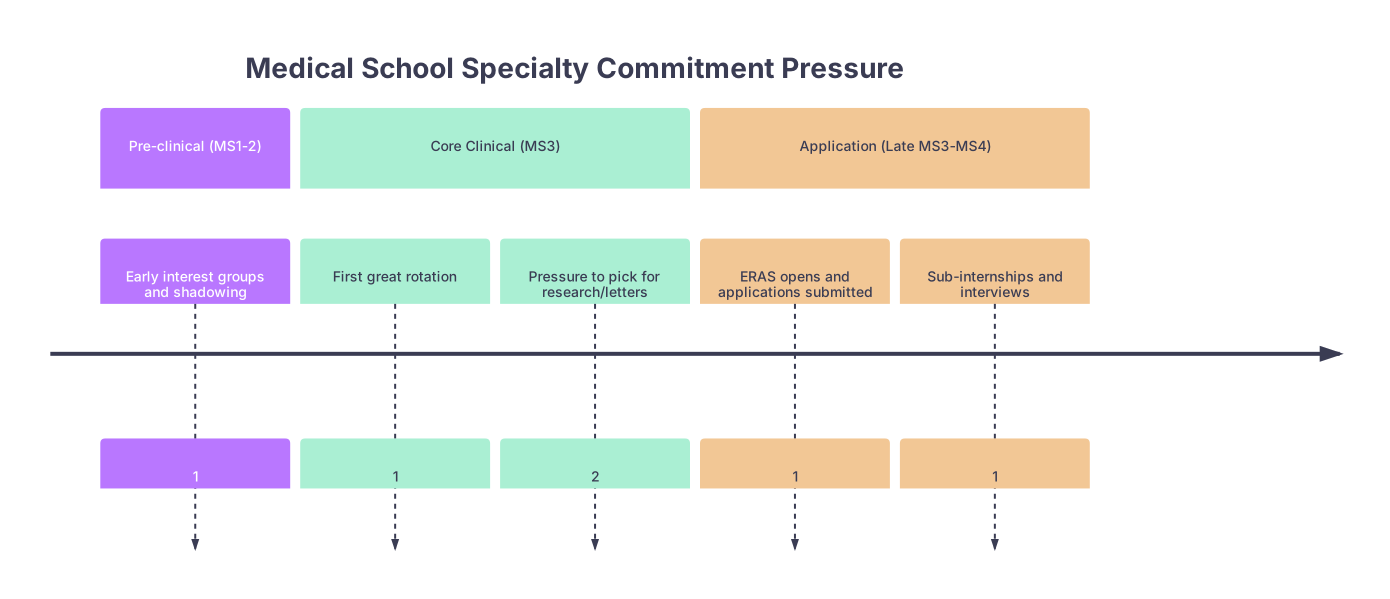
| Period | Event |
|---|---|
| Pre-clinical (MS1-2) - Early interest groups and shadowing | 1 |
| Core Clinical (MS3) - First great rotation | 1 |
| Core Clinical (MS3) - Pressure to pick for research/letters | 2 |
| Application (Late MS3-MS4) - ERAS opens and applications submitted | 1 |
| Application (Late MS3-MS4) - Sub-internships and interviews | 1 |
One too-early declaration can lock your trajectory before you have any rounded view of yourself as a clinician.
The mistake is not exploring an interest. The mistake is converting “this was a great rotation” into “this is my permanent identity” and then constructing your life around that story before it has been tested.
You are allowed to:
- Say “I am leaning toward…” instead of “I am definitely…”
- Tell mentors “I am still exploring between A and B.”
- Change your mind after a later rotation completely surprises you.
What you are not allowed to do—if you want to avoid regret—is shut down curiosity because you are scared to look indecisive.
Mistake #5: Confusing Match Strategy with Life Strategy
I know the pressure. You hear:
- “You have to commit early if you want competitive specialties.”
- “Research takes years; you cannot wait.”
- “You need letters from big names in that field by early MS4.”
Some of that is true. Competitive fields do reward early focused effort.
But here is what goes wrong: students treat “I need to be strategic for the match” as “I must irrevocably decide my life at 24.”
You can be strategic and honest about uncertainty.
The dangerous version:
- MS3 February: One amazing anesthesiology month.
- March: Decide “I am anesthesia-only.”
- April–June: Decline electives in other fields, chase anesthesia research only, tell everyone you are set.
- July: Do a surprisingly great neuro rotation and realize maybe you like that more.
- August: Too late. Your letters, CV, and schedule are locked into anesthesia.
The smarter version:
- After that great rotation, write down specifically what you liked: pace, acuity, procedures, limited clinic, circadian rhythm, whatever.
- Then intentionally schedule at least one other rotation that shares those traits but is a different specialty.
- Build a research plan that could pivot slightly if you changed to a related field.
| Aspect | Healthy Exploration | Premature Lock-In |
|---|---|---|
| How you talk | "Leaning toward X, exploring Y" | "I am 100% X" after one rotation |
| Rotations chosen | Mix of interests, compare fields | Only one field, no comparison |
| Research | Related but somewhat flexible | Hyper-narrow, locks you to one field |
| Letters | From varied mentors | Only within one specialty |
| Mindset | Curious, testing assumptions | Defending choice, ignoring doubts |
You need to match once. You have to live with the specialty for decades. Do not optimize for a single day in March at the expense of your actual daily life later.
Mistake #6: Over-Weighting Praise and External Validation
One powerful driver of “great rotation = my future” is very simple: someone finally told you that you are good at something.
The attending who says, “You have the hands of a surgeon.”
The psych resident who says, “You really get these patients.”
The peds team that calls you “a natural.”
Feels amazing. Also highly unreliable as a career compass.
Why?
- Many attendings say that as encouragement, not prophecy.
- They see you for 2–4 weeks. They do not see your longer patterns, your stress reaction, your real energy.
- Some specialties are more effusive than others. (Peds will praise your sticker application skills; surgery may grunt once in your direction and that is high praise.)
If you are starved for validation, it is very easy to decide you “belong” where you finally got it.
The problem: praise is often about how you adapted to their needs, not about your internal fit with the specialty.
Here is the healthier rubric after a “great” evaluation:
Ask yourself:
- Did I feel like myself on this rotation, or was I performing a role to impress them?
- Did I have energy after work, or was I drained but running on adrenaline and praise?
- If they had been neutral, or even a bit critical, would I still think this field was interesting?
If the honest answer is “I would not be half as excited if they had not praised me,” then your reaction is about approval, not alignment.
Do not choose a specialty because one attending told you a flattering sentence while you were sleep deprived and desperate for reassurance.
Mistake #7: Ignoring Your Body’s Feedback
Your body does not care what looks good on paper. It also does not care what your med school culture idolizes.
It responds to:
- Sleep patterns.
- Chronic stress load.
- Types of cognitive and emotional labor you are doing.
One “great” rotation can trick you because, for 4 weeks, you can brute-force your way through anything. You can caffeinate through nights, white-knuckle through OR marathons, emotionally absorb crying families. For a month, almost any specialty is survivable.
The question is: What happens by week 3, not day 3.
Warning signs I have seen students ignore after a “great” rotation:
- Needing 12 hours of sleep on post-call days just to function.
- Developing anxiety days before call.
- Dreading specific core tasks (clinic days, consults, procedures) even when they love the field conceptually.
- Feeling weirdly relieved when a case gets canceled.
They still say, “But I loved it. It was so exciting.” No. They loved parts of it. Their nervous system is sending a different message about sustainability.
You cannot know everything from one month, but you can pay attention to:
- How your sleep responds to the schedule.
- Whether you feel chronically behind and frazzled or healthily challenged.
- Whether the stress feels meaningful or toxic.
If your body is already rebelling during a honeymoon-phase rotation, imagine it five years into residency.
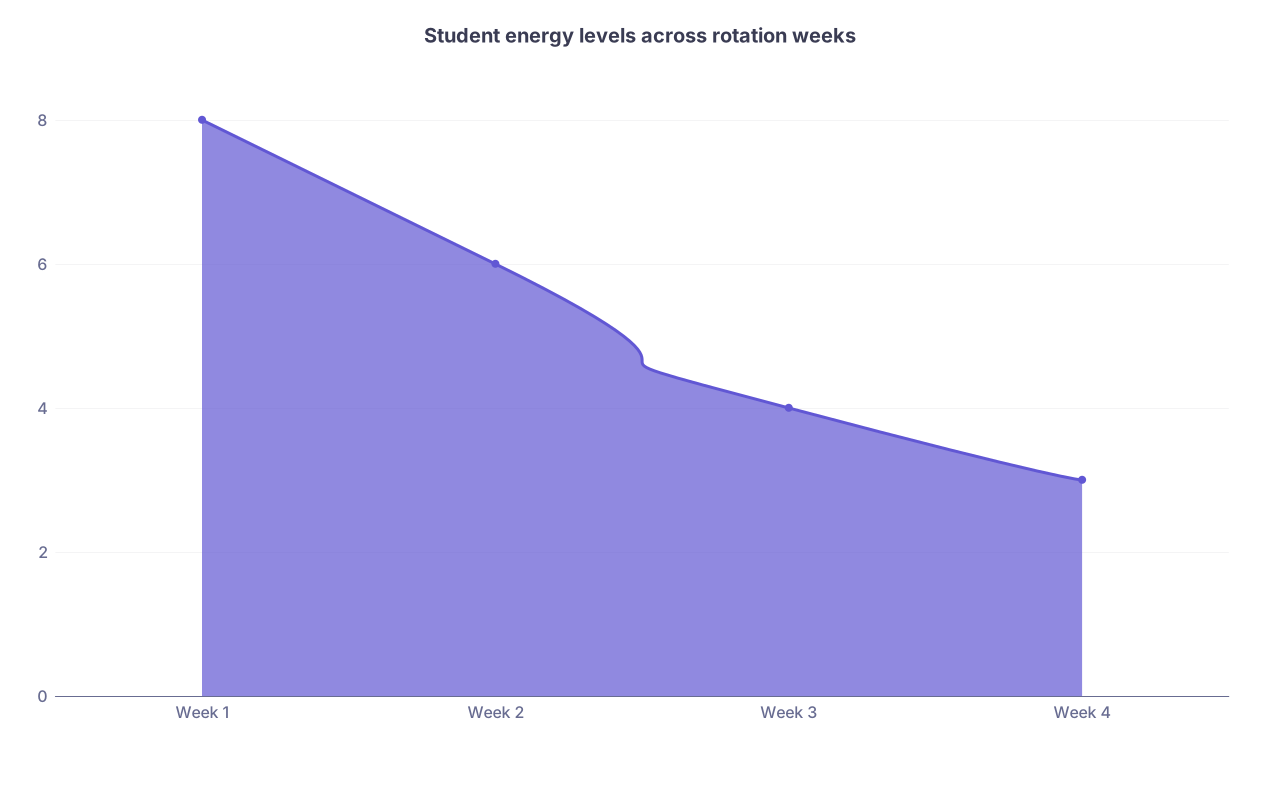
| Category | Value |
|---|---|
| Week 1 | 8 |
| Week 2 | 6 |
| Week 3 | 4 |
| Week 4 | 3 |
If that graph matches how you felt and your only explanation is “but the cases were awesome,” be very careful about locking in.
Mistake #8: Not Stress-Testing Your Choice Against Reality
Before you commit, you need to try to break your own decision. Like quality control for your life.
Most students do the opposite: they protect their choice from criticism, seek confirming evidence, and avoid hearing downsides because it makes them anxious.
This is the wrong move.
You should actively seek:
- The resident who says, “If you are thinking about this field, you need to know X sucks.”
- The attending who will honestly tell you, “If you hate paperwork / difficult families / night shifts, this will make you miserable.”
Here is a simple stress test process:
- Write down the specialty you are “sure” about after the great rotation.
- List exactly what you think you like: procedures, pace, patients, lifestyle, prestige, money, intellectual fit.
- For each item, ask two questions:
- Could I get this in another specialty too?
- What is the hidden cost that comes with this benefit?
- Then deliberately schedule at least one more rotation in a field that overlaps some of those features.
Example:
You loved OB/GYN because:
- Deliveries are meaningful.
- You like procedures.
- You want continuity with patients.
Hidden costs: crazy hours, irregular nights, high litigation, both surgery and clinic, sometimes brutal call.
Where else could you get some of that? FM with OB. IM with procedures. Maybe even EM for high-acuity deliveries.
This is not about talking yourself out of OB/GYN. It is about proving to yourself that you chose it knowing the tradeoffs, not seduced by one magical L&D month.

How to Explore Without Drifting Forever
There is a real fear underneath all of this: “If I keep my options open, I will never decide.”
You do need to decide. But there is a big difference between:
- Open-ended drifting (paralysis).
- Structured exploration with a deadline (wisdom).
Here is a straightforward structure that avoids both paralysis and premature lock-in:
During early MS3:
- After each rotation, write a 1-page reflection: what you liked, what you hated, how you felt physically and mentally.
- No declaring yet. Just data collection.
After 3–4 core rotations:
- Narrow to 2–3 “contender” specialties.
- Specifically plan to experience all of them in some meaningful way before the end of MS3: electives, shadowing, extra call shifts.
Mid-to-late MS3:
- Start leaning. Not declaring. “I am between IM and EM, leaning IM,” is honest and gives mentors something to work with.
- Begin getting letters that could serve more than one field if possible (e.g., strong IM letter can support cards, GI, hospitalist interest later).
By early MS4:
- Commit based on patterns across months, not one golden rotation.
- If you are still torn between two, have hard conversations with mentors in both fields about real lifestyle, competitiveness, and long-term fit.

| Step | Description |
|---|---|
| Step 1 | Start MS3 Rotations |
| Step 2 | Reflect after each rotation |
| Step 3 | Keep exploring 2-3 fields |
| Step 4 | Stress-test choice with residents |
| Step 5 | Commit and plan applications |
| Step 6 | Specialty stands out repeatedly? |
| Step 7 | Still best fit after stress test? |
That is how you avoid both reckless early commitment and endless indecision.
Red Flags You Are Locking In Too Early
If any of these feel uncomfortably familiar, take it seriously:
- You are avoiding scheduling rotations in other fields because “what is the point, I already chose.”
- You feel defensive or annoyed when someone questions your chosen specialty.
- Your “evidence” for the choice is mostly one rotation and one attending’s praise.
- You have never spent real time watching residents / attendings in your “backup” specialty that you keep mentioning to appease people.
- You feel secretly relieved that early commitment means you do not have to think about it anymore.
That relief is seductive. It is also exactly how people sleepwalk into the wrong career.
You do not need to blow up your plans. You may indeed have found the right field. But you do need to stress-test it honestly before you bet the next decade on one month.
FAQ (exactly 4 questions)
1. What if my first “great” rotation actually is the right specialty for me?
That happens. Some people really do click with their eventual specialty immediately. The problem is not loving it early; the problem is refusing to question that love. If, after you expose yourself to other fields, pay attention to your physical and emotional reactions, and actively try to find reasons not to choose it, and it still wins—good. Then you are choosing it with eyes open, not just riding the high of a honeymoon month.
2. How many rotations should I do before feeling comfortable deciding?
You do not need to wait until the last week of MS4, but deciding after one or two rotations is reckless. By the middle-to-end of MS3, most students have enough data if they have: (1) done all the core clerkships; (2) actually reflected after each one; and (3) done at least one extra experience in their top 1–2 contenders. The key is patterns across months, not perfection on one service.
3. What if I already committed early and now I am doubting my choice?
Do not ignore the doubt. Talk to mentors in both your current target specialty and the one tugging at you. Be specific: show them your schedule, application timeline, and concerns. Sometimes you can pivot within the same year (especially between related fields). Sometimes it is more complex. What you must avoid is silently marching on because you are embarrassed to admit that your “great” rotation might have misled you.
4. How do I talk to attendings if I am unsure without sounding unfocused?
Be clear and intentional. Something like: “I really enjoyed this rotation and could see myself in this field, but I am also considering [other specialty]. I am trying to understand the real differences in day-to-day life and long-term satisfaction before I commit. Could you share what personalities tend to thrive in this specialty and what usually makes people unhappy?” That sounds thoughtful, not flaky, and good mentors will respect it.
Open your notes app right now and list your last three rotations. Under each, write two columns: “peaks” and “daily reality.” If your favorite specialty so far is based almost entirely on peaks and very little on daily reality, you have some work to do before you let that one “great” month decide your entire career.