
The way most medical students choose a specialty is lazy and unreliable.
“See what you like on rotations” is not a strategy. It is gambling with your career.
You have two powerful data streams almost everyone underuses:
- your personality profile, and
- your clerkship feedback.
Used correctly, those two will cut your uncertainty in half. Maybe more. Let us build an actual system for it.
Step 1: Turn “Personality” Into Usable Data
Vague self-reflection is useless. You need structured input.
Here is what I recommend:
- One broad personality test
– Big Five (IPIP-120 or 50) or the NEO if you have access - One work-style / values inventory
– VIA character strengths, CliftonStrengths, or a work values survey - One “fit” style assessment (optional, but helpful)
– Even something like Holland Codes (RIASEC) is better than nothing
You are not trying to label yourself forever. You are trying to get numbers and language you can actually compare to specialties.
What to pull out of any personality test
You do not need every subscale. Focus on these domains and translate them into practical questions:
Extraversion / Introversion
- Do you get energy from people or from being left alone to work?
- How quickly do you get social fatigue on a busy clinical day?
Conscientiousness
- Are you naturally structured and detail-focused?
- Do you like long-term follow-up, tracking labs, adjusting meds?
Openness / Need for novelty
- Do you crave variety and new problems?
- Or prefer predictable patterns and clear protocols?
Emotional Stability (Neuroticism inverse)
- How well do you handle chaos, uncertainty, and high stakes?
- Do you ruminate after mistakes or move on?
Agreeableness / Conflict style
- Do you avoid confrontation?
- Are you comfortable setting hard boundaries?
Now, put it into a simple snapshot. Literally write it down:
- “I am: high extraversion, high conscientiousness, moderate openness, high emotional stability, moderate agreeableness.”
- Plus 3–5 bullet lines of what that actually looks like in your behavior.
If you do not write it, you will forget it. Or worse, you will shape your “memory” of your personality around whatever specialty you feel pressured into.
Step 2: Extract the Signal from Clerkship Feedback
Most students treat evaluations like a pass/fail: “Did I get honors?”
That is not data. That is ego.
You want patterns. Strength clusters. Weakness clusters. Situational differences.
Here is the protocol:
1. Collect and centralize
Pull every written comment from:
- Core clerkships (IM, surgery, peds, OB/GYN, psych, FM, neurology, EM if available)
- Mini-electives / subspecialty rotations
- Simulation evaluations if they had narrative comments
Paste them into a single document. Strip out names and non-essentials.
Now sort comments by rotation. Under each rotation, you will have 5–20 comments, depending on your school.
2. Code the comments quickly
You are looking for categories, not detailed qualitative research. Use simple tags in the margin or bold them in-line. Examples:
- “Hardworking” →
WORK_ETHIC - “Reads around cases” →
INTELLECTUAL_CURIOSITY - “Excellent with patients / families” →
PATIENT_COMM - “Good with the team, very helpful” →
TEAM_PLAYER - “Calm in stressful situations” →
POISE - “Needs to be more decisive” →
DECISION_MAKING_WEAK - “Slow with procedures” →
PROCEDURE_SLOW - “Picks up procedures quickly” →
PROCEDURE_TALENT - “Struggles to prioritize tasks” →
ORGANIZATION_WEAK - “Strong presentations” →
PRESENTATION_STRONG - “Weak documentation” →
NOTES_WEAK
You can pick your own tags. Just be consistent.
Now, for each rotation, count how many times key tags appear.
| Rotation | Patient Comm | Team Player | Procedure Talent | Organization Weak | Decision Making Weak |
|---|---|---|---|---|---|
| IM | 4 | 3 | 0 | 2 | 1 |
| Surgery | 2 | 3 | 4 | 1 | 0 |
| Psych | 5 | 2 | 0 | 0 | 2 |
| EM | 3 | 2 | 3 | 1 | 0 |
3. Look for environment-dependent strengths
This part most people miss.
You want to ask:
- Which strengths only show up in certain contexts?
- Which weaknesses disappear in other contexts?
Example I have actually seen more than once:
- On surgery: “Calm with rapid changes”, “Quick hands”, “Learns procedures rapidly”
- On IM: “Occasionally disorganized”, “Needs to improve follow-up planning”
Same student. Different environment. That is your clue. That student probably feels more “at home” with acute, procedural work and less with long-term follow-up and complex outpatient management.
Another pattern I have seen:
- On psych and peds: “Connects easily with patients”, “Excellent listener”, “Families love her”
- On EM: “Needs to move faster”, “Occasionally misses key ROS questions in haste”
That is someone whose strength is depth with people, not speed and triage.
Step 3: Build a Specialty-Fit Matrix (Personality + Feedback)
Now you have:
- A structured personality profile
- A coded, rotation-wise summary of how you actually behave in real clinical environments
Time to combine them into something you can act on.
1. Define what different specialties actually demand
You know the stereotypes. I want you to get more specific.
Think in terms of:
- Time horizon of care (minutes-hours vs days-weeks vs years)
- Typical work setting (OR, ED, clinic, wards, ICU, mixed)
- Interaction density (how many brief vs deep encounters per day)
- Cognitive vs procedural balance
- Tolerance for uncertainty vs love of protocol
- Team vs solo work
Here is a simplified snapshot for a few common specialties:
| Specialty | Time Horizon | Setting Mix | Interaction Style | Cognitive vs Procedural |
|---|---|---|---|---|
| EM | Minutes–hours | ED | High volume, brief | Mixed, high triage |
| IM | Days–years | Wards/clinic | Moderate depth | High cognitive |
| Surgery | Hours–days | OR/wards | Team-based, focused | High procedural |
| Psych | Weeks–years | Inpt/clinic | Deep, long conversations | High cognitive |
| FM | Years | Clinic | Longitudinal, varied | Cognitive with some procedures |
You can build a larger table for your own use that includes anesthesia, OB/GYN, radiology, path, neurology, etc.
2. Overlay your personality data
Look for alignment and friction:
- High extraversion + high social stamina → good match for:
- EM, OB/GYN, some surgical fields, FM clinic-heavy practices
- Introversion + love of deep solitary work → better match for:
- Pathology, radiology, research-heavy IM, certain consult specialties
- High conscientiousness + comfort with chronic complexity → IM, nephrology, rheum, endocrine
- High need for variety + novelty → EM, med-peds, hospitalist, some surgical subs
Do this on paper. Create a matrix with your traits down one side and specialties across the top. Mark:
- “+” if the trait clearly supports that specialty
- “−” if it clearly conflicts
- “0” if neutral
It will not be mathematically perfect, but it will force clarity.
3. Overlay clerkship feedback on top of that
Now for each specialty, ask:
- On rotations most similar to this specialty, what tags dominated?
- Did you feel you were “swimming with the current” or fighting it?
For example:
Thinking about EM:
- Look at ED, surgery nights, maybe ICU time.
- Did people comment on calm in chaos? Rapid decision making? Or did you get “slow to act”, “overthinks decisions”?
Thinking about IM:
- Look at IM and FM rotations.
- Did faculty praise your follow-up plans, med adjustments, patient education? Or did they emphasize “needs to be more organized”, “forgets to follow through on details”?
Thinking about surgery:
- Look at surgery and procedural electives.
- Did your evaluations say “technically skilled”, “quick learner in the OR”? Or “tentative with instruments”, “needs to work on efficiency”?
This is you stress-testing your personality model against observed performance.
Step 4: Use a 3-Bucket Shortlist Method
You are not choosing a specialty yet. You are cutting the field down intelligently.
Create three buckets:
Strong Fit (Green)
- Personality alignment: mostly “+” in your matrix
- Feedback on similar rotations: mostly strengths, you felt engaged
- You could see yourself doing the day-to-day work you actually saw
Conditional Fit (Yellow)
- Mixed signals (some strong fits, some real concerns)
- Personality is a decent match but evaluations revealed a major skill gap
- Or personality questionable, but you consistently performed well and enjoyed the work
Poor Fit (Red)
- Personality and daily realities are clearly at odds
- Rotations that felt like a grind even when you were “doing well”
- Consistent feedback about misalignment (e.g., slow with procedures but considering ortho purely for lifestyle/compensation)
Be ruthless. This is not permanent. You can always pull a specialty back from red to yellow if something changes, but right now you need clarity.
An example:
- Green: IM, Psych, FM
- Yellow: EM, Neurology
- Red: General Surgery, Ortho, OB/GYN
That does not mean you are “bad” at red specialties. It means, based on data, they are a bad bet for you.
Step 5: Run Real-World Tests on Your Shortlist
Thinking is not enough. You need targeted testing.
For each Green and Yellow specialty, do three things:
One focused elective or sub-I in that field
- Not a random two-week taster. A solid 4-week block if possible.
- Tell your attending: “I am seriously considering this specialty and want honest feedback about my fit.”
One structured conversation with a resident + an attending
- Ask very specific questions:
- “On a typical day, what percentage of time is procedures vs notes vs direct patient interaction?”
- “What personality traits do poorly in this field, even if they are technically strong?”
- “What kind of feedback do struggling residents often get here? Does that sound like mine?”
- Ask very specific questions:
A brutally honest end-of-rotation debrief with yourself
- Right after the elective, answer these in writing:
- At the end of a normal day on this rotation, did I feel drained, neutral, or energized?
- What part of the work felt natural?
- What part felt like I was putting on a costume?
- If salary and prestige were identical across specialties, would I still be considering this?
- Right after the elective, answer these in writing:
You are not looking for “I loved every minute.” That is fantasy. You are looking for “The trade-offs feel acceptable, and the core tasks feel like me.”
Step 6: Handle Conflicts Between Personality Data and Feedback
Sometimes the data fight. Example:
- Personality test: introverted, low on sensation-seeking
- Surgery rotation: glowing evals, strong technical skills, attendings pushing you toward surgery
Or:
- Personality test: very high extraversion
- Psych rotation: top-tier feedback, and you actually enjoyed long therapy-like conversations
- EM rotation: you liked the speed but felt scattered, got comments on missing details
How to sort that out:
Rule 1: Trust behavior in real clinical environments over abstract test results
Tests are models. Clerkship behavior is reality.
If over multiple rotations similar to a specialty you consistently thrive, that signal matters more than a single trait that “does not match the stereotype.”
Rule 2: Distinguish between can do and want to do long-term
You may be good at something that costs you more energy than it gives back.
Ask:
- “Could I sustain this pace and style for 10–20 years without resenting it?”
- “Outside of work, would I have anything left in the tank for the rest of my life?”
If you are technically great at EM but after every shift you need a full day to feel human again, that is a problem. Your future happiness is not a side note.
Rule 3: Be very suspicious of prestige-driven cognitive dissonance
I have watched students twist every piece of evidence to justify:
- “I should go into ortho / derm / plastics / neurosurgery because that is what high-achievers do.”
They downplay:
- That their happiest, most natural rotation was IM or psych
- That feedback about procedures is always “tentative,” “slow,” or “improving but behind peers”
- That they dislike OR culture but tell themselves “I will get used to it”
If your arguments for a specialty sound like you are trying to impress a committee, stop. Go back to the raw data.
Step 7: Use Data to Structure Mentor Conversations (Not the Other Way Around)
Most students do this backwards. They go to an attending and ask, “What specialty do you think I should do?” Attending projects their bias, student leaves more confused.
You are going to walk in with your data.
Here is the script:
- “I have taken a couple of personality inventories; they suggest I am [X traits].”
- “On rotations, here are the consistent things attendings have written about me: [3–5 main tag patterns].”
- “Based on that, I have narrowed my list to [A, B, C].”
- “Given what you know about [their specialty], which of these seems most and least compatible with what the work is actually like?”
You are not asking them to choose for you. You are asking them to help you interpret fit given clear input.
Step 8: Create a Simple Scoring System (Then Override It Intelligently)
If you want something more concrete, build a basic scoring tool for each specialty you are considering (Green + promising Yellow).
For each specialty, rate on a 1–5 scale:
- Personality alignment
- Clerkship performance on similar rotations
- Day-to-day enjoyment of tasks (from your own debriefs)
- Energy balance after typical days
- Tolerance of the worst parts of the job (from talking to residents/attendings)
Example:
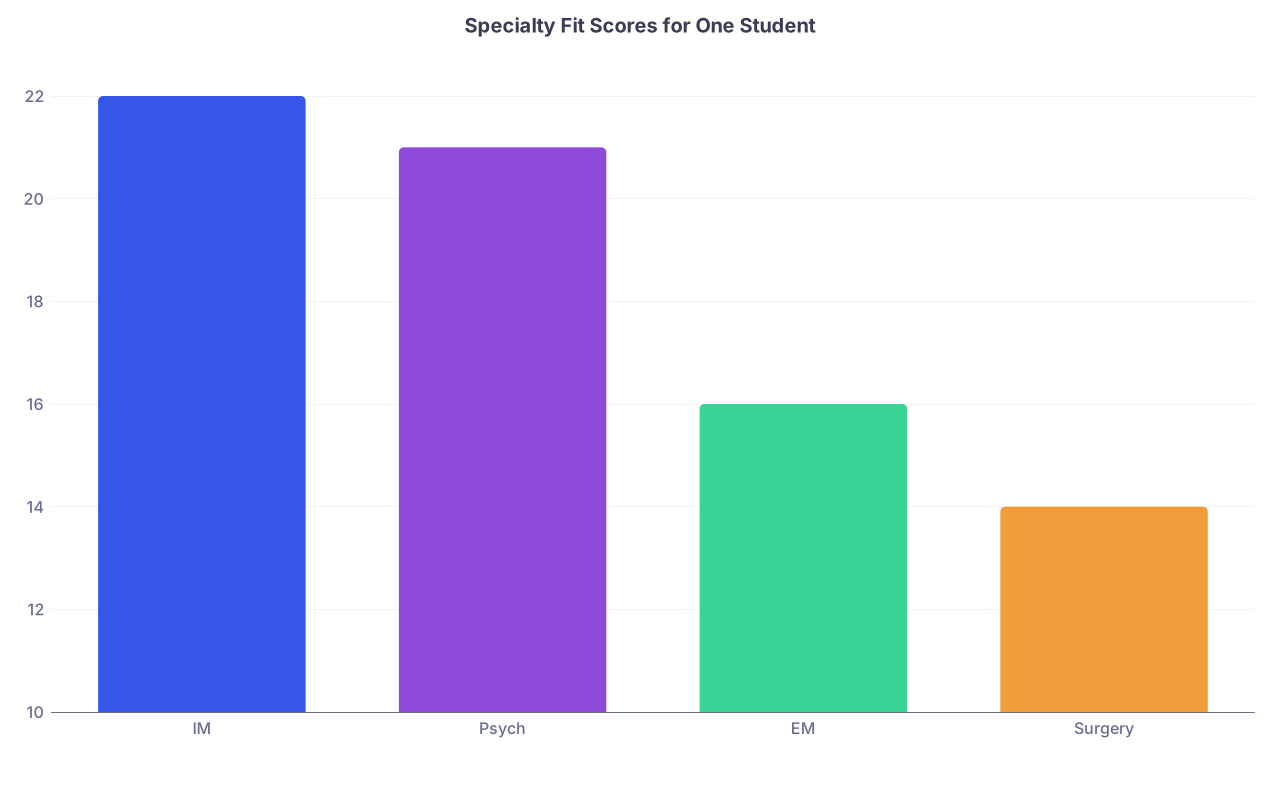
| Category | Value |
|---|---|
| IM | 22 |
| Psych | 21 |
| EM | 16 |
| Surgery | 14 |
You are not doing math to make the decision for you. You are making your own reasoning visible. Once you see it, you can say:
- “Yes, EM scores lower, but I am willing to accept that because I value [X].”
- Or, “Wow, surgery is clearly lagging on energy and enjoyment; I have just been ignoring that.”
If you override the numbers, do it consciously. Write down why.
Step 9: Watch Out for Three Common Failure Modes
I have seen the same three self-sabotaging patterns:
1. Overweighting one magical rotation
You loved one month of a specialty with an incredible team. Laughing on rounds, attendings who taught, residents who shielded you from the worst scut.
Do not confuse:
- “I loved this team”
with - “I love this specialty.”
Cross-check: Did you like the work tasks themselves when the team was not amazing? Procedures? Notes? Phone calls? Night float?
2. Underweighting chronic personality mismatch
Example:
- Very conflict-avoidant student persistently considering EM or certain surgical cultures where direct confrontation is common.
- Or highly introverted student romanticizing a fully outpatient FM clinic with 25 patients a day and nonstop conversation.
You can adapt your style somewhat, but not your basic nervous system. If you leave every day feeling like you role-played someone else, you will burn out.
3. Ignoring lifestyle realities within specialties
Lifestyle is not just specialty-level. It is practice setting:
- Outpatient vs inpatient-heavy
- Academic vs private vs hybrid
- Large group vs small group vs solo
Use your clerkship experiences to notice where you thrived:
- Busy academic wards vs slower community hospital
- High-acuity ICU vs lower-acuity rehab floor
- Fast-paced clinic vs leisurely half-days with fewer patients
Then imagine those realities stretched over a career.
Step 10: Final Decision Framework: A Simple 3-Question Test
When you are close to deciding, stop reading forums. Stop asking twenty more people. Sit with these three questions and answer them honestly:
- On which rotations did I behave most like my “best self” as described in my personality data?
- In which environments did my strengths (as documented in feedback) show up consistently without me feeling like I had to force them?
- If I matched into this specialty and had to stay in it for life, would I feel mostly relief or mostly trapped?
If a specialty gives you:
- “Yes” on 1 and 2
- And “relief” on 3
That is probably your answer.
If you still have two or three that fit, good. You have optionality. Then you can factor in secondary issues: location flexibility, fellowship options, compensation, and so on.

| Step | Description |
|---|---|
| Step 1 | Personality Tests + Values Inventory |
| Step 2 | Summarize Key Traits |
| Step 3 | Clerkship Evaluations |
| Step 4 | Tag Comments and Find Patterns |
| Step 5 | Build Specialty-Fit Matrix |
| Step 6 | Create Green/Yellow/Red Buckets |
| Step 7 | Targeted Electives in Green/Yellow |
| Step 8 | Debrief + Score Each Specialty |
| Step 9 | Apply with Confidence |
| Step 10 | Seek Mentor Input Using Data |
| Step 11 | Refine and Decide |
| Step 12 | 1-3 Specialties Clearly Lead? |
The Bottom Line
Stop guessing. Treat your personality profile and clerkship feedback as real data, not vague “self-knowledge.” Put it in writing. Tag patterns. Build a matrix.
Stress-test your preferences. Use targeted electives, structured self-debriefs, and honest mentor conversations framed by your data, not by other people’s biases.
Choose the specialty where you behave like your best self on an average day, not an exceptional one. The right field will not be painless. But your strengths will show up naturally, and you will not have to fake your personality for the next 30 years.