
Most of what you’ve heard about switching specialties after residency is wrong.
You’ve probably heard the extremes: “It’s basically impossible” on one side, and “People do it all the time, don’t worry” on the other. Both are lazy takes. The reality is more uncomfortable: it’s absolutely possible, it’s absolutely harder, and the window to make it work is narrower than anyone tells you in med school.
Let’s walk through what actually happens, who pulls it off, and what your odds look like if you decide to change course after residency.
The Myth: “Once You Finish Residency, You’re Locked In Forever”
No, you’re not “stuck forever.” But you are giving up most of your easy options.
There are three very different situations that get lumped together under “switching specialties”:
- Switching during residency (e.g., IM intern → anesthesia PGY‑2)
- Switching right after residency (e.g., board‑certified internist → radiology PGY‑2)
- Pivoting within or adjacent to your field (e.g., FM → urgent care, IM → hospitalist, gen surg → wound care)
The first and third are relatively common and not that dramatic. The second—the clean break into an entirely new specialty after you’re already trained—is where people start telling horror stories.
Those stories aren’t made up. But they’re also not the full picture.
Let me be blunt:
- If you want to switch from internal medicine to family medicine after finishing IM: not that hard.
- If you want to go from family medicine to dermatology after finishing FM: extremely hard, bordering on “you need a unicorn CV and luck.”
- If you want to go from general surgery to radiology mid‑career: hard but done. Every. Single. Year.
The critical question is not “Can I switch?” It’s:
Which direction are you trying to move, and what are you willing to sacrifice?
What the Data Actually Shows (Not the Scary Lounge Gossip)
The problem is that there’s no big, clean public dataset that says, “X% of practicing physicians successfully changed specialties after residency in 2023.” But there are real signals if you know where to look.
You can see it in:
- NRMP data on prior training status of matched applicants
- Program websites stating whether they accept “retrainers”
- ABMS/RCPSC/college policies on second residencies and dual certification
- Anecdotal but consistent patterns from program directors and GME offices
Here’s what those patterns look like in real life.
| Original Specialty | Target Specialty | Relative Difficulty | Typical Sacrifice |
|---|---|---|---|
| IM → FM or FM → IM | Primary care | Low | Minimal pay/years |
| IM/FM → EM (non-EM route) | Urgent/ED work | Moderate | Credentialing limits |
| IM → Cards, GI, etc. | IM subspecialty | Low-Moderate (if competitive) | Fellowship grind |
| Gen Surg → Anesthesia/Rads | Lifestyle specialties | High | New residency, pay cut |
| FM → Derm/Plastics/Ortho | Hyper-competitive | Very High | Second residency, huge risk |
So, no, it’s not a binary of “stuck vs. free.” It’s a gradient with some clear trends:
- Shifts within the same broad domain (medicine, primary care, hospital-based) → easier
- Shifts to lifestyle-heavy, highly competitive, procedure‑intense fields → much harder
- Earlier in your career → much more realistic
You can also see it in how prior‑training applicants match. A non‑trivial number of categorical spots each year go to people with prior GME. Most students never look at those lines in the NRMP data tables. PDs do.
Why It Is Harder After You Finish Residency
Let’s kill the fantasy first.
If you’re a board‑certified hospitalist thinking, “If I hate this, I’ll just go do radiology,” you’re treating residency like a reversible decision. It isn’t. Here’s why.
1. You’re Competing Against Fresh Applicants Who Are Cheap and Flexible
Programs like:
- Younger residents (less family constraint, fewer location demands)
- People who can work nights/weekends without grumbling
- Lower PGY salary obligations
You, on the other hand, may be:
- 32–40, with kids, mortgage, spouse job constraints
- Used to attending salary, not resident pay
- Less willing to uproot for a random program in a random state
Guess who wins in a tie? Not you.
2. You Cost More in Time and Money
GME funding is not infinite. Medicare caps FTE funding. Once you’ve been funded for X years of training, further training can be partially or fully unfunded.
Programs then have to decide:
“Do we want to take a hit on funding for this mature applicant who will cost us more, or just take a fresh grad fully funded for the full term?”
Many still choose the prior‑trained applicant if they fill a need and bring something unique, but it’s a real barrier.
3. You Start Lower on the Totem Pole… Again
I’ve watched full attendings with five years of practice go back to being interns. They’re:
- Asking a PGY‑3 how to log duty hours
- Getting scolded for incomplete notes
- Covering night float and holidays like a 26‑year‑old
Not everyone can swallow that. I’ve seen people bail halfway, not because they couldn’t do the medicine, but because the ego bruise + lifestyle hit was too much.
4. Burnout Makes Risk Tolerance Worse, Not Better
Most people who want to switch specialties after residency aren’t bored. They’re fried. They hate clinic, or call, or RVUs. They’re already running on fumes.
And then they stare down:
- 3–5 more years of residency
- 50–70k salary instead of 250–400k
- Moving away from their support system
So they do the math and stay miserable in their original field, telling students, “You’re stuck once you choose.” That’s not purely wisdom; it’s sometimes regret rationalized as inevitability.
Who Actually Manages to Switch (and How)?
Forget the boogeyman stories. Here’s the profile I keep seeing in successful post‑residency switches.
1. They Move Toward Underserved or Less Competitive Needs
Not everyone is trying to become dermatology royalty.
Common realistic moves:
- FM → hospitalist (often under IM departments)
- IM → EM‑style work via community ED, rural ED, or pathway programs
- Gen surg → anesthesia or radiology in community programs looking for mature residents
- IM/FM → occupational medicine, addiction medicine, palliative, sleep
Many of these don’t require a second full residency. Some are one‑ to two‑year fellowships, or even just certificate pathways with a willing employer.
2. They Have a Clear, Documented Story
The resident who says, “I just realized I like lifestyle” is dead in the water. Everyone likes lifestyle.
The one who can point to:
- Concrete exposure to the new field (electives, moonlighting, research, teaching)
- A timeline of how their interest evolved (not “I decided last week after a bad call shift”)
- Letters from physicians in the target specialty who’ve seen them work
That person gets taken seriously.
I’ve seen an IM hospitalist move into radiology because during residency he spent two years improving imaging turnaround and worked daily in the reading room troubleshooting consults. By the time he applied, rads faculty were writing, “He already functions like one of us.”
3. They Don’t Treat It As a Casual Plan B
The ones who succeed treat it like a full second application cycle, not a side hobby.
They:
- Take Step 3 or equivalent early and crush it
- Do targeted away rotations or observerships even after residency
- Present at the target specialty’s national meeting
- Apply broadly and swallow pride about location or program “prestige”
You can’t half‑commit and expect a program to bet 3–5 years on you.
The Ugly Truth: Not All Directions Are Created Equal
Let’s be very explicit about which moves are realistically on the table and which are fantasy for most people.
Easier (Relatively Speaking)
IM ↔ FM
Overlapping skill sets, similar boards, huge workforce needs. Some countries accept one as equivalent for many roles.IM/FM → ED‑type work
This varies by country and credentialing rules, but in many places, non‑EM‑trained docs staff a large share of smaller EDs and urgent cares. Is it the same as a full EM residency? No. But it’s a real pivot out of clinic‑heavy primary care.Medicine → IM subspecialties
If you’re within a few years of finishing IM and want cards, GI, heme/onc, etc., that’s a standard fellowship pathway, not a specialty switch. Hard if competitive, but structurally straightforward.Gen Surg → non‑OR surgery‑adjacent roles
Wound care, hyperbaric, surgical critical care, trauma without major elective load. Still “surgery world,” but a very different lifestyle.
Moderate
Gen Surg → Anesthesia/Radiology
Seen this more than once. Surgical skills + OR culture familiarity are attractive. Still competitive and funding‑tricky, but if you have strong scores and good letters, it’s doable in the right market.Peds → IM or FM (or vice versa)
Full second residency usually required. But programs sometimes like having someone already comfortable with inpatient care and multitasking.
Very Hard (But Not Technically Impossible)
FM/IM/Peds → Derm, Ortho, Plastics, ENT, Ophtho, Neurosurg
You’re basically fighting your way into the top‑tier competitive match pool after detouring. It happens, but usually with at least one of:- Extraordinary research output
- Existing deep connection to a department
- Willingness to start fully over and move anywhere
- Strong exam history and zero academic red flags
If you’re reading this as an MS2 thinking, “If surgery doesn’t work, I’ll just do neurosurg later,” stop. That’s self‑delusion. Aim at what you want now; don’t count on a heroic back‑door pivot to a hyper‑competitive field in your mid‑30s.
What Med Students Get Wrong About “Keeping Doors Open”
Med schools love to feed you vague counsel: “Choose something broad so you keep your options open.” That advice is half‑true and half propaganda.
Here’s the part that’s correct:
- Broad fields (IM, FM) do give you multiple exit ramps—hospitalist, outpatient, urgent care, admin, non‑clinical roles, subspecialty fellowship.
Here’s the part that’s misleading:
- Doing something you actively dislike, “because it’s broad,” is a bad strategy if your real goal is a narrow, specific field. You do not magically become a better derm applicant by reluctantly doing FM for three years.
In practice:
- If you love a competitive field → go all in now as a student, build that CV properly, and accept some risk.
- If you’re genuinely uncertain between several broad fields → choose the one whose day‑to‑day you can tolerate in its “worst realistic” form, knowing you can pivot within its ecosystem later.
Switching after residency is your safety valve, not your primary plan.
How to Preserve Switching Power While You’re Still in Med School
You’re not just choosing a specialty. You’re choosing how hard you want Plan B to be.
Here’s how to quietly build optionality while still being honest about what you want:
Protect your exam history.
A failed Step or licensing exam makes you radioactive in competitive second‑career switches. Take them seriously the first time.Avoid the most bottlenecked specialties if you’re already ambivalent.
If you’re 50/50 on derm vs IM, go IM. You can have a life, real patients, and exit ramps. You’re not obligated to chase the shiniest field.Build decent relationships outside your chosen field.
The radiology attending who liked you in MS3 might be the one writing your letter if you wake up at 30 and realize you chose wrong.Watch the attendings, not the brochures.
Look at the 40‑ and 50‑year‑olds in that specialty. Are they burned out? Happy? Switching to admin in droves? That’s your future, not the resident wellness pizza party.
A Concrete Example: The Late-Blooming Radiologist
Quick real‑world composite of stories I’ve seen:
- Finished IM, did 3 years as a hospitalist
- Loved diagnostic problem‑solving, hated the treadmill of clinic and endless MyChart
- Started informally hanging out in rads reading rooms, consulting on cases, helping residents interpret complex IM histories
- Picked up imaging‑related QI projects, presented at a regional radiology meeting
- Studied hard, had strong original Step scores, nailed Step 3
- Got three strong radiology letters, made a candid case: “I understand the pay cut, I understand the hierarchy, I’ve done nights and weekends. I want to read and think.”
Was this easy? No. He moved states, took a massive pay cut, and restarted a multi‑year training track in his mid‑30s. His friends thought he was insane.
Ask him now? Best decision he ever made.
That’s the level of seriousness you need if you want a real specialty switch after residency. Not “maybe I’ll think about it,” but “I’m willing to light my comfort on fire for a better 30‑year career.”
Reality Check: Before You Jump, Try Fixing the Job, Not the Specialty
One last myth to demolish: “I hate my specialty” sometimes really means “I hate this particular job configuration.”
Before you blow up your career, experiment with:
- Inpatient vs outpatient
- Academic vs community vs rural
- 1.0 FTE vs 0.7–0.8 FTE
- Day‑heavy vs call‑heavy roles
- Telemedicine, locums, concierge, admin hybrid roles
I’ve seen EM docs who thought they needed to switch to radiology realize that what they actually needed was to get out of a toxic group and drop to 0.8 FTE with more day shifts.
Changing specialties is the nuclear option. Use it if you must. But do not confuse “bad job” with “wrong specialty.”
Visual: When Do People Actually Switch?
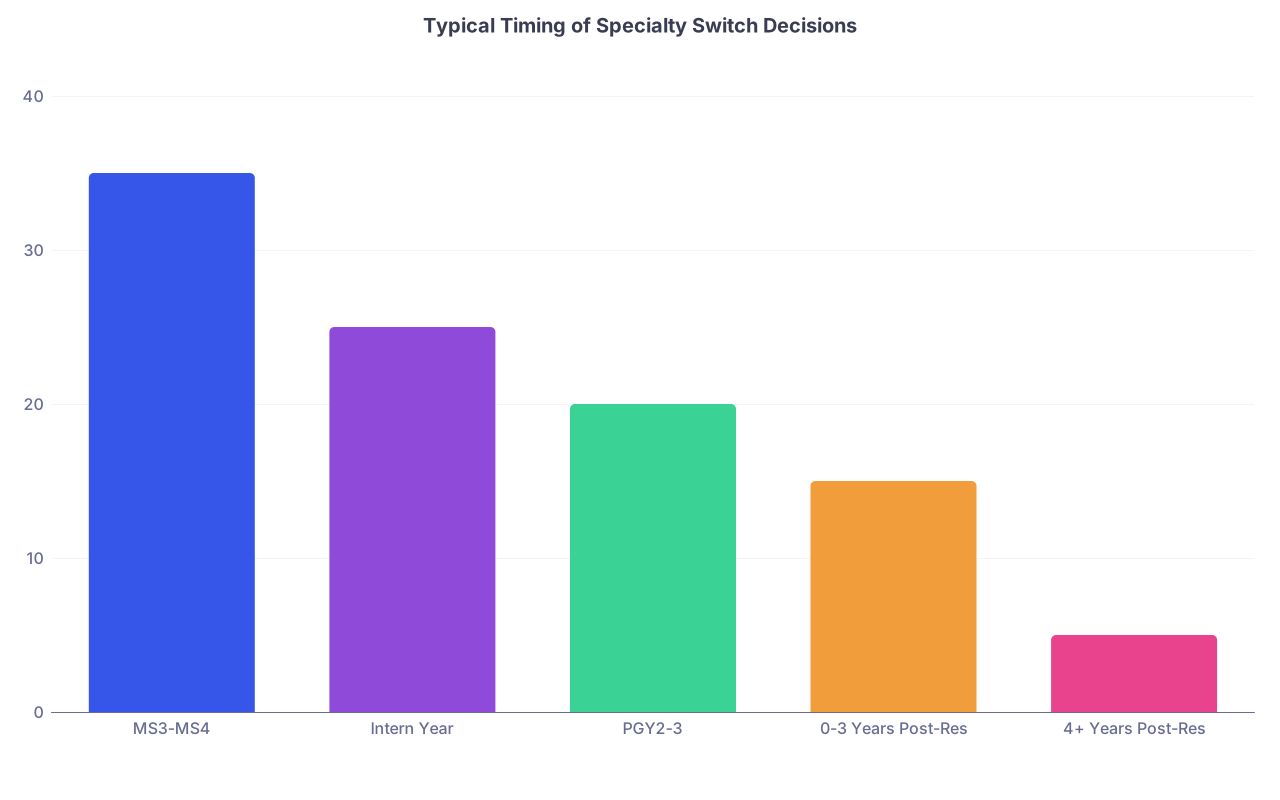
| Category | Value |
|---|---|
| MS3-MS4 | 35 |
| Intern Year | 25 |
| PGY2-3 | 20 |
| 0-3 Years Post-Res | 15 |
| 4+ Years Post-Res | 5 |
(These percentages are approximate, based on program director reports and GME anecdotes, not an official registry—but the pattern tracks reality: the further out you go, the rarer the switch.)
Process Snapshot: How a Post-Residency Switch Actually Plays Out

| Step | Description |
|---|---|
| Step 1 | Realize Misfit |
| Step 2 | Clarify Target Specialty |
| Step 3 | Shadow / Electives / Moonlighting |
| Step 4 | Talk to PDs in Target Field |
| Step 5 | Assess Feasibility & Funding |
| Step 6 | Optimize Within Current Field |
| Step 7 | Study & Take Exams |
| Step 8 | Get Strong Letters |
| Step 9 | Apply Broadly to Programs |
| Step 10 | Interview & Negotiate Start Level |
| Step 11 | Accept Position & Restart Training |
| Step 12 | Still Worth It? |
This is not a weekend decision. It’s a multi‑year plan.
One More Angle: Some Shifts Don’t Need a Full Switch
Don’t underestimate adjacent moves that completely change your day‑to‑day without new boards:
- IM → informatics, quality, utilization management
- FM → occupational medicine or student health
- EM → urgent care, telemedicine, event medicine
- Surgery → device industry, clinical trials, medical director roles
You’re still “in” your specialty on paper, but your life can look nothing like standard practice. Many burned‑out attendings find their sweet spot here instead of restarting a residency.
Final Takeaways
Let’s strip this down to the essentials.
Switching specialties after residency is absolutely possible, but the direction and competitiveness of the target field matter more than anything. IM → FM is not the same universe as FM → Derm.
The cost is real: money, time, ego, and location flexibility. People who succeed treat it like a deliberate second career launch, not a casual pivot.
As a med student, your best play is to choose thoughtfully now, protect your exam record, and build relationships across fields—so that if you ever do need to switch, you have real leverage, not just vague regrets.