
The idea that shadowing and sub-internships are equally useful for choosing a specialty is a myth. Faculty do not weigh them the same. Not even close.
Let me be blunt: shadowing is for you. Sub-Is are for them.
Shadowing helps you decide if you can tolerate a specialty. Sub-Is help them decide if they can tolerate you.
I’ve sat at the table where your name gets brought up. I’ve watched program directors scroll past shadowing-heavy CVs without a second glance and then stop cold at a single strong sub-I comment. If you understand how faculty actually use (or ignore) these experiences, you’ll stop wasting time chasing the wrong “experiences” and start setting yourself up to be the kind of student people will fight to recruit.
What Shadowing Really Signals To Faculty
Shadowing is oversold to students and nearly invisible to faculty.
To you, it feels like a big deal. Early mornings in clinic, OR days, watching cases, trying not to be in the way. To most attendings on selection committees, shadowing is background noise.
Here’s what actually runs through people’s heads when they see “50 hours shadowing cardiology” on your CV:
- “Okay, they didn’t pick this specialty randomly.”
- “Fine, they at least looked at what we do.”
- “This tells me nothing about whether they can function on a team.”
And that’s about as far as it goes.
The dirty secret: faculty know shadowing is low stakes for you and for the physician. You’re not writing notes. You’re not calling consults. You’re not managing any real responsibility. You’re a spectator with a stethoscope.
When shadowing does matter
There are three specific scenarios where shadowing actually carries some weight behind closed doors:
Early, focused commitment
When an MS1 comes in already shadowing the same neurosurgeon every week for a year, people notice the consistency. Not the “hours.” The pattern. It says: this isn’t a last-minute specialty pivot.Unusual or non-core fields
For specialties like radiation oncology, PM&R, pathology, or neurosurgery where many schools offer limited exposure, shadowing is sometimes the only proof you even know what that field is. Committees for these specialties will at least look for it.Named letters, not the shadowing itself
Faculty do care if that shadowing turns into a real mentorship with a letter from someone known to the program. Nobody is impressed by “Shadowed Dr. X for 40 hours.” They might be impressed by, “Strong letter from Dr. X, who I know and trust.”
What shadowing does for you, not them
The unglamorous truth: shadowing is mainly diagnostic for you.
You find out:
- Can you tolerate the lifestyle rhythm? Morning rounds, night calls, clinics that run late.
- Do you actually like the patients? Geriatrics vs teens vs complex ICU vs surgical patients.
- Can you see yourself speaking this specialty’s language day in, day out?
But here’s what your future program director doesn’t think when they see shadowing:
- “This proves they’re good with patients.”
- “This means they can handle responsibility.”
- “This tells me how they act under stress.”
Because none of that shows up in shadowing. You were never actually under pressure.
So yes, shadowing is critical for you to choose a field. But for them to choose you? It’s barely a data point.
Sub-I: The Loudest Signal You’ll Ever Send
Sub-internships (sub-Is, AIs, acting internships—same thing) are a completely different animal. Faculty use them as your audition tape.
On service, people forget you’re “just a student” faster than you think. Behind closed doors, you’ll hear:
- “Would you want this person on your team at 2 a.m.?”
- “If they matched here, would they sink or swim?”
- “Are they coachable, or are we going to fight them for three years?”
That’s the real question: not “Are they smart?” but “Can we survive training them?”
What faculty are actually scoring in their heads
On a sub-I, nobody cares how many shadowing hours you have. They care how you behave at 4:30 pm when consults are still rolling in and everyone’s blood sugar is crashing.
Here’s the mental rubric nearly every attending and senior resident applies, whether they articulate it or not:
Reliability under pressure
Do you do what you say you’ll do? If I tell you, “Follow up on that CT and call GI,” will it be done without me chasing you? Every single time?Work ethic without theatrics
Are you the student who quietly stays late to finish your notes, or the one who loudly announces they’re “happy to stay” and still disappears at 5?Clinical sense and trajectory, not perfection
Nobody expects you to think like a PGY-3. They care more about whether you connect dots from yesterday to today.
“Yesterday this patient was hypotensive; what changed in their labs? Their exam? Do you anticipate problems?”Emotional temperature
Are you calm when the floor is on fire? Or do you crumble, snap, get snippy with nurses, or disappear when things get stressful?How the staff talk about you when you’re not there
I’ve seen students sunk by a single nurse saying, “Honestly, they’re a little rude.” I’ve watched mediocre test-scorers rescued by, “This student was one of the nicest, most helpful people we’ve had.”
You don’t see those comments written formally, but they’re verbal currency in ranking meetings.
Why sub-I performance outweighs everything else
There’s a moment every application season where someone asks:
“Okay, but have we worked with them?”
Score reports–even now with pass/fail Step 1–can be rationalized. Research can be generated, sometimes inflated. Personal statements can be ghost-edited to death.
But a 4-week block where half the department watched you function? That’s real.
Remember this line: A strong home or away sub-I can erase a mediocre piece of paper. A bad sub-I can torpedo a perfect one.
I’ve watched it play out:
Student with average scores, no flashy research, but a sub-I where three attendings independently said, “I’d be happy if they matched here.” That student jumped 30 spots on a rank list.
Student with high 260+ Step 2, great publications, but a sub-I where residents described them as “checked out” and “condescending to nurses.” That student fell off the rank list entirely. No one wanted to say their name again.
Strength of opinion from people who’ve actually worked with you will always beat abstract numbers.
How Programs Quietly Use Shadowing vs Sub-I in Selection
Let me walk you into the ranking meeting you never see.
You’re a borderline candidate for a mid-tier but solid academic internal medicine program. Your file comes up on the projector. Here’s how it really gets dissected.
| Feature | Shadowing | Sub-Internship |
|---|---|---|
| Predicts day-to-day performance | Very poorly | Very strongly |
| Used to break ties | Almost never | Frequently |
| Source of strong letters | Rarely | Common |
| Risk if weak | Essentially none | Can sink your application |
| Conversation time in meetings | Seconds | Several minutes if memorable |
Nobody’s basing their rank list on who shadowed the longest. They’re basing it on who they’d trust with their service at midnight in July.
Shadowing on paper vs in conversation
On your ERAS/VSLO:
“Shadowed Dr. X in clinic and OR (60 hours).”
In the room:
“Okay, they’ve at least seen the field.”
Then the slide flips. That’s it.
If your shadowing led to a letter, that’s different. Now what matters is not the shadowing, but this sentence buried in your LoR:
“I have known this student for over a year, initially from shadowing and later through clinical work. They are reliable, thoughtful, and patients consistently responded well to them.”
The relationship is the currency. Shadowing was just the entry ticket.
Sub-I narratives that actually change rank lists
Now your sub-I evaluation shows up. Here’s where people slow down.
Common types of comments that move needles:
- “Functioned at the level of an intern by the end of the rotation.”
- “Took ownership of patients beyond expectations for a student.”
- “Will be an asset to any residency program – we would strongly support them matching here.”
In that moment, one of three things happens:
You get bumped up
Someone says: “Do we have room to move them into the top third? They worked with us and were great.”You get protected
When the discussion turns to cutting the list: “Let’s not drop them; they did a strong AI here.”You get quietly removed
The worst: someone who worked directly with you says, “I’d be cautious.” That’s code. Everyone in the room hears it. You’re done.
That’s the real game.
Using Shadowing Strategically To Choose – And Position – Yourself
Shadowing is not useless. It’s just misused.
You should treat shadowing like scouting and networking, not like an application booster.
Use it to choose the right playing field
When you shadow, stop passively watching; start interrogating the career:
- How miserable or energized do residents look at 3 p.m.?
- How often do attendings teach vs just push RVUs?
- What’s the emotional tone with patients—hopeful, chronic grind, high stakes crisis?
Most students shadow like tourists. That’s a waste. You’re trying to answer: “Can I live this life for decades?”
Turn selective shadowing into an actual asset
If you’re serious about a specialty, shadow in a focused, longitudinal way:
- Rather than 10 random one-off days in five specialties, do 4–5 repeated days with the same attending in 1–2 fields you’re actually considering.
- Ask early on: “Down the line, would there be opportunities for me to work more closely with you—maybe help with a project or join a clinic day with more responsibility?”
The goal isn’t to list “hours.” The goal is to get one or two faculty who actually know you. That’s how shadowing pays off. Through doors it opens, not lines on your CV.
Engineering a Sub-I That Makes Faculty Fight For You
Here’s where the stakes jump.
You do not want to “just survive” your sub-I in your intended specialty. You want to come off that month with at least one attending and one senior resident saying variations of: “I’d be happy to have them as an intern.”
Let me tell you what that actually looks like on the ground.

| Step | Description |
|---|---|
| Step 1 | Early MS1-MS2 |
| Step 2 | Targeted Shadowing |
| Step 3 | Choose 1-2 Serious Specialties |
| Step 4 | Build Relationships with Faculty |
| Step 5 | Plan Home Sub-I in Chosen Field |
| Step 6 | Away Sub-I at Realistic Programs |
| Step 7 | Strong Letters & Word-of-Mouth Support |
Day 1–3: Set your reputation trajectory
Faculty form a working opinion on you within the first 72 hours. After that, you’re either confirming or fighting it.
On the first days, you want to be:
- Early. Not on time. Early enough that residents notice you’re already there, pre-charting, before huddle.
- Prepared. Know the common diagnoses on the service cold. You should not need a full day to Google “DKA management” or “post-op fever workup.”
- Low maintenance. Ask questions that show thought, not panic. “I saw X and Y in this patient; I’m wondering if Z could be going on—does that fit?” Not: “What should I do now?”
Attendings absolutely talk like this: “They hit the ground running,” versus “They took a while to warm up.” That will follow you.
Weeks 2–3: Prove you’re trainable
Your goal here is to show an upward slope.
Faculty love trajectory. They remember students who started okay and became excellent by the end far more than those who started strong and plateaued or coasted.
You want seniors saying:
- “You know, on week one they were a bit slow, but now they’re basically functioning like a new intern.”
- “They incorporated feedback quickly, I didn’t have to repeat myself.”
So you:
- Write full, thoughtful notes and then actively ask, “Can you give me feedback on how to make these closer to intern-level?”
- Volunteer for unsexy tasks. Call the families. Update the SNF. Track down outside records. That’s what interns do in real life.
- Anticipate. Instead of asking, “Anything else I can do?” endlessly, show up saying, “Here’s what I’ve already done, and here’s what I’m planning next—does that make sense?”
The behind-the-scenes category you’re trying to land in is: “We wouldn’t be scared to have them as a July intern.”
Week 4: Lock in the narrative and the letters
The last week is when you convert performance into long-term support.
You need to strategically do two things:
- Explicitly ask 1–2 attendings for honest feedback
Say it plainly: “I’m very interested in this specialty and potentially in this program. What do you see as my strengths and weaknesses as a potential future resident here?”
Watch their body language. If they hesitate or stay vague, that’s a sign they are not your letter writer.
- Ask the right person for a letter, the right way
Best line I’ve heard work repeatedly:
“Do you feel you’ve seen enough of my work to write me a strong letter for residency? If not, is there anything I can do in this last week to help you see more of how I function?”
Nobody wants to write a weak letter after that question. If they say yes, they usually mean it. If they hedge, thank them and pivot to someone else.
How Many Sub-Is, And Where?
This is another thing students get wrong because they listen to each other, not the people ranking them.
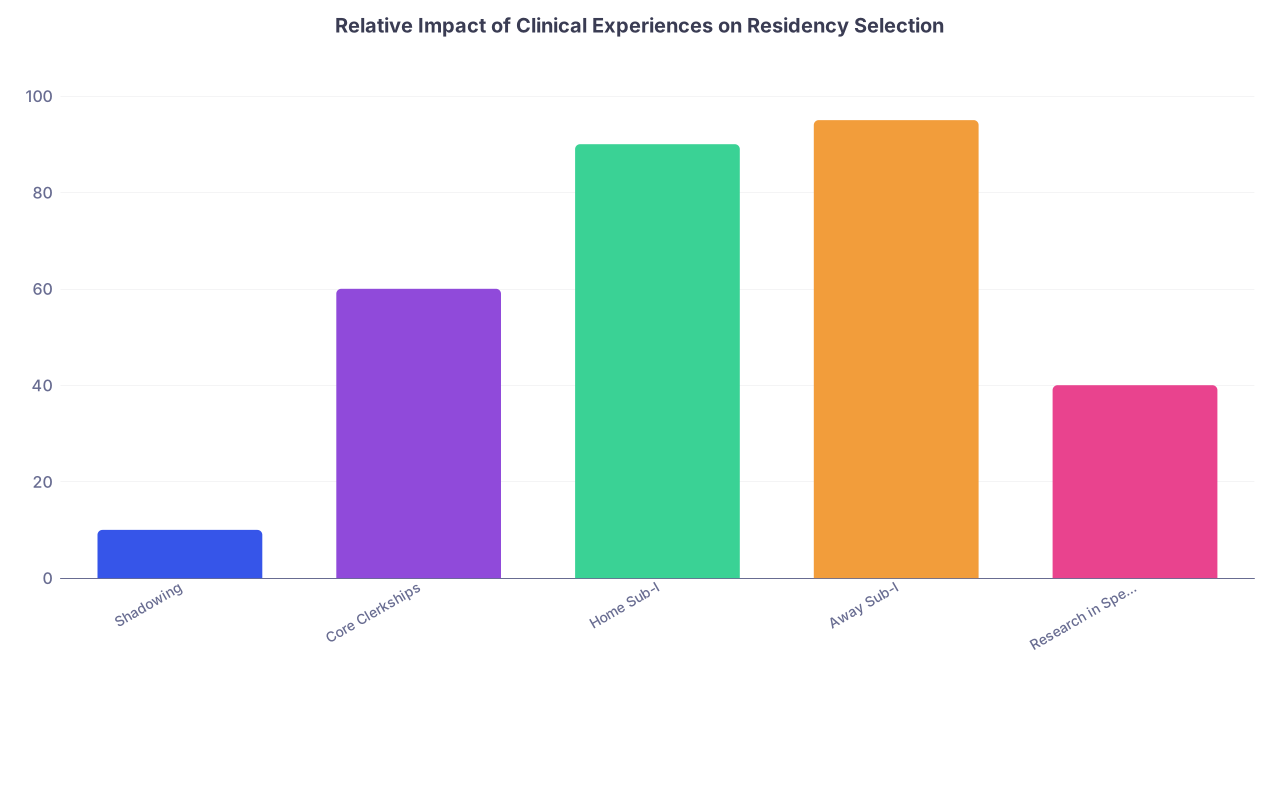
| Category | Value |
|---|---|
| Shadowing | 10 |
| Core Clerkships | 60 |
| Home Sub-I | 90 |
| Away Sub-I | 95 |
| Research in Specialty | 40 |
Those numbers aren’t literal, but the proportions are dead accurate.
Home vs away sub-I: how committees read them
Here’s how faculty decode your sub-I choices:
Home sub-I in the specialty, strong performance
Baseline expectation if your school offers it. If you don’t do it, people will ask why.Away sub-I at “reach” programs only (e.g., two top-10s)
This can backfire. If you overreach, perform average, and get lukewarm letters, you’ve just shown your best self to people who won’t rank you highly—and wasted a chance at a realistic program.One “aspirational,” one “realistic” away
This is the sweet spot. Aim high once. Then hit a solid, mid/high-tier program where you’re a plausible match. You need at least one place where you’re not the weakest person in the room.
How many sub-Is is enough?
For competitive specialties (derm, ortho, ENT, neurosurg, plastics): usually 2–3 sub-Is (home + 1–2 aways) is normal. More than that, you risk looking like a permanent sub-I with no breadth.
For moderately competitive specialties (IM, EM, gen surg, OB/GYN, peds): 1–2 sub-Is in your desired field is usually enough if they’re strong.
The mistake is thinking you can compensate for a mediocre personality or work ethic by doing more sub-Is. That just gives more people a chance to see you underperform.
Common Miscalculations Students Make
Let me call out a few patterns I’ve seen wreck otherwise decent applications.
1. Overweighting early shadowing and underweighting late performance
Students brag: “I’ve been shadowing in cardiology since first year.”
Then on their sub-I, they act like they’re still shadowing—passive, hesitant, waiting to be spoon-fed.
Committees don’t care how long you’ve watched cardiology. They care how quickly you start acting like a resident on your sub-I.
2. Using sub-I as “exploration”
Doing a sub-I in a specialty you’re unsure about is risky. That’s not exploration time—that’s audition time.
Exploration belongs in:
- MS1–MS3 shadowing
- Early clerkships
- Elective, not sub-I, rotations
Your sub-I in a specialty is you saying: “I might join you.” They will treat it that way.
3. Ignoring nurses, techs, and coordinators
You know who program directors quietly poll when they’re not sure about you? The people who saw you when you thought nobody important was watching.
- The ward nurse: “Were they respectful? Helpful? In the way?”
- The unit clerk: “Did they learn how to page, or expect everyone to do it for them?”
- The program coordinator: “Were they polite? Did they show up on time? Did they complain?”
You will never see these comments written down. But they absolutely color how your sub-I is interpreted.
How To Align Shadowing And Sub-I With Choosing A Specialty
Let’s pull this back to your actual problem: choosing what you’re going into, while not screwing your chances of matching there.
Here’s the behind-the-scenes reality:
- Faculty do not expect you to know your specialty in MS1–MS2. They do expect a coherent story by the time you’re applying.
- Shadowing gives you the raw data to pick. Sub-Is give them the data to judge.
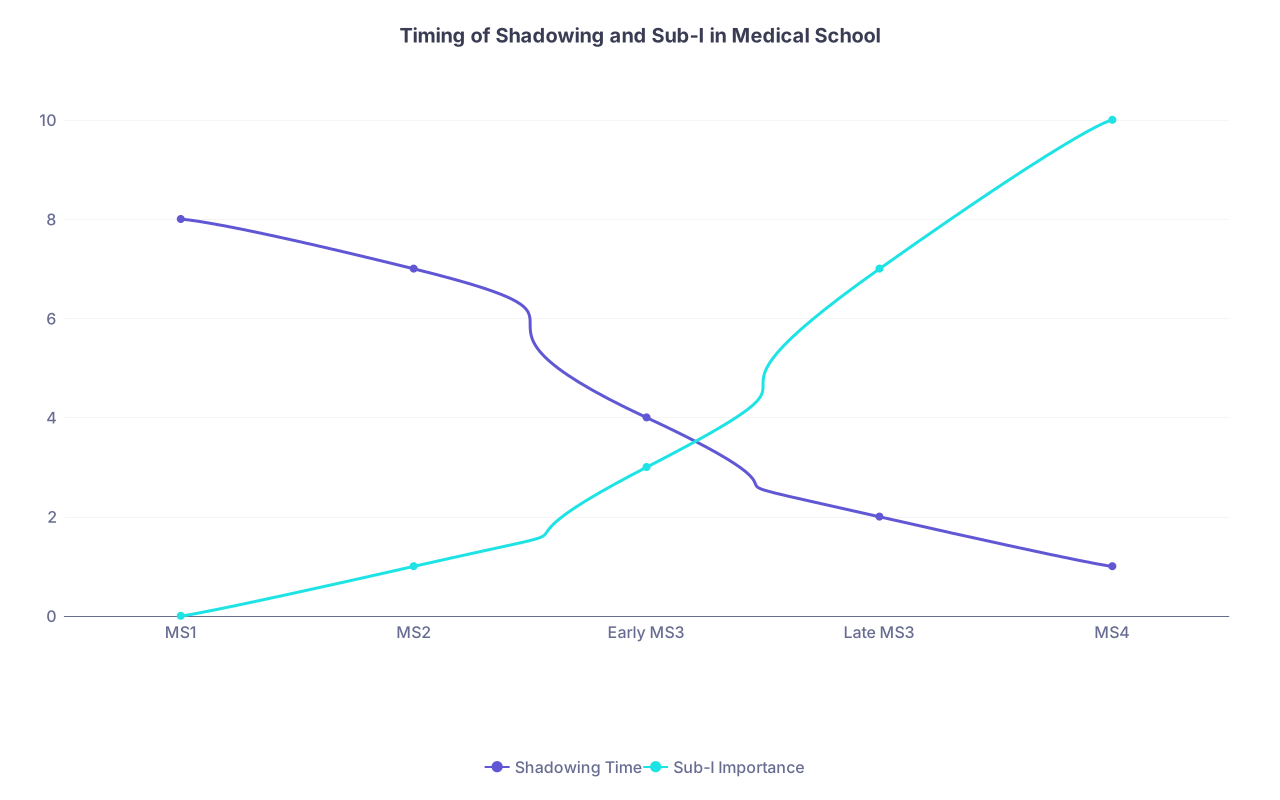
| Category | Shadowing Time | Sub-I Importance |
|---|---|---|
| MS1 | 8 | 0 |
| MS2 | 7 | 1 |
| Early MS3 | 4 | 3 |
| Late MS3 | 2 | 7 |
| MS4 | 1 | 10 |
Notice the pattern: shadowing matters early for you; sub-Is matter late for both you and them.
If you’re early:
- Use shadowing to rule out fields you clearly cannot stand.
- Pay attention to how attendings talk about their lives, not just the medical content.
If you’re closer to sub-I season:
- Lock in 1–2 real target specialties. Not five.
- Look back at your shadowing and clerkships for when you felt like time passed quickly. That’s your clue.
- And only then start treating sub-Is like auditions, not experiments.