

Most of what you’ve heard about hospitalists is incomplete. And some of it is flat‑out wrong.
The common line goes: “Hospitalists are just internists who stay in the hospital.”
Close, but not reality. The truth is messier, specialty‑dependent, and heavily shaped by billing rules, credentialing, and hospital politics—not just “what residency you did.”
If you’re a med student trying to pick a specialty and you think, “I like inpatient, I’ll just be a hospitalist later,” you’re playing with half the rulebook.
Let’s fix that.
What “Hospitalist” Actually Means (And Why Everyone Gets This Wrong)
“Hospitalist” is not a residency. It’s not a board certification. It’s a job description.
A hospitalist is simply a physician (or APP, but we’ll stay focused on physicians) whose primary practice is the care of hospitalized patients. Period. No magic board, no separate match.
That means:
- An internal medicine–trained doc working on a general med service? Hospitalist.
- A pediatrician staffing the inpatient peds floor? Pediatric hospitalist.
- A family med physician running the adult inpatient service in a community hospital? Also a hospitalist.
- A neurology attending running the stroke service? Often called a neurohospitalist.
- A general surgeon who only does emergency cases and inpatient consults? Surgical hospitalist.
So yes, most adult hospitalists are internal medicine trained—but that’s correlation, not definition. The myth is thinking internal medicine is the only legitimate door into hospitalist work.
It’s not.
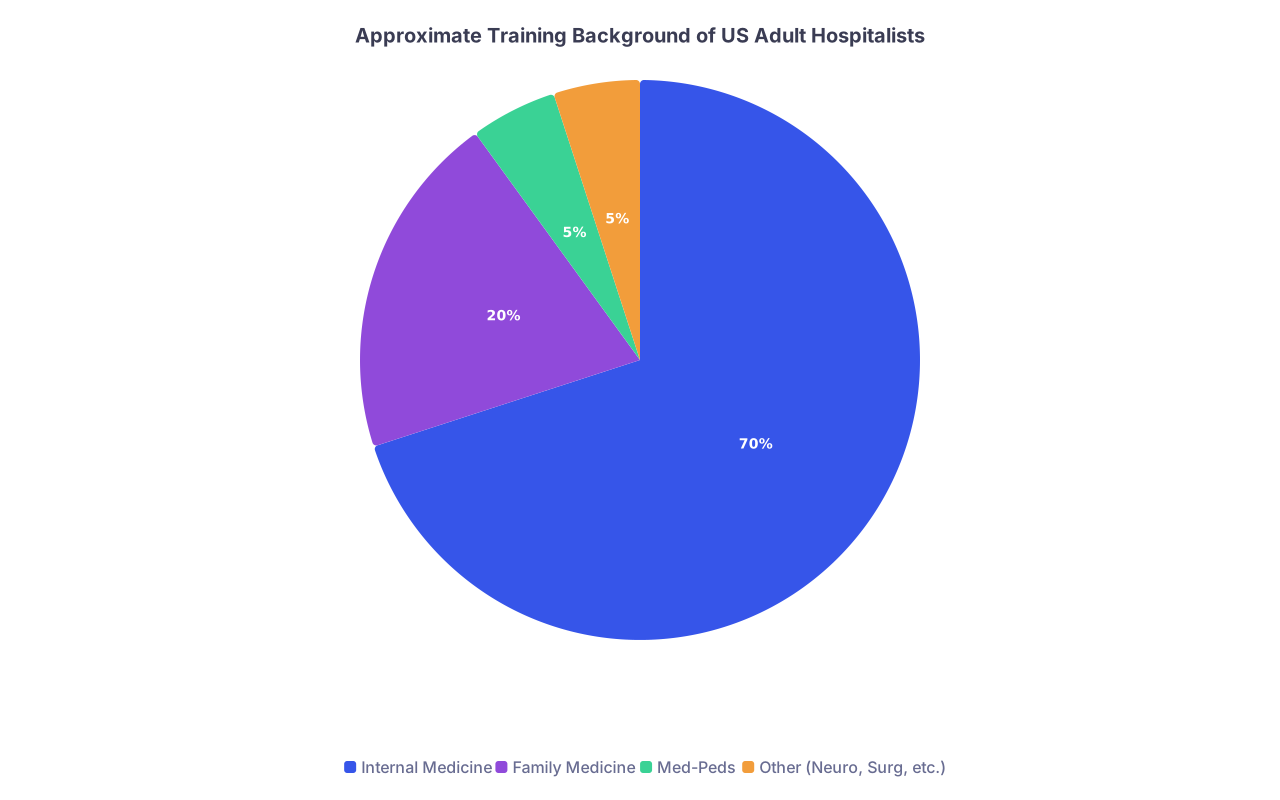
| Category | Value |
|---|---|
| Internal Medicine | 70 |
| Family Medicine | 20 |
| Med-Peds | 5 |
| Other (Neuro, Surg, etc.) | 5 |
Those numbers shift by region and hospital type, but the pattern is stable: IM dominates, yet it does not own the role.
Internal Medicine: The Default, But Not the Law
If you go to an academic tertiary center and walk onto the medicine service, 9 times out of 10 your hospitalists are internal medicine trained. There’s a reason: IM is structurally built as the pipeline for complex adult inpatients.
The straightforward IM → hospitalist path
The standard internal medicine hospitalist route looks like this:
- 3 years of categorical IM residency
- Optional: 1 extra year as a chief resident or hospital medicine fellow (not required)
- Board certification in Internal Medicine
- Hired as a hospitalist by a hospital, health system, or private group
That’s it. No fellowship required for general medicine hospitalist work. If you never want to touch clinic again after residency, IM is the most frictionless way there.
Why IM is so dominant:
Training matches the job.
Three years of ICU, wards, night float, and subspecialty admits gives you reps on DKA, sepsis, GI bleeds, weird autoimmune admissions, and “no one knows what this is, but the patient is crashing.”Credentialing is easy.
Hospital bylaws and privileging committees love clean lines. “ABIM‑certified in Internal Medicine” fits neatly into the “Adult inpatients” box.Billing structure favors IM.
Most inpatient E/M codes for adult medicine are historically linked to IM. That doesn’t mean others can’t bill them, but IM is the default mental model for administrators and payers.
So if you like complex adult inpatient medicine and you’re asking, “What’s the least painful training path to a hospitalist job?” The unglamorous answer is: categorical internal medicine.
But here’s the part almost nobody tells students: IM is not the only legitimate way in. And in some settings, it’s not even the preferred background.
Family Medicine Hospitalists: Yes, They Exist (And They’re Not “Less Real”)
The snobbiness toward family medicine hospitalists in some IM circles is real. I’ve heard the lines:
- “FM is outpatient; you shouldn’t be managing sick inpatients.”
- “FM hospitalists are fine for small hospitals, but not for real acuity.”
- “We’d never hire FM here.”
Reality: family medicine–trained hospitalists are common in community hospitals and rural systems. Some places prefer them, especially where the inpatient service cares for both adults and kids, or where OB and newborn coverage is bundled.
Typical FM → hospitalist path:
- 3 years of family medicine residency
- During residency: extra inpatient electives, maybe a track focused on hospital medicine or obstetrics
- Optional: 1‑year “FM hospitalist” or “rural hospital medicine” fellowship
- Board certification in Family Medicine
- Hired as a hospitalist (often in community, critical access, or smaller regional hospitals)
What they actually do varies wildly by site:
- In some hospitals, an FM hospitalist is managing the same adult bread‑and‑butter as IM: CHF, COPD, pneumonia, cellulitis, DKA.
- In others, they’re running the whole show: adult inpatients, peds floor, newborn nursery, occasional ED coverage, maybe low‑risk OB.

The constraints are not about “is FM allowed to be hospitalist” but:
- Hospital bylaws. Some hospitals explicitly require IM for adult inpatients. Others are agnostic as long as you’re BC/BE, trained to care for adults, and meet quality metrics.
- Case mix. A quaternary referral center taking LVADs, ECMO, transplant, and undifferentiated zebras is more likely to hire IM or subspecialty folks. A 50‑bed hospital where the sickest patients get transferred will happily hire strong FM grads.
Students rarely see this, because your med school is usually attached to a big academic center that lives inside the IM bubble. You don’t rotate at the rural place an hour away where 80% of inpatient coverage is FM‑trained.
If you love broad-spectrum practice, want clinic plus inpatient, or like the idea of rural work where you’re “doctor for the whole hospital,” FM can set you up to be a hospitalist. The key is choosing an FM residency with real inpatient depth—not one where residents barely touch the wards.
Pediatrics and Med‑Peds: Hospitalists Beyond Adult Medicine
Hospitalist ≠ “adult.” That’s another mental trap.
On the pediatric side, pediatric hospital medicine (PHM) has become its own recognized subspecialty, with an official ABP subspecialty board exam.
Typical peds → hospitalist path:
- 3 years pediatrics residency
- Historically: straight into a peds hospitalist job
- Now increasingly: 2‑year pediatric hospital medicine fellowship
- Board certification in Pediatrics
- Optional: subspecialty certification in Pediatric Hospital Medicine
The job is analogous to adult hospitalist medicine but in a different universe: bronchiolitis, asthma, FTT, neonatal jaundice, complex kids with technology dependence, post‑op management in coordination with surgeons.
Then there’s Med‑Peds—the dual internal medicine and pediatrics residency.
Med‑Peds → hospitalist options:
- Adult hospitalist (working as IM)
- Pediatric hospitalist (working as Peds)
- Combined-type roles in some children’s hospitals or systems with both services
- Hospitalist plus outpatient primary care split
Med‑Peds people often get pulled into hospitalist work because:
- They’re versatile. One FTE can be plugged into adult wards, peds wards, clinic, or transitions of care.
- They understand complex congenital patients surviving into adulthood who bounce between children’s and adult hospitals.
So no, hospitalists do not all come from IM. Plenty never did an IM rotation after intern year because their world is entirely pediatrics.
“Neurohospitalists,” Surgical Hospitalists, and Other Niche Creatures
The term “hospitalist” has started to spread beyond general medicine. Sometimes usefully, sometimes just as branding.
Here’s how the landscape actually looks.
Neurohospitalists
Usually:
- Neurology residency (4 years after prelim)
- Optional neurohospitalist or vascular neurology fellowship
- Job: inpatient neurology, stroke service, consults, sometimes neurocritical care
They’re hospitalists in that they’re inpatient‑only, but they’re not generalists. They’re organ‑system specialists grounded in neurology who rarely, if ever, manage pneumonia or sepsis outside a neuro context.
Surgical hospitalists / acute care surgeons
Typical path:
- General surgery residency
- Sometimes: Acute Care Surgery / Trauma fellowship
- Job: emergency general surgery (EGS), inpatient consults, trauma care, surgical ICU
They’re hospitalists functionally—shift‑based, inpatient‑only, no elective clinic—but their board certification and core identity are surgical. Most don’t introduce themselves as “hospitalists,” but administrators may classify them similarly for scheduling.
Other subspecialty “hospitalists”
You’ll see terms like:
- “Cardiology hospitalist” – often an IM hospitalist embedded on a cardiology service, or a general cardiologist doing mainly inpatient.
- “Oncology hospitalist” – IM‑trained, handling heme/onc inpatients and chemo complications.
- “GI hospitalist” – gastroenterologist whose work is entirely inpatient consults and procedures.
The pattern:
- Training: categorical in the specialty (IM → fellowship, or neurology, or surgery, etc.).
- Job: full‑time inpatient care for that specialty’s patients.
So when someone says, “All hospitalists are internists,” what they really mean is, “In my narrow adult general medicine world, the people called ‘hospitalists’ are almost always IM.” Which is true—but not a universal law.
What Actually Limits Who Can Be a Hospitalist?
Here’s where the boring, non-romantic stuff matters: rules, billing, and risk.
The bottlenecks are not “can a nephrologist be a hospitalist?” (yes, as an inpatient nephrologist). The bottlenecks are:
1. Hospital bylaws and privileging
Each hospital has a credentialing committee that decides:
- Which board certifications qualify you for which privileges
- Whether FM can admit and manage adult inpatients independently
- Whether peds‑only trained physicians can touch adult patients (usually no)
I’ve seen two neighboring hospitals with opposite stances:
- Hospital A: Adult inpatient service restricted to ABIM‑certified internists only.
- Hospital B: Adult inpatient service open to IM, FM, and Med‑Peds. “Demonstrated inpatient experience” is the threshold.
So when you ask “Can a family medicine doctor be a hospitalist?” the only honest answer is: it depends where.
| Hospital Type | Adult IM Hospitalist Backgrounds Commonly Accepted |
|---|---|
| Academic Tertiary Center | IM, Med-Peds (rarely FM) |
| Large Community Hospital | IM, FM, Med-Peds |
| Small Rural / Critical Access | FM, IM, sometimes Med-Peds |
| Children’s Hospital | Pediatrics, Med-Peds |
2. Payer and billing expectations
Payers care that:
- You’re licensed.
- You’re credentialed with them.
- Your training matches the population you’re billing for.
They do not have a checkbox called “Is this person a hospitalist?” They care if you’re board eligible/certified in a relevant specialty and not practicing completely out of scope.
3. Risk tolerance of the group
Even if bylaws technically allow it, groups may self‑restrict:
- An academic IM department might simply refuse to hire FM grads.
- A community group that got burned by a poorly trained or underprepared hospitalist from any background may overcorrect and prefer certain programs or specialties.
This is culture and risk tolerance, not hard law.
How Your Specialty Choice Shapes Future Hospitalist Options
You’re in med school, so let’s talk about what actually matters for you.
If you want maximum flexibility in adult inpatient work
Pick Internal Medicine. Boring answer, but true.
With IM you can:
- Be a general hospitalist almost anywhere
- Add ICU time, procedural focus, or specialty‑aligned hospitalist roles (onc, cards, etc.)
- Pivot later into fellowship if you get sick of ward life
If you want broad scope, rural options, and some inpatient, some outpatient
Family Medicine is not a consolation prize. It’s a different bet.
If you go this route and care about hospitalist work:
- Choose an FM residency with strong inpatient exposure and possibly ICU time.
- Look for programs that staff their own inpatient service, not just follow along with IM.
- Consider a hospitalist‑focused FM fellowship if you know you want big‑hospital acuity.
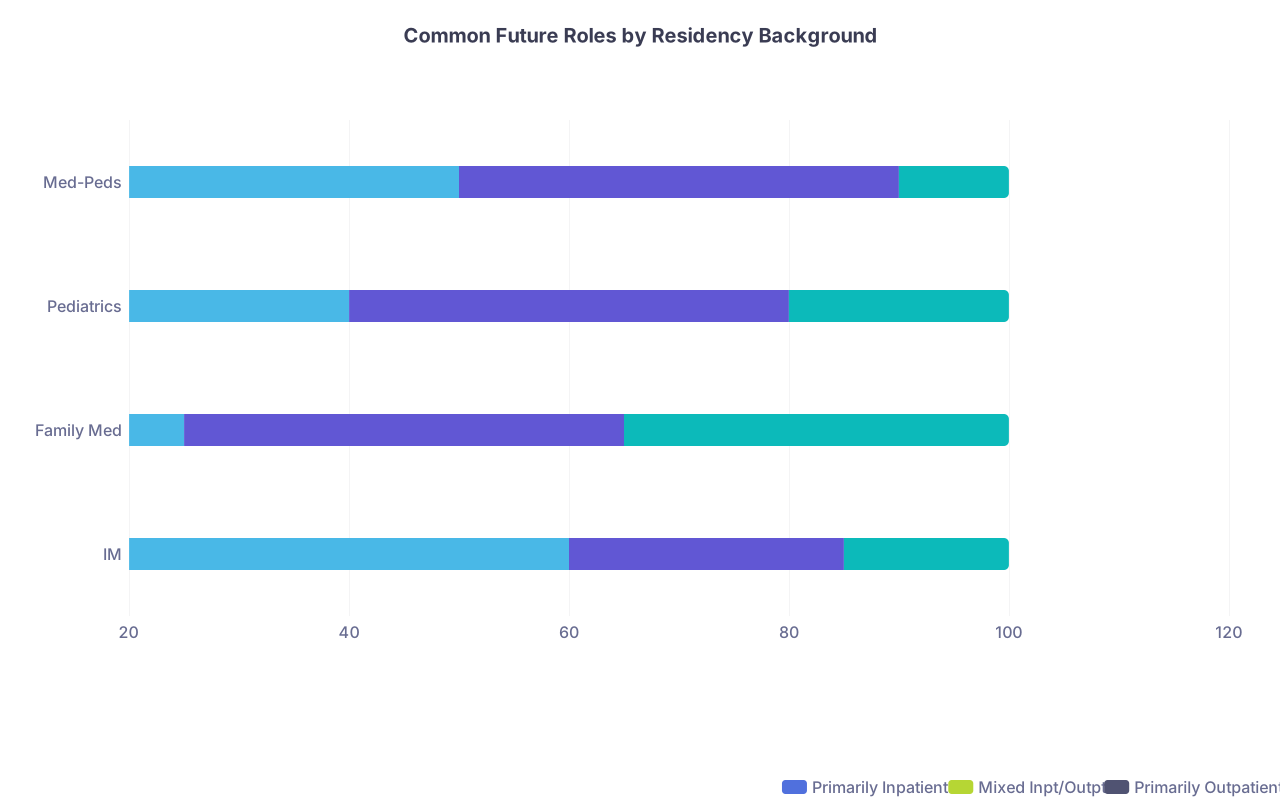
| Category | Primarily Inpatient | Mixed Inpt/Outpt | Primarily Outpatient |
|---|---|---|---|
| IM | 60 | 25 | 15 |
| Family Med | 25 | 40 | 35 |
| Pediatrics | 40 | 40 | 20 |
| Med-Peds | 50 | 40 | 10 |
If you’re drawn to kids and hospitals
Go Pediatrics or Med‑Peds. Just be aware that pediatric hospital medicine is becoming more formalized with fellowship expectations at big centers.
If you’re specialty‑obsessed (neuro, surgery, etc.)
You can still be a kind of hospitalist—just not a general one.
You’ll be the inpatient face of that specialty, not the person admitting every undifferentiated fever and fall. Your life is still on the wards, but in a narrower lane.
The Career Reality: Lifestyle, Burnout, and Choosing with Both Eyes Open
One more myth: “Hospitalist is a lifestyle specialty.”
Sometimes. Sometimes it’s a slow death by 7-on/7-off, high census, and relentless RVU pressure.
Most hospitalist jobs share a few traits:
- Shift‑based schedules (days, nights, swings)
- Compressed work (12–14 patients on a “light” day at some places)
- Emotional wear from constant handoffs, discharges, and system failures

| Category | Value |
|---|---|
| Outpatient IM | 180 |
| Academic Hospitalist | 190 |
| Community Hospitalist | 210 |
Training background does not immunize you from burnout. I’ve seen IM and FM hospitalists both fried by age 40. I’ve also seen both build sustainable, well‑bounded careers.
You should not pick IM vs FM vs Peds solely because you “might want to be a hospitalist.” You should pick based on:
- Which patient population you actually like
- Whether you prefer outpatient continuity or episodic acute care
- How much you enjoy complexity vs breadth vs procedures
The “hospitalist” label can be applied to all of those in some form, but your residency will decide which worlds are genuinely open to you and which are uphill fights.
So, Do All Hospitalists Come from Internal Medicine?
No. And believing that oversimplified story can quietly box you in.
Most adult general hospitalists in midsize and large US hospitals are IM‑trained. That’s the dominant pattern. But:
- Family medicine physicians absolutely work as hospitalists, especially in community and rural settings.
- Pediatricians and Med‑Peds physicians form the backbone of pediatric hospital medicine.
- Neurologists, surgeons, and other subspecialists live purely inpatient lives that look a lot like hospitalist work, just within a narrower clinical scope.
“Hospitalist” is a job, not a residency.
Your task in med school isn’t to chase a label. It’s to choose the training that fits the kind of patients, settings, and scope of practice you can see yourself handling at 3 a.m. when no one else is coming.
Because years from now, you won’t care whether your badge said “Internal Medicine Hospitalist” or “Family Medicine Inpatient Service.” You’ll care whether you built a career that makes sense for who you are—and whether you chose your path with your eyes open instead of following someone else’s half‑true story.



| Step | Description |
|---|---|
| Step 1 | Med Student |
| Step 2 | Internal Medicine Residency |
| Step 3 | Family Medicine Residency |
| Step 4 | Pediatrics Residency |
| Step 5 | Med-Peds Residency |
| Step 6 | Neurology Residency |
| Step 7 | General Surgery Residency |
| Step 8 | Adult Hospitalist |
| Step 9 | Adult/Community Hospitalist |
| Step 10 | Pediatric Hospitalist |
| Step 11 | Adult or Pediatric Hospitalist |
| Step 12 | Neurohospitalist |
| Step 13 | Surgical/Acute Care Hospitalist |


