

“Follow your passion” is some of the worst specialty advice medical students get—and they get it constantly.
Attendings say it. Residents say it. Advisors say it when they do not have time to actually advise you. It sounds inspirational. It’s also lazy, incomplete, and in many cases, flat‑out harmful.
Not because passion does not matter. It does. But because making a 40‑year career decision on a feeling that’s mostly shaped by a handful of short rotations, survivorship bias, and Instagram snippets of other people’s lives is a great way to end up burned out, underpaid, or boxed into a life you did not actually want.
Let’s tear this apart properly.
The Problem With “Passion” In Med School
The first problem: the passion you feel in medical school is a terrible proxy for what your life will be like as an attending.
Your “passion” is being formed by:
- 2–6 week rotations
- Seeing the best (or worst) of a specialty by sheer luck of the team
- Doing student tasks that are nothing like attending work
- Being shielded from a lot of the scut, billing, and admin
- The energy of being new to everything
That’s not passion. That’s novelty, plus a carefully filtered slice of reality.
On surgery you “love the OR”? As a student, you hold retractors, cut a few sutures, and leave by 5 if your resident likes you. As an attending surgeon, you’re dealing with:
- RVU pressure
- Complication management
- Malpractice risk
- Late add-on cases that wreck your evening
- Constant OR turnover battles and delays
The emotional load, time pressure, and medicolegal risk jump massively. Nobody is passionate about prior auth faxes at 9 pm.
Same story in pediatrics. You “love kids” on a short inpatient peds rotation with enthusiastic residents, tons of teaching, and no charting responsibility. Fast-forward to community peds clinic: 20–25 patients a day, vaccine counseling arguments, worried well, and documentation fights with insurers paying you less than many mid-levels in other fields.
Med school passion is mostly about vibes. Specialty choice has to be about conditions.
What The Data Actually Shows About Career Satisfaction
Let’s drag this into data instead of vibes.
We have decent information from Medscape, Doximity, AAMC, and several published studies on:
- Burnout rates
- Job satisfaction
- Work hours
- Compensation
- Debt load and payoff timelines
- Specialty switching and regret
It does not align with the “just follow your passion and it will work out” narrative.
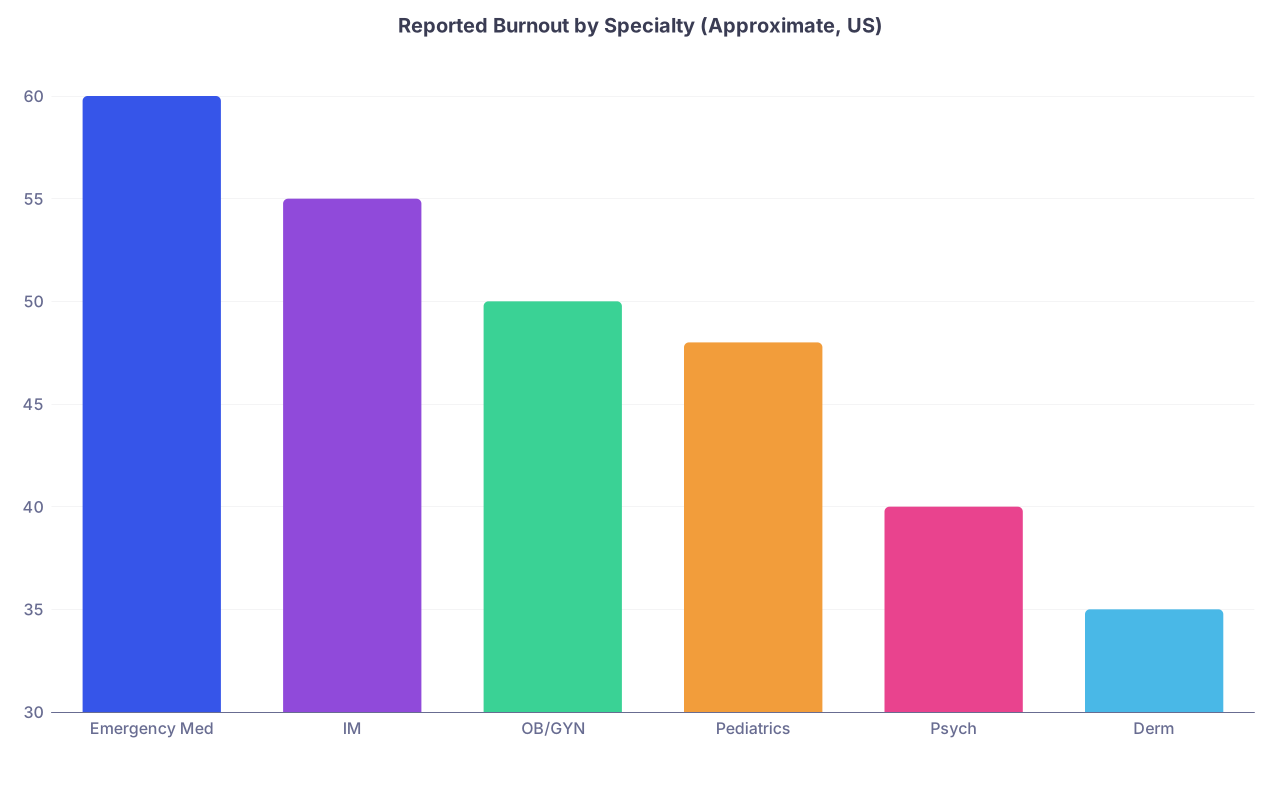
| Category | Value |
|---|---|
| Emergency Med | 60 |
| IM | 55 |
| OB/GYN | 50 |
| Pediatrics | 48 |
| Psych | 40 |
| Derm | 35 |
Notice anything? Many of the “passion specialties” medical students romanticize—EM (“I love acuity and procedures”), OB/GYN (“I love delivering babies”), even IM (“I love complex problem solving”)—sit on the high end of burnout in multiple surveys.
Compare that with dermatology or psychiatry. Almost nobody in M2 says “I’m so passionate about psoriasis follow-ups” or “I dream of prior authorizations for biologics.” Yet those specialties often land near the top for:
- Work-life balance
- Schedule predictability
- Lower burnout
- High or solid compensation
I’ve watched more than one resident who “passion-picked” emergency medicine based on fast-paced trauma nights as a student, only to be crushed five years later by:
- Night shifts + aging body
- Volume + boarding + hallway medicine
- Violence and security issues
- Chronic under-resourcing
Their passion didn’t vanish. It got ground down by the structure of the job.
You are not choosing “what do I like on a Tuesday afternoon in med school.” You are choosing an ecosystem of hours, money, risk, and control that will either preserve your enthusiasm or strangle it.
Passion Is Unreliable; Exposure Is Biased
Here’s another uncomfortable truth: your sense of “I love this” is massively biased by factors that have nothing to do with the specialty itself.
The team.
The culture of that specific hospital.
How much sleep you got that week.
Whether your resident treated you like a functional human.
You work with an engaged, kind, teaching-focused psych attending? Suddenly psychiatry feels “right.” You land on a malignant, understaffed internal medicine service with constant call, chaotic sign-out, no guidance? IM starts to feel like a prison sentence.
Both impressions are mostly noise.
I’ve seen people swear they’re “meant for” surgery based on a legendary trauma attending and a well-run OR, then hate surgery residency when they end up at a different program with zero support and a wildly different vibe.
You’re making a 40‑year call from a handful of 4‑week samples. Those samples are not representative.
The Economics You’re Told To Ignore (But Shouldn’t)
There’s a weird taboo in medicine about admitting money matters. As if saying “income and schedule influence my choice” makes you less altruistic.
Ignore that guilt. It’s irrational.
Here’s what the numbers look like in broad strokes (US context):
| Specialty | Typical Range (USD) |
|---|---|
| Family Medicine | $230k–$280k |
| Pediatrics | $220k–$260k |
| Psychiatry | $270k–$340k |
| Internal Med (Gen) | $250k–$320k |
| EM | $350k–$450k |
| Radiology | $450k–$600k |
| Orthopedics | $600k–$800k+ |
Now overlay that with:
- Median medical school debt in the US: ~$200k–$250k
- Interest rates that can push true repayment cost far higher
- Delayed earning years (your college roommate in tech may be 10 years ahead of you financially before you touch attending money)
If you pick a low-paying specialty with long hours and high burnout “because passion,” you’re effectively volunteering for:
- Longer debt payoff timelines
- More financial pressure on every non-work choice (where you live, when/if to have kids, what kind of housing you can reasonably afford)
- Less margin to say “no” to toxic job offers, relocate, or cut back hours
Passion can’t fix an anemic paycheck and an overscheduled clinic.
And to be clear: some people will still rationally choose pediatrics or family medicine knowing all that—because the structure of those jobs in certain settings (outpatient, part-time, academic) lines up with the life they want. Good. That’s informed.
But going into a low-paid, overstretched primary care job with “I just love continuity of care, it’ll be fine” and no financial reality check? That’s self-sabotage dressed up as nobility.
What Actually Predicts Long-Term Satisfaction
Long-term satisfaction has much more to do with fit on a few unsexy dimensions than with the lightning bolt of passion on a rotation.
The big ones:
Control over schedule and hours
Not how many hours you work as a resident. How much control you’ll have as an attending over:- Clinic days vs OR days
- Nights/weekends
- Call burden and call type (home vs in-house, phone vs come-in)
- Ability to reduce FTE without destroying your income
Cognitive vs procedural mix
Some people truly hate the idea of clicking through imaging studies all day. Others would rather do ten colonoscopies than one family meeting. Your energy drainers and energy givers here matter way more than the vague feeling of “I liked my GI week.”Patient population and time horizon
Chronic relationship-based care (primary care, psych) versus acute episodic care (EM, anesthesia, critical care). If you get bored with long-term follow-up, family medicine will suffocate you. If you need the sense of “I fixed something tangible,” pure cognitive subspecialties may feel pointless.Risk tolerance: clinical, legal, financial
Surgery fields come with higher lawsuit risk, higher stakes decisions, and steeper drops when you make a mistake. Radiology has high financial volatility depending on practice setting and telerad competition. If you’re already an anxious wreck on rotations, “high drama” might not age well.Geographic flexibility
Some specialties cluster in academic centers and big cities (peds subspecialties, heme/onc). Others give you leverage anywhere (FM, anesthesia, EM, general surgery). If you have a partner with a niche career, kids tied to certain schools, or family you must live near, this isn’t optional.
Look at what high-satisfaction attendings in mid- to late-career actually say, not what gung-ho interns post on social media. They talk about colleagues, autonomy, predictable time off, reasonable call, and not hating opening the EMR every morning. Passion barely makes the list.
How “Follow Your Passion” Backfires In The Real World
Let me spell out the common disaster patterns.
The Lifestyle Surprise
Student: “I loved my surgery rotation, I’m so passionate about being in the OR.”
Reality by PGY‑3:
- 80-hour weeks (yes, still)
- Weekends wrecked by call
- Constant fatigue
- Zero time for partner/kids/hobbies
The passion was real—but it was passion for parts of surgery, not for the surgical lifestyle. Nobody sat down with them and said, “Love this enough to accept 10+ years of compromised life outside the hospital?”
The Prestige Trap
Student: “I’m competitive, I should go for something prestigious like derm or ortho.”
They’re lukewarm on the actual work, but they’re passionate about winning. They grind, match, then discover:
- They don’t care about joints or skin disease as much as they thought
- They envy their friend in psych who has time to breathe
- The status high wears off and they’re left with mismatch
Prestige is a sugar high. It doesn’t last a 30-year career.
The Altruism Guilt Trip
Student: “I’d consider something higher paying, but I feel guilty. I should do primary care. That’s where the need is.”
So they ignore their own temperament—maybe they hate high-volume clinics and endless paperwork—and go into a job that drains them daily. Five years in, they’re:
- Too burned out to be the caring doc they wanted to be
- Fantasizing about leaving medicine entirely
- Bitter at a system that exploited their sense of duty
You cannot sustainably pour from an empty tank. Picking a specialty you resent in the name of self-sacrifice does not help patients in the long run.
A Better Framework Than “Passion”
So if “follow your passion” is trash advice, what’s the alternative?
Think less “What am I passionate about right now?” and more “Under what conditions will I still like this work 20 years from now?”
A practical way to approach this:
Audit your energy, not your emotions.
On each rotation, track:- What tasks make time go fast vs slow?
- Do you feel better or worse at the end of the day?
- Do you prefer thinking, doing, talking, or looking (imaging/labs)?
Don’t romanticize. Just watch your own reactions.
Map the attending reality, not the student one.
For any specialty you’re considering, ask attendings, not just residents:- “What does a bad week look like for you?”
- “If your kid were choosing this specialty, what would you warn them about?”
- “If you had to leave this specialty, what would be the reason?”
The facial expressions when you ask these are often more honest than the words.
Overlay your life goals explicitly.
Not the goals you think you should have. Your actual ones.
Kids or no kids? Urban vs small town? Do you care about a big house or is a small apartment fine? Will your parents need support? How much do you need to earn to feel secure?Then look ruthlessly at which specialties and practice settings can give you that with acceptable trade-offs.
Run the money numbers like an adult.
Take your debt, plug in realistic interest. Model a few specialties with average salaries, tax rates, and hours. See how long to pay off loans and hit basic goals (down payment, childcare, retirement savings). This isn’t greedy. It’s self-preservation.
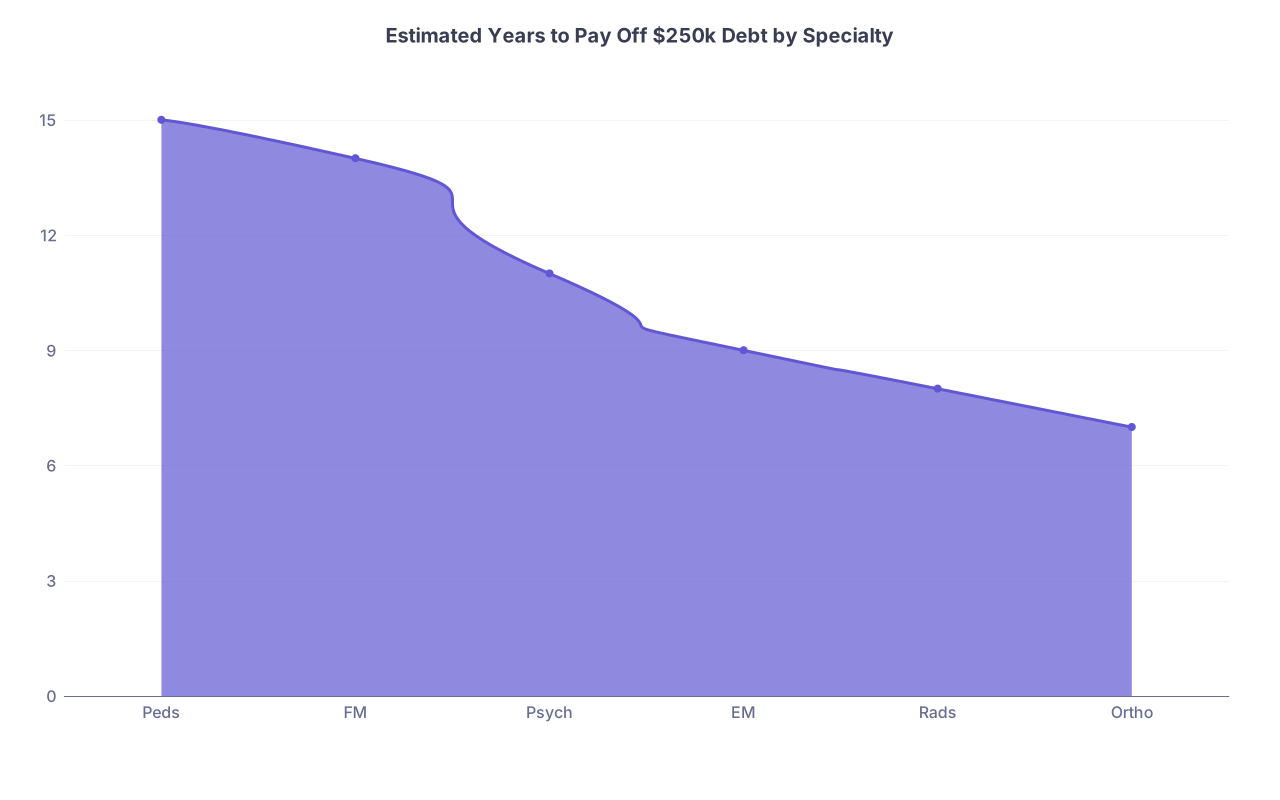
| Category | Value |
|---|---|
| Peds | 15 |
| FM | 14 |
| Psych | 11 |
| EM | 9 |
| Rads | 8 |
| Ortho | 7 |
You’re allowed to look at this and say, “I love kids, but I can’t accept 15 years of loan payoff on top of lower lifetime earnings. I’ll find other ways to work with children.”
The Mindset Shift: Grow Passion, Don’t Chase It
The most misleading premise in “follow your passion” is that passion is something you discover once, then everything falls into place.
In reality, passion often follows:
- Competence: you enjoy what you’re good at
- Autonomy: you enjoy what you can shape and control
- Impact: you enjoy what feels meaningful
You can grow deep satisfaction in multiple specialties if those three things are present. And you can lose passion in any field where they’re absent.
I’ve seen anesthesiologists who started neutral about the field become fiercely passionate because they got good, found a flexible group, and loved the team dynamic. I’ve seen “lifelong surgeons” fall out of love with surgery because the RVU grind and hospital politics made them feel like cogs.
So stop looking for the magical specialty that makes you feel “alive” during a third-year rotation. Start asking: where do I have the best shot at building mastery, autonomy, and a life I don’t resent?
One Concrete Exercise Before You Lock It In
Do this before you submit that rank list or specialty decision:
Write two one-page narratives.
A day in your life as a 45‑year‑old in Specialty A.
Be boringly specific: wake-up time, commute, first patient, lunch or no lunch, after-work time, kids’ activities, call nights, what your body feels like.The same for Specialty B (a serious alternative).
No Instagram highlight reels. Just a Tuesday in November.
Now look at those two pages and ask yourself, very bluntly: which one would I rather live 10,000 times?
That’s closer to the truth than “which one gave me butterflies on a cool trauma case at 2 am.”
The Bottom Line
Three points you should not forget:
- “Follow your passion” is shallow specialty advice because med school passion is built on biased, short-term exposure that does not match attending reality.
- Long-term satisfaction comes from the structure of the work—hours, control, risk, income, team—not from a vague sense of loving a rotation at age 24.
- You’ll make a better choice if you analyze your energy, your life goals, the financials, and the real attending day-to-day—and then grow passion where mastery, autonomy, and meaning actually have room to exist.
Ignore the inspirational slogans. You’re not choosing a summer hobby. You’re choosing a life.


