
You did not “waste” MS3 by liking the wrong specialty. You just got real data. Now you need a recovery plan.
Most people handle this badly. They panic, they apply scattered, they believe every rumor from the class GroupMe, and they end up boxing themselves into mediocre options. You can do better. But you need structure. And speed.
This is a practical, step‑by‑step roadmap for changing your specialty goal after third year and still landing in a field you want, at a program you respect.
Step 1: Get Out of Emotional Free‑Fall (Fast but Not Sloppy)
You cannot plan clearly if you are still grieving the old dream.
For a week or two, your brain will be noisy:
- “I already told everyone I was doing ortho.”
- “I scheduled all my electives around EM.”
- “I am way behind the people who knew from M1.”
- “My CV is tailored to the wrong field.”
Normal. Boringly normal. I see this every year.
Here is your immediate triage protocol for the first 3–7 days:
Name the core problem clearly.
Not: “My life is a mess.”
Instead:- “I no longer want to apply to X.”
- “I do not yet have a clear alternative that fits my values and scores.”
One sentence. Write it down.
Cap your rumination time.
Give yourself:- 30 minutes a day to vent / journal / freak out.
- Outside that window, every anxious thought gets parked: “I will think about this at 8:30 p.m.”
Tell 1–2 rational people, not 10.
- A trusted upper‑class resident or recent grad.
- One honest friend who is not competing for the same field.
Not Instagram. Not the entire class chat.
Stop consuming random Reddit/SDN “advice.”
Those threads are built for anxiety, not precision. Until you have a rough plan, they will only confuse you.
Once your head is a bit quieter, move to information gathering. Quickly.
Step 2: Do a Ruthless Reality Scan of Your Profile
You are not choosing a specialty in a vacuum. You are pairing:
- Who you are on paper.
- Who you are in reality.
- What the field currently demands.
Do not skip this. Fantasy planning is how people end up SOAPing into something they hate.
2.1. Put Your Hard Numbers on the Table
Write these down in one place:
- Step 1: Pass / Fail (and if your school gives a numerical score internally, note it)
- Step 2 CK: actual or realistic projected range (e.g., “likely 240–250” based on NBs)
- Preclinical GPA/quartile/decile if your school reports it
- Clerkship grades:
- Count your Honors/High Pass/Pass, especially in:
- Internal Medicine
- Surgery
- Pediatrics
- OB/GYN
- Psych
- Family
- Count your Honors/High Pass/Pass, especially in:
- Class rank if available
- Any professionalism “events” (yes, these matter for some specialties)
No rounding up. No “I could probably get 260+ if I really try.” Use current or conservative estimates.
2.2. List Your Real Assets
Not fluff. Real assets.
- Research:
- Number of pubs/posters/presentations.
- Are any first‑author? In what specialty?
- Leadership:
- Roles with actual responsibility (clinic leader, MSA officer, major volunteering coordinator).
- Unique background:
- Prior career (nurse, engineer, teacher).
- Language skills.
- Military.
- Letters of recommendation:
- Strong: “This attending would fight for me on the phone.”
- Medium: “Solid, generic.”
- Weak: “Knows my name and nothing else.”
2.3. Put Your Non‑Negotiables in Writing
This is where most people lie to themselves.
On a scale of 1–5, rate each:
- Need for predictable hours
- Comfort with overnight call
- Comfort with high acuity / codes
- Desire for procedures / OR time
- Tolerance for clinic volume and “churn”
- Desire for long‑term patient relationships
- Need for geographic flexibility
- Sensitivity to prestige / competitiveness
Where you circle “3” for everything, you are avoiding reality. Force yourself to pick a side.
Step 3: Rapidly Narrow Your New Target List
You are not trying to pick the perfect specialty for the rest of your life. You are picking a realistic, good‑fit direction you can commit to for this application cycle.
3.1. Create a Shortlist of 3–5 Candidate Specialties
Based on your:
- Personality (procedural vs cognitive, high acuity vs longitudinal).
- Numbers (Step 2, grades).
- Tolerance for competitive pressure.
Build a rough list. Example:
Student A:
- IM: H/H/P in IM/Surg/Other, projected Step 2 245.
- Likes thinking, OK with some nights, wants subspecialty options.
- Shortlist: Internal Medicine, Neurology, Anesthesia.
Student B:
- Average clerkship grades, stronger in Psych and FM, Step 2 likely 230.
- Hates the OR, likes talking to patients, values outpatient life.
- Shortlist: Family Med, Psychiatry, Pediatrics.
You can absolutely keep one “reach” and one “safety,” but this is not the time to chase three hyper‑competitive options with borderline stats.
3.2. Cross‑Check Competitiveness Reality
Use credible, current data:
- NRMP Charting Outcomes.
- Specialty‑specific program director surveys.
- Your own school’s match list.
You want to know:
- Median Step 2 of matched applicants.
- Typical number of programs applied to.
- Whether research is expected or just a bonus.
- How much AOA, class rank, and honors matter.
| Specialty | Relative Competitiveness | Step 2 Typical Range | Research Emphasis |
|---|---|---|---|
| Internal Med | Moderate (broad range) | 230–255+ | Helpful, not strict |
| Pediatrics | Lower–Moderate | 225–245 | Light–Moderate |
| Psychiatry | Moderate and rising | 230–250 | Helpful |
| General Surgery | High | 240–255+ | Strongly valued |
| Dermatology | Extreme | 255+ | Heavy |
Does your profile sit at, above, or clearly below the median for that field?
If you are truly below for your initial dream specialty, accept that. You can always circle back after residency through fellowship or later moves.
3.3. Have Two 30‑Minute Reality Consults
You need feedback from people who actually match applicants, not just lecture theories.
Your school’s advising dean / career advisor.
Ask directly:- “With this profile, what fields are realistic, reach, and fantasy?”
- “Where have students like me matched in the past 3 years?”
One attending in each candidate specialty.
Structure the conversation:- “Here are my grades, Step 2 range, research, and what I liked / disliked on rotation.”
- “What kind of student tends to be happy in your field?”
- “If you had my profile, would you apply to your field this year?”
When more than one trusted person says, “You would be fine in X, Y is a stretch, Z is probably unrealistic this cycle,” listen.
Step 4: Restructure Your Fourth‑Year Schedule Like an Adult
This is the part many students botch. They change specialty late, but their M4 schedule still screams their old field.
4.1. Lock in 1–2 Home Sub‑I’s in the New Field
Sub‑internships (acting internships) are your currency now.
Priority order:
One sub‑I in your new target specialty at your home institution.
- Earlier is better (June–September).
- Goal: strong letter + signal to your own program.
A medicine or surgery sub‑I (if your new field values that base).
- For IM: a general medicine or ICU sub‑I.
- For anesthesia: medicine or surgery sub‑I.
- For EM: medicine or ICU and maybe EM if not already done.
If your school’s schedule is “frozen,” push back. Talk to the dean. Explain the specialty change and that you need an early sub‑I in the new field for letters. I have seen many schedules adjusted when the student was clear and persistent.
4.2. Decide on Away Rotations Strategically
People overuse aways. They are expensive, risky, and exhausting. They are not a magic ticket.
Good reasons to do 1–2 away rotations:
- You are switching into a moderately competitive field (e.g., anesthesia, EM, radiology) and want to show commitment.
- Your home program is weak in that field or has limited capacity to write strong letters.
- You have specific geographic targets.
Bad reasons:
- “Everyone else is doing 5 aways.”
- “I think programs need to see me in person or they will never interview me” (post‑COVID, that is less true than you think).
If you do aways:
- Prioritize programs in regions where you truly want to live.
- Schedule them June–September if possible.
- Treat each one like a month‑long interview (because it is).
Step 5: Rebuild Your Application Story So It Does Not Sound Like a Panic Pivot
You changed your mind. That does not make you flaky. It makes you responsive to reality. But you have to frame it correctly.
5.1. Reframe Your “Old Specialty” Experience
Do not pretend your previous interest never happened. Program directors read your entire history. They see the EM clerkship honors, the 2 EM research posters, the EM interest group leadership.
You must connect the dots.
Example narrative structure:
Exposure and attraction.
“I entered clinical training strongly drawn to emergency medicine because I enjoyed high‑acuity, undifferentiated patients and fast decision making.”Deep experience + mismatch realization.
“Working multiple night blocks and longer EM rotations, I recognized that the constant shift work and limited continuity of care conflicted with my desire to follow patients over time and think through complex diagnostic problems in depth.”New field alignment.
“On my internal medicine rotation, I found that the same challenge—evaluating undifferentiated presentations—was present, but with the added satisfaction of building longitudinal relationships, coordinating care, and teaching patients about their disease.”Commitment now.
“Since then, I have pursued a medicine sub‑internship, joined our resident teaching service, and sought mentorship with Dr. X in cardiology…”
Own the earlier interest. Explain the pivot as a logical refinement, not a crisis.
5.2. Personal Statement: Keep It Tight and Honest
Structure:
- First paragraph: one specific patient/experience in the new field that captures what you like about it.
- Second–third paragraphs: how your previous experiences (even in the old field) built skills that are valuable now.
- Final paragraph: what you want from residency + what you offer.
Avoid:
- Apologies.
- Long emotional backstory about “confusion” or “searching.”
- Bashing the old specialty (“I hated surgery; the people were awful”)—this reads as immature.
Step 6: Salvage and Re‑Aim Your Letters of Recommendation
Letters can make or break a late pivot. You need to extract maximum value from what you already have, while adding at least one targeted letter.
6.1. Categorize Your Existing Letter Options
Category A: Same‑field, strong:
Attending in your new specialty who knows you well, can comment on performance, work ethic, and clinical judgment.
→ You need at least one of these. Two is better.Category B: Other‑field, strong but relevant:
Example: EM attending for an IM application who can say, “I watched this student manage complex undifferentiated patients at 3am, and they were calm, thorough, and excellent at follow‑up.”Category C: Weak / generic:
“Nice student, showed up.”
→ Avoid if possible.
6.2. Ask for Letters with a Clear Script
When asking a non‑target‑field attending to write for your new specialty, be direct:
“Dr. X, I am applying to Internal Medicine. I know your field is EM, but I felt you saw me handle high‑acuity patients and work on interprofessional teams. Would you feel comfortable writing a strong letter on my behalf that speaks to those skills for an IM application?”
If they hesitate or qualify too much, do not use them as one of your core letters.
6.3. Use a Mix That Makes Sense
Common, sensible mixes:
Internal Medicine:
- 2 IM attendings (one from sub‑I).
- 1 from another field (EM, ICU, Surgery) who saw you in acutely ill settings.
Psychiatry:
- 1–2 Psych attendings.
- 1 from Medicine/FM who can vouch for overall clinical skills.
Anesthesia:
- 1 Anesthesia attending (away or home).
- 1 Medicine or Surgery attending.
- 1 ICU or EM attending, if available.
Check each specialty’s letter requirements. Do not ignore program‑specific rules.
Step 7: Decide Single vs Dual Application Strategy
This piece is often misunderstood and handled badly.
7.1. When One Specialty Is Enough
You should apply only one specialty if:
- You are comfortably within the competitive band for that field (scores, grades, letters).
- You have at least:
- 1 sub‑I in that field.
- 2 letters in that field.
- You would genuinely be unhappy in the “backup” field.
Dual applying “just in case” can backfire; it can dilute your story and raise red flags.
7.2. When Dual Applying Is Sane, Not Cowardly
Dual apply if:
- You are switching late into a field where your numbers are slightly below median, but not hopeless.
- You have limited exposure in the new field (e.g., one rotation, no sub‑I yet).
- Geographic constraints make matching harder (partner’s job, kids, visa limitations).
Reasonable dual‑apply pairs:
- IM + Neurology
- IM + Psychiatry
- Psychiatry + Family
- General Surgery + Preliminary Surgery / Transitional Year
- Anesthesia + IM (for backup)
Bad dual‑apply combinations:
- Dermatology + Neurosurgery with 230 Step 2. That is not strategy. That is denial.
- “Three or four” completely unrelated fields. This looks scattered.
When dual applying, you need:
- Two distinct personal statements.
- Thoughtful program lists (do not apply to the same institution in wildly different fields unless your story is extremely tight).
- Clear explanation ready for interviews if asked about the dual plan.
Step 8: Time‑Boxed Action Plan by Month
Here is what a late MS3 / early MS4 pivot can look like as an actual schedule.
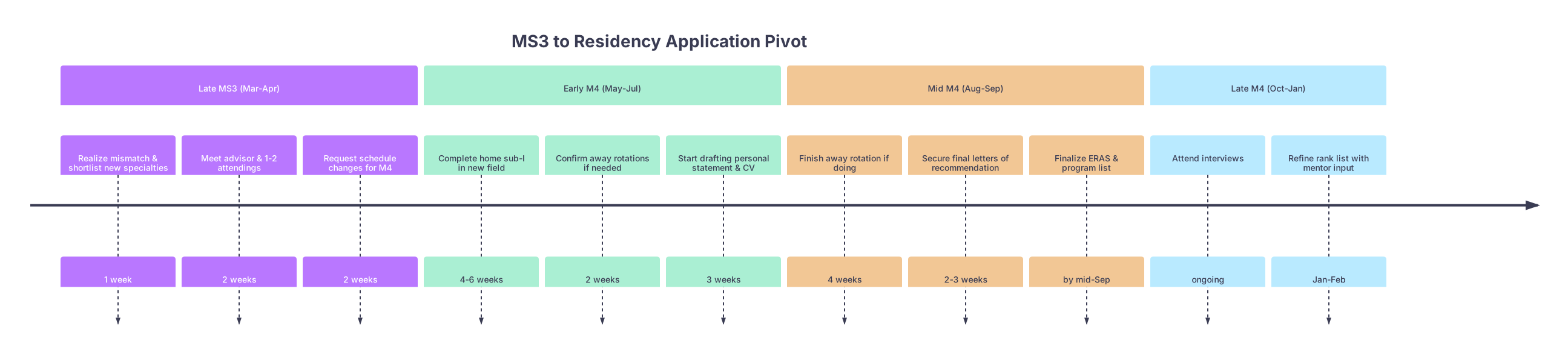
| Period | Event |
|---|---|
| Late MS3 (Mar-Apr) - Realize mismatch & shortlist new specialties | 1 week |
| Late MS3 (Mar-Apr) - Meet advisor & 1-2 attendings | 2 weeks |
| Late MS3 (Mar-Apr) - Request schedule changes for M4 | 2 weeks |
| Early M4 (May-Jul) - Complete home sub-I in new field | 4-6 weeks |
| Early M4 (May-Jul) - Confirm away rotations if needed | 2 weeks |
| Early M4 (May-Jul) - Start drafting personal statement & CV | 3 weeks |
| Mid M4 (Aug-Sep) - Finish away rotation if doing | 4 weeks |
| Mid M4 (Aug-Sep) - Secure final letters of recommendation | 2-3 weeks |
| Mid M4 (Aug-Sep) - Finalize ERAS & program list | by mid-Sep |
| Late M4 (Oct-Jan) - Attend interviews | ongoing |
| Late M4 (Oct-Jan) - Refine rank list with mentor input | Jan-Feb |
Use this to check whether you are actually on track or just thinking about being on track.
Step 9: Interview Season – Control the Narrative
By interview time, programs will have read your file. They will see the specialty pivot. You need clean, rehearsed answers that sound like reflection, not flailing.
Expect variants of these questions:
“I see you had significant exposure to [old field]. Why did you ultimately choose [new field]?”
- Answer in 3 parts:
- What you liked in the old field.
- What did not fit long‑term.
- What you found in the new field that fits better.
- Answer in 3 parts:
“Are you sure about this choice? Any regrets about not pursuing [old field]?”
- Acknowledge the loss briefly.
- Then pivot to what excites you now and how your experiences make you more certain, not less.
“How do you see your background in [old field] influencing you as a [new field] physician?”
- Highlight transferable skills:
- Comfort with acute situations.
- Procedural familiarity.
- Systems‑based thinking.
- Communication with high‑anxiety patients.
- Highlight transferable skills:
If you come across defensive or apologetic, they will worry you might pivot again. Calm, clear, and forward‑looking wins.
Step 10: Common Pitfalls You Need to Avoid
I have watched people do this well, and I have watched them burn their own chances. Here is how they sabotage themselves:
Waiting too long to commit.
Waffling until August or later, hoping for a sign, then trying to scramble multiple sub‑I’s and letters. Result: weak letters, rushed PS, poor program list.Not telling key people.
Keeping advisors and attendings in the dark because “I do not want them to judge me.” Then they find out anyway and trust you less. Tell the people who can help.Rewriting reality to suit ego.
Insisting on a hyper‑competitive field with mediocre numbers and no time left, ignoring clear advice. You might match, but you probably will not. Do not gamble your entire career on denial.Using a bitter or defensive tone.
In PS, in interviews, or with faculty: “I hated X, it was toxic, I would never do that.” People hear: “This person might badmouth us someday when things get hard.”Over‑dual‑applying as a substitute for strategy.
80 IM programs, 80 Psych programs, 40 FM programs “just in case.” It looks scattered and forces you into superficial applications.
You do not need to be perfect. You just need to avoid these obvious mines.
Quick Comparison: Smart vs. Self‑Sabotaging Pivot
| Area | Effective Approach | Ineffective Approach |
|---|---|---|
| Timing | Decide by late MS3 / early M4 | Waffle until ERAS opens |
| Scheduling | Early sub-I in new field, 0–2 targeted aways | No sub-I in new field or 4+ random aways |
| Letters | 1–2 strong letters in new field + relevant others | Mostly letters from old field, generic comments |
| Story | Clear, logical progression | Confused, apologetic, or bitter explanation |
| Programs List | Data-informed, realistic spread | Mostly reach or random mix of unrelated fields |
Visual: Where Your Time Should Go After the Pivot
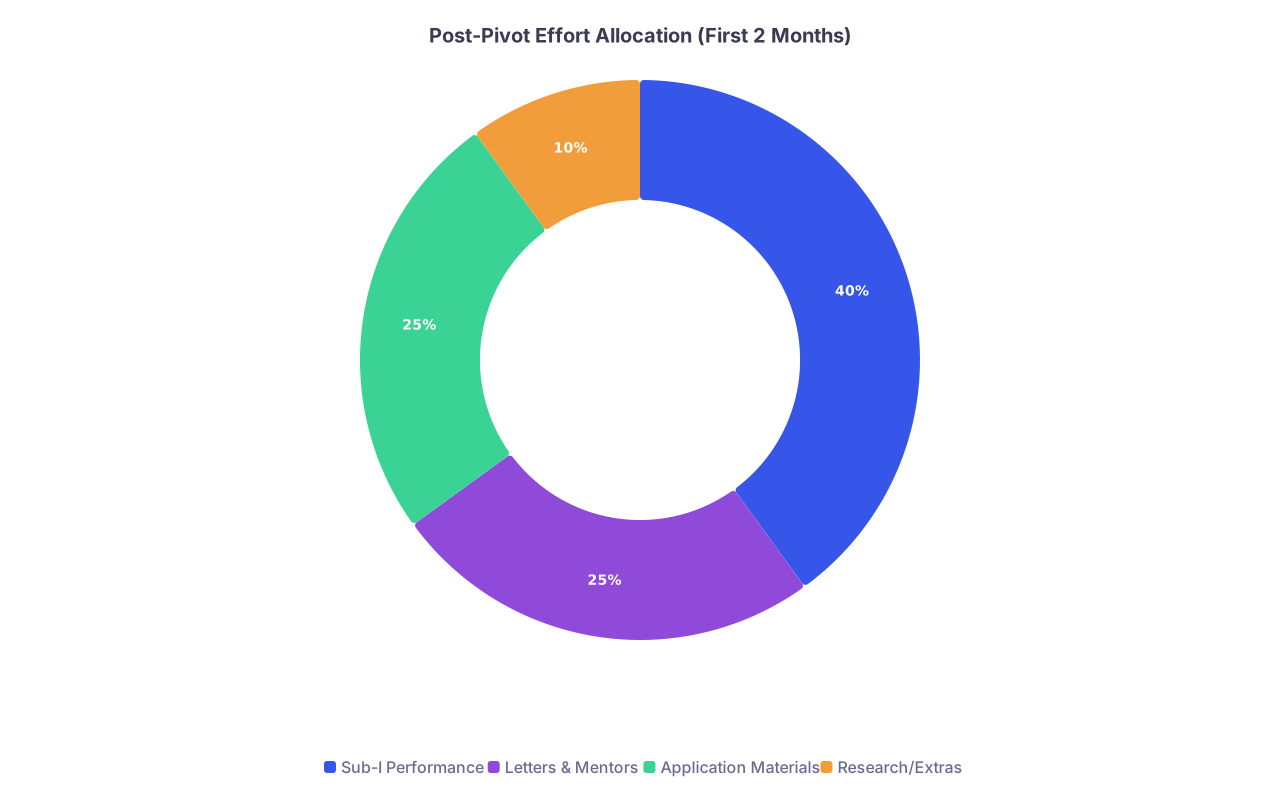
| Category | Value |
|---|---|
| Sub-I Performance | 40 |
| Letters & Mentors | 25 |
| Application Materials | 25 |
| Research/Extras | 10 |
The message: stop obsessing about “extra” research and rank lists before you fix the basics—performance, letters, and a coherent story.
Final Check: Are You Actually Recovering or Just Spinning?
Ask yourself 4 blunt questions:
- Do I have a clear primary specialty target by name?
- Do I have at least one early sub‑I in that field scheduled or completed?
- Do I know exactly which attendings I am asking for letters, and have I spoken with at least one?
- Can I explain my pivot in 60–90 seconds without rambling?
If you cannot answer “yes” to all four, that is your to‑do list for the next 2 weeks.


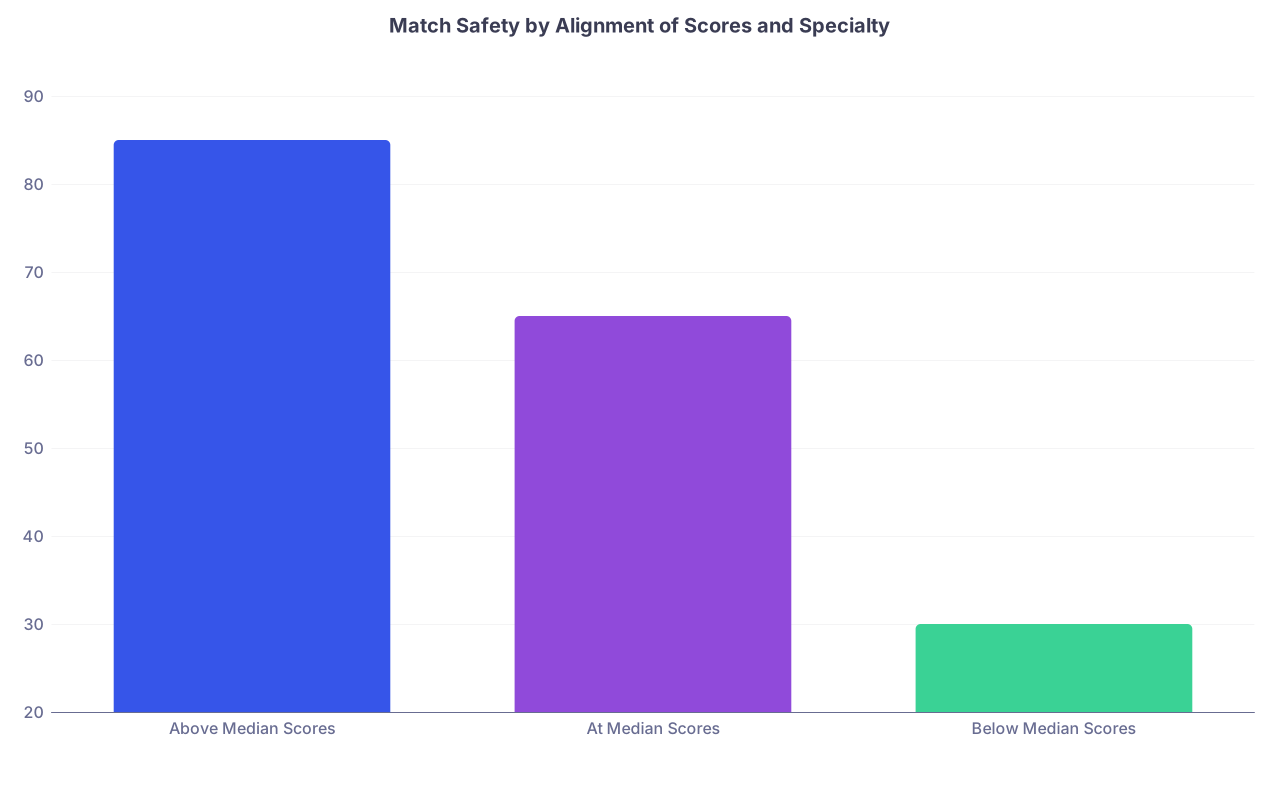
| Category | Value |
|---|---|
| Above Median Scores | 85 |
| At Median Scores | 65 |
| Below Median Scores | 30 |
Key Takeaways
- Changing specialty after MS3 is common and salvageable if you move quickly and deliberately.
- Your recovery hinges on three things: an early sub‑I in the new field, strong targeted letters, and a coherent story that links your past experiences to your new choice.
- Do not hide the pivot, do not wait for “certainty,” and do not build a fantasy application. Own the data, choose a realistic field, and execute a focused plan.
FAQ (Exactly 3 Questions)
1. How late is “too late” to change my specialty goal?
You start to run into serious structural problems if you decide after August of your M4 year. Before that, you can usually still get a sub‑I, a letter, and a coherent story. I have seen people pivot as late as July, scramble a single focused sub‑I and one away rotation, and match fine—because they committed and did not keep shopping around. After ERAS submission, changing specialties in the same cycle is extremely difficult and usually unwise. At that point, it is often better to regroup for the next year than to spray desperate applications.
2. What if I am switching into a more competitive specialty than my original one?
Then you need to be absolutely brutal about your numbers. If your Step 2 and grades are already top‑tier and you simply discovered a new passion, fine—focus on sub‑I performance and letters. But if your stats are average and you suddenly want derm, plastics, or ortho in June of M4, you are likely setting yourself up to fail this cycle. In those cases, either accept a more realistic field now with the option to specialize later, or plan a deliberate extra research year or extended training path. Do not pretend the competitiveness data does not apply to you.
3. Should I delay graduation or take an extra year to strengthen my application after a late pivot?
Sometimes. An extra year makes sense if:
- You are dead‑set on a competitive field where your current profile is clearly underpowered, and
- You can secure a meaningful research or clinical year in that field with real mentorship and output.
It is a bad idea if you are just hoping “time” will fix things without a clear plan or if the field you are targeting is already well within reach now (like IM, FM, Peds, Psych for many students). In many cases, it is better to match into a solid, realistic field this year and use fellowships or later moves to refine your path than to burn a year wandering.