
The idea that you should already “feel called” to a specialty by third year is nonsense.
Most students do not magically click with a field. They stumble into something that starts as “tolerable” and becomes “this fits” because they explored it systematically. You are not behind. You are just unguided.
Let’s fix that with a 4-week, structured plan.
The Real Problem: You’re Sampling Vibes, Not Systems
You are probably doing what everyone does:
- Waiting for a rotation to magically feel right
- Overweighting one loud attending’s personality
- Panicking because classmates “already know” they want ortho or derm
- Confusing “I like this attending / team” with “I like this specialty”
This is how people end up:
- Half-committed to a field they barely understand
- Realizing in late M4 that the day-to-day does not match what they imagined
- Or worse, in residency thinking, “I made a mistake.”
You need a system. Not vibes. Not random shadowing. Not 100 personality quizzes.
Here is the 4-week structure:
- Week 1: Clarify what actually matters to you
- Week 2: Deep-dive into 4–6 candidate specialties
- Week 3: Reality-check with real people and real schedules
- Week 4: Narrow, test, and create a 6–12 month plan
You will not “magically know” in 4 weeks. But you will:
- Eliminate obviously poor-fit fields
- Identify 1–3 realistic specialties to prioritize
- Have a concrete next-step roadmap instead of vague anxiety
Week 1: Get Ruthlessly Clear On What You Want
You are not choosing a specialty. You are choosing:
- A lifestyle pattern
- A personality fit
- A set of repetitive tasks you will do thousands of times
So you start with you.
Step 1: Define Your Non-Negotiables
Block one 60–90 minute session. No phone. No notes from other people. Answer these blunt questions in writing:
Schedule reality
- Do I care more about my daily control (clinic-based, predictable) or having stretches of time off (shift-based, hospital-heavy)?
- Can I tolerate frequent nights/weekends for something I love? Or is that a hard no?
Physical / cognitive style
- Do I like working with my hands and moving around? Or do I prefer thinking, talking, deciding?
- Do I want procedures as a major part of my identity—or genuinely do not care?
Emotional exposure
- Am I okay seeing people die regularly? Trauma? ICU multi-organ failure?
- Am I okay with chronic, slow-burn disease and non-adherent patients?
Team vs independence
- Do I prefer big teams (ICU, OR), or small teams / mostly me (outpatient, consult service)?
- Do I enjoy teaching, conferences, group discussion? Or do I prefer quiet work?
Career arc
- Do I want a field where fellowship is almost mandatory (hemonc, cards, neonatology)? Or do I want to be employable right after residency?
- How much does money actually matter to me compared with schedule?
Then categorize each answer:
- Non-negotiable
- Strong preference
- Nice to have
If you cannot rank things, that is your first problem. Indecision here leads to misery later.
Step 2: Quick Self-Assessment (Without Over-Respecting It)
Use something like the AAMC “Careers in Medicine” self-assessment or similar tools, but treat it like a starting hypothesis, not truth.
- Pull out the top 6–8 specialties it suggests
- Add 3–4 fields you are curious about, regardless of its suggestion
- You now have a rough list of 8–12 specialties
You are not “deciding” from this list. You are building your exploration pool.
Step 3: Filter Out Clear Mismatches
Use your Week 1 values to cut the list down to 6 or fewer.
Example filters:
- Hate the OR → cut general surgery, ortho, ENT, neurosurg (unless you genuinely doubt that hatred)
- Cannot stand chronic clinic follow-up → cut fields that are mostly outpatient continuity like outpatient-only psych, outpatient IM without hospitalist, many primary care setups
- Need highly predictable 8–5 M–F → ED, trauma, many surgical fields drop way down in probability
Do not overthink borderline calls. For now:
- Create 3 groups:
- Strong maybe (A-list) – 3–4 specialties
- Weak maybe (B-list) – 3–5 specialties
- Probably no – park them, do not delete
You will focus this 4-week plan on the A-list, with minor sampling of the B-list if time allows.
Week 2: Build a 4–6 Specialty “Mini-Dataset”
Now you stop theorizing and start collecting data.
Step 1: Use a Structured Comparison Template
You are going to use the same lens on each specialty so you can actually compare apples to apples. Create a one-page template per specialty with these headings:
- Daily work mix (clinic, procedures, floor work, ICU, OR, consults)
- Typical schedule (residency vs attending)
- Patient population (acute vs chronic, age, social determinants, intensity)
- Cognitive style (pattern recognition, algorithms, diagnostic puzzles, procedures)
- Training length + required / common fellowships
- Lifestyle outliers (community vs academic; urban vs rural)
- Common frustrations in the field (from real people)
- Personality fit notes (based on you, not stereotypes)
Then as you research, fill it in.
Step 2: Do Rapid, Focused Research (Not Endless Googling)
For each A-list specialty (3–4 fields), spend 1–2 hours max with focused sources:
- Residency program websites – look at rotation schedules, call structures, didactics
- FREIDA / NRMP data – training lengths, competitiveness, fellowship patterns
- Specialty society pages – e.g., ACP for Internal Medicine, ACOG for OB/GYN
- 1–2 high-quality blogs / podcasts from residents or attendings in that field
Your goal in Week 2:
- Identify what the average day* looks like, not the unicorn lifestyle flex on YouTube
- List 3 things that genuinely attract you to the field
- List 3 things that seriously worry you about it
Do not let any specialty escape Week 2 without both an attraction list and a concern list.
Step 3: Make a Brutally Honest Comparison
Once you have 3–4 specialty sheets filled out, put them side by side and force ranking decisions:
- Which specialty’s worst days would you rather tolerate?
- Which specialty’s typical schedule aligns best with your Week 1 non-negotiables?
- Which field’s main frustrations look “annoying but manageable” vs “soul-crushing”?
To make this less abstract, use a very simple scoring grid.
| Factor | Internal Med | EM | Psych | Gen Surg |
|---|---|---|---|---|
| Lifestyle fit (1–5) | 3 | 2 | 4 | 1 |
| Interest in patients | 4 | 3 | 5 | 3 |
| Tolerance of downsides | 3 | 2 | 4 | 1 |
| Training length fit | 3 | 4 | 4 | 2 |
You do not need perfect scoring. You need relative patterns.
Attach your gut reaction notes, but keep your Week 1 non-negotiables front and center. If a specialty violates 2–3 of your core non-negotiables, it should be demoted unless there is an extremely strong compensating factor.
Week 3: Stop Guessing—Talk to Real People
Week 3 moves you from “theoretical fit” to “what the job actually feels like when you are 7 years in and tired.”
You are going to interview 6–10 people:
- 2–3 attendings in A-list specialties
- 2–3 residents (PGY2–4 ideally) in those specialties
- 1–2 wild cards (someone in a field you ruled out but are curious about)
Step 1: Set Up Targeted Conversations
Send short, direct emails:
- To residents you met on rotation
- To attendings who were decent human beings
- To alumni from your school’s specialty interest groups
Script (adapt as needed):
Subject: Quick 15-min chat about [Specialty]?
Hi Dr. [Name],
I am an MS[2/3/4] at [School], trying to make a more deliberate decision about specialty. I am considering [Specialty] among a few others and would value your perspective.
Would you be open to a brief 15-minute call or Zoom sometime in the next 1–2 weeks? I am specifically trying to understand what your day-to-day looks like and what you see as the biggest downsides of the field, beyond the usual talking points.
I know you are busy, so any time you could spare would be appreciated.
Best,
[Name]
Aim for:
- 2 attendings + 1 resident in your top choice specialty (or two top choices)
- 1 attending + 1 resident in a “backup / alternate” field
Step 2: Use a Standard Question Set
Stop asking, “Do you like your job?” They will almost always say yes. Instead, ask questions that expose friction.
Some you should use verbatim:
- “Walk me through a typical day for you—clinic days and non-clinic days.”
- “What are the 2–3 parts of your job that drain you the most?”
- “What type of colleague absolutely hates this specialty, in your experience?”
- “How has your view of the field changed from residency to now?”
- “If you had to switch specialties today, what would you pick and why?”
- “How different are your best days from your worst days?”
- “What do you wish students understood about this field that they usually do not?”
Take notes immediately after each conversation. Not during, if you can avoid it.
Step 3: Synthesize What You Hear
Within 24 hours, update each specialty’s one-page sheet:
- Add a “Real-world notes” section:
- Recurring complaints you heard
- Personality traits of physicians who seemed happy vs burned out
- Any red flags that keep coming up
You are looking for patterns:
- If 4 different people mention documentation burnout in the same field, that is signal
- If the happy people share certain traits (e.g., love of long-term relationships, high tolerance for ambiguity), compare that with yourself honestly
At the end of Week 3, you should be able to say:
- “If I choose X, I am signing up for [A, B, C upsides] and [D, E, F downsides], and I am okay with that trade.”
- Or, “No chance. This would drain me.”
Week 4: Narrow, Test, and Build a 6–12 Month Plan
By now, you should have:
- Written values / non-negotiables
- 3–4 specialty one-pagers
- Real conversations with 6–10 physicians
You are not lost anymore. You are just at a decision junction.
Step 1: Force Yourself To Choose a Provisional Top 2–3
You are not signing a contract. You are setting direction.
Rank:
- Provisional #1 choice
- Serious backup
- Dark horse / wildcard (optional)
If you absolutely cannot pick a #1, that means:
- You have not been honest about your non-negotiables, or
- You are treating the choice as permanent and absolute
Write this in one sentence:
“If I had to submit ERAS today, I would apply in [Specialty] and feel [emotion].”
If the emotion is pure dread, listen to that.
Step 2: Design a 4-Week “Micro-Rotation” Test (If You Can)
If your schedule allows (especially in pre-clinical years or flexible M3), line up very specific exposure for the next month or two:
- 2 half-days in clinic with your provisional #1
- 1 OR or procedure day with the field (if procedural)
- 1 call shift or evening shadow (if hospital-based)
- 1–2 half-days with the backup field for contrast
Do not just “be there.” You are testing hypotheses. Before each shadowing block, write:
- 3 things you expect to like
- 3 things you expect to dislike
After each day, rate:
- How mentally drained you felt (1–10)
- How emotionally drained or fulfilled you felt (1–10)
- How much of the day you spent doing things you could see yourself repeating for 10 years
Track this for multiple days. Patterns matter more than one amazing or terrible day.
If your school structure does not allow free shadowing, then:
- Use elective time more aggressively
- Request specific cases or clinics within required rotations
- Tell the clerkship director your goal: “I am trying to decide between X and Y—can I be placed with Dr. Z or get an extra clinic day in X?”
Step 3: Build a Concrete 6–12 Month Plan
Now you translate everything into an actual plan with dates and actions.
Core components:
Targeted rotations / electives
- Schedule an acting internship / sub-I in your provisional #1
- Add at least one rotation in your backup field
- Avoid stacking all your critical specialty exposure at the very end of M4
-
- Pick 1 attending and 1 resident in your top field
- Email them:
- Your current thinking
- What you are doing to explore
- That you would like to check in 2–3 times over the next year
Competitiveness reality check
- Compare your Step/COMLEX scores, grades, and research to specialty norms
- If you are below average for a highly competitive field, you need:
- A concrete gap-filling plan (research, away rotations, strong letters)
- Or a realistic shift toward a less competitive but still satisfying field
Backup strategy
- Decide: would you be okay dual-applying in your #1 and #2 if necessary?
- If so, clarify what you need to be eligible / convincing in both
Lay this out in blunt timeline form.
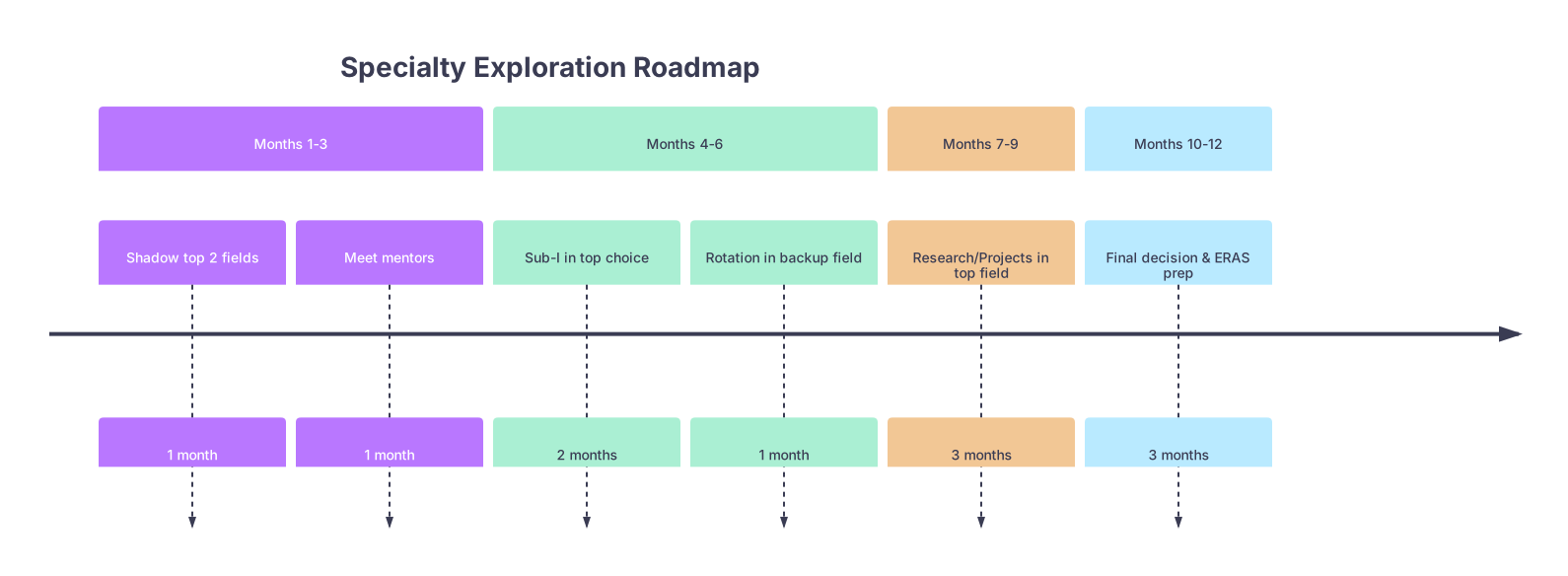
| Period | Event |
|---|---|
| Months 1-3 - Shadow top 2 fields | 1 month |
| Months 1-3 - Meet mentors | 1 month |
| Months 4-6 - Sub-I in top choice | 2 months |
| Months 4-6 - Rotation in backup field | 1 month |
| Months 7-9 - Research/Projects in top field | 3 months |
| Months 10-12 - Final decision & ERAS prep | 3 months |
This eliminates the “I hope it clicks later” fantasy. You are steering the process.
A 4-Week At-A-Glance Schedule
If you want the plan collapsed into something you can print and stick on a wall:
| Week | Focus | Deliverable |
|---|---|---|
| 1 | Values + filters | Written non-negotiables, A/B/C lists |
| 2 | Research 3–4 specialties | One-page sheets for each |
| 3 | Conversations | Notes from 6–10 residents/attendings |
| 4 | Narrow + plan | Provisional top 2–3 + 6–12 month roadmap |
You can absolutely compress or stretch this, but do not skip weeks. Each does something different.
Common Traps You Need To Ignore
A few patterns I have seen wreck good decision-making:
Trap 1: Chasing Prestige Instead of Fit
You do not need to impress your classmates with your specialty choice.
I have watched students force themselves into surgical subspecialties they did not like because they were “too smart” (their words) for primary care. Three years later: miserable, burnt out, counting the days.
You will be far more respected as an excellent hospitalist, pediatrician, or psychiatrist than as a mediocre, bitter subspecialist who resents their own job.
Trap 2: Confusing One Rotation With a Whole Field
- Toxic attending ≠ bad specialty
- Angel attending ≠ perfect specialty
You need multiple data points. Different settings. Different practice styles.
Your structured approach (values → research → conversations → testing) protects you from overgeneralizing one clerkship.
Trap 3: Waiting To Feel 100% Certain
You will not. The doctors who seem “sure” mostly made an educated bet, then grew into it.
You are aiming for:
- Reasonable confidence
- Clear-eyed awareness of tradeoffs
- A plan if your first choice does not pan out
That is enough.
Visualizing Your Preference Shifts Over Time
You will probably notice your preferences change over these 4 weeks. That is not a bad sign. It means you are actually learning.
You can even track your interest level numerically to see which fields are gaining or losing ground.
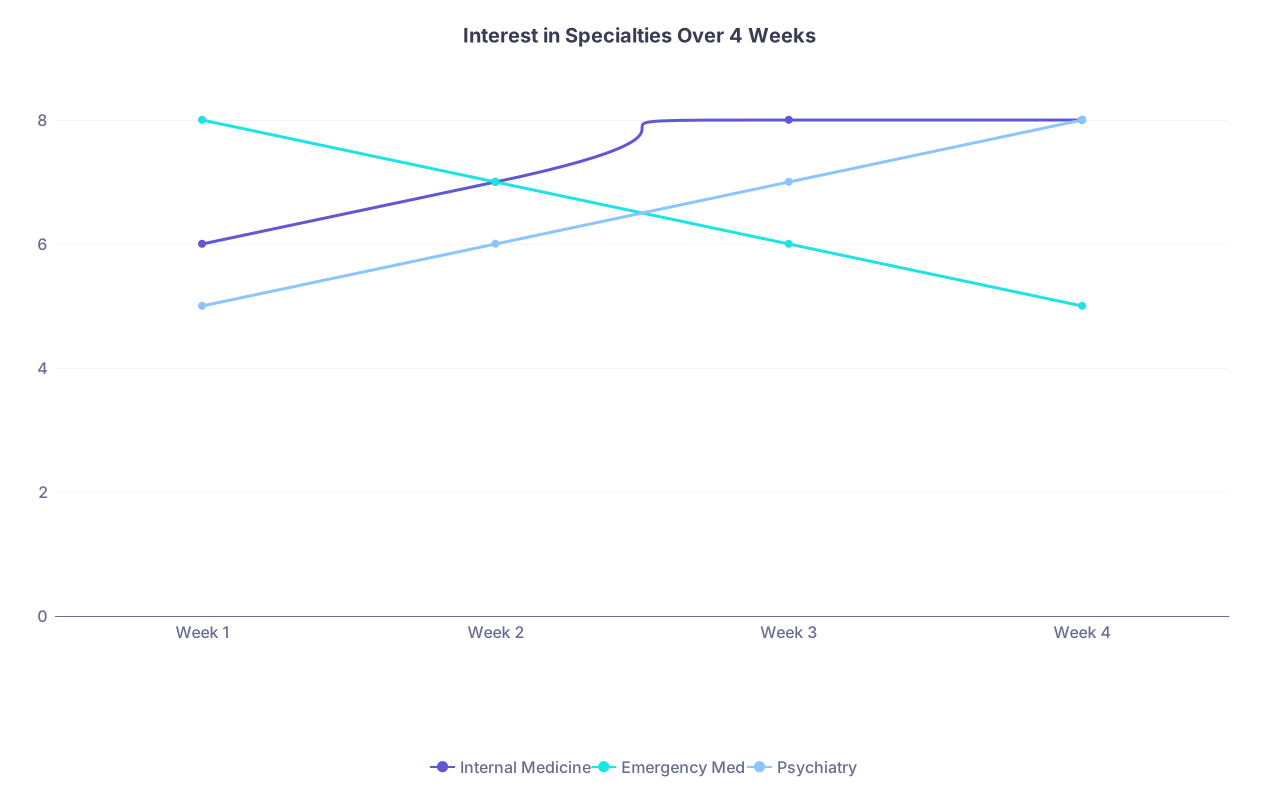
| Category | Internal Medicine | Emergency Med | Psychiatry |
|---|---|---|---|
| Week 1 | 6 | 8 | 5 |
| Week 2 | 7 | 7 | 6 |
| Week 3 | 8 | 6 | 7 |
| Week 4 | 8 | 5 | 8 |
If a field keeps trending down as you learn more, pay attention.
How To Use Your Current Rotations Strategically
You do not always have full control over what rotation you are on. That is fine. You can still farm data for your decision.
On any rotation, ask yourself:
- Which parts of this rotation do I actually enjoy?
- Procedures? Explaining things to patients? Interpreting diagnostics? Running lists?
- Which environment pieces work for me?
- Pace? Team size? Acuity? Call structure?
Then map them:
- “I liked running codes in IM → maybe EM, ICU, anesthesia should stay on my radar”
- “I liked reassurance and long talks on psych → maybe palliative, primary care, rheum”
Your specialty choice is often a collage of these micro-preferences. Do not waste them.
A Few Reality Checks On Lifestyle and Burnout
People love to say “X is a lifestyle specialty” like burnout does not exist there. Wrong.
Here is the thing that matters more than raw hours: alignment.
A 50-hour week doing work you find meaningful, with a pattern that matches your natural energy, beats a 35-hour week doing work that grates against your personality.
Look at this loosely:
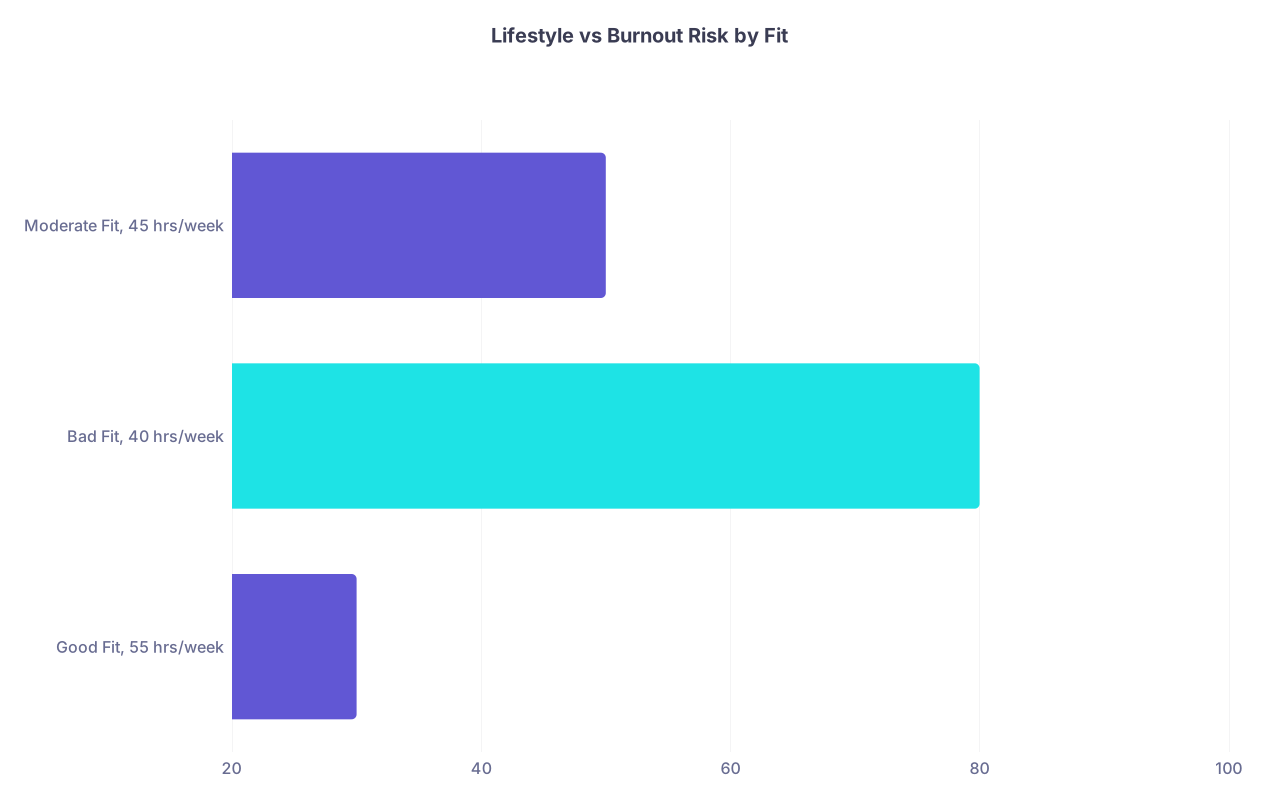
| Category | Value |
|---|---|
| Good Fit, 55 hrs/week | 30 |
| Bad Fit, 40 hrs/week | 80 |
| Moderate Fit, 45 hrs/week | 50 |
(Values here as “burnout risk index” – higher is worse.)
The data in real life is messy, but I have seen this: students who chose “lighter” fields for lifestyle but hated the actual work burned out just as hard.
So yes, consider hours. But do not treat them as the only or even primary variable.
You Are Not Behind. You Are Undirected.
If you follow this 4-week plan seriously:
- You will know more about yourself and 3–4 specialties than many M4s do
- You will stop waiting for fate to hand you a calling
- You will have a concrete plan with dates, names, and next steps
That alone will drop your anxiety level a notch or two.




Key Takeaways
- Stop waiting for a “calling.” Use a 4-week structure: values → research → conversations → testing.
- Choose a provisional top 1–3 specialties and then design a 6–12 month plan to stress-test that choice.
- Fit beats fantasy. The right specialty is the one whose routine work and downsides you can tolerate for years, not the one that sounds impressive on paper.
FAQ (Exactly 3 Questions)
1. What if I still do not have a clear #1 choice after 4 weeks?
Then you are where many normal, thoughtful students are. Narrowing to 2–3 fields with clear pros/cons is already progress. At that point, your next step is not more thinking—it is targeted action: schedule sub-Is or electives in those top 2, get strong mentors in each, and let real-world experience over the next 6–12 months break the tie.
2. How much should competitiveness influence my specialty choice?
You would be foolish to ignore it and foolish to let it completely dictate your choice. If you love a competitive specialty and your metrics are average, you need two things: (1) an honest conversation with mentors in that field about realistic options, and (2) a viable backup field you could also be happy in. Dual-apply strategically if advised. But do not chase a competitive field purely for ego—it rarely ends well.
3. Can I change my mind after building this whole plan?
Yes. And you probably will refine it. This 4-week structure is not a trap; it is a decision scaffold. As you learn more, you update your non-negotiables, revise your top 2–3, and adjust your rotations accordingly. Changing your mind based on better data is not failure. It is exactly how good decision-making is supposed to work.