

The idea that you must “fit” neatly into one traditional specialty is a lie that stresses out a lot of good students.
If your interests do not match any one specialty cleanly, you are not broken, behind, or indecisive. You’re just using a 1980s framework for a 2020s training environment. Let’s fix that.
Step 1: Stop Trying To Find “Your One True Specialty”
Here’s the core problem: med school sells you a soulmate story.
You’re told you’ll rotate, “fall in love” with a field, and everything will click. For some people, sure. For a lot of others, what actually happens is:
- You like parts of medicine, psych, and peds.
- You like the OR some days, hate it others.
- You enjoy talking to patients, but also really like data, imaging, or procedures.
- No single rotation felt perfect. Every one had big pros and big cons.
So you start thinking, “Something’s wrong with me. Everyone else seems to know.” They do not. You’re just hearing from the very loud 5–10% who “always knew they were going to be a surgeon/pediatrician/etc.”
Shift your goal. You’re not trying to find a perfect identity match. You’re trying to engineer a career that:
- Uses your strengths often
- Minimizes what drains you
- Gives you options to pivot, sub-specialize, or shape your practice over time
Once you accept that, a lot opens up.
Step 2: Break Your Interests Down Into Components
“Nothing fits me” is usually code for “I haven’t taken my interests apart into usable pieces.”
Instead of asking, “Do I like internal medicine?” ask bite‑sized questions:
- Do I like acute vs chronic care?
- Inpatient vs outpatient?
- Adults, kids, or all ages?
- Longitudinal relationships vs one‑time intense encounters?
- Thinking vs doing: how much do I want my day to be procedures vs cognitive work?
- How much uncertainty can I tolerate?
- How much do I care about lifestyle predictability vs adrenaline?
Write this down. Literally. One page, two columns: “Energizing” and “Draining” from each rotation you’ve done.
Then translate what you like into skills/themes, not specialty labels. For example:
- “I like puzzling out diagnostic mysteries” → high-cognitive, internal‑med-y thinking
- “I like counseling and motivational interviewing” → psych/primary care/addiction medicine
- “I like procedures but not 8-hour operations” → EM, IM with procedures, hospitalist with lines, GI, pulm, anesthesia, IR-lite roles
- “I like normal physiology + patient education” → OB, peds, primary care, sports medicine
Once you have themes, you stop chasing a “match” and start designing a mix.
Step 3: Understand That Modern Careers Are Built From Mixes
Residency is labeled by one specialty. Your career is not.
I’ve watched people do:
- Internal medicine → addiction medicine + primary care HIV clinic
- Family medicine → sports medicine + urgent care + teaching
- Psychiatry → women’s mental health + collaborative care embedded in OB clinics
- Pediatrics → complex care clinic + hospitalist shifts + palliative consults
- Radiology → MSK imaging + procedural spine injections
- EM → ultrasound fellowship + outpatient POCUS clinic + education
None of those careers “fit” a clean shelf-exam box.
So instead of “What specialty matches me?” try “What base specialty gives me the most ways to express my interests later?”
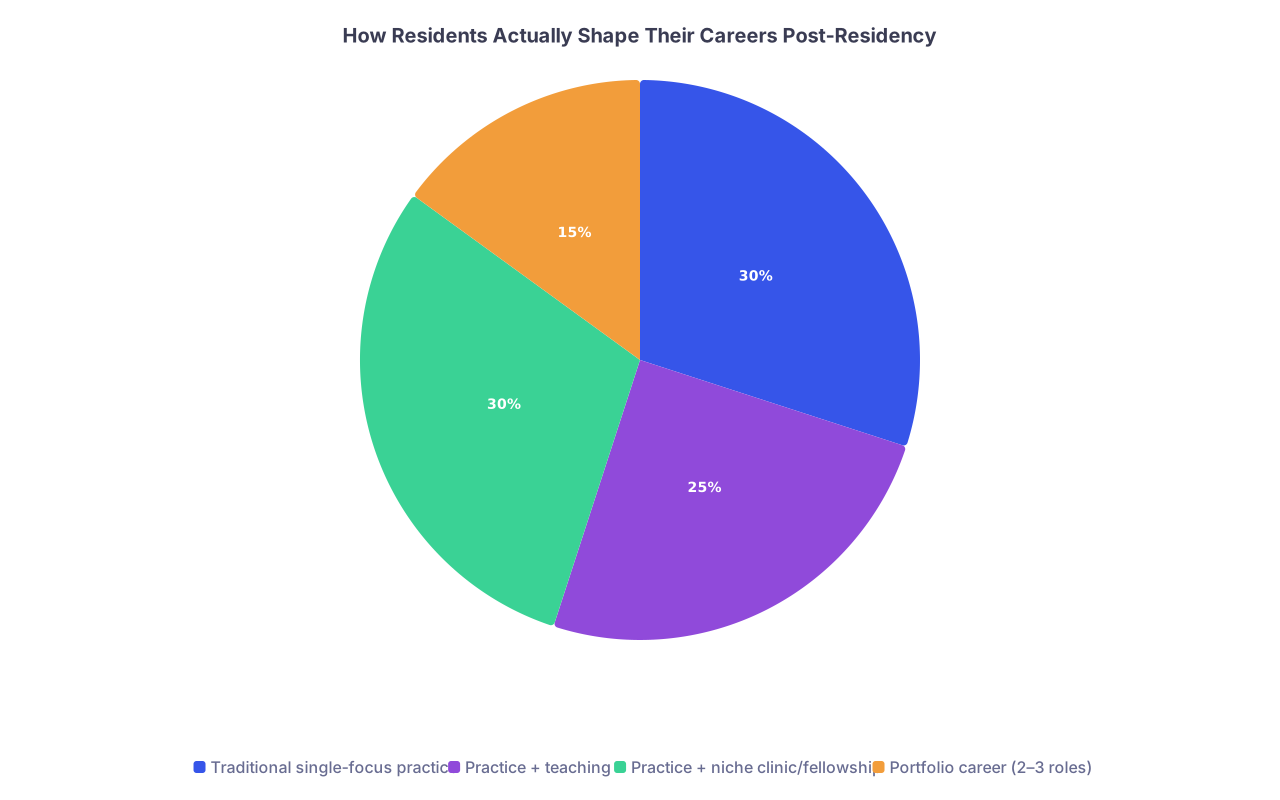
| Category | Value |
|---|---|
| Traditional single-focus practice | 30 |
| Practice + teaching | 25 |
| Practice + niche clinic/fellowship | 30 |
| Portfolio career (2–3 roles) | 15 |
If you’re a mixed-interest person, you usually want a base with:
- Many fellowships or niche roles
- Flexible practice models (academic, community, outpatient, inpatient, hybrid)
- A broad patient population
IM, FM, EM, pediatrics, and psychiatry are especially good for this. But surgery, OB, radiology, anesthesia all have ways to carve out hybrid lives too.
Step 4: Use This 4-Box Framework Instead Of “What Do I Like?”
You need a filter that’s harsher than “I enjoyed this clerkship.”
Use this simple 4‑box grid. On a piece of paper, draw 4 quadrants:
- Things I enjoy that I’m good at
- Things I enjoy but I’m average/weak at
- Things I don’t enjoy but I’m good at
- Things I don’t enjoy and I’m bad at
Now plug in tasks from each rotation:
- Taking a complex history
- Motivational interviewing
- Rapid decision-making in uncertainty
- Standing in the OR for hours
- Managing 20+ patients on rounds
- Document-heavy chronic care visits
- Talking about prognosis/end-of-life
- Doing procedures (lines, LPs, suturing, scopes, etc.)
Patterns will show up fast.
Your specialty short-list should come mostly from careers where the daily work is strongly in box 1, tolerably in box 2 or 3, and rarely lives in box 4.
That’s a better predictor than “I like women’s health” or “I like kids,” which are way too broad.

Step 5: Know The Hybrid-Friendly Specialties (And What They Combine Well With)
If your interests are scattered, some bases simply give you more room to play. Here’s a quick comparison.
| Base Specialty | Good If You Like | Common Hybrid Directions |
|---|---|---|
| Internal Medicine | Complex diagnostics, adults, inpatient or clinic | Cards, GI, pulm/CC, ID, palliative, hospitalist + clinic |
| Family Medicine | Breadth, procedures + clinic, all ages | Sports med, OB-lite, addiction, urgent care, academic roles |
| Emergency Medicine | Acute care, variety, procedures, shifts | Ultrasound, critical care, admin, event medicine |
| Pediatrics | Kids, families, chronic care | NICU, PICU, heme/onc, complex care, adolescent med |
| Psychiatry | Talking work, longitudinal relationships | Addiction, consult-liaison, women’s MH, neuropsychiatry |
If you’re torn between very different things (“I like psych and ICU,” “I like OB and primary care,” “I like procedures and talking”), look hard at hybrid paths:
- FM + OB-heavy practice in rural/underserved settings
- IM or EM then critical care → huge overlap of cognitive + procedural work
- Psych + primary care collaborative clinics
- IM or FM + addiction medicine → lots of counseling + meds + systems work
- EM + palliative or EM + admin → acute care plus meaning or influence
These are not theoretical. I’ve seen people build them.
Step 6: Use Rotations Strategically When Nothing Fits Cleanly
Stop passively “seeing what clicks.” You don’t have the time.
Here’s how to actively use what’s left of med school:
- On each rotation, identify: what parts of this could I imagine tolerating daily for 10 years? What parts make me think “absolutely not”?
- Ask residents attending-level questions:
- “If you burned out of pure clinical work tomorrow, what alternate roles do people in this specialty realistically do?”
- “Who here has a non-traditional career in this field that you admire?”
- Aim for at least 1–2 away rotations or electives that explicitly test your “border zones.” For example:
- If you’re between psych and IM: try consult-liaison psych, addiction consults, or primary care mental health integration.
- Between surgery and medicine: surgical oncology clinic, GI or interventional pulmonology where there’s scope-based procedures + medicine thinking.
- Between EM and IM: ED observation unit, hospitalist on nights, or ICU.

| Step | Description |
|---|---|
| Step 1 | List Interests & Strengths |
| Step 2 | Shortlist 2-3 Base Specialties |
| Step 3 | Identify Overlap Areas |
| Step 4 | Choose Targeted Electives |
| Step 5 | Ask Residents About Real Careers |
| Step 6 | Refine Specialty Choice or Hybrid Plan |
You’re not looking for a magical “this is it” moment. You’re collecting data that narrows down what you can live with and shape over time.
Step 7: Consider Non-Traditional Paths Without Romanticizing Them
Some students jump to “I’ll just do lifestyle field X and then do health tech/consulting/administration” because nothing clinical feels right.
Reality check:
- Yes, there are doctors in industry, tech, policy, consulting, informatics.
- No, you should not pick a specialty you actively dislike just to one day escape it entirely. That’s a recipe for misery in residency.
If you know you’re drawn to broader systems/tech/policy work:
- Consider specialties that touch many parts of the system: IM, EM, FM, anesthesia, radiology, psych.
- Learn enough clinical medicine to be credible and useful. That still matters for almost every non-clinical doctor job.
- Seek mentors who’ve actually made that jump. Not just people talking about maybe doing it.
Step 8: Gut Check: Are You Actually Under-Exposed Or Just Afraid To Commit?
Sometimes “nothing fits” is really:
- “I’ve had 2 decent experiences and 6 dysfunctional team experiences, so everything looks bad.”
- “I’m perfectionistic and scared of closing any doors.”
- “I’m exhausted, so everything seems unappealing.”
Do a quick self-audit:
- If you imagine doing your favorite rotation’s best day once a week and its worst day once a week, is that survivable?
- If I told you you had to choose in 48 hours, what would you tentatively pick? (Your flinch answer is data.)
- Are you expecting a job to give you identity, or are you willing to treat it as one (important) part of a broader life?
If the problem is fear of commitment, that’s different from truly not fitting anything. In that case, you want a broad specialty base and mentors who openly talk about evolving their careers.
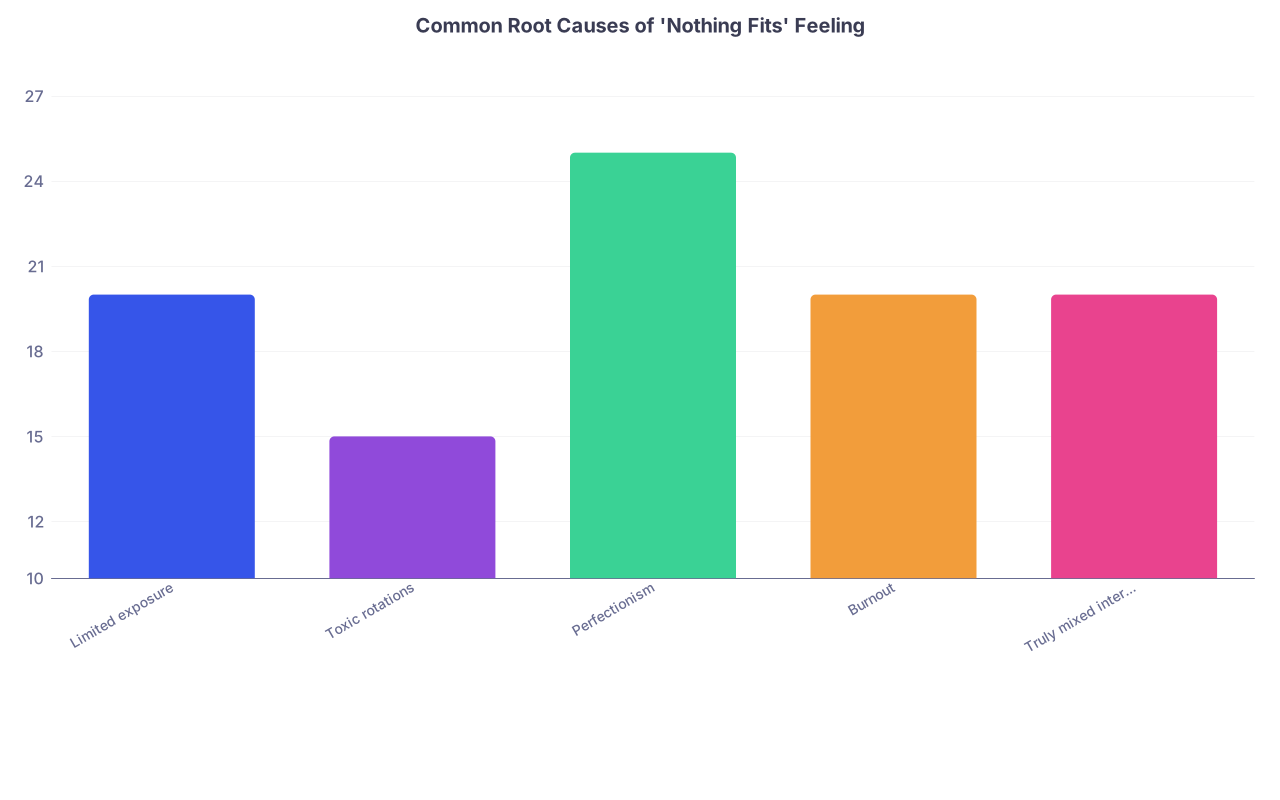
| Category | Value |
|---|---|
| Limited exposure | 20 |
| Toxic rotations | 15 |
| Perfectionism | 25 |
| Burnout | 20 |
| Truly mixed interests | 20 |
Step 9: How To Talk About This With Advisors (Without Sounding Lost)
You need letters, advocacy, and someone to sanity check you. But a lot of formal advising is stuck in “pick a specialty, then we build an application around it.”
Go in prepared:
- Bring your “Energizing vs Draining” list and 4-box grid.
- Start with: “Here’s what I’ve learned about what I like and what I’m good at. Here are the specialties I’m considering as base platforms, and here are example careers I could see myself in.”
- Ask very pointed questions:
- “Which base specialty best preserves these interests and keeps options open?”
- “What’s the risk if I choose X and later discover I want more of Y?”
- “Based on my evaluations and strengths, where do you see genuine fit vs struggle?”
You’ll get much better guidance if you show you’ve done the internal work.
Step 10: Red Flags You’re Forcing The Wrong Fit
There’s a difference between “I don’t fit cleanly anywhere” and “I’m ignoring what my experience is screaming at me.”
Be cautious if:
- You’re choosing a field solely because of perceived prestige or income, while most daily tasks land in your quadrant 4 (don’t like + not good at).
- You routinely leave that rotation emotionally drained, dreading the next day, even when the team is supportive and reasonable.
- Your best attendings gently nudge you away: “You’d be great, but I wonder if you’d be happier in X, given what you’ve told me.”
- You’re telling yourself: “I’ll suffer through 3–7 years, then I’ll change everything.” That’s a long time to be miserable.
You can absolutely have mixed interests. You do not have to sign up for daily suffering to prove something.
FAQ: “What If My Interests Don’t Match Any One Traditional Specialty Cleanly?”
1. Is it a bad sign if I like parts of almost every rotation but don’t love any one specialty?
No. It usually means you’re adaptable and curious, not broken. Many internists, family docs, EM docs, hospitalists, and psychiatrists felt exactly like this as students. Your job is to identify what you cannot tolerate long-term and avoid those fields, then pick a broad base that lets you build a hybrid career over time. Expect “good enough plus options,” not a perfect soulmate specialty.
2. How do I choose between two very different specialties I sort of like?
Stop treating them as abstract labels. Compare the day-to-day realities and the exit ramps. Shadow on call nights, clinics, and weekend shifts. Talk to attendings 15+ years out. Ask: whose bad days would I rather have? Then look at flexibility: which one lets me flex into my other interest via fellowships, niche clinics, academic work, or side roles? That combination—tolerable bad days + flexible exit ramps—usually points to the better base.
3. Could I just pick a broad field like internal medicine or family medicine and figure it out later?
You can, and many people do, but do it intentionally. Don’t treat it as a dumping ground for indecision. Go in with a hypothesis: “I’ll do IM because I enjoy complex problem-solving and may want cards/GI/hospitalist,” or “I’ll do FM because I want breadth, outpatient procedures, and maybe sports medicine or women’s health.” Broad fields are powerful when you see them as platforms, not placeholders.
4. What if I realize mid-residency that I still don’t fit cleanly?
First, that’s more common than people admit. You have several options: shape your practice within the field (clinic vs inpatient, academic vs community, niche populations), pursue a fellowship that leans into the parts you enjoy, or add non-clinical roles (teaching, admin, QI, informatics, research). Only in extreme mismatch cases do people fully retrain in another specialty, but redesigning within your field is often enough to make the work fit you much better.
5. What’s one practical exercise I can do this week to get clarity?
Take 30 minutes today and list every rotation you’ve done. Under each, write three columns: “What I genuinely liked,” “What I strongly disliked,” and “What I was surprisingly good at.” Then circle all the “liked + good at” items across rotations and see what themes keep repeating—procedures, counseling, acute care, chronic management, specific age groups, etc. That pattern is more valuable than your feeling about any single specialty label. Use that list to set up one focused meeting with an advisor or mentor in the next 2 weeks.
Now: grab a sheet of paper and draw that 4-box grid of “like/don’t like” vs “good at/not good at.” Fill it out from your last two rotations today. That’s your first real map out of the “nothing fits me” trap.


