
Most med students are asking the wrong question about specialties.
You don’t actually care whether a field is called “procedural” or “cognitive.” You care whether your day-to-day work feels right: the pace, the decisions, the risks, the kind of thinking, the kind of “wins” you get. The procedural vs cognitive label is just a shortcut to get there.
Let’s break this down in a way that actually helps you decide.
1. What “Procedural” vs “Cognitive” Really Means in Real Life
Forget the textbook definitions. Here’s how this split actually shows up in your day.
Procedural specialties are fields where your core value comes from doing things to the patient:
- Cutting, scoping, inserting, ablating, injecting, suturing, imaging-guided “stuff”
- Your calendar has blocks like “OR 7:30–3” or “Cath lab 8–12”
- Your biggest wins are tangible: a stone removed, a vessel opened, a tumor resected
- Your notes and conversations are often built around an intervention and its outcome
Think: general surgery, ortho, ENT, urology, OB/GYN (especially L&D/OR), EM with lots of procedures, interventional radiology, GI (endoscopy-heavy), anesthesia, ophthalmology, some derm paths (procedural derm).
Cognitive specialties are fields where your core value is thinking about the patient:
- Diagnosing, integrating, pattern-recognizing, risk-stratifying
- Lots of conversations, charts, images, and data review
- Your biggest wins are clarity: “We figured it out,” “We optimized this complex mess”
- Procedures may exist, but they’re secondary to your brain-work
Think: general internal medicine, hospitalist, endocrinology, rheumatology, heme/onc, ID, nephrology, psych, many neurologists, palliative, geriatrics.
Then there are hybrid fields, which is where many people get confused:
- Cardiology (clinic + imaging + cath/interventions depending on subspecialty)
- Pulm/critical care (ICU lines, vents, bronchoscopies + complex management)
- Emergency medicine (procedures + rapid cognitive triage)
- Neurology (largely cognitive, but stroke, EMG, botox, procedures possible)
- PM&R (cognitive rehab + injections, EMGs, procedures)
- GI and IR (heavy procedural, but with real cognitive components in complex cases)
So the goal isn’t to slap a label on yourself. It’s to figure out: Do you want your best days to center around doing a thing with your hands or solving a complex puzzle with your head?
2. The Quick-and-Dirty Self-Test (That’s Actually Useful)
Run yourself through these questions. Don’t overthink. Go with your first gut answered.
A. What kind of fatigue feels “good” to you?
End of a long day:
- Scenario 1: You’ve been standing for hours, scrubbed in, your back hurts, your feet are dead, but you replay the case in your head and feel a deep “I did something” satisfaction.
- Scenario 2: You’ve been bouncing between patients and charts, your brain is fried from complex decision-making, but you can’t stop thinking how that one weird case finally made sense.
Which sounds more like the good kind of tired?
- If Scenario 1 lights you up → you lean procedural.
- If Scenario 2 is your version of a “worth it” day → you lean cognitive.
B. What actually made you happy on rotations?
Not what impressed your attending. What secretly made you happy.
Think back:
- Did you feel a little rush tying knots, suturing lacs, doing pelvic exams, putting in lines, helping with paracenteses, doing the lumbar puncture?
- Or did you walk away proud in situations like: unspooling a complex history, noticing the one lab that changed the plan, putting together a diagnostic framework on rounds, or crafting a smart note?
Wherever your mind drifts when you think “that was fun” is a clue.
C. How do you think during downtime?
Be honest: in the shower, walking home, zoning out:
- Are you visualizing steps of a procedure? Planning how you’d approach a chole, a central line, an intubation, or a joint injection?
- Or are you mentally organizing differential diagnoses: “For hyponatremia I’d think through these buckets… For chronic cough I’d structure it like this…”
If your random mental play is “hands doing things” → procedural leaning.
If it’s “brain structuring problems” → cognitive leaning.
3. Signals From Your Rotations: What You Should Be Watching For
Most students misinterpret their clerkships. They focus on:
- Personality of the attending
- How nice the residents were
- Whether the hours sucked
Those matter, but they can mislead you. You need to zoom in on what type of work felt natural.
Here’s what to watch.
On surgical/OR-heavy rotations
Pay attention to:
- Do you lose track of time in the OR or are you clock-watching?
- Are you annoyed by standing and holding retractors… but still weirdly excited to scrub in the next day?
- Do you care about anatomy in a 3D, tactile way, or only enough to pass exams?
If even as a med student doing scut and holding hooks you still feel drawn in, that’s a strong procedural heart. Because you’re seeing the worst, least satisfying version of surgery and still like it.
If the OR feels like a prison and you only perk up when you’re on the floor talking through patient management, that’s a sign you’re more cognitive.
On medicine/clinic-heavy rotations
Watch for:
- Do you enjoy long rounding discussions, or do you find them painfully slow?
- Does the idea of following same patients over months/years feel meaningful or boring?
- Are you the one who volunteers to look up guidelines, sort through old notes, or organize a complex med list?
If parsing through a 20-year chart and building a plan feels like a puzzle you want to solve, that’s cognitive territory.
If you can’t sit through a 30-minute family meeting without wanting to jump out of your skin, pure cognitive-heavy specialties might grate on you long term.
4. How Each “Type” Experiences the Same Day Very Differently
Two students. Same environment. Very different takeaways.
On Internal Medicine
- Procedural-leaning student: “We talked for an hour about diuretics. We changed one med. Then rounded for 6 hours. Is this it?”
- Cognitive-leaning student: “That refractory heart failure case was fascinating. I love thinking through why the usual stuff didn’t work.”
On Surgery
- Procedural-leaning student: “Rounds are whatever, but once I get to the OR, I’m awake. Time flies. I replay the anatomy in my head all day.”
- Cognitive-leaning student: “The OR is repetitive. I’d rather spend 30 minutes understanding a patient’s comorbidities than 3 hours doing a hernia.”
On Emergency Medicine
This is a good litmus test because EM has both.
- If you love the intubations, lacs, chest tubes, pelvic exams, and reductions more than anything else → you’re probably a procedure person.
- If what you liked was triage thinking, prioritizing diagnostics, risk-stratifying chest pain, and coordinating care → you’re probably more cognitive.
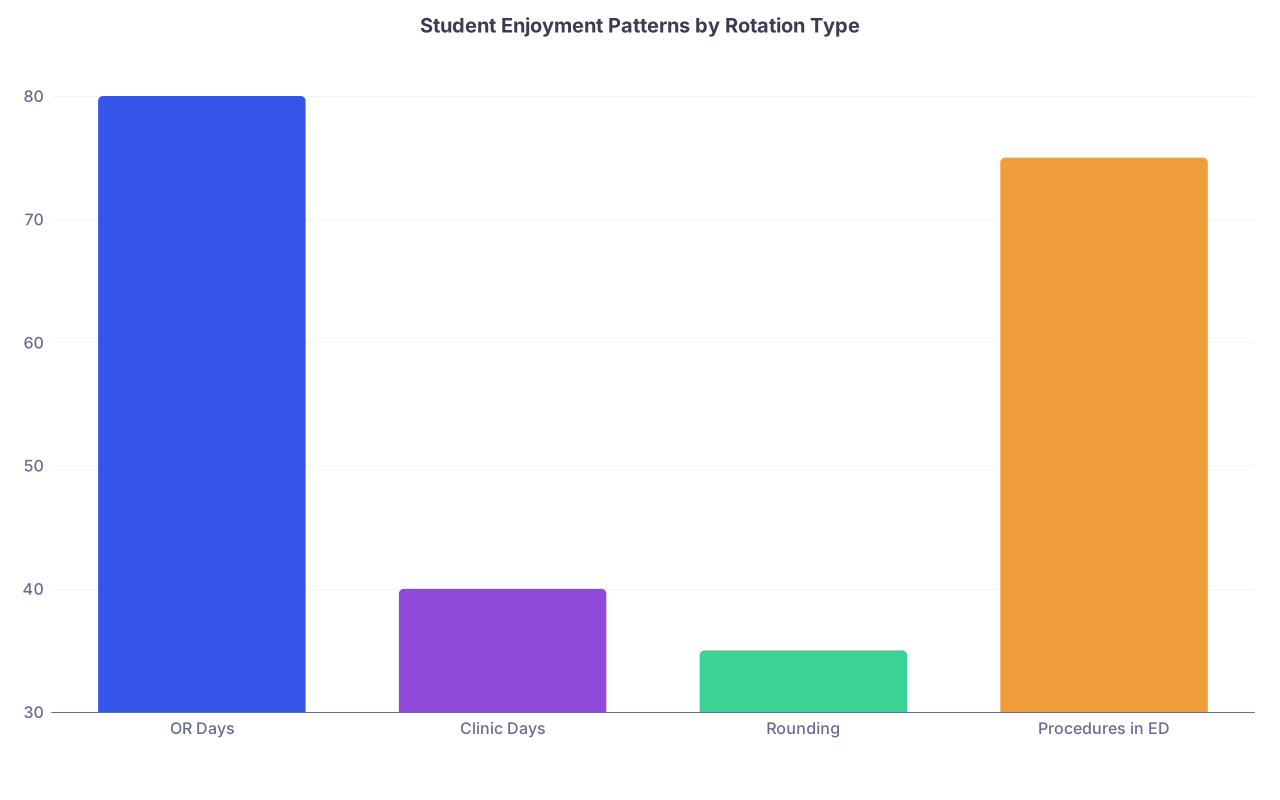
| Category | Value |
|---|---|
| OR Days | 80 |
| Clinic Days | 40 |
| Rounding | 35 |
| Procedures in ED | 75 |
Imagine that bar chart as your own “enjoyment score.” You probably already know, roughly, where yours would be higher or lower.
5. Personality Clues That Actually Predict Fit
Not all personality traits map cleanly, but some patterns show up over and over.
You might tilt procedural if:
- You like fast feedback loops: do something → see result now
- You tolerate (or even enjoy) controlled chaos and acute crises
- You’re okay with binary outcomes: it worked / it didn’t
- You like physical skills: sports, instruments, crafts, anything “hands-on”
- You get impatient with endless “maybe this, maybe that” discussions
You might tilt cognitive if:
- You enjoy nuance and probability more than “yes/no” answers
- You like deep dives into mechanisms, guidelines, and literature
- You get satisfaction from fine-tuning meds, optimizing complex systems
- You don’t mind (or even enjoy) long conversations with patients/families
- You like structuring information, frameworks, and algorithms
This is not destiny. There are thoughtful surgeons and action-oriented internists. But if your natural default is way out on one side, you’ll fight your own temperament daily if you pick the opposite.
6. How to Test Yourself On Purpose in Med School
Don’t just “float through” and hope your identity magically appears. You can actually run structured experiments on yourself.
A. Track your day-to-day satisfaction for 2–3 weeks
Make a simple note on your phone. Every day, score:
- Enjoyment: 1–10
- What you did most: procedures, talking, charting, thinking, OR, clinic, rounds
- One sentence: “Best moment of today was…”
After 2–3 weeks on a rotation, review:
- Do your highest enjoyment days cluster around procedures?
- Or around solving complex cognitive problems or meaningful conversations?
Patterns beat vibes.
B. Aggressively seek procedures when you can
On medicine, OB, ED, ICU – tell everyone early: “I really want to do as many procedures as possible. Please grab me.” Then notice:
- Do you feel a small adrenaline rush with each one?
- Do you want to get faster, smoother, more technically solid?
- Or do you feel like you’re just “getting through it” and the real interest is elsewhere?
If, after a fair shot at procedures, they still don’t excite you, don’t force a procedural identity.
C. Do at least one elective that’s the opposite of your current bias
If you think you’re procedural → do a consult-heavy cognitive elective (ID, rheum, endocrine).
If you think you’re cognitive → do a real OR-heavy or cath-heavy month.
You’re looking for a clear reaction: “I could not do this for 30 years” vs “This is surprisingly tolerable/interesting.”
7. Common Myths That Mess Up Med Students
Let me be blunt about a few things I’ve seen derail people.
Myth 1: “Procedural = smarter/more respected”
Nonsense. Some of the scariest-smart people I’ve met are in ID, rheum, heme/onc, and nephrology. If you’re chasing prestige over fit, you’re gambling your burnout risk hard.
Myth 2: “Cognitive = less money, less control”
Depends. Procedural fields tend to earn more per hour, but there are high-earning cognitive practices and lifestyle-friendly procedural ones. Also, control comes more from practice setup than specialty label.
Myth 3: “If I pick cognitive, I’ll never do anything with my hands”
Plenty of cognitive-ish people still get some procedures: LPs, paracenteses, biopsies, EMGs, scopes, injections. You won’t be carving people open daily, but you won’t be glued to a chair either if you don’t want to be.
Myth 4: “If I pick procedural, my brain won’t be used”
This one is silly. High-level surgery, IR, GI, cards, etc. are mentally intense. You’re just applying cognition around anatomy, risk, and interventions instead of purely meds and differential lists.

8. Matching Your “Heart Type” to Real Specialties
Here’s a quick, very simplified mapping. Don’t take it as gospel, but use it as a starting point.
| Specialty | Leaning |
|---|---|
| General Surgery | Procedural |
| Internal Medicine | Cognitive |
| Emergency Med | Hybrid |
| Cardiology | Hybrid |
| Neurology | Cognitive |
| OB/GYN | Procedural |
If you’re strongly procedural at heart, you’ll likely feel more at home in:
- Surgery (and its subs)
- OB/GYN (especially if you love L&D and OR)
- Ortho, ENT, urology, ophthalmology
- Anesthesia
- GI, IR, interventional cards, some EM practices, some PM&R subs
If you’re strongly cognitive at heart:
- General internal medicine (outpatient or hospitalist)
- Endocrine, rheum, ID, nephro, heme/onc, allergy/immunology
- Geriatrics, palliative
- Psych, many neurology paths
If you’re hybrid / in-between:
- EM, cardiology, pulm/crit, neuro, PM&R, GI, IR, some subspecialty IM
And if you’re thinking “I like both,” that’s normal. That usually means:
- Aim for a hybrid field, or
- Pick a cognitive base with procedural-heavy subspecialty (e.g., IM → cards, GI; neuro → interventional/stroke), or
- Pick a procedural field but lean into its more cognitive niches (complex onc surgery, advanced recon, transplant, etc.)

| Step | Description |
|---|---|
| Step 1 | Start: Reflect on Rotations |
| Step 2 | Consider Hybrid Fields |
| Step 3 | Procedural-Heavy Specialties |
| Step 4 | Cognitive-Heavy Specialties |
| Step 5 | Re-examine values & lifestyle |
| Step 6 | Enjoy procedures most? |
| Step 7 | Also enjoy complex thinking? |
| Step 8 | Enjoy diagnostic puzzles? |
9. What to Do This Year If You’re Still Unsure
You don’t need a perfect label right now. You just need to move from “no idea” to “strong leaning” in the next 6–12 months.
Here’s a practical plan:
On your upcoming core rotations, intentionally:
- Ask for procedures
- Pay attention to how you feel on long rounding/clinic days
- Write down your best/worst 1–2 hours of each week
Book at least:
- One clearly procedural elective (surg subspecialty, IR, GI, EM with a procedure-heavy site)
- One clearly cognitive elective (ID, rheum, endocrine, nephro, heme/onc)
Talk to residents and attendings in each camp and ask them:
- “What part of your day makes you feel most like you?”
- “What kind of med student regrets going into your field?”
Actually listen to your own annoyance:
- If the thought of another day in clinic makes you want to scream, stop forcing cognitive primaries.
- If you dread scrubbing, stop pretending you’re a surgeon at heart.
Your irritation is data. Don’t ignore it.
FAQ (5 Questions)
1. Can I be “procedural at heart” but still choose a mostly cognitive specialty?
Yes, but you’ll probably want a niche with some procedures: hospitalist who does lines and LPs, neurologist doing EMGs and botox, rheum doing joint injections, pulm doing bronch. If you ignore your procedural side completely, you might feel restless or under-stimulated.
2. What if I like both procedures and complex thinking equally?
Then aim for a hybrid field or a path that allows you to dial the mix over time. Cardiology (with options from clinic-heavy to cath-heavy), EM, pulm/crit, neuro (with interventional options), and GI are classic “both” roads. You can fine-tune your practice style later.
3. Does being more introverted or extroverted push me toward one side?
Not reliably. There are introverted surgeons who love the OR and extroverted internists who live for family meetings. The bigger question is whether social interaction drains you more than it energizes you and how much uninterrupted “doing” vs talking you want in a day.
4. How early in med school do I actually need to know if I’m procedural or cognitive?
You don’t need a firm answer in M1–early M2. Use preclinical years to notice what kind of studying you enjoy (mechanisms vs anatomy vs pattern recognition). By the end of core clerkships (late M3), you should have at least a leaning so you can pick smart fourth-year electives and away rotations.
5. What if I’m scared off procedural fields just because I’m clumsy now?
Skill is trainable. Interest is not. Every surgeon started out awkward with knots. If you want to be good with your hands and you like the work, don’t let early clumsiness decide for you. If you hate every second of doing procedures, that’s more meaningful than whether you’re naturally dexterous right now.
Bottom line:
- Watch what kind of work actually gives you energy: doing vs thinking vs talking.
- Use your rotations as a structured experiment, not a blur you “get through.”
- Don’t pick a label; pick a daily life that fits your brain, your hands, and your temperament.